To round off a week of posts made up of other peoples’ words, here are some articles and reviews from the most recent Vector. If you’re a member and still haven’t received this mailing, plans are afoot to get you a copy, but we need to make sure we’ve contacted everyone who might be missing it first. Also, please note that the magazine website URL has changed slightly: it’s now www.vectormagazine.co.uk (no hyphen), so update your bookmarks. On with the show:
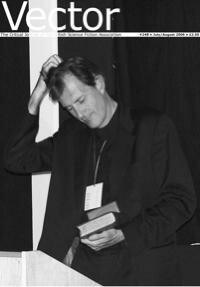 Paul Kincaid considers the Clarke Award Twenty Years After:
We didn’t know what we were doing.
Or, to be fair, we knew what we wanted to do. We just weren’t too clear about how to go about achieving it.
The goal was to promote British science fiction. That was the aim laid down by Arthur C. Clarke when Maurice Goldsmith approached him for funds. What that might entail was less clear. A new magazine? But there was already Interzone. So, an award? But there was already the BSFA Award. Would a juried award be different enough? But if we are promoting British science fiction, should this be an award for British sf only? At the time that was unrealistic. Besides, how do you promote British science fiction by fencing it off from the whole of the rest of the world?
 Andy Sawyer takes an in-depth look at the winner of this year’s Clarke Award, Geoff Ryman’s Air:
Air took the award, of course, and this means that the science fiction writer, as opposed to the “mainstream” writer with something which looks like science fiction, was the success. In what follows I am, I hope, going to suggest why I feel uncomfortable writing a sentence like that, but also why it’s good for both the Clarke award and that collection of extremely different texts that we point to and call science fiction that it was Ryman who won the award.
 Kevin Brockmeier’s The Brief History of the Dead reviewed by Claire Brialey:
In the beginning is the city. Although you might not call it the beginning, or the end, or either customary combination of the two. But there is a city, and it is where people go when they die — at least for a time. Literally, at least, it is an afterlife, but it is not a mythic existence; in the city, people are still people and they still think and feel and behave and –— to all intents and purposes — live as people do in cities everywhere.
 James Morrow’s The Last Witchfinder reviewed by Dave M. Roberts:
It is now almost seven years since James Morrow completed his Godhead Trilogy, which took on the death of God and its implications as its subject matter. The Last Witchfinder, his first novel since then, is no less ambitious, taking on the battle between scientific reason and superstition and fear of the unknown.
 Robert Charles Wilson’s Spin, reviewed by Gary Dalkin:
One night a few years from now the stars go out. Or so it appears to three young people in the garden of ‘The Big House’ in Washington DC. Jason and Diane Lawton are 14, their father a pioneer in a fledgling communications technology and junior Washington power player. Together with Tyler, son of E. D. Lawton’s former business partner, the trio are inseparable. Narrated by Tyler, Spin chronicles the complex relationship between the three over the next several decades and three billion years.
Next week I’m on holiday, so I might have time to actually write some words of my own.
 vector-bsfa.com