Introduction

Look, we have a blog! And a website! We, by the way, being the editors of Vector, the critical journal of the British Science Fiction Association: myself, Geneva Melzack, and my co-editor Niall Harrison.

We’ve put some articles from issue 245, which was the first issue Niall and I edited after taking over from previous editor Andrew M. Butler, up on the website, as well as some articles from issue 246 which has just come out. We plan to post a couple of articles and a selection of reviews from each issue online, to give a bit of a flavour of what we’re publishing in Vector, and hopefully to spark some interest in the kind of issues we want to use Vector to talk about.

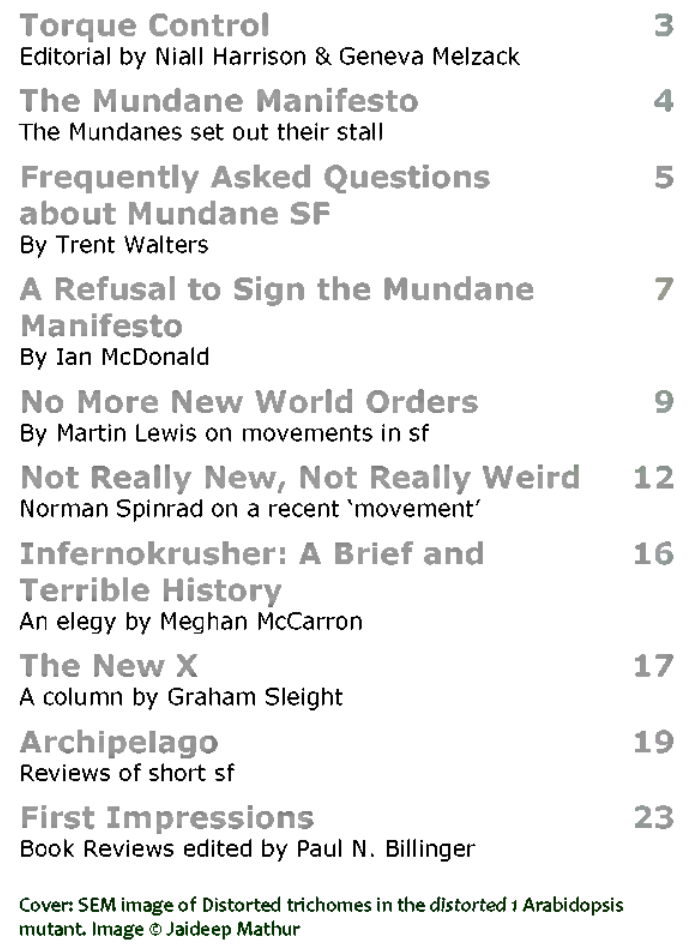
I’d just like to take this opportunity to pimp the stuff from issue 245, which was on science fiction manifestos and movements. In his article ‘No More New World Orders‘ Martin Lewis explores some of the genre’s major movements by looking at the books that are thought to represent them. Meanwhile, in ‘Morning Children,’ the first of his regular columns for Vector, Graham Sleight ponders the implications online communication is having/will have for sf movements. The rest of the issue also included articles by Ian McDonald and Trent Walters on the Mundane manifesto, Norman Spinrad on the New Weird, and Meghan McCarron with a brief and terrible history of Infernokrusher.

Niall and I will be using this blog to point out more of the great articles we’ll be putting on our website, so expect to hear more soon about the articles we’ve already put up from issue 246, which was the Review of 2005 issue. And we’ll also be blogging about the interesting writings we find around and about on the ‘net, and posting our own thoughts on various matters to do with sf, books and reading.


Note: Links redirected to Internet Archive in February 2021.
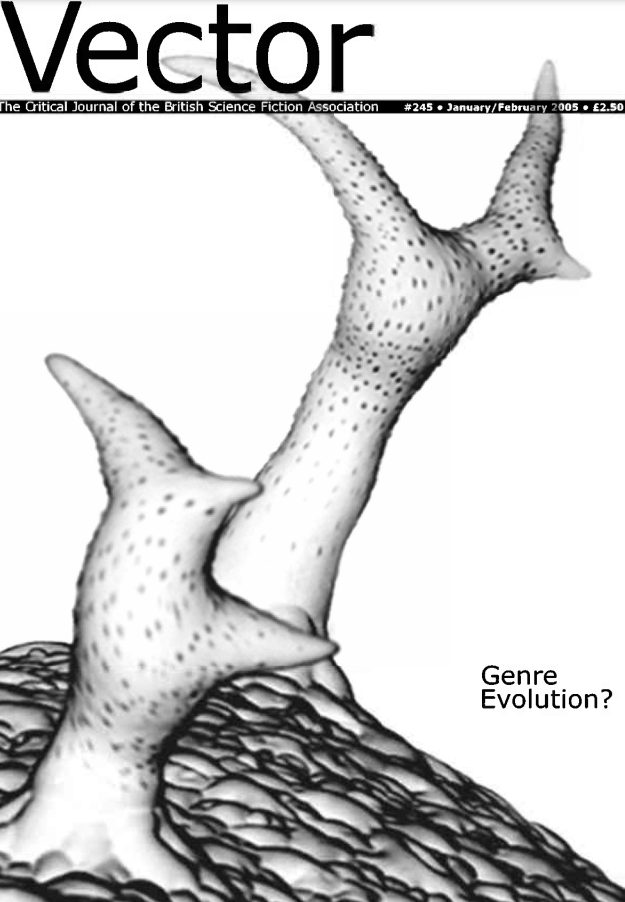
Vector #245

In this way I’m not entirely unsympathetic to the Mundane Manifesto: I just feel that it is incapable of producing ‘better’ science fiction. It will not reinvigorate the genre. Science fiction is an imaginative literature, not a realist one. Much of its strength and power lies in its ability to mythologise – the Manifesto condemns as stupidities many of the genre’s most powerful myths: the alien, time-travel, the artificial intelligence made in our own image.

Ian McDonald

But before you go and read everyone else’s manifestos, we thought we should set out our own. After all, although you may recognise our names from the reviews sections of this magazine and Matrix, we’re still relative newcomers to the BSFA, and we’re only just joining the Vector editorial team with this issue, following in the illustrious footsteps of Andrew M. Butler, under whose guidance Vector was the sort of magazine we discovered we wanted to read – and edit.

Niall Harrison & Geneva Melzack

Moorcock also had a theory about the uses of prose itself, too complex to go too deeply into here or even in his introduction to the anthology. Briefly, rather than being confined to ‘transparent’ narration of the surface phenomenology of the story, the prose line could skip allusively along its surface or swim in the iconographic and archetypal imagery beneath it, rather in the manner of poetry. Which perhaps was why the magazine paid serious attention to serious poetry, too.

Norman Spinrad

I blew up the plums

which were in the icebox

and which you were probably saving

Meghan McCarron

Reading ‘Amnesty’ recalls for me every traumatic and wonderful Butler book I’ve read, and reminds me, again, of how much reading Butler has changed my view of my world and my place in it. What changed me was Butler forcing me to root for characters who didn’t stand up for their rights (because it would have gotten them killed) but rather compromised out of necessity. She forced me to look at myself, at my often silly insistence upon abstract rights in the face of daily, unbearable, soul-destroying compromise. Would I be able to be a slave? Could I do what was necessary to save not only myself but my entire community? What would I do in a situation in which I had no good choices?

Claire Light

Note: Marked 2005 on cover.