I like lists. This will probably not come as a surprise. But when it comes to the time for end-of-year roundups, I’m like a kid in a candy store: I like reading everyone’s lists, I like arguing with them, and I like composing my own. A large part of the reason I keep track of what I read, sad to say, is so that I can summarise it at the end of the year in a post like this. This time (admittedly, by request), I even made graphs. Look on my works, ye less geeky, and despair.
Although this year the portrait of 2006 that I can offer is even more partial than usual. That’s not to say I don’t have a portrait in my head, but I am currently a judge for the Arthur C. Clarke Award, and will not be talking about eligible books, although I’m including them in my summary stats; which means that everything mentioned below is either (a) not fiction, (b) not science fiction, (c) not a novel, (d) not published in the UK, (e) not published in 2006, or (f) some combination of (a) to (e). (There were also a fair few fantasy novels submitted. I’m not going to talk about those, either.) Since I’m about to blind you with numbers, I should also say that my totals don’t include books that I didn’t finish (over a dozen, this year) or haven’t yet finished (some books, such as anthologies or collections of essays, I tend to read in small chunks over longish periods of time, unless I’m reading them for review). I’m going to talk about collections and anthologies that I have finished, but not (in this post) about individual short stories. And one final consequence of having read a large number of published-in-2006-books that I wouldn’t otherwise have read means that there is a substantial pile of such books that I would otherwise have read but haven’t: off the top of my head, it includes Vernor Vinge’s Rainbows End, James Morrow’s The Last Witchfinder, Margo Lanagan’s Red Spikes, Jo Walton’s Farthing, Charles Stross’ Glasshouse, John Clute’s The Darkening Garden, and Stephen Baxter’s Resplendent. And I haven’t finished M. Rickert’s debut collection Map of Dreams, either, although it seems obvious that it’s one of the best books of the year.
So, all of that said, what did I read?

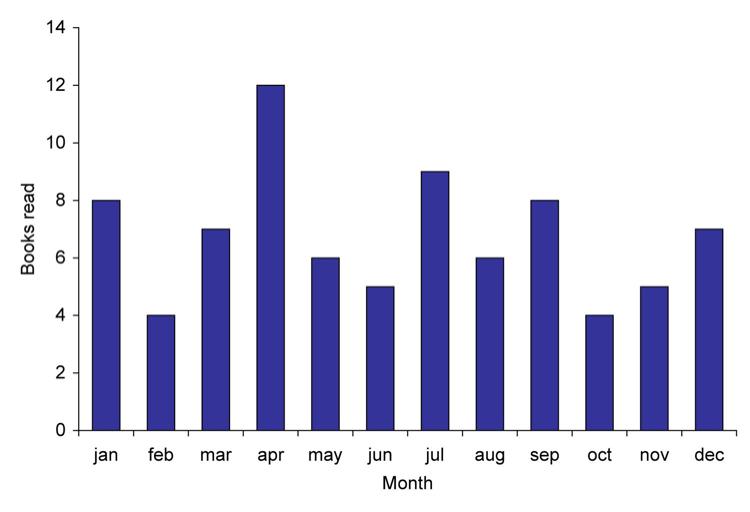
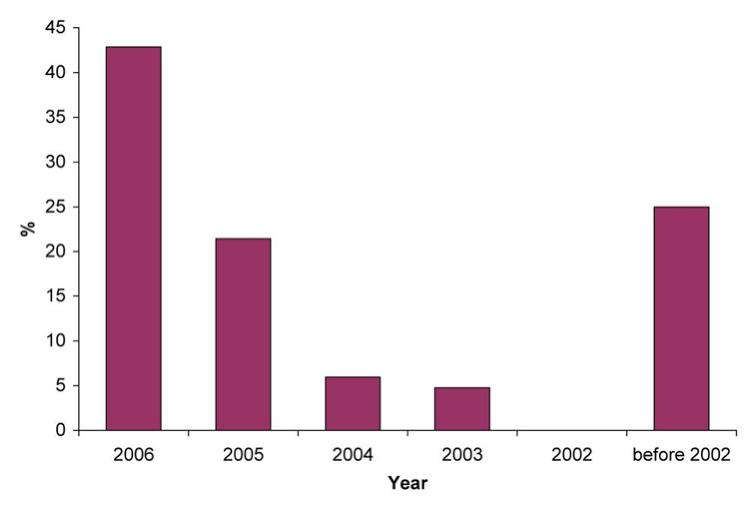
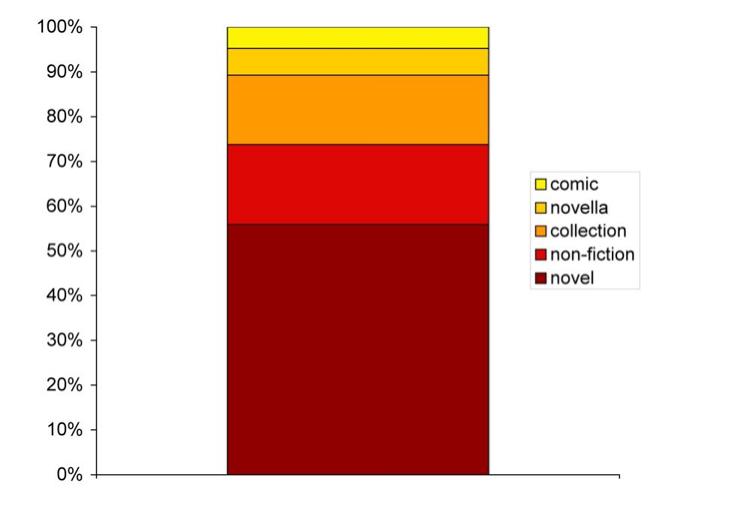
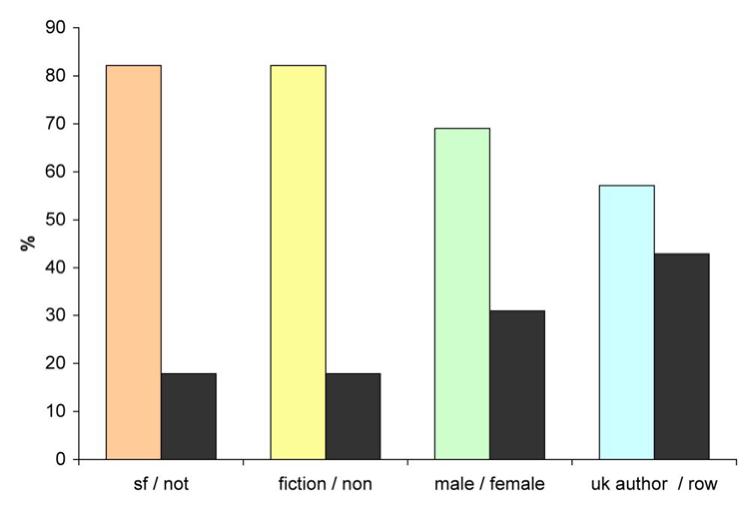
I finished 84 books in 2006, up from 64 in 2005; of these, 56% were novels, 18% were non-fiction, 15% were collections, 6% were standalone novellas, and 5% were collections of comic strips or graphic novels. I read at a relatively consistent rate throughout the year — the peak in April coincides with a reading holiday; the lesser peaks in January, July, September and December largely coincide with either other holidays or business trips where I could read on the flights — and I marked 44 titles as particularly worth reading. Bear in mind that although my reading was heavily skewed towards recent titles — only a quarter of the books I read were published before 2002 — this is a snapshot of what I read in 2006, not the best books published in 2006 per se. The demographics (for want of a better word) of my reading were more or less what you’d expect, based on my natural tendencies being amplified by Clarke submissions —

— which is to say that 82% of the books I read were sf (in the broadest sense) or sf-related, 82% were fiction (although that’s actually a higher percentage of non-fiction than in some previous years), 69% had the names of male writers or editors on the cover, and 57% had the names of UK-based writers or editors on the cover.
 For those of you whose eyes haven’t glazed over yet, this is where I start talking about specific titles, although I won’t pretend I’m going to mention everything. The Rickert aside, the best collection of short stories I read — old or new — was Jeffrey Ford’s second, The Empire of Ice Cream. It’s a book in which almost every story is a highlight: not just the ones that everyone knows, like “The Empire of Ice-Cream” and “The Annals of Eelin-Ok“, but also the stories from more out-of-the-way venues, such as “The Beautiful Gelreesh” (I can’t decide whether the ending is a closed door or a slingshot; either way it’s wonderful) and “Summer Afternoon” (which spins off from Henry James’ famous phrase in an irresistably playful manner), as well as the long original novella, “Botch Town”. Two other new collections that I finished in 2006 were particularly notable, although neither was of quite such sustained brilliance. Past Magic, the third collection by Ian R. Macleod (a writer not dissimilar to Ford in a number of ways) was delayed for months but eventually snuck in under the end-of-year wire, and displayed its author’s strengths and weaknesses in roughly equal measure; with stories like “Nina-With-The-Sky-In-Her-Hair”, “Returning”, and “Nevermore”, however, the good far outweighs the bad. Similarly, if some of the stories in Theodora Goss’ much-anticipated debut, In The Forest of Forgetting, were too self-aware and mannered to breath, the majority — and particularly the graved-by-time fairytales and folk myths — were beautifully balanced.
The older collections I read ranged from the superb (Maureen McHugh’s Mothers and Other Monsters, although it perhaps presents a slightly distorted picture of her as a writer, and arguably the two stories-that-later-became-novels don’t justify their hefty page count) through the good (China Mieville’s Looking for Jake) and the mixed (Margo Lanagan’s White Time, which isn’t a patch on Black Juice; Sonya Taaffe’s Singing Innocence and Experience, which includes a number of richly beautiful, often melancholy tales, but also plenty that don’t quite work; Geoff Ryman’s Unconquered Countries, which includes the extraordinary title novella and the powerful dystopia “O Happy Day”, but also the badly-dated “Fan” and the frankly baffling “A Fall of Angels” — and I’ve said it before, but a more comprehensive collection of Ryman’s short fiction is long overdue) to the downright terrible (the less said about Mike Resnick’s Kirinyaga the better, I think). I didn’t read enough anthologies in 2006 — or at least didn’t finish enough, since I’m still dipping into (and enjoying) Pete Crowther’s Forbidden Planet and David Moles and Susan Marie Groppi’s Twenty Epics — but as you may have gathered, I liked Ellen Datlow and Terri Windling’s Salon Fantastique a good deal; and whatever my reservations about the argument it presents, the James Patrick Kelly and John Kessel-edited slipstream anthology, Feeling Very Strange, is at least composed almost entirely of home-run stories.
 My non-fiction reading, like my fiction reading, was heavily sf-driven, although the best non-fiction book I read in 2006 — which was, of course, Julie Philips’ biography of Alice Sheldon — should be read by everyone, sf fan or not. (Although you may want to hang on for the paperback, which is apparently going to include additional photos and examples of Sheldon’s artwork.) The other book I’d have no hesitation in recommending to anyone is Jan Morris’ A Writer’s World. It’s a collection of Morris’ travel writing spanning the second half of the twentieth century, and remarkable in many ways, from the simple grace and clarity of its prose, to the portrait of the world it offers: arguably it’s as interesting as a historical text as it is as travel writing, because by virtue of the fact that it’s defined by both geography and time, it is frequently less parochial than the stories you think you know of the period it covers.
  It’s fascinating to watch the past turn into the present, and there’s something in the way Morris captures pre-millennial fever — “Everywhere people were similarly disturbed, with the same sense of rudderless betrayal. There was something febrile in the air of the world, like the start of a fever” — that resonates strongly with such intensely of-the-moment novels as William Gibson’s Pattern Recognition, or Simon Ings’ The Weight of Numbers (for which see below). I don’t usually read much travel writing, but A Writer’s World is a book that has sent me seeking more — although so far, at least, with mixed results.
My other nonfiction recommendations are more idiosyncratic, although I doubt there are many people reading this who would not be charmed by Anne Fadiman’s Ex Libris, a slender collection of witty essays about all things bookish. Mention the problem of merging libraries — or the simple instruction SIR, YOU MUST NEVER DO THAT TO A BOOK — to anyone familiar with the book and watch them wince in recognition. Anyone who aspires to write anything intelligent about sf, meanwhile, should seek out The Issue at Hand and More Issues at Hand, two compilations of (mainly) review-essays by James Blish (writing as William Atheling Jr) which are frequently trenchant and infuriating, and as frequently entertaining and devastatingly perceptive: for me they even eclipse Damon Knight’s In Search of Wonder as exemplary introductions to sf criticism. And once you’ve digested those (there’s a third volume of Atheling, The Tale That Wags The God, but I haven’t finished it yet and it seems less even), you could do worse than to move on to Farah Mendlesohn’s festschrift for John Clute and Judith Clute, Polder. I’m not quite as effusive about the book as I was when I first read it, but it’s still true to say that it features a high proportion of strong essays (those by Bruce Sterling, Gary K. Wolfe, Paul Kincaid and Graham Sleight are particularly good) about not just the Clutes, but the practice of sf criticism in general — plus at least two excellent original stories, by Pamela Zoline and Sean McMullen.
 Looking at my novel reading, I find that I only read half a dozen novels published in 2006 that were not eligible for the Clarke Award. On the upside, the hit rate was satisfyingly high. Two were major non-sf novels by writers better known for their sf. Simon Ings’ dazzling The Weight of Numbers is a story woven into the mesh of the second half of the twentieth century; as Abigail Nussbaum noted in her review, it can be read as an exploration of the limits of reason, and as a thundering broadside against the assumptions of genre sf (indeed, I would argue that for sf-familiar readers it demands to be read as such, and not just because it features an eccentric organisation modeled after the SF Foundation). But there is much more to the novel than that: characters whose struggles against a world turning inevitably into the present are absorbing even when they’re infuriating; stories that grip; and writing that is, sentence by sentence, simply very good. Geoff Ryman’s The King’s Last Song is not much less ambitious, being a portrait of past and present-day Cambodia, and perhaps more heartfelt: the sixty-page segment set in the immediate aftermath of the collapse of the Khmer Rouge is powerful, while — miraculously — not descending into cliche or easy sentiment. But it’s not quite as comprehensively impressive as the Ings. Nor is David Mitchell’s Black Swan Green an unqualified success — it feels, in retrospect, just a little lightweight, although Mitchell’s command of voice is as impressive as ever, and it’s a fascinating book when looked at as a marker in his continuing career.
 Back in the genre, I am no less impressed by Peter Watts’ Blindsight now than I was when I first read it. Watts’ depiction of characters who have internalised the language and paradigms of science — whose psyches are shaped by the operations of science — is as impressive as that of any writer this side of Greg Egan, and the remorseless logic of his novel’s central premise more than compensates for any brief moments of impenetrability (arguably, in fact, such moments are a demonstration of fidelity, of commitment to his argument). Not nearly on the same level, but not un-worthwhile, are Mark Budz’ Idolon and Scott Lynch’s The Lies of Locke Lamora; both struggle to own their generic components in the way that Watts manages so effortlessly, but at the very least both succeed simply as engaging yarns.
Lynch’s novel is, of course, his first; a nontrivial chunk of the older books I read were also lauded first novels (the genres of the fantastic are nothing if not relentlessly neophilic), a number of them by names already mentioned above. So, travelling back in time, we have David Marusek’s restless, information-dense Counting Heads (roll on his debut short story collection later this year, I say); Johanna Sinisalo’s lively examination of sexuality and gender identity, Not Before Sundown; Ian R. Macleod’s mesmerising exploration of faith and purpose, The Great Wheel; Maureen McHugh’s moving, meandering China Mountain Zhang; and Geoff Ryman’s (him again) exuberant if undisciplined The Warrior Who Carried Life.
 Of the remaining books on my list, the one that most demands to be noted is Ali Smith’s The Accidental, deserved winner of the Whitbread Novel of the Year Prize (and, in all honesty, probably the book that should have won both the Orange and Booker prizes). Almost a full year after I read it, my memories of the book are fresh and vivid, from the characters (particularly, of course, the precocious Astrid) to particular phrases and sentences (“Believe me. Everything is meant”) to the breathtaking energy and invention of the telling. If there is one writer whose back-catalogue I want to investigate further in 2007, it’s Ali Smith (if there’s a second, it’s Ian McDonald, but I’ve been saying that for a while). Too many other much-anticipated books, however, failed to live up to their billing: David Mitchell’s Number9Dream and Christopher Priest’s The Prestige are perfectly adequate, but both writers have done better before and since; Octavia E. Butler’s last novel, Fledgling, is curiously dry, succeeding more as thought experiment than story; similarly, Alastair Reynolds’ Pushing Ice is as average as the other novels I’ve read by him (though I have both his 2006 short story collections — Galactic North and Zima Blue — and look forward to getting stuck into them); Scott Westerfeld’s So Yesterday is fun enough, but far too thin to induce me to pick up his other books (although I’m looking forward to the second novel of another YA writer I encountered in 2006, Frances Hardinge, with no small anticipation); and we will draw a discreet veil over Jon Courtenay Grimwood’s 9TailFox.
There were other books, but I think at this point I’ve gone on long enough. Can I say what kind of year it has been? Only in a very limited sense: although the vast majority of my reading came from a quite narrow slice of the literary spectrum, 2006 felt like a diverse and diffuse year. But to the half-dozen books I was most impressed by in my personal reading — The Empire of Ice-Cream, James Tiptree Jr, A Writer’s World, The Weight of Numbers, Blindsight and The Accidental — I could probably add another four or five of similar calibre from the Clarke dark matter, and that’s not nothing. Coming soon: posts about films and short stories, although probably without graphs — and of course, I need to start working on my lists for 2007.
 vector-bsfa.com