BSFA Awards Winners

Congratulations to all those who won the BSFA Awards for work produced in 2011!

Best Non-Fiction: The SF Encyclopedia, third edition (beta), edited by John Clute, Peter Nicholls, David Langford and Graham Sleight.
Best Artwork: Cover of Ian Whates’s The Noise Revealed by Dominic Harman (Solaris)
Best Short Fiction: “The Copenhagen Interpretation” by Paul Cornell (Asimov’s, July)
Best Novel published in Britain: The Islanders by Christopher Priest (Gollancz)

At Eastercon, as well as four other conventions held that same weekend, the Hugo shortlists were announced. The BSFA Award winners for best non-fiction and best short fiction both made that ballot, so their fans will have another opportunity to vote for them, should they wish!

Gollancz did extremely well this year, since they host/publish The SF Encyclopedia as well as The Islanders.

P.S. Please see the BSFA’s apology for the way the awards ceremony worked out.

2012 BSFA Lecture at Eastercon

The 2012 BSFA Lecture at Eastercon will be given by Dr Marc Morris, and is entitled ‘Regime Change in England, 1066’. It draws on his recently-published book The Norman Conquest. The lecture will be given at 2.30 on Saturday April 7th, in the Commonwealth Hall of the Radisson Edwardian Hotel, Heathrow. The lecture is open to any members of Eastercon (if you’re not already a member, I’m afraid membership is now closed).

Marc is a mediaeval historian and broadcaster.  He presented the television series Castle in 2003, and wrote the accompanying book (a new edition comes out in May 2012).  He is also the author of The Bigod Earls of Norfolk in the Thirteenth Century, and A Great and Terrible King: Edward I and the Forging of Britain.  His new book, published on March 29, is a history of The Norman Conquest.  Copies will be available to purchase at Eastercon. He also appeared in the most recent episode of Time Team.

The BSFA lecture is intended as a companion to the George Hay Lecture presented at the Eastercon by the Science Fiction Foundation. Where the Hay Lecture invites scientists, the BSFA Lecture invites academics from the arts and humanities (with a particular bias towards history), because we recognise that science fiction fans aren’t only interested in science.  The lecturers are given a remit to speak “on a subject that is likely to be of interest to science fiction fans” – i.e. on whatever they want!  This is the fourth BSFA Lecture.

Spirit, Part 1: Take One

I started Gwyneth Jones’ Spirit at the wrong time, or at least in the wrong headspace. The plot was a Lego patchwork of interlinked episodes, and it didn’t seem to have enough momentum to take me much of anywhere plot-wise, even as it spanned a barely-known universe in its events. I hadn’t read any of Jones’ other Aleutian novels, had no greater context thus far into which to slot it. I didn’t feel lost, but it wasn’t a universe to which I had any existing commitment.

It didn’t help that I knew there was a rape scene coming, somewhere in its expansive, multi-volumesque middle. With that looming, somewhere, I read more and more episodically, which did nothing to help the volume’s flow. Doom, gloom, and stuckness overwhelmed the characters and I, seeing no hope for them and fearing what I knew was coming, went adrift. I stopped reading.

Despite that unpromising beginning, I always meant to go back to it. My intentions were good. The SFX blurb promised me a take on The Count of Monte Cristo, a novel I remembered fondly and whose plot I’d happily revisit. Nearly halfway through the book, I was barely halfway through the lavishly extensive blurb on the back of the book when I failed to keep reading.

It really is quite a blurb. As Martin Lewis observed in his discussion of the novel last week, it synopsizes up to page 255 out of 472 pages. At the time, however, it was a token framework for me, a checklist of events which the plot had gotten around to, rather than any real roadmap of structure. (Which raises the question: is it still really a spoiler once it’s mentioned in the blurb?) It really was the wrong time and headspace for me to be reading the novel.

Fortunately, Martin suggested I have another go at the novel this March, complete the task I set myself last year when I undertook to write – or host writing on – the eleven best science fiction novels by women from the first decade of this millennium.

I’m glad he did. The second time around, the book was good.

Advanced voting for the BSFA Awards closes today

If you’re not attending Eastercon this year, then today, Monday 2 April, is the last day to vote on the BSFA Awards, by email or online form.  If you’re attending Eastercon, you can vote on site by paper ballot up until noon on the day of the ceremony, i.e. Sunday, 8 April. Both BSFA members and Eastercon members can vote at the convention.

The newest BSFA mailing is starting to arrive, and along with it, the BSFA Awards booklet, which will hopefully help you make up your mind as to what to vote for in the Awards’ four categories.

2012 Clarke Award Contest Update

If entrants into the 2012 Guess-the-Clarke Award shortlist contest were voters, only half of the actual shortlist would have made the cut: Embassytown, The Testament of Jessie Lamb, and Rule 34.

Here are the six books which received the most guesses among all the books on the submissions list which were not on the shortlist:
By Light Alone by Adam Roberts (Gollancz)
The Islanders by Christopher Priest (Gollancz)
Osama by Lavie Tidhar (PS)
Reamde by Neal Stephenson (Atlantic)
Savage City by Sophia McDougall (Gollancz)
Wake Up and Dream by Ian R. MacLeod (PS)

Six people guessed that The End Specialist would be on the shortlist; four guessed Hull Zero Three would be on it; and Amanda and John clearly have special insight or instincts, as they were the only two people who guessed that Sheri Tepper’s The Waters Rising would make it.

Forty-four people submitted valid entries to the contest, of which only two failed to guess any of the books which the jury chose for the shortlist. Thirteen people correctly guessed one book, sixteen guessed two books, and a very respectable ten people guessed half of the shortlist correctly.

Three people tied for guessing most the shortlist, with four correct guesses each. Which one will formally win the contest and its prizes? That will depend on Tom Hunter, the Clarke Award director. We’ll let you know shortly.

Meanwhile, the discussion about the award which began with the release of the submissions list and the contest continues with various posts and articles. (Here’s Abigail Nussbaum’s roundup of critical reviews of the books.)

If you’re going to be at Eastercon, you can participate in the conversation in person (in addition to online before and after that!) at the SFF’s Not the Clarke Award panel at 17:30 on Saturday, of which Maureen Kincaid Speller has written, “Clearly, *the* panel to go to at Eastercon will be the Not the Clarke Award panel. Hope it’s in a decent-sized room.” Come join the crowd and the conversation.

March BSFA London Meeting: The BSFA Awards Discussion

With the BSFA Awards imminent (Olympus, Eastercon 2012, registration closes at 6 pm TODAY/Tuesday) we have arranged for a panel at the monthly London meeting to discuss this year’s nominations. This takes place on Wednesday 28th March 2012.

Our esteemed panellists this year are Duncan Lawie (aka Hoopoes, reviewer for Strange Horizons and The Zone), and Dave Hutchinson, (aka Hutch, science fiction writer and editor, shortlisted for the 2009 BSFA Best Short Fiction Award for ‘The Push’) and Donna Scott – BSFA Award Administrator. We are hoping for some lively debate so please do come along and join in the discussion.

ALL WELCOME – FREE ENTRY (No entry fee or tickets. Non-members welcome.)
The discussion will commence at 7.00 pm, but the room is open from 6.00 (and fans in the ground floor bar from 5ish).
There will be a raffle (£1 for five tickets), with a selection of sf novels as prizes.

Location: Cellar Bar, The Melton Mowbray Public House. 18 Holborn, London EC1N 2LE . Map is here. Nearest Tube: Chancery Lane (Central line)

All welcome! (No entry fee or tickets. Non-members welcome.)
Interview will commence at 7pm, but the room is open from 6pm (and fans will very likely be in the ground floor bar from 5pm).
There will be a raffle (£1 for five tickets), with a selection of sf novels as prizes.

FUTURE EVENTS:
25th April – SHARYN NOVEMBER interviewed by Professor Farah Mendlesohn
23rd May* – CJ LINES interviewed by Tony Keen
27th June – TANITH LEE interviewed by Nadia van der Westerhuizen

* Note that this is a month with five Wednesdays. The meeting will be on the fourth, not the last, Wednesday of the month

P.S. BSFA members voting on the awards in advance of Eastercon – the deadline for submitting your votes is the 2nd of April.

Arthur C Clarke Award Shortlist 2012

The Waiting, Part I, is over, and this year’s Clarke Award shortlist is out. (Since it was released all of twelve hours ago, many or most of you reading this are already well-aware that it’s out.)

There are five members of the jury, which this year is comprised of Juliet E McKenna (BSFA), Martin Lewis (BSFA), Phil Nanson (SFF), Nikkianne Moody, SFF, and Rob Grant (SCI-FI-LONDON film festival), with Andrew M. Butler representing the Arthur C. Clarke Award as the Chair of Judges. The jury read the sixty books submitted to the award, ruled out the ones they considered to not be science fiction, and from the rest, chose what they collectively agreed (through however much argument and compromise) to be the best six works of science fiction published in Britain in 2011.

  • Greg Bear, Hull Zero Three (Gollancz)
  • Drew Magary, The End Specialist (Harper Voyager)
  • China Miéville, Embassytown (Macmillan)
  • Jane Rogers, The Testament of Jessie Lamb (Sandstone Press)
  • Charles Stross, Rule 34 (Orbit)
  • Sheri S.Tepper, The Waters Rising (Gollancz)

There’s plenty of commentary elsewhere about the items actually on the shortlist. I’ll be number-crunching all of the entries in the Guess the Shortlist contest in another day or so, although some of that analysis has already been done elsewhere.

There’ll be even more speculation available at the SFF’s Not-the-Clarke Award panel at Eastercon on Saturday, 7 April, at 17:30 (but only if you’re an Eastercon member this year; join now if you haven’t already and plan to attend, as they’re on course to sell out this week, before the convention.).

But meanwhile, speaking of the Clarke Award, have a look at its tasteful, newly-redesigned website!

Eastercon on track to sell out this week

For the first time ever, so far as anyone I’ve talked to can remember, Eastercon is due to sell out before the convention. This means there will be no memberships whatsoever, whether for the weekend or day passes, available at the convention itself, unless pre-bought. None at all.

If you’d like to attend this year’s BSFA Awards, on Sunday, 8 April at 6 pm at this year’s Eastercon, Olympus 2012, you’d better get your membership if you don’t already have it.

As a reminder, all Eastercon members can also vote for the BSFA Awards! But you don’t have to attend to do that, so long as you are a BSFA member and submit your votes by the 2nd of April.

If all goes to plan, you should even have the awards booklet by then. The printers started printing it this weekend.

Update: Eastercon memberships are selling fast enough that they are likely to be sold out before this time tomorrow/Tuesday!

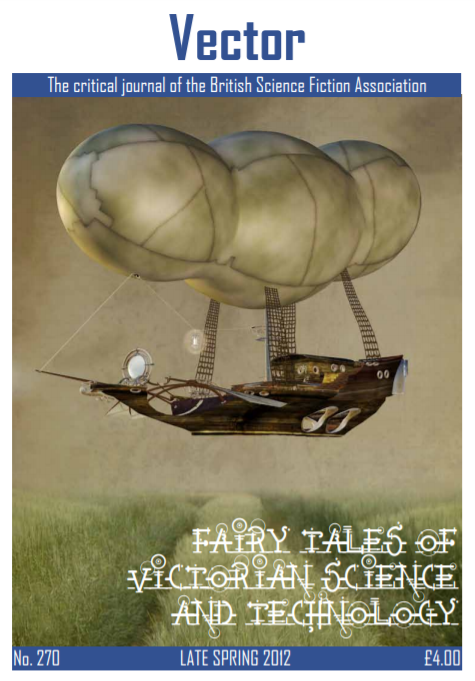
Vector #269

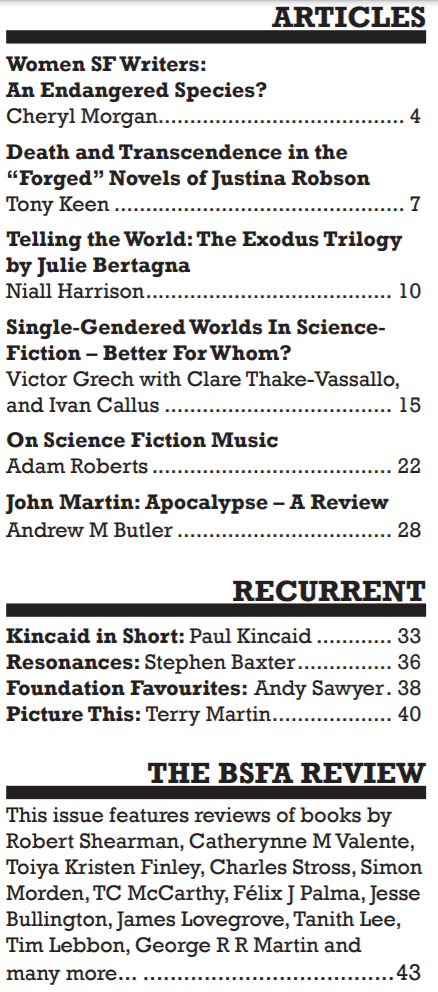
This issue of Vector is dedicated, in part, to revisiting the subject of women writers of science fiction. Few female UK-based science fiction authors currently have contracts, but worldwide, there’s a great deal going on, a geographic, cultural, and linguistic diversity which Cheryl Morgan surveys in this issue. I came away from reading it with a massively expanded to-read list, and I hope it inspires you similarly. Tony Keen examines the roles of death and transformation in Justina Robson’s books Natural History (one of the books on last year’s list of the previous decades best science fiction by women) and Living Next Door to the God of Love. In contrast, Niall Harrison examines a very different author, Glasgow-based Julie Bertagna. Her post-apocalyptic trilogy, which begins with Exodus, provides an intriguing comparison with Stephen Baxter’s current series of prehistoric climate change novels which began with Stone Spring.

The second part of Victor Grech’s three-part series on gender in science fiction doesn’t focus on women science fiction authors, but does deal with quite a few of them in the process of discussing the variety of single-gendered world in science fiction. In particular, he examines the in-story reasons, the biological explanations for their existence, and the degrees to which those mechanisms are found in the ecologies of our own world.

Shana Worthen