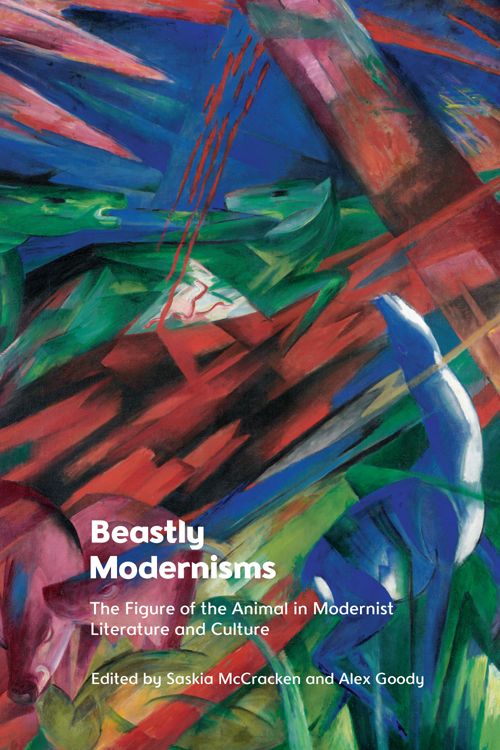
Beastly Modernisms: The Figure of the Animal in Modernist Literature and Culture, eds. Saskia McCracken and Alex Goody (Edinburgh University Press, 2023)
Reviewed by Paul March-Russell
At face value, this collection of essays may not seem to be of immediate interest to the sf reader. It is primarily concerned with the development of Animal Studies – a sub-discipline that has already been significantly explored in relation to sf in the work of Sherryl Vint, Joan Gordon, and others – with reference to literary modernism, a diverse movement already noted for its challenge to traditional notions of identity and individual autonomy. The potential, though, for creative overlaps between modernism, sf and Animal Studies is already indicated by the fact that one of the co-editors, Alex Goody, was a keynote speaker at the 2019 Corroding the Now conference at Birkbeck College, London. Seen through a science-fictional lens, the encounter between human and non-human animals, the slippages between them, and their mutual affinities and kinships immediately invoke the First Contacts and uncanny relations between humans and aliens which are the stuff of genre sf. As the introduction’s reference to Jorge Luis Borges and Karen Eckersley’s chapter on Leonora Carrington make clear, imagined bestiaries are common to both Animal Studies and speculative fiction.
Without seeking to be a guide, the introduction nonetheless touches upon many of the key moments in the evolution of Animal Theory: from Peter Singer’s pioneering Animal Liberation (1975) and Donna Haraway’s ‘cyborg manifesto’ (1985) to Gilles Deleuze and Félix Guattari’s concept of ‘becoming animal’ (1982) and Jacques Derrida’s pivotal essay ‘The Animal That Therefore I Am’ (2002). The introduction also registers many of the other posthuman thinkers whose ideas have contributed both to Animal Studies and this volume in particular; from Giorgio Agamben and Rosi Braidotti to Michel Foucault and Cary Wolfe. The editors however, beginning their account with an exchange between Djuna Barnes and James Joyce (two modernists in exile, both of whom would flit between the centres and margins of the modernist canon), emphasise the affinities between Animal Studies, the revaluation of women’s writing and the decolonising of the curriculum. All such practices foreground and deconstruct the historic imposition of borders, the arbitrary gatekeeping that has characterised academic protocols and the maintenance of cultural shibboleths. To that end, the editors also note the collapsing boundary between ‘high’ and ‘low’ cultures, an elision that not only permits the entry of sf into the conversation, but which would also have appealed to such modernists as Barnes (boxing fan and purveyor of crime fiction) and Joyce (publican’s son, cineaste, and Anita Loos devotee).
The book is divided into five sections grouped around the themes of companionship, traces, empire, encounters, and violence. The first section takes Virginia Woolf’s fictional autobiography, Flush (1933), as its central text; one of several works by Woolf, the most obvious being Orlando (1928), which use fantastical and non-mimetic devices in order to prise apart the male-dominated discourses of history and biographical record. Jane Goldman offers an enthusiastic account of the novel, parsing it not only with Elizabeth Barrett Browning’s, Flush’s owner, most famous sonnet ‘How do I love thee?’ (1850), but also with Derrida and Haraway’s concept of the interspecies kiss. Derek Ryan, on the other hand, considers the novel’s afterlife, from bestseller in Woolf’s lifetime to critical and popular neglect for the next seventy years to renewed interest not only for Animal Studies but also so-called ‘metamodernist’ novels by Ceridwen Dovey and Sigrid Nunez. Lastly, Juanjuan Wu offers a comparative analysis between Flush and two other contemporaneous novels, by Mary Gaunt and Florence Ayscough, which not only use anthropomorphic devices but also in a colonial context. The author’s argument is that their usage foregrounds the strengths and weaknesses of anthropomorphism. For the pro-imperialistic Gaunt, anthropomorphism upholds her own anthropocentrism by maintaining differences between herself and her canine companion and, by extension, the Chinese setting of their journey. For the anti-colonial Ayscough, anthropomorphism acts as a form of empathy between herself and her dog and, again by extension, racial others. Of the three chapters, Juanjuan Wu’s may be most relevant for sf by thinking through the possibilities of communication between different races and species, while Goldman’s is of interest by thinking through different levels of subjectivity and intersubjective relation.

The second section is the least integrated part of the book. Carrie Rohman is curiously silent on D.H. Lawrence’s misogyny as she attempts to assimilate Women in Love (1920) to what she terms a ‘bioaesthetic’ theory of artistic creation. Noting that Gudrun’s rabbit is named after Bismarck, whom Rohman simply describes as ‘a conservative Prussian statesman’, fails to comprehend the sexual and social repression that German women experienced under the Bismarckian regime, and which Lawrence is surely alluding to (perhaps approvingly) in the bloody encounter between the rabbit, Gudrun, and Gerald. Nonetheless, Rohman’s ‘bioaesthetics’ may have some traction for such sf texts as Octavia Butler’s Xenogenesis (1987-9) where a third species acts as a generative intermediary for their companion hosts. Peter Adkins is on firmer ground when he extends the theme of animality, prominently explored in Djuna Barnes’s lesbian, Gothic, modernist classic Nightwood (1936), to Barnes’s theatrical works. Lastly, Paul Fagan’s analysis of the ways in which taxidermy prefigures a modernist preoccupation with masks and other kinds of fabricated personae has the most relevance for sf: one of his central texts is H.G. Wells’s fake interview, ‘The Triumphs of a Taxidermist’ (1894), while he also refers to other writers with sf credentials such as Shelley Jackson and Flann O’Brien. Indeed, Fagan comments that O’Brien’s short story, ‘Two in One’ (1954), ‘anticipates the late twentieth century’s taxidermic imaginary as a site both of kitsch neo-Victorianism and of uncanny eco-horror and abject body horror’. Fagan’s contemporary examples are serial killer movies but the hybrid bodies to be found elsewhere in science fiction would be just as relevant, if not more so, by describing the perverse relations between surgery and body modification.
The third section begins with Gabriela Jarzebowska’s analysis of how the removal of rats in Poland between 1949 and 1956 was instrumentalized using the rhetoric of pogroms. Besides the immediate historical contexts of both Nazi and Stalinist propaganda, Jarzebowska’s account resonates with how species extinction is represented in terms of current political discourse; a discursive ‘fact’ not lost on such eco-science fictions as Ned Beauman’s Clarke Award-winning Venomous Lumpsucker (2022). By contrast, Beerendra Pandey’s examination of the Partition stories of Saadat Hasan Manto, Mulk Raj Anand and Mohan Rakesh deflects the ‘beastliness’ ascribed to the violence of this event into an account of the animality within humans; a mirror-imaging often seen within colonial encounters in science fiction. Lastly, Katharina Alsen focuses on human-animal contact in the visual art of the Sámi people who live in Spámi (better known by the exonym Lapland). Although their art appears to be pastoral, Alsen observes that it often describes ecological damage due to outside economic forces; an abcanny presence (we could say) that signifies the unprecedentedness to be found within other Indigenous futurisms.
The theme of contact is explored further in the penultimate section. Lauren Cullen examines the wilderness stories of Canadian author, Charles Roberts, as an admixture of realist and proto-modernist devices to represent the non-human animal. Whilst Roberts’s fiction is also bound up with the development of a Canadian settler literature, Elizabeth Curry’s focus upon the role of human-animal encounters in the work of Harlem Renaissance author, Anita Scott Coleman, exposes the binary oppositions also found within white settler culture: the animalisation of the native inhabitant or the imported slave. Although such motifs can also be found within science fictions preoccupied with empire, race, and colonialism, the most science-fictional of the chapters (as noted above) is Eckersley’s account of human-animal hybrids in the stories and paintings of Leonora Carrington. This chapter not only satisfies the theoretical framework of the introduction, indicating the ways in which Carrington’s surrealism prefigures the assemblages of Deleuze and Guattari and the posthuman, eco-feminisms of Braidotti and Haraway, but also resonates strongly with the estranging devices of science fiction, in particular, the radical feminist sf of the 1970s. It is a superb analysis, one that complements the growing body of work on Carrington’s art, and which re-emphasises Carrington’s pivotal role in the development of feminist aesthetics from the 1930s to the present day.

The final section begins with Laura Blomvell’s intriguing survey of WW2 poetry, in which the experience of non-combatants of aerial warfare is communicated through the language and imagery associated with birds; what Blomvell neatly calls ‘avian noir’. However, as she indicates, this imaginary goes beyond poetry and incorporates other media such as fiction, painting, and film. We might, to that end, invoke the Neo-Romanticism associated with 1940s literary and visual culture as well as the most famous instance of avian warfare, Daphne du Maurier’s ‘The Birds’, published just after the decade in 1952 (and, therefore, alongside such science fictions of avenging nature as John Wyndham’s The Day of the Triffids [1951]). Blomvell herself resolves her account into a brief mention of Muriel Rukeyser’s The Life of Poetry (1949), a critical work which not only prefigures the open-ended structures of Charles Olson’s Maximus Poems (1953-75) but also the holistic and rhizomatic thinking of science fiction writers from Samuel R. Delany onwards.
The final chapters pick up from Blomvell but also look back at the two World Wars from today’s climate crisis. Caroline Hovanec focuses on the fugitive figure of the pigeon in Ahmed Ali’s Twilight of Delhi (1940) as an embodiment of modernity, seeking safe haven within the ecological catastrophe that is the modern city. Rachel Murray, meanwhile, circles back to another of Ryan’s ‘metamodernists’, Tom McCarthy, who offers an apocalyptic scenario in the form of an expanding jellyfish population, symptomatic of the effects of global warming. Murray uses McCarthy’s apocalypse as a lens to reflect upon the responses of Wyndham Lewis and H.D., both of whom use jellyfish as a symbol for what McCarthy calls (via Jacques Lacan) ‘the Real’ or which we might variously call, in the language of James Joyce, an ‘epiphany’, or in the terminology of H.P. Lovecraft, ‘cosmic horror’: that point when the subject achieves total realisation and objective experience floods back into subjective consciousness. For Lewis, this realisation is mediated through a misogynistic hierarchy, in which his male characters fear dissolution into a jellylike state, but for H.D., it represents immersion into a fluid condition of Being. As Murray concludes, instead of McCarthy’s apocalypse, the jellyfish may actually be a companion species with which to think with and through our own ecological crisis: an affinity that chimes with many other recent moves both in science fiction (think of novels by Sue Burke, Adrian Tchaikovsky, or E.J. Swift) and sf criticism (Gerry Canavan’s notion of ‘the zombie embrace’, for instance).
The volume concludes with Kari Weil’s afterword which returns us to Woolf, most prominently the autobiographical ‘A Sketch of the Past’ (1939), and also touches upon several of the other essays in the collection. Weil focuses on the symbol of the mirror and argues, with Woolf and against Lacan, that the mirror fails to reproduce all that is human: there are senses other than the visual and which connect us to our non-human kin. (To be fair to Lacan, though, his concept of ‘the mirror stage’ contends that the process is founded upon mis-identification between the child and their image.) It is, nonetheless, a satisfactory way to wrap up what has largely been a very strong addition to both modernist criticism and Animal Studies. In exploring the boundaries between humans and their non-human others, the volume also suggests several relevant ways for reflecting upon similar encounters in science fiction. The next step would be to bring these discourses together as part of the gradually unfolding conversation between modernism and SF.
 vector-bsfa.com