By Amalia Cotoi
This article explores how Romanian science fiction novels written between 1899 and 1954 engage with modernity. I am particularly interested in examining how key texts that center around the protagonist’s exploration beyond the familiar realms intersect with a modern development that was a game changer in human history: electric energy. The analysis centers on three novels from the modernist era − Victor Anestin’s pioneering Romanian Sci-Fi novel, În anul 4000 sau o călătorie la Venus [In the Year 4000 or A Trip to Venus] (1899), Henri Stahl’s Un român în lună [A Romanian on the Moon] (1914), and Felix Aderca’s Orașe scufundate [The Submerged Cities] (1937) − and one written and published in the aftermath of WWII − Drum printre aștri [Path Among Stars] (1954), penned by I. M. Ștefan and Radu Nor. If the works written during the interwar period represent initial major forays into the Sci-Fi genre, it wasn’t until the postwar era that the first notable presence of Sci-Fi in Romanian literature, holding institutional significance and capturing general interest, emerged. By including a novel written in the 1950s in this inquiry, I aim to challenge the chronological convention of the modernist era ending with World War II. The emergence of the communist regime, influenced by the Soviet model, signaled an unparalleled drive toward industrial and technological advancement in a European nation that was among the least developed, with a rural population twice the continental average (Murgescu, 140). Such a transition is all the more justifiable in the case of electricity, as the pace of electrification accelerated after World War II, particularly between 1950 and 1970 (Murgescu, 344), witnessing the shift from electricity as a speculative concept to a democratically commodified resource.
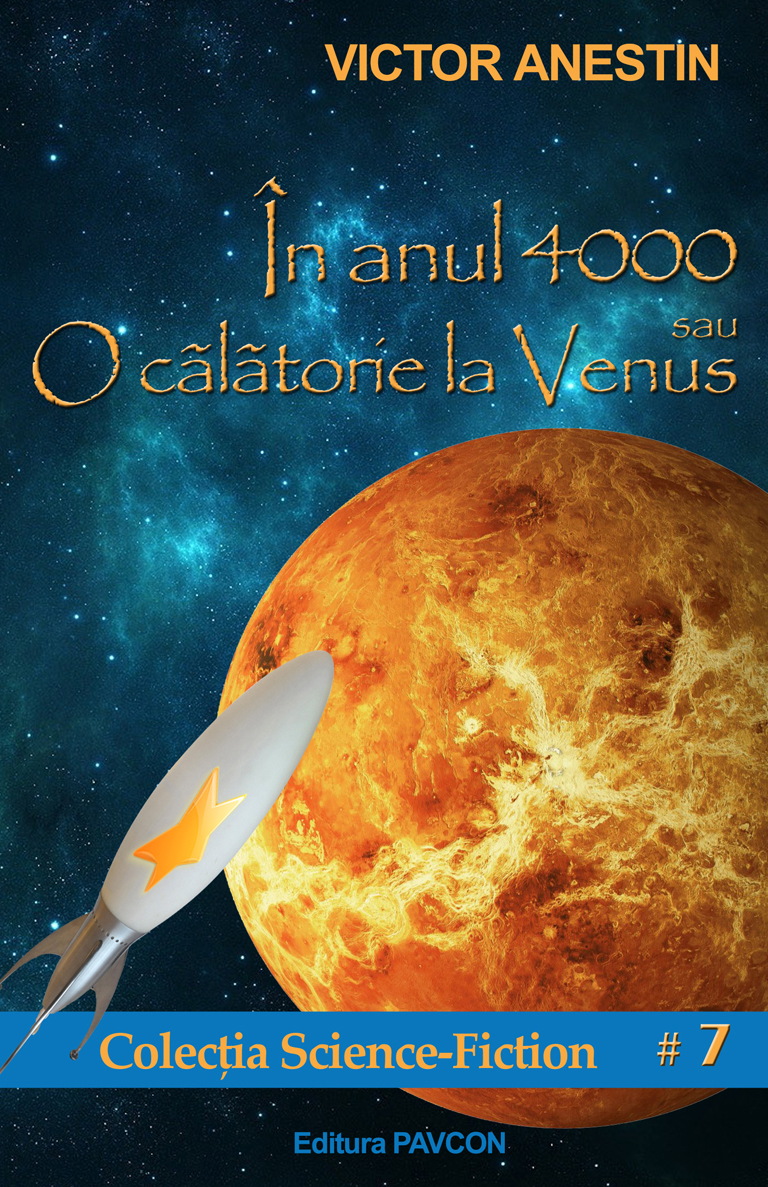
Victor Anestin, the advocate of a scientific literature
It is noteworthy that Romanian Science Fiction originated amid the modernization process, which extended beyond economic and political spheres to encompass social dimensions. As such, Romanian SF emerging at the end of the 19th century not only served to popularize science but also played a pivotal role in building trust in science.
While there were earlier texts that could in hindsight be classified as science fiction stories, the first Romanian science fiction novel emerged in 1899 under the title În anul 4000 sau o călătorie la Venus [In the Year 4000 or A Trip to Venus], penned by Victor Anestin, who is the pioneer of the genre in Romania. He was recognized during his era as the “Flammarion of Romania” not just for translating a fragment of Camille Flammarion’s Les merveilles célestes [Celestial Wonders] (1865) in Revista Olteană [Oltenian Review] in 1889, or for installing a telescope believed to have been a gift from the French author known for his popular science works about astronomy (Robu, as cited in Anestin, 6-9) on the roof of his house. Anestin was also acknowledged for his efforts in popularizing astronomy in the Kingdom of Romania at the close of the 19th century, heavily influenced by Flammarion’s writings.
The Romanian writer produced works that he himself considered contributions to the popularization of astronomy, such as Romanul Cerului [The Novel of the Sky] (1912), and science fiction works, including the previously mentioned novel, O tragedie cerească [A Celestial Tragedy] (1914) and Puterea ştiinţei [The Power of Science] (1916), referred to as ‘scientific novels’ (Anestin, 288). Additionally, he was active in the contemporary press, participating in discussions about science and literature in the Kingdom of Romania. In an article titled Ce au cu astronomia? [What do they have against astronomy?], published in 1913 in Ziarul călătorilor și al științelor populare [The Travelers’ and Popular Sciences Newspaper], he criticizes Felix Aderca, the author of the science fiction novel Orașele scufundate [The Submerged Cities] (1937), now acknowledged as a modernist writer. Starting from the third poem in Aderca’s debut cycle titled Spinozism Științific [Scientific Spinozism] (1913), Anestin reproaches Aderca for lacking scientific understanding of astronomy, stating that, for Aderca, ”the outcomes of astronomy are regarded as mere fairy tales” (Anestin, 365).
Anestin raises here an issue that the Western world extensively investigated and debated, beginning in the second half of the 20th century (Aït-Touati, 3): the connection between various domains of knowledge, and the correlation between literature and science, which “has been a discipline unto itself” (3), according to the French historian of literature and sciences, Frédérique Aït-Touati (Fictions of the Cosmos: Science and Literature in the Seventeenth Century, 2011). Victor Anestin proposes a viewpoint extending beyond his critique of Felix Aderca’s poem. He asserts that the ”scientific novel”, as he calls it, represents a mode of writing that integrates literary form with scientific content, presenting science not solely as narrative but as a manifestation of truth: scientific truth is indeed modern truth. According to him, to contribute effectively to the SF literature, which he labels the ”scientific novel”, one must possess a comprehensive understanding of scientific advancements and consistently strive to convey truth.
That’s why, in Anestin’s 1898 article titled Scientific Novel, regarded by Mircea Opriță as a theoretical manifesto of anticipation (464), the author cited as a prime example of a proper scientific novel is Flammarion rather than Jules Verne: ”Jules Verne’s vivid imagination often leads to numerous errors contrary to science, whereas Flammarion never does so: even when constructing hypotheses, he does so only on the foundation of scientific truths” (Anestin, 189).
Nevertheless, this quote may appear as a paradox for an English reader given the dispute between Jules Verne and H.G. Wells at the start of the 20th century. Often referred to as “the English Jules Verne”, Wells writes a preface for Seven Famous Novels by H. G. Wells (later edited and published as The Complete Science Fiction Treasury of H.G. Wells), published by Knopf in 1934. In attempting to distance himself from the influence attributed to Verne, he defines both his own style and Verne’s, while also offering a proto-definition of the genre. The paradox I referred to arises from the contrasting views on Verne held by Anestin and Wells. Anestin believed that Verne was primarily a science popularizer who relied too heavily on imagination. However, Wells considered his own work to be merely an “exercise of imagination” (iii), while Verne’s speculations were both practical and feasible: ”his work dealt almost exclusively with actual possibilities of invention and discovery, and he made some remarkable forecasts” (Wells, iii).
The dissemination of science in a casual manner, as astutely observed by Mircea Opriță (465), emerged during the early decades of the 20th century, marking the presence of Henri Stahl as the second significant Romanian author of Soft science fiction. Identifying himself as a ”Sunday astronomer” (Stahl, 14) due to his anxiety over Anestin’s influence, Stahl’s behavior appears to mirror that of Wells, although I will refrain from labeling him a Romanian Wells. Not only is he more relaxed regarding scientific accuracy, but with him, ”the power of imagination, humor, and a touch of sentimentality are called upon to contribute to the success of a scientific novel” (Opriță, 465). Far from the social commentary implied by Wells in his writings, Stahl manages to liberate Anestin’s scientific novel from its scientific nature and to emphasize, above all, its status as fiction.
As noted by Mircea Opriță, following Florin Manolescu’s line, the first critic to write a book on Romanian SF in the 1980s, the genre will not produce such manifestos for a long time from now on. During the 1930s, it shifted towards “sensational pulp literature” or the “fantastic,” altering its “scholarly component” (Opriță, 465). Regarded as minor literature during that period, it saw a significant transformation in the 1950s, during which local tradition was largely set aside.
However, what persisted was the connection that science fiction maintained with the modernization of Romanian society, propelled by both a modern ethos and technological advancements, with electricity prominently featured among them.
The “electrical thinking” in Romanian SF
The term “electrical sun”, though it may sound like a science fiction title, was actually used in an advertisement in a Romanian magazine (Curierul de Iași) in 1868 to announce the first demonstration of street lighting. The event took place in Iași, a city situated in the present-day eastern region of Romania, that served as the capital of Moldavia, and gained prominence as one of the two key cities within the United Principalities of Moldavia and Wallachia since 1859 (alongside Bucharest). This moment foreshadowed the year 1884, when Timișoara—now one of the most important cities in western Romania, but then a part of the Austro-Hungarian Empire—became the first city in Europe to be illuminated with electric lightning, earning the title the “Citadel of Light of Europe” (Mihai Caba, Dilema Veche, 2023).
It is not coincidental that, in the first two significant Romanian science fiction novels, travelling into outer space meant taming and thus mastering electricity. A source of fear at the end of the 19th century, but also a symbol of confidence in progress, electric energy emerged as main character and element, at times fluid and at times material, without which Romanian science fiction would not have been the same. At the close of the 19th century, discussions were underway in the Romanian sphere between progressives, the supporters of electricity, on the one hand, and conservatives, those resisting the new technology, on the other. Meanwhile, on an international level, considering the example of the United Kingdom, electricity experts of the 1880s-1890s redirected their attention from efforts to “domesticate” electricity through testing street lighting publicly, to emphasizing the promise of a brighter future facilitated by electricity (Domesticating Electricity, 2008, 4). In this context, science fiction literature appears to align with the progressives, seeking to domesticate electricity through speculations on future advancements.
In În anul 4000 sau o călătorie la Venus [In the year 4000 or A Journey to Venus] by Victor Anestin, the first space opera novel in the Romanian Kingdom, published in 1899, the journey to Venus by the scientists Asales and Saitni would not be possible without a rocket powered by electric accumulators. The appearance of the electric power source—specifically the accumulators in this context—is not a mere coincidence. Firstly, it reflects the societal concerns prevalent at the end of the 19th century. Graeme Gooday’s research on the British context reveals a pervasive skepticism toward electricity, shared by both experts and the general public. This skepticism is reflected in the contemporary depictions where electricity appears either “mysterious” or “hazardous” (3). While there are no studies in Romania that parallel the investigations conducted by Gooday for Great Britain, information from the second volume of Istoria tehnicii și a industriei românești [ The History of Romanian Technology and Industry] (2020), edited by Dorel Banabic, indicates that skepticism toward new technology is a characteristic of the Romanian context as well. The establishment of the first technical museum in 1909 holds significant importance, as stated by its creator, Dimitrie Leonida, who emphasized its role “in the training of electricians and in preparing the population to accept new electronic technologies and products” (Istoria tehnicii, 16-17). The necessity of such a museum to facilitate the acceptance of new technology not only signals distrust, but also represents an attempt to “domesticate” electricity.
Secondly, the explanation of how the rocket operates, enabling Anestin’s characters to journey to Venus through the use of an accumulator, is significant because it likely reflects the discussions within Romanian society in 1899. By that time, not only had public lighting been tested and implemented in several cities, such as Craiova and Bucharest, but the first electric power plant in Craiova was established in 1897 − 15 years after the world’s first electric power plant built by Thomas Edison in New York (1882) (Istoria tehnicii…, 11). Furthermore, science fiction literature not only engages with scientific problems and debates, but also delves into the socio-cultural atmosphere of the century, examining how society receives, assimilates, and understands science. In this case, although electric accumulators already existed at that time, Anestin’s novel highlights their importance and possibly alludes to the anticipation of the year 1911 when the first electric accumulator factory, named Tudor, emerged in the Kingdom of Romania (10).
While Anestin’s text reveals that the rocket’s source of electricity is the accumulator, and we understand that this resource, like any other, is finite − each case of excessive electricity consumption is consistently detailed by the narrator − the novel leaves the method of delivering electric energy to the accumulator in outer space as a puzzle. As such, in the middle of the novel, following a conference in which Asales speaks to the Venusians about Earth’s cosmological knowledge, he makes a note:
“A few days after this conference, I had a very long discussion with Saitni about how we could acquire electricity for the accumulators of our vehicle, enabling us to return to Earth. Not without apprehension, I initiated this conversation, knowing well that Saitni, like me, was unaware of a means by which we could capture electricity from the atmosphere. We lacked the necessary equipments because, being too large, we couldn’t bring them with us” (Anestin, 127).
What is particularly suggested here is that electricity is traversed by the following contradiction: on the one hand, it allows for physical emancipation from natural conditions and even leaving Earth; on the other hand, electricity can only come from Earth, so leaving it entails a crisis. Despite the crisis, electricity appears to be a force that can be harnessed and domesticated, even without a clear understanding not of its origin (Earth), but rather of its nature. This is because, ultimately, the rocket begins functioning due to a Venusian named Silanis, who “connected the accumulators of the vehicle with a thick wire made of an unknown metal on Earth. The attempt aimed to channel all the electricity through that wire into the accumulators, which had a strong receptive force” (128).
From being framed as having an almost magical status in 1899, as portrayed by Anestin’s text, which depicted it as a mysterious force controlled solely by “initiates”, there was a gradual shift in how electricity was presented. Alongside the evolution of the electro-technical industry in the Kingdom of Romania, electricity is progressively conceptualized as a “transformative power” (Gooday, 15). Consequently, transitioning from a form of energy and fluid (as seen when electricity “flows” through a wire (Anestin, 128)), electricity gradually transforms into something tangible (light) and “a mode of motion” (Gooday, 15).
Published in 1914, Un român în lună [A Romanian on the Moon] is a novel in which Henri Stahl, as stated in the Preface, suggests “a very gradual detachment from Earth”, distinguishing it from the literature of Jules Verne and H. G. Wells, who depicted “our globe disappearing in an instant” (Stahl, 13). This remark is significant because this slow detachment is made possible by electricity, and because this gradual process reflects the status of electricity in the Romanian context at the time of writing and publishing this novel: a status distinct from that portrayed in Anestin’s text.
The deliberate slowness suggested here reflects a confidence in the power source of unknown origin. In Un român în lună [A Romanian on the Moon], electric current transcends its role as a mere resource and assumes the characteristics of an aesthetic object. It functions not only as a color – specifically, blue – but also as an emotion, embodying a more corporeal essence rather than a purely rational one. Houses adorned with lights in every window signify occasions for celebration and joy. Moreover, beyond being an indispensable prerequisite for space travel, electric current assumes the role of an agent, a friend reminiscent of characters in Romanian fairy tales: an eagle meets its demise through the activation of electric current passing over the electric rocket (named “aerosfredelul”) (Stahl, 47), while contemplating a butterfly, the Romanian on the Moon is torn between destroying it with an electric spark or keep it (61).
I present below an excerpt from the aforementioned novel, which Stahl himself describes as an “astronomical novel” (9). This passage succinctly captures the contemporary viewpoint on electric lighting, while also reflecting the significant events in the electro-technical industry in the Kingdom of Romania during that period:
“I couldn’t sleep peacefully due to the excessive light. Our narrow flying cabin was indeed brightly illuminated a giorno, with an abundance of light as even the director of K. K. Privat-Allgemeine-Aktien-Elektrizitäts Gesellschaft himself could not have imagined. This light came not so much from the Sun, which remained just as small and feeble as we earthlings see it in winter, but rather from waves of blue light, like those of voltaic arc globes, coming from above and below, from the Earth in the first square, from the Moon in the last square.” (111)
“K. K. Privat-Allgemeine-Aktien-Elektrizitäts Gesellschaft”, or AEG, most likely refers to a German electricity company founded in 1884 by Emil Rathenau. In in the Kingdom of Romania in 1895, AEG opened representation stores and repair workshops (Istoria tehnicii…, 10), probably for electric bulbs, hence the mention of “voltaic arc globes” in the above paragraph.
The transition from the “scientific” fiction, as outlined by Anestin, to that of Stahl, where electricity appeals to the senses, is noteworthy. This suggests that in the meantime, electricity has been subdued, and its source is not an actual voyage beyond Earth, but an expansion of imagination beyond the constraints of nature. Electricity enables fiction to transcend nature or reshape it into something more spectacular than perceived in romanticism/realism.
As Anestin aligns himself with Flammarion, embracing the role of a science popularizer, particularly in astronomy, and Stahl, influenced by him, takes on the label of a “Sunday astronomer” (Stahl, 14), Felix Aderca emerges as the pioneering science fiction novelist who completely embraces a role beyond the confines of scientific accuracy and historical realism. He does so by asserting that literature primarily serves as a domain of fiction, with scientific inquiry playing a secondary role. While his work, Orașe Scufundate [The Submerged Cities] (1937), fundamentally serves as a melodrama against an SF backdrop, Aderca, as proposed by Mircea Opriță, raises the standards of literature through the use of fantasy (Opriță, 43).
Aderca envisions a new reality, one in which humanity is forced to live at the bottom of the oceans, a response to Earth’s incessant cooling rendering life on its surface impossible. There are four places that harbor the last former inhabitants of Earth, namely, the underwater colonies of Hawaii, Cape Verde, Ceylon, and the industrial city in the Pacific, Mariana. These are conceived as cubist geometric structures, extremely transparent due to one of the materials specific to modernity that Aderca uses extensively, that is glass. The glass not only renders the body transparent, undergoing unprecedented physiological transformations such as body temperature dropping to 25 degrees, leading to numerous cases of asphyxiation (Aderca, 79), as well as having other detrimental effects. Mircea Opriță astutely observes the strong thematic connection between the cold setting, created by the low temperatures in the ocean and the glass structures, and emotional detachment:
”This refrigerating setting aligns with the attributes allowed within it: emotional detachment, thinly veiled cynicism under the guise of extreme lucidity; false optimism sustained through olfactory drugs and anesthetic spectacles, masking the profound fear of nothingness. Far from the nature that created him, man depletes himself. Biological regression heralds the imminent death of the species, prompting the acute awareness of the lack of a planetary future” (69).
Thus, if in Stahl’s city, where the blue, electric light of the Earth met the Moon’s light, in the still-romantic spirit of the early 20th century, electricity held the dual power to save and destroy humanity. In Aderca’s glass city, despite being sought and yearned for, salvation is no longer possible. The sun ultimately dies, and humanity is annihilated. Yet, salvation is no longer sought in electricity; instead, it is sought in the atom. This is not surprising, given that research on the atom and debates around it were flourishing in the early 20th century. In approximately three decades, understanding of atoms shifted from them being perceived as a compact, solid mass, akin to a “plum pudding” (Thomson, 1897), to a vast space with minuscule particles arranged in a model resembling the solar system, featuring a nucleus at the center (Rutherford, 1909). By the year 1925, with the development of the Quantum Mechanical Model by Erwin Schrödinger, the structure of the atom was understood to resemble that of a cloud, and its position was revealed to be volatile and probabilistic (Rachel Fountain Fames, 2023, 15-17).
However, the atom envisioned by Aderca differs from Schrödinger’s, a perspective that was not popular in that era. Instead, it aligns more with Rutherford’s conception of the atom as a solar system, where the path from the nucleus represented by ”a lamp” to the electronic shell, depicted as ”cones”, can be established and delineated. The manuscript left by the deceased president of the Hawaiian colony contains a lamp with eight cones, described by a character named Santio as follows: “The eight cones are like eight ovens, which, with eight different gases, at a certain temperature caused by platinum coils, are meant to progressively break down atoms. The president did not find the gas for the last cone…” (Aderca, 91). What is interesting in this vision is that the author envisions the atom’s nucleus as a lamp, a source of light likely to be electric, given that we are already in the midst of the Romanian interwar period when public lighting is much more advanced compared to the previous era. Furthermore, through the description of gas 8 in the last cone, which would potentially save humanity if discovered, it seems that the author combines the understanding of the atom with that of electricity. To find gas 8 in the universe, either a fluid is needed (“if the necessary fluid for the last cone truly exists in the Universe” (92)) or a force that must be extracted from matter (“if he fails to find gas 8 now, to extract the force from matter, and escape to the new planet, Xavier’s death will be more dreadful than that of all the people buried in Formoza” (213)).
The destruction of humanity, unable to discover gas 8 and thus master the atom, is a failure not only of mankind but also of its “electric thinking”. Envisioning a decent end for humanity, where ”vials with essence, opium, and morphine” are distributed among the population of Hawaii, Dr. Harwester also speaks about humanity’s progress up to that point, the year 5000. Progress is confined to the mastery of electrical energy and its assimilation to such an extent that thought/reason acquires the attribute “electric,” as if reason were inseparable from electricity. Here’s the full quote: “It would be the only end worthy of the people who have transformed this globe of rocks and mud into a celestial jewel, those who have endowed the initial protoplasm with the virtues of electric thinking. Do any of you know a more flavorful end to this biological and solar ball?” (94).
While “bourgeois” literature falls under censorship and entire literary subgenres, such as detective literature, are prohibited, science fiction literature was institutionally supported during the communist regime. The most successful SF novel of the 1950s is Drum printre aștri [Journey Among the Stars] (1954) by Radu Nor and I.M. Ștefan, which depicts the journey of a team of Romanian researchers throughout the solar system over the course of a year. They travel aboard an asteroid propelled by a rocket conceived and built using domestic resources. What’s amusing here, as observed by Iovănel in both a 2013 article and his literary history from 2021 (the first to include SF literature in the canon), is that although the rocket is atomic, it uses water as fuel, “functioning as a steam locomotive”(Fantastica, 2013).
Nevertheless, despite the incorporation of socialist ideology into the narrative—highlighted by the depiction of all significant discoveries as Soviet accomplishments, the consistent dependence of Romanian explorers on Soviet aid, and the resolution of all challenges through party meetings—a less overtly addressed yet pervasive issue in Romania during the 1950s emerges: food shortages. The reported abundance of food during the space journey, with a chemist-cook cultivating diverse and ample supplies in space greenhouses for sumptuous meals, indirectly alludes to the scarcity of such abundance in the actual world, particularly in 1950s Romania.
Moreover, by referencing electricity and the developments in the electrical industry, such as household appliances, Drum printre aștri [Journey Among the Stars], despite its ideological nature, carries on the Romanian SF tradition by interweaving the histories of SF and electricity. Expressions like the “electric refrigerator,” “pocket electric flashlight”, “electric microprojector,” “electric vacuum cleaners,” and the “electric kettle” speak not only about the developments in electrical energy but also likely reflect the aspirational status of such objects in communist Romania. The electric kettle has one of its earliest mentions in the periodical press in 1922 (Universul), featured in the advertisements section at a time when it hadn’t gained widespread popularity. It was only in 1927 that the electric kettle developed by Arthur Leslie Large became a widely commercialized product. The electric vacuum cleaner, portrayed in the novel not as a household appliance but as a public utility employed for cleaning the city, has one of its earliest appearances in the periodical press in 1911 (Universul), in the classified ads section.
In Radu Nor and I.M. Ștefan’s novel, televisions multiply and become portable, and people on the streets listen to the discussions of the members of the Astronomical Institute. This is not accidental, as, on the one hand, Romanian television began broadcasting in 1956, and, on the other, towards the end of the 1950s, the first television sets manufactured in Romania were produced (Istoria tehnicii…, 41). Thus, there is a shift from the diffuse image of electric current in previous novels, seen as a fluid, as a driving force, to a material and pragmatic image. Electricity no longer merely saves or propels us toward the future; instead, it facilitates our lives and diminishes geographical barriers by providing access to information, albeit limited to what the regime dictates.
Delving into critical SF novels from 1899 to 1954 in relation to the pivotal modern development of electricity, my aim was to underscore how SF literature adeptly captures not just the scientific advancements of the era but also the dynamics of the socio-cultural modern Zeitgeist. If my investigation focused on one of the most renowned science fiction works of the Stalinist era, its aim was to illustrate that despite the constraints imposed by canonical accounts on literature, the onset of the post-World War II era accelerated the modernization process initiated decades earlier. This strengthened the connection between science fiction literature and modernity. Thus, by employing electricity as a speculative device to craft expansive, intricate worlds imbued with philosophical and political significance, science fiction skillfully weaves a narrative that aligns with the history of electricity in Romania. It explores the progress in electrical engineering and delves into how society perceives and embraces these advancements. Therefore, Romanian SF emerges as a body of literature that reflects the tensions and debates surrounding emerging technologies and their transformation into societal phenomena.
Amalia Cotoi is Assistant Professor at Babeș-Bolyai University in Cluj-Napoca, Romania. She recently edited a special issue on modernism and Bruno Latour for the Philobiblon Journal: Transylvanian Journal of Multidisciplinary Research in Humanities (2/2023), and she is now collaborating with an international group of scholars on a special issue titled ‘Integrated Modernisms’ for the Echinox Journal.
Works Cited
Aderca, Felix, Orașele scufundate, Nautilius, Nemira, București, 2014 [1937].
Aït-Touati, Frédérique, Fictions of the Cosmos. Science and Literature in the Seventeeth Century, Chicago, translated by Susan Emanuel, The University of Chicago Press, 2011.
Anestin, Victor, În anul 4000 sau o călătorie la Venus, edited by Cornel Robu, Dacia, Cluj-Napoca, 1986 [1899].
Dorel Banabic (ed.), Istoria tehnicii și a industriei românești, II. Electrotehnica, energetica, transporturile și învățământul tehnic, Editura Academiei Române, București, 2020.
Iovănel, Mihai, Istoria literaturii române contemporane, 1990-2020, Polirom, București, 2021.
Iovănel, Mihai, ”Un cuplu clasic al sefeului românesc: Radu Nor și I.M. Ștefan”, in Fantastica, 7/2013: https://fantastica.ro/un-cuplu-clasic-al-sefeului-romanesc-radu-nor-si-i-m-stefan/.
Manolescu, Florin, Literatura S.F., Univers, București, 1980.
Murgescu, Bogdan, România și Europa. Acumularea decalajelor economice (1500-2010), Polirom, București, 2010.
Opriță, Mircea, Anticipația românească, Editura Viitorul Românesc, București, 2004 [1994].
Petrescu, Camil, Noua structură și opera lui Marcel Proust (1935), in Teze și Antiteze, Editura 100+1 Gramar, București, 2002.
Stahl, Henri, Un român în lună, 2, Editura Tineretului, București, 1966 [1914].
Ștefan, I.M., și Radu Nor, Drum printre aștri, 3, Editura Tineretului, București, 1959 [1954].
Wells, H. G., The Complete Science Fiction Treasury of H.G. Wells, Avenel Books, New York, 1978 [1934].
 vector-bsfa.com