By Matthew Burchanoski
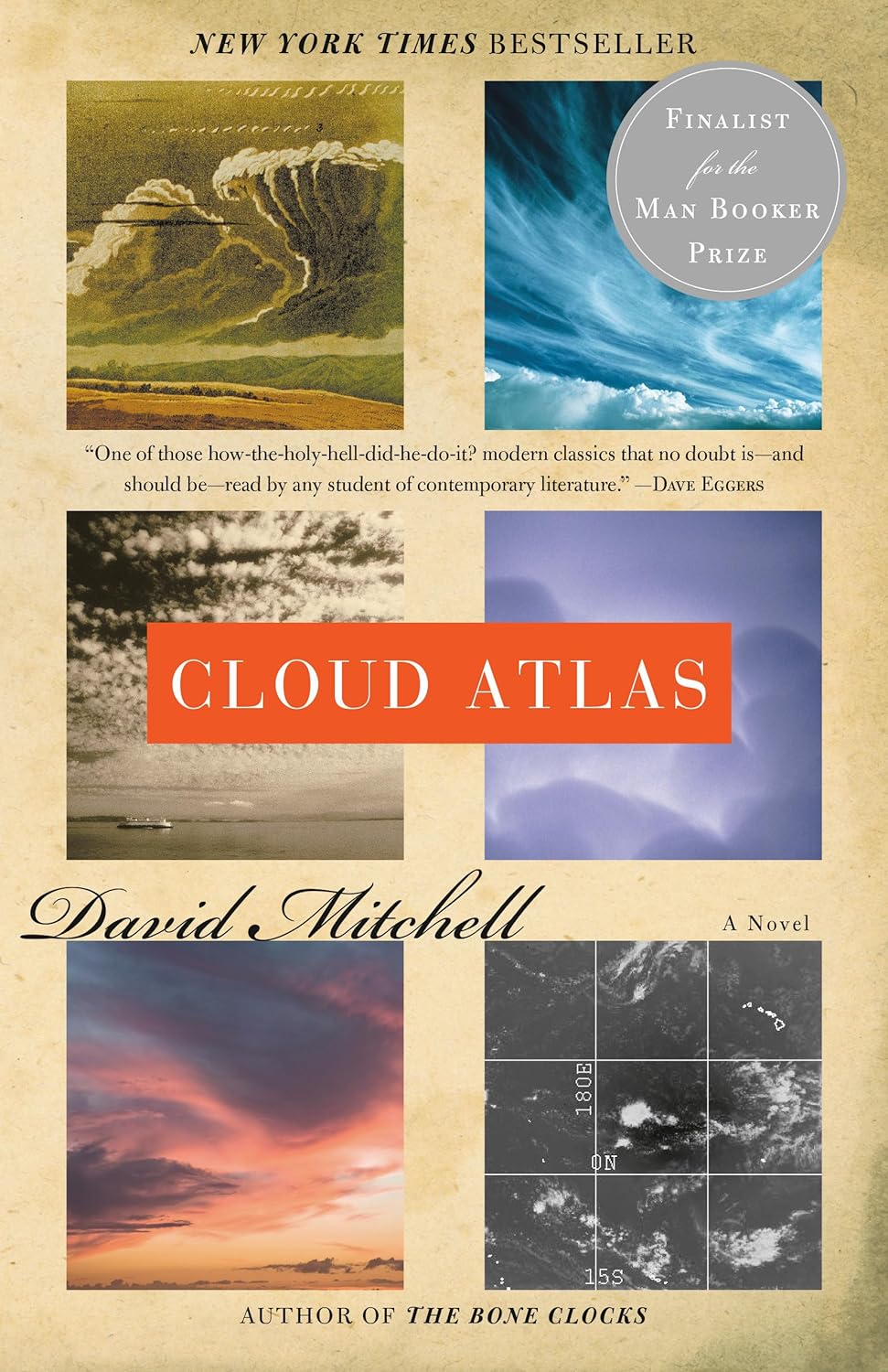
Immediately praised upon its release, David Mitchell’s Cloud Atlas (2004) stands as one of the most significant books of the 21st century. Though it has its skeptics, the novel was shortlisted for the Booker Prize, Arthur C. Clarke Award, and Nebula Award for Best Novel and won in Literary Fiction at the British Book Awards. The novel’s support across the communities of historical, speculative, and literary fictions is itself quite interesting but, suffice to say, the novel was well received and remains so in myriad lists of Best Books of the Century. One reason potentially behind its plaudits is how Cloud Atlas attempts to catalogue the challenges, tensions, and anxieties of its post-postmodern period. Many of the sociopolitical concerns shared by theorists regardless of their periodizing name of choice also drive Cloud Atlas’ structure and world. Less a realist representation of the contemporaneous moment than a warning about violent mistakes being repeated over and over, the novel assesses what entwines human’s past, present, and future morally as well as, in the broadest sense, politically. Put simply, Cloud Atlas is one of the most comprehensive attempts at understanding and representing the anxieties of the present moment. The impressive chronological and physical scope of Cloud Atlas is both obvious from its audacious structure and poured over in critical assessments. More than any other element, its expansive world motivates and helps organize analysis of the novel. Spanning roughly 1200 years with sections set on four different continents, Cloud Atlas presents a truly global vision of connectivity through time and space. The recurrence of objects, themes, and markers, as well as the reappearance of distinct, previous texts in newer sections, binds the eleven sections together as not simply diegetically related, but in many ways as repetitions of similar stories, phenomena, and souls.
The boomerang structure of the novel, in which six different narrators and chapters comprise eleven sections, all but one of which are split in half, shoots the story forward in time from the 1850s to the 31st century, and then back around to the 1850s at novel’s end. More specifically, we begin and end with Adam Frobisher’s “The Pacific Journal of Adam Ewing,” Robert Frobisher’s “Letters from Zedelghem” comprises the second and tenth sections, “Half-Lives: The First Luisa Rey Mystery” is the third and ninth sections, “The Ghastly Ordeal of Timothy Cavendish” fourth and eighth, “An Orison of Sonmi-451” fifth and seventh, and then, uninterrupted in the middle of the novel, “Sloosha’s Crossin’ an’ Ev’rythin’ After” comes sixth. Cloud Atlas’ unique structure allows for historical analysis in two directions, first in a more typical form of historicity and second as reassessment of chronologically earlier sections based on glimpses of the future of this world. Put differently, readers can see how certain actions and themes ripple forward through time, to an eventual post-apocalyptic world, as well as identify moments for potential change as they wind backwards in time. Narratively, that all but the farthest future section are split in two suggests that not only can’t the present or future be understood without the past, but that the past can’t be fully understood without imagining future worlds and consequences. Those future consequences, for the novel itself, are ecological cataclysm, plague, and nuclear fallout. The dystopic imagination of the novel also garners much attention in critical assessments, and understandably so given the odd relationship between Cloud Atlas’ disastrous future and its seemingly hopeful ending. “Sloosha’s Crossin’” envisions an Earth reduced to pockets of humanity running from some indistinct plague and searching for any tenable lands left after global environmental cataclysm and nuclear war. Zachry, the section’s narrator and a native of a tribe of farmers on a former Hawaiian island, tells the tale of his relationship, and travails, with the Prescients, a group of foreigners who’ve saved and maintained some technological capabilities from before the novel’s Fall. While the section represents the chronological end point of Cloud Atlas, the “Ev’rythin’ After” of the chapter title refers to the only small portion of Zachry’s tale that occurs after the actual events at Sloosha’s Crossin’ and, more broadly, to the novel that remains after this chapter. Not only is the time of the novel fractured, then, but not upset by the rendering ambiguous of “after,” which we can read as a temporal marker or a diegetic one. The history presented in Cloud Atlas stops at this point in the future, with little indication of what happens after. The framing makes clear that at least some humans live on, but where precisely and how many is left open. Thus, the novel invites readers to consider everything in the novel after the moment at Sloosha’s Crossin’ in light of Zachry’s actions. At Sloosha’s, Zachry unintentionally led a tribe of violent cannibals, the Kona, to his family, then saved himself by hiding as he watched the Kona massacre his family. That guilt haunts Zachry his entire life, and it’s a moment of individually minded inaction for which Zachry seeks to atone. Mitchell is careful not to demonize Zachry to readers, because acting in a moment like that is far easier said than done and because Zachry now stands as a proxy. Cloud Atlas slings backwards in time from the point of “Sloosha’s Crossin’,” inviting readers to consider if a better future might be possible by investing in action and community. Though Zachry lives in a distant, fictional future, memory of his tale becomes vital to understanding where hope might reside in Cloud Atlas as a whole in the face of impending ecological, biological, and nuclear disaster. As such, Cloud Atlas can be read in a third direction: concentrically. Concentric reading of the novel breaks down further, both in terms of the literal center of the novel, “Sloosha’s Crossin’,” and with the reader’s contemporary moment positioned as the center to which the novel’s past reaches and from which its future extends. Readers are invited to consider the stories and moments that lead to the dystopian future of the novel and what repeated moments and themes from that imagined future portend cataclysm in earlier moments. In equal measure, readers are challenged to consider their moment as the center point of Cloud Atlas and to judge said moment by not just past failures and violence, but the future inherency of such violence as well. All six stories in the novel either stem from or build to a critical moment of individual action which could have ripple effects through time and space. While the scope of any one action seems, at best, limited and certainly not world historic, the passage of texts and symbols through Cloud Atlas suggests any belief or action, positive or negative, could be one that casts a long shadow. SECTION OVERVIEWS The Pacific Journal of Adam Ewing Cloud Atlas opens in mid-nineteenth century New Zealand, following American lawyer Adam Ewing as he awaits ship repairs in the Chatham Islands to begin the long journey home to San Francisco. While wandering about the island, Ewing meets Henry Goose, an esoteric and foreboding English surgeon who immediately worms his way into Adam’s confidence. As the sections of “The Pacific Journal” progress, Adam becomes increasingly more ill, which Henry blames on a vague, exotic parasite for which he will treat Adam; in reality, Henry is slowly poisoning Adam to then steal what he assumes to be a chest full of gold in Ewing’s cabin. In the first section, Adam also witnesses the whipping of a Moriori slave, Autua, by a Maori overseer, backed by a cavalcade of white missionaries. Adam and Autua share a brief moment of eye contact, which Autua remembers when he sneaks onto the Prophetess and stows away in Adam’s cabin, begging him for help and passage to somewhere new. Begrudgingly, Adam obliges and manages to assist Autua in proving his bonafides as a deck hand, which secures him passage to the Prophetess’ next stop in Hawaii. Section two of “The Pacific Journal” picks up with Adam growing increasingly frail and anxious as, as Henry tells it, his worm keeps spreading through his body. Goose assures Ewing of his plan, however, and manages to keep him none the wiser about the slow poisoning. With Adam on the verge of death, Henry reveals his doings and reasoning, that he wanted Adam’s gold and killed him for it. Fortunately, Autua intervenes and eventually fights off Henry and saves Adam, deboarding him in Hawaii to recover and rest. There, Adam imagines his return to San Francisco and of a life guided by new principles. Letters from Zedelghem In a novel full of stylistic variance, with each section written as a different genre, “Letters from Zedelghem” may be the most jarring. While several other entries are one-way communiques (Ewing’s journal, Luisa Rey’s book, Cavendish’s memoir), Frobisher’s letters to his lover, Sixsmith, are collected and presented as a whole, but with none of the responses from Sixsmith. As such, readers receive Frobisher in an odd isolation, referring to Sixsmith’s own letters and reproducing conversations but removed from the ongoing dialogue of which he is a part. This first half takes place from late June through August of 1931 and the second half covers October through mid-December. The tumultuous seven months see Frobisher run from creditors on a scheme to be an amanuensis for a renowned composer, Vyvyan Arys. Aged and syphilitic, Ayrs has no new work to speak of, and Frobisher views this as a prime opportunity to gain shelter, money, and time to compose for himself, while even possibly rehabilitating his name. Ayrs has never met Frobisher at this point, but Robert’s cocksureness extends from a certain nothing-to-lose status. He has no money, regard, or connections besides Sixsmith, despite his privileged upbringing and schooling. Frobisher and Arys do manage to establish a productive and nearly familial relationship for several months; however, both are schemers by nature and exploiting the partnership for their own gain. Frobisher, in addition to having an affair with Arys’ wife, Jacosta, continues to insist that his revival of Arys’ stature will allow him to submit and orchestrate his own masterpiece, “The Cloud Atlas Sextet.” Arys, however, knows of Frobisher’s wayward past and affair with Jacosta and holds both over Robert as incredibly powerful blackmail, threatening to destroy Robert’s name if he refuses to stay and write new material under Arys’ name. Frobisher contemplates murdering Vyvyan, but instead steals his Luger and runs, again, to a hotel, where he finishes composing the Sextet and, to end the chapter, composes one last letter to Sixsmith before committing suicide. Half-Lives: The First Luisa Rey Mystery “Half-Lives” perhaps feels the most novelistic and familiar of all of Cloud Atlas’ sections. What we read is the experiences of journalist Luisa Rey in the form of a mystery novel, allowing for slight movement between perspectives, something the Ewing and Frobisher sections lack given their form. The section opens, in fact, not with Luisa but with Rufus Sixsmith, Robert’s old lover, now sixty-six and a scientist at a nuclear energy company, Seaboard. This is the first, and only, appearance of an actual character in a subsequent story (not including virtual appearances). While the choice of Sixsmith for such a distinction might seem odd, his narrative move from a deeply personal crisis (Robert’s suicide) to a widely existential one (nuclear catastrophe in “Half-Lives”) helps illustrate the connection that Cloud Atlas consistently draws between the two. Fittingly, Luisa’s crusade to expose the remorseless danger Seaboard poses is both personally motivated and communally minded. Sixsmith and Luisa get stuck in an elevator together, beginning the latter’s involvement with the “Sixsmith Report,” an analysis of Seaboard’s practices that will expose their malevolent neglect. What follows is a compelling and twisty hard-boiled thriller, with Luisa hunted by Seaboard’s unofficial assassin as she searches for a surviving copy of Sixsmith’s report. She’s assisted by Joe Napier, who we meet as a nearly retired security guard at Seaboard and becomes sympathetic to Luisa’s cause. Eventually, and perhaps expectedly, Luisa does obtain and release a copy of Sixsmith’s report, sinking Seaboard’s stock though, as is made evident later in the novel, not the fate of malicious corporate practice within energy companies in general. Luisa’s victory is a small, even pyrrhic, one but a triumph for her nonetheless. The tension between individual success and global change concretizes in “Half-Lives” and drives subsequent sections. The Ghastly Ordeal of Timothy Cavendish Timothy Cavendish, a down on his luck editor in present day London, undergoes perhaps the most sweeping change of any of Cloud Atlas’ protagonists, growing from an irreverent, weaselly literary agent to a still irreverent but humbled, gracious, and on the lamb scribe by the end of his writing. Despite the power of his pen, Cavendish finds himself among unsavory lots. Having recently signed a notorious gangster, Dermott Hoggins, whose racy autobiography flops, Cavendish experiences increasing pressure from Hoggins and debt collectors of all stripes. Upon defenestrating an eminent critic after a scathing review, Hoggins finds himself in prison and thus out of the profits from his now best-selling book. After a brief period of elation for Cavendish, Hoggins’ goons come to extort old Timothy to the tune of 50,000 pounds. Desperate, Cavendish turns to everyone in his address book before attempting to woo his brother, Denholme, whose patience is clearly strained, yet again. Denholme refuses but does inform Timothy of a favor owed to him, one that will allow the latter to go on the run to wait out the searches from more debt collectors and Hoggins’ gang. Cavendish accepts, gladly, being hoodwinked into a far-off and tightly secured nursing home, Aurora House, to be subjected to all manner of scorn and infantilization. “Ghastly Ordeal” prompts consideration of the ways in which globalization affects not only our present, but also recontextualizes our pasts while threatening the future. Timothy Cavendish ghastly ordeal may be, to him, primarily about his escape from imprisonment in a nursing home; for readers, his ordeal is more about attempts to self-signify, to craft and control one’s own narrative, in a world global capitalist structure so eager to regulate our bodies and experiences. An Orison of Sonmi-451 Thematically, “An Orison of Sonmi-451” gestures toward the rest of Cloud Atlas immediately and regularly. Sonmi-451’s almost meta digressions on power and autonomy frame each preceding section in an explicitly philosophical way, while also relating her own journey from service industry clone to sentience. Besides passing mention of Sonmi-451’s unusual comet-shaped birth mark, however, the section saves its diegetic connections and callbacks for a dizzying flurry in the last few pages, just before a brazen cliffhanger. Sonmi-451, essentially doing a final interview for the record before her death sentence, recounts the time between her “ascension” and capture and reaches the night of her capture as readers hit the section break. She talks of a truly transformative experience with a particular movie, a 21st century relic long forbidden to all but a select few in Neo So Copros: The Ghastly Ordeal of Timothy Cavendish. After the humor and hijinks of Cavendish’s memoir, the moment would read as a gag if Sonmi-451 weren’t so starkly earnest. Yet here is Sonmi-451 expressing genuine devotion for the filmed version of Cavendish’s memoir, largely because it depicts such a strange looking world from centuries before. Sloosha’s Crossin’ and Everythin’ After In this far-future moment, the last diegetically known vestiges of humanity reside on the islands of Hawaii (stylized as “Ha-Why” in Zachry’s tongue) in various hunter-gatherer tribes. Zachry, and his tribe the Valleymen, live in constant fear of attack from the Kona, a ruthless and cannibalistic tribe with the advantages of horses and better weaponry than the more agricultural Valleymen. In addition to the various Hawaiian natives, the off-land “Prescients” appear throughout “Sloosha’s Crossin’” as symbols and explorers of the wider world unknown to Zachry and his people. Prescients still have much of the modern technology from before the Fall, including rapid transit ships, modern medicine, computer technology, and even some guns. Prescients are notoriously secretive and cagey, especially in Zachry’s mind, and while they maintain a strictly trading-based relationship with the islanders, the specter of their colonial conquest hangs over “Sloosha’s Crossin’,” especially when Meronym begins an extended stay with Zachry’s family. Meronym reveals much later in the chapter that the plague is now reaching Prescient strongholds – which, to best estimate, appear to be on the U.S. and/or Canadian west coasts – and they’re observing Hawaii as a potential place to re-settle. Cloud Atlas reaches its structural climax and begins the return of its boomerang structure in section six, “Sloosha’s Crossin’ An’ Ev’rythin’ After.” While all the themes readers become accustomed to in the previous five sections return and are supplemented in “Sloosha’s Crossin’,” the title itself and the narrative framing complicate the temporality of an already temporally complex novel. The physical journey in “Sloosha’s Crossin’” functions as a metonymy for the novel as a whole, as Zachry’s and Meronym’s travel up a sacred, abandoned mountain and then back down into a radically altered future mirrors, in a way, the reader’s journey forward in time, into the future, and descent back to the moment of Ewing, whose given name is even more suffused with meaning after “Sloosha’s Crossin’”. RINGS OF CONFUSION Cloud Atlas begins with a pun, one that confuses sense of place and direction. “Beyond the Indian hamlet,” begins this entry in Adam Ewing’s journal, a mile marker cloaked in racist identity markers. The journal date, November 7th, includes neither a year nor a place, leaving readers wondering, at the outset, where and when Ewing is. Whether the use of Indian refers to actual Indians or India itself, serves as a catch-all for some other brown-skinned ethnic group, or is the misnomer applied to Native Americans remains an open question. As Adam traipses through “rotting kelp, sea cocoa-nuts & bamboo” the possibilities narrow, yet still readers are left to wonder. Such ambiguity serves to destabilize clear historical narrative. The deeply personal genre of diary does not require such details, Adam’s words being chiefly for himself. The combination of highly specific observational details and broadly unclear physical and chronological markers disorients readers, making them feel privy to and part of Ewing’s general confusion and out-of-placeness, a sensation Cloud Atlas will continue evoking in each section. Robert Frobisher finds himself scattered and running in a land in the midst of radical change. The historical break of WWI and WWII seep through Frobisher’s own timelessness, or perhaps out-of-timeness. Robert isn’t living or acting particularly anachronistically, but in his letters to Sixsmith he floats through reference points, rejecting the past, modernity, and the future. He compels Sixsmith, when he visits, to, Lose yourself in the city’s rickety streets, blind canals, wrought-iron gates, uninhabited courtyards…leery Gothic carapaces, Ararat roofs, shrubbery-tufted brick spires, medieval overhangs, laundry sagging from windows, cobbled whirlpools that suck your eye in, clockwork princes and chipped princesses striking their hours, sooty doves, and three or four octave bells, some sober, some bright. (47) While he’s simply describing the city’s wide-ranging styles and influences, all baked into the layout and construction, the effect of the passage is to set Frobisher as lost in a swirl of times and modes, a state he wishes Sixsmith to join him in. Readers meet Frobisher as he travels to a place that resists a clear chrono-classification, a place where medieval, Gothic, and classical Turkish design mix with blatant symbols of modernity in advanced clock towers and sooty doves. Antiquity and modernity cohabitate. As they do, also, in Frobisher’s description of Ayrs’ estate, the west wing of which is in disrepair with, among several other issues, “rainwater runneling medieval sandstone” (62). The passing acknowledgement of the chateau’s medieval foundation speaks, briefly, to its true age and place within the architectural mix of Bruges, though Zedelghem lies slightly removed from the city. With the west wing shuttered off, money goes to upkeep of the east wing with its “moody central-heating system and rudimentary electricity that gives one crackling shocks from the light switches” (63). While the antiquated portion of the chateau slowly falls apart, the maintained portion, while comfortable and relatively safe, threatens with the dangers of modern technology. Moody and crackling electric systems carry the potential for widespread damage and danger, as does the mold and infestation of the west wing. Sixsmith faces the calamity of the future in the opening moments of “Half-Lives,” where he ponders whether the American empire marches its way to collapse or unprecedented reach. Sixsmith, now sixty-six and a scientist at Seaboard, gazes over a balcony and gauges the fall, he remarks on his positioning, “West, the Pacific eternity. East, our denuded, heroic, pernicious, enshrined, thirsty, berserking American continent” (89). Sixsmith stands at the precipice, between the Pacific expanse of Ewing’s travails and the old, crumbling estate of his beloved Robert, during a crucial moment of empire, the summer of 1975 mere months after the Fall of Saigon but, in terms of nuclear energy, four years before the Three Mile Island meltdown in Pennsylvania and eleven years before the Chernobyl disaster in the U.S.S.R. The United States has finally admitted defeat in the Vietnam War, yet remains, as Sixsmith notes, hungry for expansion to improve its own global influence and standing during the Cold War. Ventures into the Middle East and Latin America would continue as the U.S. and U.S.S.R. sought control of the global order. With few options for physical expansion, a fact symbolized by Sixsmith’s positioning, the U.S. faces either an imperial fall or must adopt a new strategy. Ultimately, “Half-Lives” occurs after a series of momentous breaks in history. The break of “pure science” after the use of nuclear bombs on Japan; the break of truth and reporting after Watergate; and the break, and resituating, of American imperialism after Vietnam. The latter notion is how the section ends, calling back to the beginning with Sixsmith standing at a point of precipice and considering the American continent. Now Bill Smoke, having just run Luisa off a bridge, stands in the morning light as “The American sun, cranked up to full volume, proclaims a new dawn” (142). The U.S. decimated Japan, approached the brink of nuclear war in Cuba, ravaged Vietnam in a failed effort, and yet remains as “pernicious, enshrined, thirsty, [and] beserking” as ever (89). The second half of “Letters from Zedelghem” begins almost immediately with the anxiety of the inter-war period in Europe as a microcosm of the dilemma between global inevitability and individual action that “Half-Lives” clarifies. While riding through the Dutch countryside, Frobisher notes how “the land grows crater-scarred, crisscrossed with collapsing trenches and pocked with burnt patches where not even weeds take root” (440). He describes the vegetation as “lifeless charcoal” and says the land has “mildewed” as it anticipates more violence. Frobisher has been benefiting from the separation that Arys’ wealth provides; while the mansion has its own scars and reminders, it doesn’t prompt the same considerations as “the density of men in the ground” that Frobisher must confront in the countryside (440). As much as the memory of WWI hangs over the land, the impending onset of WWII hangs over the characters. Marty Dhondt, a merchant and Frobisher’s escort for this countryside trip, speaks of his time during WWI, which he was able to ride out in Johannesburg due to his wealth and, as Frobisher says, his foresight. “Wars do not combust without warning,” Dhondt replies, “They begin as little fires over the horizon. Wars approach. A wise man watches for the smoke, and prepares to vacate the neighborhood” (444). Dhondt’s reply, like Sach’s consideration of time, provides a way of reading the novel as a whole, a way of looking at and for the small moments of violence that connect each section, some as ripples and some as cascades. The cataclysms that lead to the future of “Sloosha’s Crossin’” are not sudden. They are, rather, smoke in each of the preceding sections, an approaching disaster that could be redirected but isn’t. Dhondt casts war as utterly inevitable, something that can only be sidestepped rather than something that can be eliminated. “Another war is always coming,” he says to Robert, “they are never properly extinguished” (444). Dhondt’s fatalism regarding the “always coming” nature of war, whether literal battle or a cultural war, may not be wrong. It is, he says, “The will to power, the backbone of human nature” which sparks wars, and diplomacy simply “mops up war’s spillages; legitimizes its outcomes; gives the strong state the means to impose its will on a weaker one” (444). Each section of Cloud Atlas concerns some confrontation of will-to-power, concerns multiple impositions of the strong upon the weak, and concerns the constant legitimizing of forms of oppression. Those aspects of human nature do seem to be, by the novel’s admission, inevitable. Dhondt’s assessment of vacating while the “little fires” are still “over the horizon” works as a metaphor for the novel as well. The choice(s) one makes in those moments are the most consequential. Dhondt’s new worry is one Cloud Atlas seems to share, though without the obvious classist and racist subtext, namely that “the next war will be so big, nowhere with a decent restaurant will be left untouched” (444). WWII is but a few years away from this moment, and surely Dhondt’s comment is a metatextually knowing one. Even so, the novel poses the same worry to readers, that the next war, whether it be on a battlefield or against some systematic pressure, may be too big to escape. Indeed, the fire may already be upon us in the pervasiveness of global capitalism and, especially, climate crisis. Dhondt’s commentary both foreshadows WWII and challenges readers to consider our own positions within inevitable catastrophe. Even the novel’s speculative sections are set amidst momentous change. “An Orison” occurs just before the ultimate dissolution of Nea So Copros, not due to Sonmi’s rebellion but because of inevitable rot. Sonmi-451’s assessment of Neo Seoul casts it as a natural extension of sociopolitical happenings in the 21st century rather than some radical break in history. Sonmi-451 enumerates the ills of Nea So Copros to the Archivest, Nea So Copros is poisoning itself to death. Its soil is polluted, its rivers lifeless, its air toxloaded, its food supplies riddled with rogue genes. The downstrata cannot buy drugs to counter these privations. Melanoma and malaria belts advance northward at forty kilometers per year. Those Production Zones of Africa and Indonesia that supply Consumer Zones are now 60-plus percent uninhabitable. Corpocracy’s legitimacy, its wealth, is drying up. The Juche’s rounds of new Enrichment Statutes are sticking band-aids on hemorrhages and amputations. Corpocracy’s only strategy is that long favored by bankrupt ideologies: denial. (325) Destabilizing effects of climate change, including the increased ranges of viruses and bacterium and the rendering inhospitable of equatorial locations, and the toxic results of, at this point, centuries of pollution and industrial waste have left the earth at the far-reaches of its hospitable conditions for human life. Even the Upstrata are feeling the effects, though they can live in denial and separated from what are functionally death zones where the poor live. Similarly, “Sloosha’s Crossin’” takes place after worldwide cataclysm yet before an impending biological disaster in the form of global disease. This section, like “An Orison,” reads eerily familiar (in 2004 and especially now), lending further credence that the connecting piece of the novel’s structure is its readers. Choices must be made throughout in times of instability and unknowing, on the precipice of radical change and, sometimes, following massive upheaval. The choices characters make in those moments help us to understand the world of the novel and the relationship between its past and future, but the moments themselves challenge readers to imagine how their own choices fit within the continuum. CHOICES ALL THE WAY DOWN Cloud Atlas often places characters in meaningful interregnums, both personally and culturally. The specific decisions made are, obviously, significant to the progression of the novel. As much, if not more, significant, however, is that such moments exist, and their stakes established. Even when individual decisions do not lead directly to radical, progressive change that they are in the position of having to make tough choices is a challenge for readers to imagine themselves in the same position, and to reflect on the choices we make everyday that could have unforeseeable ripple effects. Following from the emphasis put on Zachry’s choice at Sloosha’s Crossin’ and his engagement with the Abbesses’ three prophecies, the novel becomes more explicitly engaged with the possibility of revolutions, big and small, and the impact of individual actions. Sonmi-451’s revolution will fail, as she has already been captured and sentenced, but her memory echoes for readers through the rest of the novel as it reverses its chronology. The novel ends in a post-apocalypse, so clearly revolution never occurred. As such, when the novel reverses course, it shifts the call to action from its characters to readers, inviting us to remember and learn from the failures of this diegetic past and future in order to avoid the eventual fall. This begins with a small moment decentering fate. When Sonmi-451 tells Union she “was not genomed to alter history,” she’s told “no revolutionary ever was” (327). Beyond the surface ‘anyone can change history’ reading, Hae-Joo’s response extends to the novel itself, which seems to suggest a cataclysmic fall is inevitable yet the choices we make within that are our own, and meaningful. “Half-Lives” challenges us further still in its examinations of passive complicity. Isaac Sachs, a meek scientist at Seaboard who knows the contents of Sixsmith’s report and decides to release it to Luisa, is thrust into a fight he truly believed science to be separate from, a naïve yet genuine belief. In the midst of agony over whether to shred or release Sixsmith’s report, Isaac “longs for his old lab in Connecticut, where the world was made of mathematics, energy, and atomic cascades, and he was its explorer” (128). The pure practice of science is what appealed to Isaac, but now he and his ideas are “the property of Seaboard Corporation” and his loyalties collide. The vision of science as an innocent playground, while genuinely felt, is dangerous. Even Isaac’s positioning of himself as an explorer of a world that makes inherent sense and has truth waiting to be discovered reeks of some colonial efforts. Tellingly, the use of past tense in saying the world was made of scientific principles and phenomena in the “old lab” suggests a break not only in the expectations and freedom of his job, but in the world itself. The world is no longer math and chemistry and biology; the world is, rather, narrative, a dirty game played between, in this case, Grimaldi and Luisa. What seemingly pushes Isaac to give the report to Luisa is his remembrance of a moment that casts a long shadow over the entire section, one that has, to this point, remain unmentioned. “Then his thoughts slide to a hydrogen buildup,” we’re told, “an explosion, packed hospitals, the first deaths by radiation poisoning” (128). Any writing about nuclear power, especially one set in the 1970s, wrestles implicitly with the legacy of the Manhattan Project and the detonating of nuclear bombs on Hiroshima and Nagasaki. While the time gap between “Letters from Zedelghem” and “Half-Lives” elides a lot of world historical events, none haunt Luisa Rey’s mystery quite like the bombs, an event that forever tainted any supposed purity of scientific exploration. Isaac clings to that old vision, yet he knows where that road leads, having seen it play out a few decades prior. The human toll of unfettered power scares Isaac into action as he finally realizes he can never escape the “political orders…where erroneous loyalties can get your brain spattered over hotel rooms” (128), nor can the practice of science. The dueling philosophies of Grimaldi, “power is truth,” and Luisa, “truth is power,” cannot be disentangled, just as science cannot be disentangled from politics nor personal action from communal or global context. Elsewhere in “Half-Lives,” Javier goads Luisa into considering the haziness of far time by asking her whether she would see into the future if she had the ability. Their ensuing conversation about the possibility of changing the future via foresight begins to reshape the function of the novel going so far into both the future and the past. “If you could see the future,” Javier says, “that means it’s already there. If it’s there, you can’t change it” (401). Luisa responds that whatever you see in that moment “isn’t made by what you do. It’s pretty much fixed, by planners, architects, designers, unless you go and blow a building up or something. What happens in a minute’s time is made by what you do” (401). Luisa’s entire journey speaks to her insistence that individual actions in the present matter and of the importance of speaking truth to power. And her actions will, eventually, have some effect, at least a local one when the Swannekke plants shut down. The legacy of her actions, and the ripples through history, is left open and, seemingly, small in the novel’s long history because of the priorities of those with political and economic power. Ultimately, Luisa tells Javier that changing the future is “a great imponderable” and wonders if “Maybe the answer is not a function of metaphysics but one, simply, of power” (401). How those in power shape and decide the future comes to bear almost immediately after Luisa considers the potential, in a moment that predicts the events of the book’s world. The corpocracy of Nea So Copros, which we know to happen, is framed as a specific priority of those with the most power, as well as a nationalistic endeavor. Mixed into smatterings of jingoism and worries over who else might cede global control if the US doesn’t, a few businessmen, on whom Luisa is eavesdropping, consider the future and “our country’s rightful – corporate – empire” (403). “The corporation is the future,” they continue, “We need to let business run the country and establish a true meritocracy” (403). This conviction reads as a sly reference to the impending presidency of the business obsessed Ronald Reagan and, for readers in the early 2000s, the presidency of George W. Bush and the ever-increasing kowtowing to big business lobbying and corporate mindsets in the US after Luisa Rey’s story. Reading the passage after the election of Donald Trump, and his fashioning of himself as the ur-businessman, feels like a further extension of the novel’s conception of power and the future. In essence, then, Cloud Atlas points to past moments that, in hindsight, presaged the contemporary 21st century moment, as well as future visions that demonstrate the natural extensions of that present. In other words, the novel presents a virtual past and future through which readers must dig to find the center shell, the 21st century present. What the second part of “Half-Lives” puts most into perspective is a clear way of reading the significance of Cloud Atlas’ structure of embedded virtual shells of presents. Individual actions, while seemingly overwhelmed by corporate and economic powers, do matter as potential agents of change, whether immediately or over centuries. “Half-Lives” causes no illusions that Luisa’s dogged pursuit of corruption has a large-scale impact in her time; the nuclear plant does shut down, and the CEO, Lloyd Hooks, is nominally punished, but the corporate politics proceed largely unhindered. President Ford’s sly remarks regarding the punishment of Hooks make that clear, “My administration makes no distinction between lawbreakers. We will root out the crooks who bring ignominy to corporate America and punish them with the utmost severity of the law” (434). Hooks, also a Nixon appointee, is, ostensibly, punished with a vigor Ford did not have when pardoning Nixon who, for all his crimes and transgressions, did not disrupt “corporate” American in the same way. Ford’s labeling of only corporate America as a concept worth defending, while perhaps shocking in its candor, does not surprise given where the novel goes in its future. Luisa’s actions brought down one corporation, not a whole system that values said corporations more than individual citizens. And yet, Cloud Atlas’ general pessimism about where the future leads never extends to the importance of individual actions and decisions. The real future of the novel that we, as readers, know exists in a hazy, distant time that renders it essentially useless to someone like Luisa. All she can do, as she tells Javier, is hope that her actions from minute present to minute present can help generate global change eventually. CENTER PIECE As inventive as its structure is, the question remains whether Cloud Atlas is an assessment or a prediction. While the textual chronology is layered, there remains a gap: what fills the space between the ambiguous beginning and the speculative ending of the novel? Ewing’s sections implicate readers by troubling any firm sense of time and place while also directly engaging the question of individual action in global contexts. “Half-Lives” and “Sloosha’s Crossin’,” however, fold reads into the novel even more fully, the former by suggestion and the latter quite directly. In an echo of Sixsmith pondering the new American dawn in the first section of “Half-Lives,” another about-to-be-murdered Seaboard scientist, Isaac Sachs, ponders change and history, We imagine how next week, next year, or 2225 will shape up – a virtual future, constructed by wishes, prophecies + daydreams. This virtual future, as in a self-fulfilling prophecy, but the actual future will eclipse our virtual one as surely as tomorrow eclipses today. Like Utopia, the actual future + the actual past exist only in the hazy distance, where they are no good to anyone. (393) He continues by considering the distinction between simulacrum and actuality, if any such distinction exists, and finally, before the C4 explodes his flight, a conception of time that can be reasonably read as the construction of Cloud Atlas itself, “One model of time: an infinite matryoshka doll of painted moments, each ‘shell’ (the present) encased inside a nest of ‘shells’ (previous presents)” (393). Cavendish’s present moment, assumed to be around the time of the novel’s writing and publication in the early 2000s, could be the primary “shell” residing in the five other sections’ presents and be said to be the reader’s own to a degree. That conception works well for considering the connections of other presents to specific moments in the early 21st century, work the novel certainly encourages. However, especially as time passes, the reader’s own present moment, whenever they’re reading the book, becomes the most interior shell, the painted moment encased within all others in the novel. Despite an abundance of writing on the novel’s structural features, not much is made of the framing or title of “Sloosha’s Crossin’.” Readers learn early in the section that they are thrust into the position of audience to an elder in the community spinning a yarn about the past. We later learn this is Zachry’s son speaking, and through him readers learn of the Fall, the particulars of which remain hazy but involve global plague, environmental catastrophe, most likely nuclear fallout, and the slow decimation of the human species. Yet the hope remains that Zachry’s tale of overcoming, of ascendence to a dangerous precipice, might lead to a return to something greater. That hope, as beleaguered as it is, lies firmly in humanity and in memory. Cloud Atlas rejects any actual peace, instead leaving Zachry and the remaining Prescients to consider how to forge ahead in building some sustainable, and not Fall-susceptible, community. Rampant violence still exists in this far future, and the threat of decimation looms, but as the novel begins its structural turn and descent, the narrative prompts readers to look back on that past and how its truths might shape the future. Nearly all “Sloosha’s Crossin’” maintains this narrative structure and voice, even with occasional interjections from Zachry’s son asking for food or quiet or rest. The introduction of oral tradition to the novel’s genre-hopping is interesting, however the final page of the section shocks any sense of context. After wrapping up by waking up on the Prescients ship, Zachry’s yarn gives way to his son commenting on his reliability, or lack thereof, “Zachry my old pa was a wyrd buggah…most o’ Pa’s yarnin’s was jus’ musey duck fartin’” (308). The sudden introduction of Zachry’s son, and Zachry’s death, prevents Zachry from becoming a dogmatic figure, like Sonmi-451 is to him and the Valleymen, while also making clear the importance of memory to change. The son now has Meronym’s orison, which contains holograms of Sonmi-451 and remained dear to Zachry, and he invites his audience, including readers, to sit and watch. “Sit down a beat or two,” he tells us, “Hold out your hands. Look” (309). Look at what? The past. The opening of the orison to reveal Sonmi-451 transitions the novel to the second half of her interview, and the amount of truth in Zachry’s tale, which his son can never quite determine, is now a question for readers going forward as Cloud Atlas completes its future. Cloud Atlas’ future is determined; ours is in our hands now. IN YOUR HANDS So what could change at this pivotal moment in our own history to avoid the fate of “Sloosha’s Crossin’”? What is the positive flipside, if any, of Henry’s violent, essentially nihilist vision of humanity? Cloud Atlas proffers two possibilities, one incredibly subtle and the other the final line, and one of the greatest takeaways, of the novel. Adam, resting and healing in Hawaii after being saved from Henry by Autua, imagines the eventual exchange with his father-in-law upon his return to San Francisco when Adam pledges himself to the abolitionist cause. Newly philosophical, Adam, in an echo of Isaac Sachs’ final ruminations, ponders that “history admits no rules; only outcomes” (507). He continues, “What precipitates outcomes? Vicious acts & virtuous acts. What precipitates acts? Belief” (507). In effect, Adam agrees with Henry. History is not the march of preordained actions or even logically compelled. Acts, kind or malicious, are performed based on socially generated and engrained beliefs. Heather Hicks summarizes this realization as Cloud Atlas functioning as a warning against an impending apocalypse but not necessarily a prediction of one, “Mitchell’s novel implicitly adds to this series of propositions that if we believe both events and selves are old as well as new, we may invest ourselves in both in a less destructive fashion” (13). Humans, Adam seems to be realizing, are on their own and wholly responsible, and he now intends to attune his actions to actively creating a better, more just world, rather than simply believing one is inevitable. “If we believe humanity is a ladder of tribes, a colosseum of confrontation, exploitation & bestiality, such a humanity is surely brought into being…[and] a purely predatory world shall consume itself” Adam insists. Alternatively, he argues, if we believe in a just, equitable, peaceful, and shared world, then such a world can come into being. Not, however, without incredible and sustained effort, “Torturous advances won over generations can be lost by a single stroke of a myopic president’s pen or a vainglorious general’s sword” (508). His father-in-law’s (assumed) response makes the intense effort necessary even clearer, as one life spent doing “battle with the many-headed hydra of human nature” irrevocably ends as “no more than one drop in a limitless ocean” (509). Adam’s conversion to abolitionism means little in any grand scheme. It’s even unclear how Adam follows up this decisive moment, we have no access to how his life continues. But his decision is a real step toward shaping a world he wants his son to inherit, a decision guided by the kindness of Autua and the fact that Adam owes his life to a person he considered lesser at the beginning of his journey. Fittingly, however, Adam hopes and imagines here, still far from the life he intends to live going forward; his choice remains unsettled and, thus, malleable. Adam insists he “must begin somewhere,” and that insistence on acting when and in whatever capacity possible allows Adam to flip his father-in-law’s contempt, much like he flips Henry’s violence, by asking “Yet what is any ocean but a multitude of drops?” (509). Adam’s flipping of his father-in-law’s phrase is a poignant supplement to his previous comment about belief and humanity; while his father-in-law believes in the (white, aristocratic) status quo, Adam now chooses to believe in a more collective, more unified world, one in which every action contributes to and helps move a much larger whole. Adam, in other words, believes himself a part of something much grander now, something perhaps beyond purely human society. The ambiguity of Adam’s positioning extends to readers’ own when encountering Adam’s renewed belief and hope. As much as his multitude of drops line, Adam’s earlier query about fate may just as well hang over the novel as a unifying question, “Is this doom written within our nature?” (508). We, as readers, know what befalls the world in Cloud Atlas: plague, ecological disaster, nuclear fallout, and seemingly perpetual war. What stock can be put in Adam’s faith in ethical action knowing what the centuries to come will bring, knowing how the same forms of predation and violence ripple through all six timelines? Here the novel’s speculative qualities become a challenge rather than simply a tool of warning. The boomerang structure of the novel presents a doomed future but with several potential inflection points along the way, Adam’s chief among them. Cloud Atlas leaves hanging what’s to come beyond its covers. By showing us the doom to come and wrapping us back around, Cloud Atlas unsettles its own timeline. Perhaps Adam’s decision starts some ripple effect that alters the future of the novel. Of course, the history of the 20th and 21st centuries are far from encouraging in terms of mass change brought on by belief in a more equitable, communal world as Adam suggests is necessary. But just as Adam finds himself in the midst of a momentous change in his life upon which he must act, so too might readers, who, as the final shell of the novel’s structure, are challenged to speculate and believe in a radically different, and more expansive, world. Works Cited Appiah, Kwame Anthony. Cosmopolitanism: Ethics in a World of Strangers. Norton, 2006. Bayer, Gerd. “Perpetual Apocalypses: David Mitchell’s Cloud Atlas and the Absence of Time.” Critique, vol. 56, no. 4, 2015, pp. 345-354. Begley, Adam. “Brilliant Stutter-Step Novel Cuts Smoothly Through History.” Observer, 16 August 2004. Bentley, Nick. “Trailing Postmodernism: David Mitchell’s Cloud Atlas, Zadie Smith’s NW, and the Metamodern.” English Studies, vol. 99, no. 7, 2018, pp. 723-743. Bissell, Tom. “History is a Nightmare.” The New York Times, 29 Aug. 2004, 7. Brown, Kevin. “Finding Stories to Tell: Metafiction and Narrative in David Mitchell’s Cloud Atlas.” Journal of Language, Literature, and Culture, vol. 63, no. 1, 2016, pp. 77-90. Childs, Peter and James Green. Aesthetics and Ethics in Twenty-First Century British Novels. Bloomsbury, 2013. Commissiong, Anand Bertrand. Cosmopolitanism in Modernity. Lexington Books, 2012. Hicks, Heather. “‘This Time Round’: David Mitchell’s Cloud Atlas and the Apocalyptic Problem of Historicism. Postmodern Culture, vol. 20, no. 3, 2010. Knepper, Wendy. “Toward a Theory of Experimental World Epic: David Mitchell’s Cloud Atlas.” Ariel, vol. 47, no. 1-2, 2016, pp. 93-126. Meloy, Maile. “Cloud Atlas a Series of Virtuosic, Soaring Stories.” NPR, 1 March 2004. Mezey, Jason Howard. “‘A Multitude of Drops’: Recursion and Globalization in David Mitchell’s Cloud Atlas.” Modern Language Studies, vol. 40, no. 2, 2011, pp. 10-37. Mitchell, David. Cloud Atlas. Random House, 2004. Norfolk, Lawrence. “Cloud Atlas by David Mitchell.” Independent, 27 February 2004. Shanahan, John. “Digital Transcendentalism in David Mitchell’s Cloud Atlas.” Criticism, vol. 58, no. 1, 2016, pp. 115-145. Shaw, Kristian. “Building Cosmopolitan Futures: Global Fragility in the Fiction of David Mitchell.” English Academic Review, vol. 32, no. 1, 2015, pp. 109-123. Tait, Theo. “From Victorian travelogue to airport thriller.” The Telegraph, 1 March 2004. Turrentine, Jeff. “Fantastic Voyage.” Washington Post, 22 August 2004. Wood, James. “The Floating Library: What Can’t the Novelist David Mitchell Do?” New Yorker, 5 July 2010, pp. 69-73.
 vector-bsfa.com