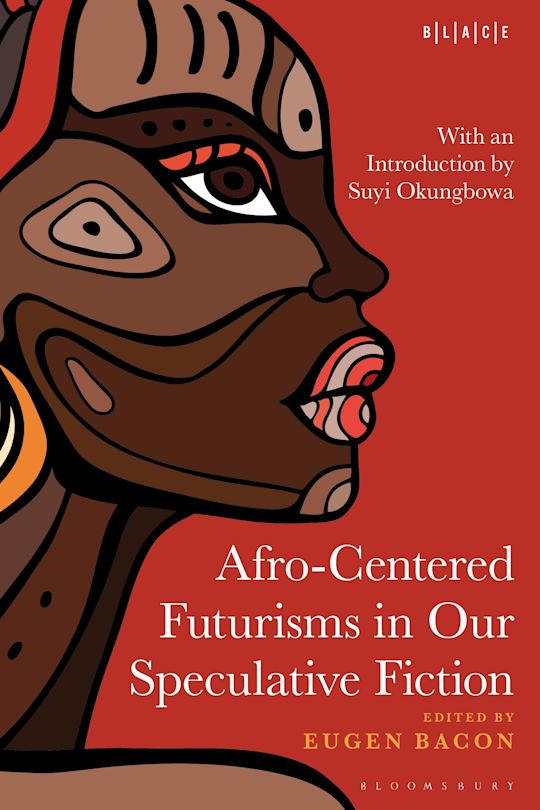
Edited by Eugen Bacon, Afro-Centered Futurisms in Our Speculative Fiction (2024) is an anthology of award-winning African speculative fiction writers, including Suyi Okingbowa, Cheryl S. Ntumy, and Dilman Dila.
The anthology pushes us to question the genre labels we take for granted – namely, Afrofuturism, Africanfuturism, and futurism – alongside introducing us to new terms, fusing specificity with inclusivity. Key to the anthology is the concept of the ‘gaze’: of looking in order to name, and the tension between fixity and fluidity that comes from it. With a blend of fiction and nonfiction, Bloomsbury describes the anthology as offering “excerpts from their work and creative reflections on futurisms with original essays.”
Afrofuturism, Africanfuturism and Afro-centred Futurisms
There are many names for speculative fiction by African writers. The anthology is chiefly concerned with differentiating Afrofuturism, Africanfuturism, and introduces Afro-centred Futurisms. ‘Afrofuturism’ often refers to Black speculative fiction, although the anthology reminds us of its origins in the United States of America through Mark Dery’s coinage. ‘Africanfuturism’ is Nnedi Okorafor’s invention to describe speculative fiction invested in African histories, presents and futures. ‘Afro-centred Futurisms,’ as Suyi Okungbowa defines it, is a plural term with an “active consciousness and open-armed framework — the privileging of the Afrodescendant self, an investment in timelessness, and an embrace of the spirituality-to-science spectrum” (18).
At a glance, these terms edge towards the same thing: a unifying approach to categorising African speculative fiction. As a result, they either appear too similar to be different, or too different to be related to the same body of literature that defies being put in a box. Instead of providing a final solution to this debate, the anthology pushes us to consider the terms Afrofuturism, Africanfuturism and Afro-centred Futurisms as a set of nested dolls; intimately connected but distinctly separate; a lineage of sorts can be traced, but it is not their defining feature. Okungbowa goes on to say that the writers in this anthology operate within the framework of Afro-centred Futurisms, even where they specify their subjects with different terms or draw different distinctions between the terms in use.
The plurality, inclusivity, and broadness of expression evoked by Afro-centred Futurisms is central to the anthology. It is less about finding a single, definitive label for African speculative endeavours, but more about the endeavours themselves — which, in their speculation, are always plural and open to evolution.
What’s in a World?
World-building — a key aspect of speculative fiction craft — is explored by nearly all of the contributors in the anthology, with critical attention given to both physical detail and narrative purpose.
Creating a universe is a big job. The scale and consistency of the speculation required is an imaginative feat. The Sauútiverse does just that – and its collaborative way of working allows diverse lived experiences to enrich the universe. Initiated in 2021 by Fabrice Guerrier and Wole Talabi, the Sauútiverse is an interplanetary worldbuilding collective that draws on African myths and folktales to create a universe that is both speculative and distinctively African. The collective and their works are well-represented in this anthology by some of its founding members, including Stephen Embleton, Cheryl S. Ntumy, Xan van Rooyen, and Eugen Bacon.
In particular, Embleton’s chapter emphasises the creative opportunity that language presents in speculative writing. His research in linguistics and writing systems, including Ge’ez, Nsibidi, Tifinagh, and isiBheqe soHlamvu or Ditema tsa Dinoko, led to the creation of the word Huriǁhaoǃnakhoena for his novel, Soul Searching (2020). Embleton writes that “Huriǁhaoǃnakhoena is both a word and a phrase – literally translated, it means ‘the people who built the settlements in the sea”’ (28). The word is a microcosm for the ways that Embleton has combined the technical research involved in writing his novel (including his collaboration with Pule kaJanolintji), with the ways that language evolves to reflect cosmology for both real and fictional worlds.
Building cosmology often means attending to spirituality and faith systems (or lack thereof), which has consequences for both decolonial resistance and genre classifications. Nuzo Onoh argues that the past and the future are of equal importance in African spirituality, citing Azuka and Iruka in Igbo culture as examples. Shingai Njeri Kagunda also argues for thinking nonlinearly about time in order to resist capitalist and white colonial systems of oppression, as explored in her novella & This is How to Stay Alive (2021). In tracing the ways that Ghanaian faiths, spirituality, and community are weaved into her stories differently, Cheryl Ntumy categorises her series Chronicles of the Countless Clans (2021 – 2022) as Africanfuturism or African fantasy, and her short story “Godmother” (2021) as Afrofuturism.
Spirituality and faith systems affect how stories are told, both within and beyond speculative worlds; they offer a cohesive perspective through which to see the world. But these perspectives need to be interrogated before they are applied. Nerine Dorman, Xan van Rooyen and Dilman Dila demonstrate that part of the project of worldbuilding is navigating the visions that have historically been imposed on African histories (and futures). Dorman shows that histories of colonialism and oppression can and do coexist with the dreams of freedom that build nations and define selves. van Rooyen finds that histories of queerness in Africa have been erased by colonisation, but that queerness in Africa need not be viewed through Western lenses to make it recognisable as such. Dila’s vision of governance in the Yat Madit universe takes inspiration from the pre-colonial political systems of Acholi (northern Uganda/southern South Sudan). His examination of how decentralised government might arise in Yat Madit emphasises that there have been organisations of governance that differ from Eurocentric and colonialist expectations.
Yet, it is fictional narratives that draw attention to gaze. They provide the blueprint for telling new stories and challenging old ones. Kagunda describes her novella & This is How to Stay Alive as Afrosurrealist, putting the power of the genre succinctly when she says it “strips white capitalist narratives of their believability” (94). Afrosurrealism blends the fantastical with the impossible, pushing at the edges of both to challenge what readers will consider believable. Its premise is expanded upon by Bacon’s addition of the Afro-irreal, where she finds that “the irreal story stays unpredictable and believable in all its unbelievability.” (47). Bacon works across Afrofuturistic dystopias in her novel about climate collapse, Mage of Fools (2022), and the Afro-irreal in the short story collection, Chasing Whispers (2022). In doing so, she demonstrates how genre might connect with and deploy different aspects of the African continent (including literature, languages, cultures and traditions) with sensitivity, creativity and futurity.
In contrast, Aline-Mwezi Niyonsenga and Tobi Ogundiran take flexible approaches to genre labels, but they both advocate for the compatibility of folktales and myths with speculative fiction. Niyonsenga’s novelette “Fell Our Selves” (2023) explores the complexity of returning home to the floating island of Majestia by fusing Rwandan folklore with speculative fiction, while Ogundiran takes examples from his short story collection Jackal, Jackal: Tales of the Dark and Fantastic (2023) to mix Western fairy tales with Yoruban folktales.
The anthology’s approach to worldbuilding prizes not simply precision but fluidity; we cannot build worlds without specifics, but we should not be bound by them – how else can we ensure inclusive expression?
Autoethnography – The Self-as-Research
Summarising the innovative approach of the anthology, Bacon demonstrates the ways autoethnography as a practice can enrich storytelling. She explores narrative, characterisation and perspective in the semi-autobiographical short story “Still She Visits” in Danged Black Thing (2021).
For Bacon, autoethnography is both a resource and a creative process: “it’s a gaze into the process and practice of writing the self, of leveraging on narrative to find meaning and a sense of identity, belonging, a sense of place in an imbalanced world” (208). Autoethnography allows writers (and readers) to work with and work through an expansive sense of lived experience, particularly on the African continent and throughout its diaspora. This methodology indicates the breadth of imaginative spaces that African writers can draw on, encouraging us to see the value of lived experiences as more than simply a diversity of perspectives, but a prerequisite to becoming what Bacon terms “informed insiders” (221).
The core strength of Afro-Centered Futurisms in Our Speculative Fiction lies in its nuance. Whether it is searching for inclusive expression, worldbuilding that ingrains freedom into its details, both specificity and fluidity, or advocating for autoethnographic practices, the anthology is committed to expansiveness and accuracy. It shows us how to hold seemingly contradictory approaches simultaneously, thus providing effective analytical frameworks for key concerns in both writing and researching African speculative fiction.
Works Cited
Bacon, Eugen. “An Afrofuturistic Dystopia and the Afro-irreal, Tanzania/Australia”. Afro-Centered Futurisms in Our Speculative Fiction. Ed. Eugen Bacon. 41-58. Bloomsbury Academic, 2024.
Bacon, Eugen. “Denouement: Autoethnography – The Self-As-Research.” Afro-Centered Futurisms in Our Speculative Fiction. Ed. Eugen Bacon. 207-223. Bloomsbury Academic, 2024.
Bloomsbury. “Afro-Centered Futurisms in Our Speculative Fiction”. Bloomsbury. Web. https://www.bloomsbury.com/uk/afrocentered-futurisms-in-our-speculative-fiction-9798765114674/. Accessed 11 September 2024.
Embleton, Stephen. “Cosmologies and Languages Building Africanfuturism.” Afro-Centered Futurisms in Our Speculative Fiction. Ed. Eugen Bacon. 23-39. Bloomsbury Academic, 2024.
Kagunda, Shingai Njeri. “Black-Futurisms Vs. Systems of Domination.” Afro-Centered Futurisms in Our Speculative Fiction. Ed. Eugen Bacon. 77-96. Bloomsbury Academic, 2024.
Okungbowa, Suyi. “Afrocentric Futurisms – The Case for an Inclusive Expression.” Afro-Centered Futurisms in Our Speculative Fiction. Ed. Eugen Bacon. 1-21. Bloomsbury Academic, 2024.
 vector-bsfa.com