By James C. Bassett
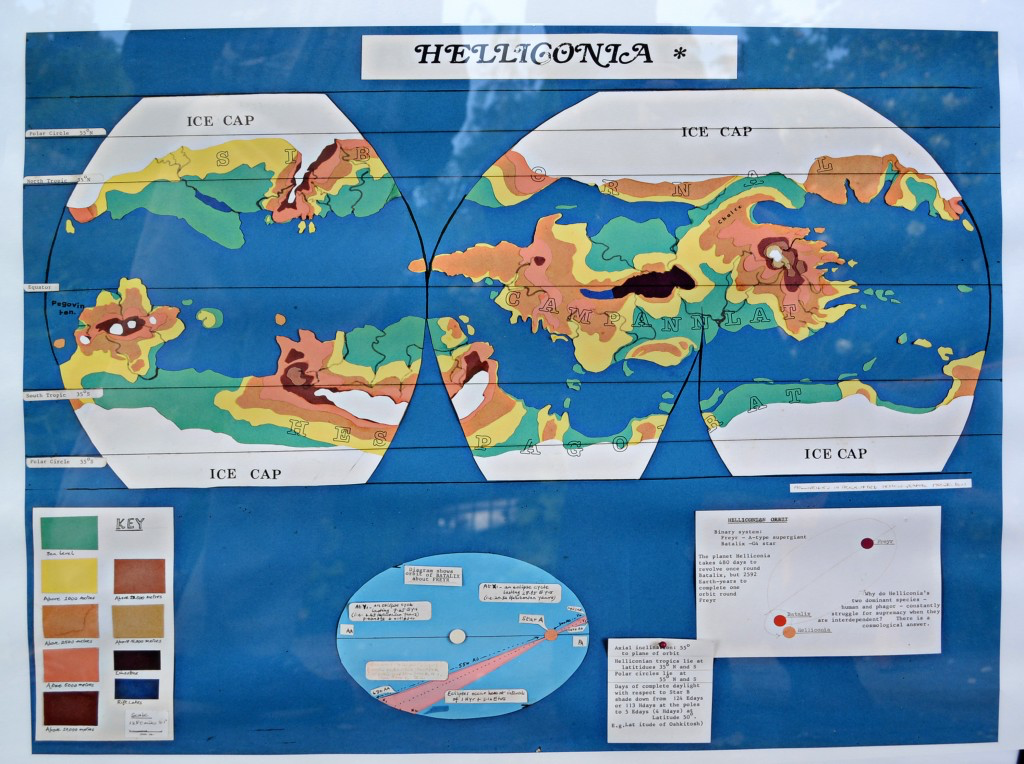
Brian Aldiss, map of ‘Helliconia.’ https://brianaldiss.co.uk/writing/novels/novels-h-l/helliconia/
I recently came across a most curious and unsettling pair of essays by Brian Aldiss that I am still trying to process, because they seem to strike against the very heart of science fiction literature, and even much of Aldiss’s own writing. “As far as we know, we are alone in a universe,” Aldiss points out in the second of these essays on the subject of aliens (Aldiss 1999, 340), and he is absolutely right. As far as we know.1 But although the jury is still out on the Big Question, in this essay Aldiss seems fervidly convinced that extraterrestrial sentience simply does not exist. When Aldiss argues “the case for mankind’s solitary state here [the universe], for which the evidence is plentiful” (Aldiss 1999, 334). He appears to accept an absence of evidence as evidence of absence, an extrapolative leap which defies logic and scientific method.
“There is no scientific evidence that [alien sentience exists], any more than there was ever any evidence for the long-held belief in spontaneous generation”2 (Aldiss 1999, 335), an unfair comparison, because spontaneous generation (the theory that living creatures could arise from nonliving matter—for example, that flies grow from rotting meat or that frogs grow from mud) was disproved by scientific evidence against it, a state of affairs that has not been reached regarding the existence or non-existence of sentient extraterrestrial life.
Still, anyone who believes in aliens absent any definite proof is misleading themselves, according to Aldiss. Such belief “represents a continuation of that venerable credulity” (Aldiss 1999, 340) that cursed our race with gods and monsters. Yet absent any definite proof that aliens do not and have never existed, Aldiss seems to be just as guilty of relying on a type of faith — just as “credulous” — in forming his conclusions.
Whatever the reasons for it, or the reasoning behind it, this personal disbelief in the existence of aliens is of little consequence to anyone but Aldiss himself. Of far greater import, however, and far more troubling to the science fiction genre, is an earlier essay in which Aldiss presents an overview of the development of the role and portrayal of sentient alien life in SF literature from its long pre-Campbellian days to the present, and an examination of the causes and effects of the debased and increasingly “monsterish” concept of aliens and what is alien (Aldiss 1996).
I call this first essay troubling because Aldiss uses it to declaim the presence of aliens not only in the real world but also in fiction — even though he himself often featured aliens in his own fiction, including of course the Nebula Award-winning novella “The Saliva Tree” (and a “monsterish” alien, at that) and the highly acclaimed Helliconia trilogy.3
Aldiss included aliens in his science fiction for the same reasons he included robots and rayguns and rocketships and every other classic trope of science fiction: as a literary device to advance the story. Aldiss was always a very literary writer (he was one of the first writers of the modern era to write intelligent literary science fiction, at a time when the field was dominated by schlocky American pulp writing), and throughout his long and illustrious career he fiercely supported and defended the literature of science fiction. This explains his preoccupation with explaining why science fiction is slighted by the Establishment — but it cannot explain his thesis that aliens are the sole reason.
Fortunately, for all his historical insight, Aldiss never succeeds in validly relating his conclusions to his stated intent of showing that aliens are the reason that “for all its commercial success, SF has failed to be accepted, or indeed even seriously considered, in literary circles” (Aldiss 1996, 1). Still, the fact that one of the genre’s most respected writers and scholars would make such an argument should raise a warning (if not a few hackles) among both writers and readers of science fiction.
Aldiss explicitly states that his essay is about “the unexamined preoccupation with aliens and alien life, their general hobgoblin role in SF, and whether that preoccupation is at all reasonable” (Aldiss 1996, 1). Ignoring for the moment both the over-generalization inherent in this statement and the curious assertion that the preoccupation with aliens is “unexamined”4, we can see in this statement of purpose one of the basic flaws underlying Aldiss’s proposal: this problematic reference to “reasonableness”, a concept fundamental to his essay.
What, precisely, does Aldiss mean by “reasonable”? More importantly, because it is a deliberately provocative statement, what precisely does he consider to be unreasonable about aliens?
“We have had the audacity in the past to believe that conscious life existed on the Moon, on Mars, on Venus, and beyond”, Aldiss complains (Aldiss 1999, 335). Such speculation was incorrect, certainly, but why audacious? There is nothing wrong with speculation per se as a human endeavour5 — especially when employed in speculative art. All fiction is speculative to some degree, and is not required or expected to portray reality exactly as it is.
If science fiction is characterized by “alienation, whether through the presence of an alien or the simple isolation of the human: humanity made strange in the world or the world made strange for humanity” (Rabkin 1983, 3), then aliens are simply a modern, technologically influenced interpretation of the archetypal “legion of monsters”, from goblins to gods, that we have inherited from our evolutionary past — they are yet one more refraction of the phylogenetic impulse that has led us to create both religion and mythology.6 Aldiss acknowledges this: “Aliens . . . have come up through the floorboards of the distant past” (Aldiss 1996, 8).
However, he laments, with the expansion of our scientific knowledge of the solar neighborhood, “the Martians have faded into the cold sands of their hypothetical world” (Aldiss 1996, 3), as though this failure of aliens to settle next door implies that aliens therefore must not exist anywhere, a stance that comes dangerously close to the “unisample exo-extrapolation” decried by Aldiss in the same essay. Yet despite this troublesome lack of aliens in our real-world experience, SF continues to employ them, and it is this, ultimately, to which Aldiss objects: “High SF disclaims aliens, Low SF embraces them” (Aldiss 1996, 9).
But Aldiss never succeeds in establishing why this should matter so — why the mere presence of aliens, alone and above any other factor, should preclude SF from critical estimation. And it is when he attempts to qualify an answer that his focus disappears. While it certainly is true that “popular SF seized upon the alien without bothering with its philosophical implications” (Aldiss 1996, 9), such shallowness is not peculiar to SF, but marks the ranks of popularity in literature as a whole. Aldiss further weakens his argument by the gross generalization that “pluripresence [of aliens] has been universally adopted without that conceptual questioning which was once a hallmark of good SF” (Aldiss 1996, 9; emphasis mine). Having delineated the difference between High and Low SF, Aldiss then ignores any separation with such generalizations. A separation is crucial, but it is not one built on the grounds claimed by Aldiss.
“Just as the derisive term sci-fi has taken over from SF, so the damaging idea of aliens as a) external to us and b) almost universally hostile has greatly prevailed” (Aldiss 1996, 8). Greatly, yes, but not universally — and in fact I would argue that the shallowness demonstrated by this damaging idea is one of the hallmarks of Low SF that specifically delineates it from High SF; of sci-fi as opposed to science fiction. If “the concept of what is alien has decayed” (Aldiss 1996, 9), it has done so only in Low SF, and not in High SF. From Clarke’s Rendezvous with Rama to Card’s Speaker for the Dead to Robert Wilson’s The Harvest to McDevitt’s The Engines of God to Okorafor’sLagoon, in Lem, Le Guin, and Liu, aliens still in large part retain their inspiring “sense of wonder” and their ability to stimulate philosophical enquiry. Aldiss even acknowledges as much when he says Fogg and Barr’s Coti Mundi project “was certainly no excuse for another bogeyman outing; rather, a fine example of SF’s constructive ingenuity” (Aldiss 1996, 5). Obviously, Aldiss admires the creativity evident in properly analyzed aliens and is not necessarily wholly opposed to their use in SF. In fact, his desire to “retreat from xenophobic violence” and “[come] to terms with our demons” (Aldiss 1996, 8) can be seen as a direct call to use the semiotic power of the external alien as a significatory means of exploring the internal alien.7
According to Robert J. Sawyer, “science fiction is at its best . . . when it is giving us unique insights into what it means to be human, examining the human condition in ways that mainstream fiction simply can’t”8 (Sawyer 1996, 10). Aliens are a means of achieving this; they are a device in a writer’s toolkit, and are as valid as any other, be it allegory or first person narration. Still, Aldiss complains only about aliens — and no other literary device — having “acquired almost religious status in SF circles” (Aldiss 1996, 6).
High SF uses aliens — and many other devices — as a means to examine ourselves and our relation to the world. And so, too, does “accepted” literature, a fact which Aldiss ignores. As a single example, aliens and other science fictional elements appeared in many of Kurt Vonnegut’s works (most notably his classic Slaughterhouse Five), which are by the rabid denials of many critics not SF, but literature.
Is it such denials of our genre’s worth by outsiders that leads Aldiss to proclaim that we might “have trouble . . . justifying our belief that SF, that stormy ocean of miscellaneous work, has reason” (Aldiss 1996, 1)? SF is only one small stormy sea within the great and tempestuous ocean that is literature.
Aldiss further complains that “aliens have become axiomatic in SF, but an axiom is not proof” (Aldiss 1996, 6). Is he implying that the use of fictional aliens in a fictional setting is unreasonable only in SF? If it is unreasonable, it must be so absolutely, in “mainstream” literature as well as in SF — in Vonnegut as well as in Van Vogt. And if axiomatic aliens are unreasonable, then why not, too, FTL or time travel? Or even human travel beyond the limits of cislunar space, a concept which has yet to be made more than theoretical? If the merely axiomatic is grounds for unreasonableness, then SF is by its very nature unreasonable — but so is all of literature beyond the strictest, most journalistic realism.
Aldiss moves even farther afield in his attempt to discredit the presence of aliens in SF when he makes the unreasonable statement that “there is a desperation about those who seek alien life” (Aldiss 1996, 6). We who write science fiction do not necessarily seek alien life — we create it (in imagination only), and we do so for solely artistic purposes (Kepler’s Somnium aside). Art is not merely representational, even when it is used for representational ends. This was the lesson of Cézanne and the Impressionists. In the words of Albert Murray, “art is the process by which raw experience is stylized into aesthetic expression” (Scherman 1996, 71) — in other words, art does not depict Nature, it remakes Nature.
This is not to say that rationality and reason have no place in art, but theirs is by definition a secondary role. Yet Aldiss seems to call for these as the primary, if not sole attributes of art. “Are we to suppose that other species will also reason?” (Aldiss 1996, 1) he asks in the introduction to the first essay. Is it not the raîson d’etre of SF to suppose, beyond the boundary of what is strictly known and/or accepted?
Why, then, should an alien sentience be any more unreasonable an artistic conceit than Impressionism’s intentional unrealness? “Martians are an invention of the human mind . . . and not a discovery” (Aldiss 1996, 6), Aldiss complains. But so is all art.
Still, according to Aldiss, it seems to be aliens and aliens alone that have relegated SF to literature’s ghetto. Retreating only somewhat from his earlier wholesale generalisations, he asserts, “most of them [i.e., aliens] have dwindled to groundless fantasy, and disbar SF from serious acceptance” (Aldiss 1996, 10). Why, then, is Vonnegut’s Slaughterhouse Five, in which aliens not only appear but figure prominently, one of the most critically acclaimed novels of the twentieth century?
While it is certainly true that in large part aliens’ “seriousness as archetypes is trivialised” (Aldiss 1996, 10), it in no way follows that this one fact is responsible for all our genre’s reputational woes. Any writer who trivializes their subject matter trivializes their work. This is a universal fact, not at all peculiar to SF. If most SF writers produce trivial SF literature, so too do most mainstream writers produce trivial mainstream literature. “Of course we have good writers still . . . but they have become lost in the madding crowd” (Aldiss 1996, 8).
Here at last we come to the real problem. Sturgeon’s law applies to everything, to SF as well as to mainstream literature: 90% of it is crap. Yet good literary writers become elevated above the crowd of Jackie Collinses and John Grishams while good SF writers all too often are left to sink beneath the sea of mediocrity. Critics treat good literary writers with respect and use their names to incant Literature, but they ignore good SF writers and judge the genre by its basest examples. In his introduction to an historical collection placing science fiction within the Irish literary tradition, Jack Fennel states
Until quite recently science fiction was regarded as marginalia by Irish literary critics, if it was acknowledged at all. Dismissive rather than openly hostile, this lack of attention reflected a commonplace assumption that the genre was frivolous and not worthy of serious consideration. From this point of view, science fiction is . . . irrelevant by dint of its abstraction from the here and now. (Fennell, x)
Fennell wrote this specifically for an Irish context, but the assessment is generalisable.
The question that Aldiss’s first essay begs, then, and which Aldiss ignores, is no less than this: why is SF as a whole dismissed on the basis of its most trivial examples, while capital-L Literature is uplifted by the merits of its most outstanding examples? After all, science fiction is merely a different narrative perspective from contemporary realism, as Stanislaw Lem points out when he talks about “the real world — the world that realism describes in its contemporary shape and that science fiction tries to describe at other points on the space-time continuum” (Lem 1984, 35). Furthermore, “science fiction uses such images to ask deeper hypothetical questions that go to the core of who we are as human beings — questions that might not be as easy to articulate in other kinds of writing” (Fennell, x). And as Bryan Appleyard noted in no less a bastion of respectability than The Times of London, “The big problem with being sniffy about SF is that it’s just too important to ignore. After all, what kind of fool would refuse to be seen reading Borges’s Labyrinths, Stanislaw Lem’s Fiasco, Orwell’s 1984, Huxley’s Brave New World or Wells’s War of the Worlds just because they were SF?” (Appleyard 2007).
In spite of its claims of revolutionary avant-gardism in proclaiming such radical schools as post-structuralism and deconstruction, critical theory has always been and remains tremendously conservative, slow to change established views or to admit new works to its accepted canon.9 Science fiction is slowly breaching the walls of the literary establishment, so that “Today, there are growing numbers of critics willing to discuss science fiction; there are scholarly journals and conferences, university press publications, and college textbooks devoted to science fiction” (Westfahl 2000, 63).
Still, SF suffers — but it does not suffer alone. We often overlook the fact that it is not just SF, but all genre literature — Romance, Westerns, thrillers, detective novels, et al. — whose worth is largely rejected by the mainstream literati, simply because it willingly confines itself to a particular genre, thereby limiting its “universal appeal.” Because genre literature of any kind is considered “inferior,” accepted literary writers cannot be admitted to write such nonliterary work.10 Graham Green wrote crime novels, but was never considered a genre writer because of his previously established reputation as a literary writer (Lem 1984, 49); García Márquez, Borges, Hawthorne, Orwell, Pynchon, Calvino, Vonnegut, Ishiguro, and many others may use fantastic, even “science fictional” elements in their works, but the acknowledged literary quality of such works — and their authors’ reputations — apparently inoculates them against being considered (and, generally, marketed) as “genre”. (If you’re looking for Slaughterhouse Five, or another highly regarded Vonnegut novel, Sirens of Titan, which is stuffed to the gills with a plethora of SFnal tropes such as space travel, time travel, interplanetary war, robots, and, yes, aliens, you are almost certain to find them not in the Science Fiction section of your local bookstore, but in Fiction or Literature.) This may be unfair, but it is hardly the kind of “personal” slight against SF that so many have made it out to be.11
SF’s own unique history may be partly responsible for the lack of critical respect given its particular genre. Science fiction as a distinct genre arguably was invented out of whole cloth in 1926 when Hugo Gernsback created Amazing Stories to immediate and great success. But because SF is “a specialized and demanding literature,” Barry Malzberg notes
There were not in the 30s and 40s (and perhaps even to the mid-50s)12 enough competent science fiction and fantasy writers to fill the available space . . . there was more room than there were acceptable stories and novels. Editors had to scramble to develop writers and they also had to let a lot of marginal material through. . . . Editors at the second-rank markets who knew better had to often stretch a point, simply to maintain sufficient copy. (quoted in Resnick and Malzberg 2008, 33)
In any case, critical rejection of SF as a whole (or, indeed, of any genre) based on its worst examples is akin to Aldiss’s own objection to aliens — because this SF is bad, all SF is bad; because aliens do not exist here (so far as we know), they do not exist, period. It is the same kind of unisample exo-extrapolation that Aldiss himself claims to abhor in alien apologists. “What is unreasonable is to believe that extrapolation from only one example can have scientific plausibility. This was Kepler’s error” (Aldiss 1996, 6).
In these two essays — though, fortunately for us, not in his greater body of work — it is Aldiss’s error as well.
~
- This (rather contentious) conundrum — that a universe 13.8 billion years old filled with at least 100 billion galaxies and perhaps 200 billion trillion stars should be teeming with life, yet we have no evidence that there is or ever was another sentient technological race to keep us company — is commonly called the Fermi paradox, after Enrico Fermi’s famous (and possibly apocryphal) question, “where is everybody?”
↩︎ - If aliens do exist, they could well be saying the same about us — a position which is hardly fair, as I for one am more than reasonably certain of my own existence. ↩︎
- Furthermore, Aldiss admits in yet another article decrying the lack of respect given to the SF genre that “[a]s a youth, I most enjoyed stories of disorientation. A reader did not know where he was, in past or present or future, or who was speaking, man, android, or alien.” (Aldiss 2007) ↩︎
- Much has been written examining aliens both literal and metaphorical. As merely one example, Julia Kristeva wrote an entire book, Strangers to Ourselves, dealing with the psychological and semiotic ramifications of the “outsider” both internal and external. ↩︎
- “Speculation is the art of tiptoeing beyond verifiable fact”, Aldiss himself writes (Aldiss 1999, 335). It is also the basis for many scientific advances — as well as the basis of science fiction. ↩︎
- Many, of course, argue that religion and mythology are one and the same. ↩︎
- In fact, Aldiss himself said that he believed science fiction to be “a metaphor for the human condition” (Young 2007). ↩︎
- Sawyer wrote this about his novel The Terminal Experiment, in which the title character discovers scientific proof for the existence of the human soul. Sawyer was thematically inspired by Clarke’s “The Nine Billion Names of God” and “The Star” because “each asserts as real an aspect of religion normally taken on faith, and then examines the repercussions of that reality” (Sawyer 1996, 11,12; emphasis mine). The Terminal Experiment won the 1996 Nebula Award for Best Novel. ↩︎
- Terry Eagleton notes that the literary cannon “is usually regarded as fairly fixed, even at times as eternal and immutable” (Eagleton 1983, 201). ↩︎
- See Lem (1984), p. 48. ↩︎
- It is possible (but far beyond me to determine) that to Aldiss it was in fact a very personal slight. Speaking of the two years of research he did to make Helliconia a scientifically plausible world, he noted that “that cosmological set-up now has been shown to exist in deep space. There is somewhere like that. So why am I treated as though I’m a hack? Why didn’t the TLS ever review those books?” (Kerridge 2017). Later in the same interview he says “I don’t like the label [science fiction], but I put up with it”. The interview did not delve into why a man who had been awarded an OBE for services to literature felt that he was treated as a “hack”. ↩︎
- Malzberg further points out that this period happened to coincide with “science fiction’s so-called Golden Age”. ↩︎
Works cited
Aldiss, Brian. 1996. “Kepler’s Error: The Polar Bear Theory of Pluripresence.” Science Fiction Studies 23,1:1–10.
——-. 1999. “The Inhabited Place.” Extrapolation 40,4:334–340.
——-. 2007. “Why are science fiction’s best writers so neglected?” Times Online November 23.
Appleyard, Bryan. 2007. “Why don’t we love science fiction?” The Sunday Times December 2. https://www.thetimes.com/uk/science/article/why-dont-we-love-science-fiction-hn0r7tr7p8v.
Eagleton, Terry. 1983. Literary Theory. Minneapolis: University of Minnesota Press.
Fennell, Jack. 2018. “Introduction: The Green Lacuna.” A Brilliant Void: A Collection of Classic Irish Science Fiction, vii—xiv. Dublin: Tramp Press.
Kerridge, Jake. 2017. “Brian Aldiss interview: ‘there’s too much snobbery about science fiction’.” The Telegraph 21 August. https://www.telegraph.co.uk/books/what-to-read/brian-aldiss-interview-much-snobbery-science-fiction/.
Kristeva, Julia. 1991. Strangers to Ourselves. New York: Columbia University Press.
Lem, Stanislaw. 1984. Microworlds: writings on science fiction and fantasy. Edited by Franz Rottensteiner. San Diego: Harcourt Brace Jovanovich.
Rabkin, Eric S. 1983. Science Fiction: A Historical Anthology. New York: Oxford University Press.
Resnick, Mike And Barry Malzberg. 2008. “The Resnick/Malzberg Dialogues XXXIX.” The SFWA Bulletin 42,2:31–36.
Sawyer, Robert J. 1996. “About the Nominees: Robert J. Sawyer.” The SFWA Bulletin 30,1:10–12.
Scherman, Tony. 1996. “The Omni-American.” Interview with Albert Murray. American Heritage 47,5:68–77.
Westfahl, Gary. 2000. “Who Governs Science Fiction?” Extrapolation 41,1:63–72.
Young, Kirsty. (Host). 28 January 2007. Desert Island Discs: Brian Aldiss [Radio broadcast]. BBC. https://www.bbc.co.uk/programmes/p0093tnd.
~
James C. Bassett’s fiction has appeared in Amazing Stories, the World Fantasy Award–winning anthology Leviathan 3, and many other markets around the world and online. He co-edited the anthologies Zombiesque (DAW Books, February 2011, with Stephen L. Antczak and Martin H. Greenberg) and Clockwork Fairy Tales (ROC, June 2013, with Stephen L. Antczak). He co-wrote and co-starred in the 1987 film Twisted Issues, a “psycho-punk splatter comedy” that Film Threat Video Guide named to its list of “25 underground films you must see” and that is receiving rave reviews on Letterboxd in its remastered Blu-ray release.
 vector-bsfa.com
A lot of prominent SF authors, from Aldiss to Lem to Moorcock, put ashes on their heads saying too much of SF is crap, it should improve itself. However, it people read and enjoy it, moreover, I guess some SF writers from the 50-50s are read more NOW than Nobel laureates in literature for the same period… so maybe SF is true, lasting literature