- Reviews of Anathem: Michael Dirda in the Washington Post (grumpy), The Complete Review (snobby), Laura Miller in the LA Times; Paul Witcover in Locus; Martin Lewis at Strange Horizons; Jeff VanderMeer at Barnes & Noble review.
- Abigail Nussbaum on William Gibson’s Spook Country and Ian McDonald’s Brasyl: “Much as I enjoyed the substance of Brasyl, the experience of reading it was marked by an ever-increasing sense of unease at McDonald’s treatment of the real country in which his story is grounded.”
- Gardner Dozois will be reviewing short fiction for Locus; some discussion here.
- Jonathan Strahan announces the final contents for Eclipse Two … including new stories by Margo Lanagan and Ted Chiang!
- Adam Roberts reviews Peter Ackroyd’s Casebook of Victor Frankenstein. Three times.
- Roz Kaveney reviews The Gargoyle by Andrew Davidson in The Independent: “Though completely crackers, this is a powerful and engaging book”. Tim Martin in the Indie on Sunday is less keen.
- Rick Moody reviews Victor Pelevin’s lates novel
- Dustin Kurtz reviews Implied Spaces by Walter Jon Williams
- Graham Joyce is a finalist for the O Henry Award, for a story which became this book.
- Jonathan McCalmont writes about the uncanny valley of near-future sf.
- Paul Kincaid’s latest “science fiction skeptic” column plays with the idea of sf awards as a “rolling canon”; though I can’t help pointing out that the most immediate reason Kathleen Goonan’s In War Times wasn’t shortlisted for the Clarke Award is that it hasn’t been published in the UK.
- Time machine time: Ellen Datlow’s year in horror summation, 1987.
- Tor UK have a couple of sales on: 20% off these titles, and 3-for-2 on these e-books until the end of December.
- Dirk Maggs will unfortunately not be attending LX
- And Lou Anders has details of a new sf imprint: “Angry Robot’s first titles will be published in July 2009 … Michaels told The Bookseller that it would be a completely different model to HC’s existing Voyager imprint. ‘We really see Voyager as the gold standard for science fiction,’ he said. ‘They take big name authors like Robin Hobb or Terry Goodkind. At Angry Robot we will be building the next wave of authors, people like Cory Doctorow or Fiona McIntosh who are on their first books with us at Voyager.’”
Author: Niall
Evidence of Love in a Case of Abandonment

The problem is under control now. No one would think of getting an abortion. There’s already talk about cutting back the program in a few years and I feel kind of sentimental about it. I’ve grown up with executions and can’t imagine what kids will watch instead. Not that I would wish this on anyone. It’s a miserable thing to be in my situation.
So speaks Lisle, the young narrator of M. Rickert’s most recent story, “Evidence of Love in a Case of Abandonment: One Daughter’s Personal Account“, published in this year’s October/November double issue of F&SF. The sentences above are fairly typical of Lisle’s style and tone; what’s significant about them, I think, is where they place their emotional weight, and which emotions they invoke. By this point in the story, for example, we know that “the program” is the systematic capture and public execution of any American woman who has ever had an abortion, but it’s still a shock to realise that Lisle is so used to it as a background fact of her life that she would miss it if it were gone, and still hard to imagine anything so brutal as entertainment for children. We also know that, as the daughter of a “disappeared” mother, Lisle is something of a social pariah. Having an executed mother is “not necessarily that bad”, purely because it’s so common; “a lot of women of my mother’s generation,” Lisle explains, “were swayed by the evil propaganda of their youth, had abortions and careers even, before coming back to the light of righteous behaviour.” A missing mother, on the other hand, is cause for suspicion: where has she gone, and what is she doing? So Lisle resents her mother’s perceived selfishness in leaving, which explains the miserableness, even if it’s difficult for us to accept.
I start with Lisle because, although her worldview is not the first indication we get that the world has gone wrong, it’s the most enduring testament the story offers to the way in which it has gone wrong. Lois Tilton, at the Internet Review of SF, argued that for her, Rickert doesn’t do enough to make the setting plausible:
With the example of the Taliban before us, no one can really say anymore: This couldn’t happen. Yet it is up to the author to convince us that it could have actually happened, or at least to willingly suspend disbelief and enter into the mutual pact between author and reader in which we accept the scenario for the sake of the message the story is meant to deliver. The problem with such fiction, however, is that the Message can outweigh the story, and I think that in this case it has done so, going too close to the line between chilling and absurd.
While I can take issue with various bits of this assessment, I do think the question of plausibility is hard to avoid when talking about “Evidence of Love”. The idea of an authoritarian, theocratic government presiding over the continental United States is, at this point, something close to a cliché, but even so – and despite the fact that the magazine blurb introduces Rickert’s story as “a chilling glimpse of how the near future might be” – this version of this future is not one I can believe in, Taliban or no. It goes too far, too fast. I can believe (with depressing ease, in fact) in the advent of an American government that criminalizes abortion, even to the point of enforcing the ban with the death penalty. And I recognise that there are people who would like to go as far as the story does, and kill everyone who’s ever had an abortion; one of them provides the story’s epigraph, taken from a 1995 speech: “When I, or people like me, are running the country, you’d better flee, because we will find you, we will try you, and we’ll execute you.” You don’t need to know who Randall Terry is (I’d never heard of him) to understand that “Evidence of Love” is a story where he, or someone like him, has made good on his promise. My difficulty is in believing that a regime capable of enforcing a retrospective ban could arise in the United States within (as “Evidence of Love” must be) a generation. The distance between Randall Terry’s current residence and the White House seems too great to cover in that time, never mind that – so far as I’m aware – there has never been a retrospective act of criminalization on such a scale, and with such severe consequences for those convicted. So I can’t see “Evidence of Love” as a story about “how the near future might be” in anything more than a technical sense and – to return to Tilton’s criticism – I don’t think any writer could have rendered the story’s world convincingly enough to withstand post-reading reflection.
I wouldn’t normally spend this much time discussing whether or not I found a story’s premises plausible, because for an awful lot of science fiction the question is something of a blind alley: execution is all. (And in twenty-five years, when “Evidence of Love” is just one more of yesterday’s tomorrows, the question will be all but irrelevant.) I’ve spent some time on the issue here because, as I indicated, I think you can’t not. “Evidence of Love” gives every impression of being an Awful Warning, which is probably one of the exception categories where plausibility is concerned. If it’s not likely, after all, how urgently can we need to be warned against it? But in both “Evidence of Love” and Rickert’s only other straight sf story (so far as I’m aware), “Bread and Bombs“, the future is presented to us as a fait accompli. Both stories, in fact, draw their power from a gradual accretion of detail, not about the world, but about its inhabitants.
Which leaves us back where I started, with Lisle. Rickert, it seems to me, is intensely interested in subjective experience; a story like last year’s “Holiday” succeeds because it makes its narrator’s worldview both convincing and absorbing, and I think “Evidence of Love” pursues the same goal. (This view of the story means that, for example, I find Chris Barzak’s comparison of the story to “The Lottery” somewhat odd; Shirley Jackson’s story is third-person, and much more interested in a group dynamic than in an individual.) Here too the story has been criticized. Abigail Nussbaum wrote that “Evidence of Love” is “shamelessly manipulative and unsubtle, a piece aimed only at people who agree with its politics, and one which encourages them to sneer rather than think”, and attributed this in part to the setting, but in part to Lisle:
there’s also the fact that the narrator is so clearly brainwashed. She’s someone we can pity, but not sympathize with, because her reactions are so obviously wrong and twisted. Rather than putting us in her head and inviting us to feel her pain (and there is real pain there – this is a child who has lost her mother and been raised to believe that that mother is a horrible person), the narrative stands apart from her and regards her – or rather, what’s been done to her – with disgust.
I read the story differently. I don’t think, for example, that it’s accurate to describe Lisle as brainwashed, since she had no original convictions to destroy and replace. Rather, her personality and beliefs are the result of simply growing up in this future. As indicated in the quotes above, Lisle’s worldview has been shaped by the regime under which she has been raised: she talks of “righteous behaviour” entirely without irony, and resentfully assumes, as the title suggests, that she has been abandoned — the possibility that her mother has been taken never seriously crosses her mind.
What we pity her for is not the pain in her life, but the absence of pain. Here’s what she recalls of a time when her mother caught her with a list of boys’ names, and asked if they were boys Lisle had crushes on:
I don’t know what she was thinking to say such a thing because there were seven names on that list and I am not a slut, but anyhow, I explained that they were baby names I was considering for when my time came and she got this look on her face like maybe she’d been a hologram all along and was just going to fade away and then she said, “When I was your age, I planned on being an astronaut.”
My cheeks turned bright red, of course. I was embarrassed for her to talk like that. She tried to make light of it by looking over the list, letting me know which names she liked (Liam and Jack) and which she didn’t (Paul and Luke). If the time ever comes (and I am beginning to have my doubts that it will) I’m going to choose one of the names she hated. It’s not much, but it’s all I have. There’s only so much you can do to a mother who is missing.
This, to me, is heartbreaking. Nothing in the passage stretches beyond what it is conceivable for Lisle to have noticed or for her to be describing, yet it evokes so much in subtle ways: the long run-on sentence indicating how much the memory troubles her, the mother’s simple statement indicating how bad things have got, the choice of names extremely suggestive of the type of people who are responsible. There is, I think, just a hint in her final sentence that her feelings about her mother’s absence may come from more than one source; a suggestion that, however much she professes to be angry, knows she should be angry, Lisle misses her mother. But that’s powerful precisely because Lisle herself is unaware of it, and for Rickert to make more of it would be to betray her character’s integrity.
So I don’t know that I can agree with the idea that we should be able to sympathize with Lisle. It seems to me that the distance we are kept from Lisle is the major source of the story’s strength, since it enables the emotional misplacement I talked about at the start of this post, and the feeling of hopeless dislocation it engenders in the reader (or, at least, me). When it is strongly implied that, as the daughter of a disappeared mother, the best Lisle can expect later in life is to be a “breeder”, we should indeed pity her; but we should also notice that the problem with being a breeder (for Lisle) is not the idea of being forced to have children per se (since what could be more natural?) but the idea of having to give those children up to other people, every time; the idea of never being allowed to be a mother.
Perhaps most striking are Lisle’s reactions to the public execution she attends with her father. Her depiction of the event itself is unsentimental. It is implied that Lisle’s father takes her in an attempt to show her how horrific it really is — since her mother’s disappearance, Lisle has been obsessed with watching executions on television — but all the trip does is reveal that her desensitization is complete. “It’s way more powerful,” Lisle tells us, “than how it seems on screen”; but her descriptions of the fear and nervousness of the convicts are for the most part those of a person enamoured of a spectacle, detached and dispassionate. “No one wants to be away from his seat when the criminal gets close to the red circle at the center of the field”, she says. And if one of the criminals looks like not breaking down, and not giving Lisle (and presumably the rest of the audience) the emotional catharsis they crave, this is her reaction:
Occasionally there is a stoic one, but there aren’t many of these, and when there is, it’s easy enough to look away from the screen and focus on the big picture. What had she been thinking? How could she murder someone so tiny, so innocent, and not know she’d have to pay? When I think of what the time from before was like I shudder and thank God for being born in the Holy Times. In spite of my mother, I am blessed. I know this, even though I sometimes forget. Right there, in the football field bleachers, I fold my hands and bow my head. When I am finished my father is giving me a strange look. “If this is too upsetting we can leave,” he says. He constantly makes mistakes like this. Sometimes I just ignore him, but this time I try to explain. “I just realized how lucky I am.” I can’t think of what else to say, how to make him understand, so I simply smile.
We stand with her father here: we expect Lisle to be upset by what she’s watching, but of course, believing as she does in the rightness of what is occurring, she finds it reassuring, draws strength from the ways in which (she thinks) it keeps her safe. It’s all the more disturbing because her thoughts are clearly those of youth, and unconsidered. After the shot, this is her reaction: “I see the gaping maw that was her head, right where that evil thought was first conceived to destroy the innocent life that grew inside her. Now she is neither stoic nor alive. She lies in a heap, twitching for a while, but those are just nerves.” It is, to Lisle, justice.
To me, what ultimately makes “Evidence of Love” a success is that we never doubt Lisle. She makes the world real, which is to say that the tale gains what power it has not from the abhorrence of the society in which it is set, but from the shock of what that society has done to Lisle; and the trick at the tale’s heart is that if the society in which it is set were more plausible, Lisle would be less shocking. Put another way, if “Evidence of Love” were merely an Awful Warning against the rhetoric of anti-choice positions, if it were merely a Message story, it would be somewhat facile. The awfulness is fairly obvious. We would indeed, as Abigail puts it, be being invited to sneer. But I don’t think the same follows from the fact that we’re held apart from Lisle. We may not be able to fully sympathise with her, but I think we can certainly understand her, and most particularly we can understand that she doesn’t understand herself. After all, the only certain evidence of love that Lisle displays comes in the very last line of the story, and is its final sting: it reframes everything that came before as a denial.
Evidence of Links in a Case of Abandonment
- Jetsie de Vries is resigning as co-editor of Interzone: “I am unhappy with the direction and tone the fiction in Interzone will be taking.” UPDATE: response from the remaining editorial team: “We would like to reassure readers and authors that there is no change in editorial ethos or policy – explicit or implicit, actual or pending – at Interzone.” Curious.
- The deadline for the BSFA 50th Anniversary Short Story competition is this Friday.
- Abigail Nussbaum reviews the October/November issue of F&SF; Lucius Shepard takes exception to her criticism of his review of Iron Man; Abigail responds; and Shepard responds. I am pretty much on Abigail’s side on this one.
- Stephen Mitchelmore discusses Jeannette Winterson’s The Stone Gods (and takes a swipe at Ursula Le Guin’s review of same while he’s at it).
- Steven Shaviro reviews The Red Men by Matthew de Abaitua, and is a fan: “The Red Men is a brilliant work of social theory, in the same way that (as I have argued before) novels by authors like J G Ballard and Bret Easton Ellis are works of social theory.”
- Two reviews of Saturn’s Children: Russell Letson in Locus (my copy of which seems to have gone AWOL somewhere over the Atlantic), and Andrew Wheeler
- Andrew Wheeler has also reviewed Zoe’s Tale by John Scalzi
- An interview with Mary Doria Russell
- Reviews at SF Site: Paul Kincaid on John Crowley; Jonathan McCalmont on Greg Egan (taking some issue with Adam Roberts’ review of Incandescence; and Paul Raven on Snow Crash. Oh, and a less-than-convincing review of The Steel Remains by John Berlyne.
- An in-depth interview with Richard Morgan; lots on the thinking behind his recent books in there.
- Dan Hartland has a new blog (and a great review of The Brief Wondrous Life of Oscar Wao at Strange Horizons).
- At Strange Horizons, Richard Larson tackles The Del Rey Book of Science Fiction and Fantasy (of “The Goosle” fame), and Abigail Nussbaum looks at Karen Joy Fowler’s Wit’s End.
- Faren Miller reviews The Alchemy of Stone
- Allegra Goodman has written a (YA) sf novel
(There will be content soon, honest. Probably starting with something about the M. Rickert story whose title I have corrupted for the title of this post.)
London Meeting: Gwyneth Jones
The guest at tonight’s BSFA London Meeting is Gwyneth Jones, author of Bold as Love and many other books, and winner of the 2008 Pilgrim Award for SF Criticism. She’ll be interviewed by Tanya Brown.
As usual, the venue is the upstairs room of The Antelope, 22 Eaton Terrace, London, SW1W 8EZ. The closest tube station is Sloane Square, and a map is here.
The meeting is free (although there will be a raffle), and any and all are welcome. The interview will start at 7pm, although there’ll be people in the bar from 6 onwards. (Annoyingly, those people won’t include me.)
n Things Make a Post
Mike Glyer tagged me for a meme a little while ago. It’s the “which sf novels that have been made into films have you read?” list. Bold if I’ve read it, italicized if I started but didn’t finish.
- Jurassic Park
- War of the Worlds
- The Lost World: Jurassic Park
- I, Robot
- Contact
- Congo
- Cocoon
- The Stepford Wives
- The Time Machine
- Starship Troopers
- The Hitchhiker’s Guide to the Galaxy
- K-PAX
- 2010
- The Running Man
- Sphere
- The Mothman Prophecies
- Dreamcatcher
- Do Androids Dream of Electric Sheep?
- Dune
- The Island of Dr. Moreau
- The Body Snatchers
- The Iron Giant/The Iron Man
- Battlefield Earth
- The Incredible Shrinking Woman
- Fire in the Sky
- Altered States
- Timeline
- The Postman
- Freejack/Immortality, Inc.
- Solaris
- Memoirs of an Invisible Man
- The Thing/Who Goes There?
- The Thirteenth Floor
- Lifeforce/Space Vampires
- Deadly Friend
- The Puppet Masters
- 1984
- A Scanner Darkly
- Creator
- Monkey Shines
- Solo/Weapon
- The Handmaid’s Tale
- Communion
- Carnosaur
- From Beyond
- Nightflyers
- Watchers
(I’ve assumed that “The Invasion of the Body Snatchers” and “Body Snatchers” both refer to The Body Snatchers, and combined accordingly.)
Just for once, I’m not too bothered about doing badly on one of these lists, since there’s not many books on it I actually want to read and haven’t. (Although, yes, I probably have read more Michael Crichton novels than strictly necessary.) Some of the entries, as noted at SF Signal, look a bit dodgy; the one that jumped out at me was The Thirteenth Floor, although it looks like that may have been based on a comic. I assume films like The Prestige and Children of Men don’t make the grade because they didn’t take enough money. Of course, the adaptation I’m looking forward to most at the moment is Blindness.
F&SF are doing another one of their blogger giveaways, this time of the October/November double issue. Since I don’t have a subscription at the moment (yeah, yeah, I know), I put my name in the hat, and was lucky enough to receive a copy. So far I’ve only read M. Rickert’s story, “Evidence of Love in a Case of Abandonment: One Daughter’s Personal Account” and, while I’m not as completely bowled over as Chris Barzak, it’s definitely a powerful story.
Other recent reading, and future plans: I’ve finished Benjamin Rosenbaum’s The Ant King and Other Stories, and am working on a review, although depending on how it turns out I’m toying with submitting it to the Virginia Quarterly Review Young Reviewers Contest rather than posting it here. Like Liz, I’ve read Anathem and enjoyed it; I’ve submitted my review to IROSF. I’m currently reading, on the one hand, Kairos by Gwyneth Jones (in advance of her BSFA interview on Wednesday) and, on the other hand, The Broken Sword by Poul Anderson, with the aim of writing a series of posts about various heroric fantasy stories for early next month. It’s the Gollancz Ultimate Fantasy edition, the best thing about which — as with the SF4U titles — is not the pretty cover (although that’s nice) but the fact that the text has been re-set so as to be legible. After that lot’s out of the way, I’ve got a number of review commitments for various places: Zoe’s Tale by John Scalzi, Going Under by Justina Robson, Maps and Legends by Michael Chabon, Dogs and Nano Comes to Clifford Falls by Nancy Kress, The Quiet War by Paul McAuley and (if I’m honest, the one I’m most impatient to get to) Song of Time by Ian R MacLeod.
And now, some links:
- Lois McMaster Bujold’s Devention guest of honour speech, about science fiction and romance
- An interview with Mary Robinette Kowal, winner of this year’s John W Campbell Award for Best New Writer
- Dan Green on Steven Millhauser
- Graham Sleight on Philip Jose Farmer
- Martin Lewis on David Llwellyn and Will Ashon, and Jonathan McCalmont defines “Barleypunk”
- M. John Harrison on a biography of Lewis Carroll
- Adrian Tchaikovsky’s long response to the issues discussed in Nic Clarke’s post about Empire in Black and Gold
- Paul Kincaid on The Best of Lucius Shepard
- Peter Watts engages in some rumour control
- Neal Stephenson’s endings: is the problem exaggerated?
- This sounds interesting: Blonde Roots by Bernadine Evaristo
- An interview with Javier Grillo-Marxuach, creator of The Middleman. You are all watching The Middleman, aren’t you?
- And finally: Bear Creek Apartments, by Hope Larson and Bryan Lee O’Malley
The Host
 The most depressing thing about Stephenie Meyer’s first science fiction novel, set in a future in which billions of humans have had parasitical aliens who call themselves “souls” implanted into their brains, is how throughly an interesting premise has had its body stolen by the mind of an emotionally stunted fairytale. Two choices on Meyer’s part prop up the story. The first is to begin after humanity has well and truly lost. Doing that skips over most of the familiar antecedents and suggests a story that will be as much about accomodation — about coming to terms — as it will be about resistance. The second choice sets up exactly that: the narrator is one of the souls, Wanderer, who discovers that the consciousness of her host, Melanie, is lurking in the back corridors of their shared mind. Although Mel begins to assert herself fairly quickly, the initial stages of the novel are successfully alienating, and some aspects of Wanderer’s coming to terms with her new humanity (such as her initial assessment of human language as “choppy, boxy, blind and linear”, compared to what she had access to in her previous life as an underwater sentient tree) are vividly done. So much of the book is good medicine: sadly, it comes with much more than a spoonful of sugar.
The Host, you see, is a novel in which everything is special. It is not enough, for example, that humans be sufficiently willful that they are hard to subdue, and sufficiently emotionally intense that occupation be disorientating for the souls; they must be the most willful species the souls have ever encountered, and their emotional reactions must be the most emotionally intense the souls have ever encountered, such that Wanderer (the narrator) is driven to wonder how any soul could survive in a human host. (And this is not to mention humanity’s “physical drives”, the like of which the souls have never seen, although in fact Meyer does a very good job of not mentioning them for most of her book’s six hundred-plus pages.) Nor can the narrative simply be the story of a soul and a host wrestling for control of a body: it must be the story of an extraordinary soul, who has lived many lives on many worlds, and an equally extraordinary host, so secure in her identity that, one soul asserts, she would have “crushed” any soul other than Wanderer in days.
To an extent, the snowflake-ness of all this can be justified. Melanie is only 17, and has just experienced her first love, while for Wanderer’s species altruistic urges are as powerful as the base physical ones that afflict humans. A better recipe for rose-tintedly seeing the best in everything is hard to imagine, and in fact the novel’s very last move could be read as an acknowledgement that nothing about the book’s story is as special as Wanderer tells us it is. But long before you reach that point, the sheer density of exceptionality becomes suffocating, and leaves you with the feeling that some of the most interesting implications of the novel’s premise are never being drilled to any great depth. The division between Melanie and Wanderer eschews anything resembling a reflection of the real complexity of memory, for instance; Melanie’s remembrances are simply a collection of home movies.
The true target of the novel is revealed in a conversation between Wanderer and her therapist who, in a nice touch, turns out to have been a front-line soldier during the initial colonization period. Describing why she kept a human name, and how she ended up bonding strongly enough with her assigned partner to maintain the relationship after the war, she says:
“At first, of course, it was random chance, and assignment. We bonded, naturally, from spending so much time together, sharing the danger of our mission. […] We lived every day with the knowledge that we could meet a final end at any moment. There was constant excitement and frequent fear.
“All very good reasons why Curt and I might have formed an attachment and decided to stay together when secrecy was no longer necessary. And I could lie to you, assuage your fears, by telling you that these were the reasons. But …” She shook her head and then seemed to settle deeper into her chair, her eyes boring into me. “In so many millennia, the humans never did figure love out. How much is physical, how much in the mind? How much accident and how much fate? Why did perfect matches crumble and impossible couples thrive? I don’t know the answers any better than they did. Love simply is where it is. My host loved Curt’s host, and that love did not die when the ownership of the minds changed.” (41-2)
As noted above, we already know by this point that Melanie was travelling with a man she truly loved, name of Jared. Actually, that’s being too kind: we have been bludgeoned over the head with the fact. The first time Wanderer gets caught up in Melanie’s memories of Jared, she says that despite the intimidating similarity of human faces (only “tiny variations in color and shape” to tell them apart by), “This face I would have known among millions” (10). Another memory recalls Melanie’s first meeting with Jared, after months of trying to survive with her younger brother, Jamie, during which, despite thinking he’s soul-possessed and out to get her, she has time to note his iron-hard abs and prominent cheekbones. Nor does Melanie object too strenuously when Jared’s his first action on realising she is also a free human is to kiss her, with only “I’ve just been alone so long!” (33) as an excuse. She focuses rather on his gentle voice, and how “He seems to realize how brittle I am, how close to breaking” (34). And this is only the beginning: originality of phrasing is not Meyer’s strong point, and once the relationship gets going, there’s really a lot of talk about how Jared’s touch sets Melanie aflame, and similar cliches of burning passion. Again, some of this — and some of the (for Wanderer) terrifying intensity of Melanie’s memories in general — can be attributed to the excitement of youth. But a lot of it seems to just be trying too hard. Jared says things like, “Neither heaven nor hell can keep me apart from you, Melanie” (84), after only a month of acquaintance, and without any detectable irony; never is the necessity of the relationship seriously questioned.
The questions the novel is interested in, clearly, are those identified by Wanderer’s therapist: whether Melanie’s love will transfer to Wanderer as completely as Wanderer’s therapist’s host’s love transferred and what such a transfer might mean. So it’s no surprise at all that Melanie’s yearning persuades Wanderer to go AWOL in an attempt to find Jared and Jamie (“I could not separate myself from this body’s wants”, 88), nor a surprise that she succeeds (thanks to directions to a secret hide-out in the Arizona desert memorized by Melanie); nor is it even a surprise that Jared, Jamie, and the plucky band they’ve hooked up with in Melanie’s absence are not best pleased to see Wanderer.
Nevertheless, what follows — when Meyer has moved all her pieces into place, and can just let them bounce off one another for a few hundred pages, with Wanderer’s struggles to fit in among a small community of survivors and deal with human emotions as the notional centre of gravity — is when the novel is at its most successful. The relationships that Wanderer (with Melanie as the devil on her shoulder, a dynamic that becomes increasingly appealing) builds up with various members of the community are largely well-handled, from the surrogate-mother role she adopts with Jamie to a genuine, if tentative, friendship that develops with the group’s pragmatic-yet-secretly-kind leader, Jeb. (Sometimes it seems as though Meyer is being cheerfully blatant about her use of central casting extras: the community’s Doc is exactly as crotchety yet honourable as you’d expect a character called Doc to be.) Wanderer’s relationship with Jared is, as you’d expect, fraught, recalling the reactions of human crew on Battlestar Galactica on learning that a close friend is a cylon (or, perhaps more aptly, recalling the reaction of Buffyverse humans to vamped friends). Wanderer is gradually accepted as a sort of teacher, giving the community (and, of course, us) the chance to learn things about her people that were heretofore unknown. We get more detail on the evolution and biology of souls, explaining why it is they were so horrified by the brutal violence of normal human affairs (indeed, it was a dramatic decrease in crime and unpleasantness that led to humans noticing the arrival of the souls in the first place). We get glimpses of a possible future in which humans and souls co-exist, such as an apparently loving family in which two souled parents are raising an unensouled child. There’s a lovely conversation about television at one point, in which it is revealed that all human shows up to and including The Brady Bunch have been censored due to their sexual and violent content. The new ones all have happy endings: “you have to consider the intended audience” (477).
That the novel stays readable right up to the end is something of an accomplishment, because the further into her story she gets, the more Meyer seems determined to undermine its integrity. (Maybe she thinks she’s considering her audience.) There is an odd inconsistency, for example, between the emphasis on Melanie-as-Melanie’s athleticism, on Wanderer-in-previous-life’s adventuresome feats, and the way in which Wanderer-in-Melanie’s-body turns into a weakling girl whenever the plot requires it: she is rendered helpless by the sight of a gun, and finds digging a hole in the ground an impossibly intimidating physical feat. Such a retreat to traditional gender roles — because of course Jared is a powerful leader of men — can’t be entirely unselfconscious on Meyer’s part, given the discussions elsewhere in the novel about alien societies with different constructions of gender; but it does seem odd. Similarly, there are moments in which the sf elements of the story are betrayed to lend a frisson of sensationalism to the relationship between Wanderer and Jared: at one point, Wanderer is forced — forced! — to kiss Jared, hoping the intensity of the contact will re-awake Melanie’s personality within her; at another point, Jared is forced — forced! — to scar Wanderer’s face, to provide her with a convincing alibi. Of course, the souls’ medicine can heal said scar right up.
But these are passing moments, and to be kind, you could argue that one way of parsing the novel’s trajectory is that it’s about Wanderer learning to escape from the neutered narratives of her kind. Sadly, she never quite does, and even with a six-hundred-page run-up the novel’s closing stages, which lean heavily on Wanderer’s propensity for selflessness, become tedious, not least because Wanderer’s final choice is rigged so as to make everyone else believe in it, too. In the last fifteen pages, Wanderer is put on a pedestal that threatens to burst out of the stratosphere; as I mentioned earlier, the book’s final move undercuts this somewhat, but it’s too little, too late. If Melanie is the devil on Wanderer’s shoulder, then Wanderer is an angel; and angels are even harder to believe in than souls.
Speculative Japan
 I’ve got a new review up at Strange Horizons: Speculative Japan, edited by Gene van Troyer and Grania Davis. It’s a somewhat belated review, in that the anthology was actually published this time last year to mark the first Worldcon held in Japan, but it’s an interesting book, worth reading and (hopefully) talking about. Not that it’s been entirely ignored until now — I was pleased to see the Hugo nomination statistics, for instance, which revealed that what is probably my favourite story (“Where do the Birds Fly Now?”) got ten nominations for Best Novelette, while another story (“Hikari”) got the same number of nominations in Best Short Story.
Twenty Epics
For anyone who didn’t click through, yesterday’s post about essential sf books of the last twenty years provoked quite a lot of discussion, plus the suggestion that we repeat the experiment with fantasy books. For me at least, this is a somewhat more daunting prospect, not just because I’ve read less fantasy than sf, but because fantasy seems more a much more diffuse category. Terry points to this discussion about “essential reads in literary fantasy”, which may provoke some thoughts, although it’s not limited to the last two decades. Possibly also useful for reference are the winners of the World Fantasy Awards for best novel, best anthology and best collection.
Graham Sleight’s already offered his first-draft list:
- Aegypt sequence (1987-2006), John Crowley [I know it falls slightly outside the period, but just considering the three in-period novels would be silly.]
- Rats and Gargoyles (1990), Mary Gentle
- Moonwise (1991), Greer Gilman
- The Ends of the Earth (1991), Lucius Shepard
- Was (1992), Geoff Ryman
- The Course of the Heart (1992), M John Harrison
- Wise Children (1992), Angela Carter
- Glimpses (1993), Lewis Shiner
- The Iron Dragon’s Daughter (1993), Michael Swanwick
- His Dark Materials sequence (1995-2000), Philip Pullman
- Waking the Moon (1995), Elizabeth Hand
- The Physiognomy (1997), Jeffrey Ford
- Declare (2000), Tim Powers
- Perdido Street Station (2000), China Mieville
- The Other Wind (2001), Ursula Le Guin
- Stranger Things Happen (2001), Kelly Link
- Coraline (2002), Neil Gaiman
- The Salt Roads (2003), Nalo Hopkinson
- Jonathan Strange & Mr Norrell (2004), Susanna Clarke
- Map of Dreams (2006), M Rickert
Lal also mentioned some fantasy novels:
- The Iron Dragon’s Daughter, Michael Swanwick (1993)
- A Game Of Thrones, George R. R. Martin (1997)
- Perdido Street Station, China Mieville (2000)
- Declare, Tim Powers (2000)
- Galveston, Sean Stewart (2000)
- Jonathan Strange & Mr Norrell, Susannah Clarke (2004)
- Worldstorm, James Lovegrove (2005)
Taking these into account, and engaging in some further consultation, here’s my suggestion:
- Tigana, Guy Gavriel Kay (1990)
- Tehanu, Ursula Le Guin (1990)
- The Course of the Heart, M John Harrison (1992)
- The Iron Dragon’s Daughter, Michael Swanwick (1993)
- Was, Geoff Ryman (1992)
- Assassin’s Apprentice, Robin Hobb (1995)
- His Dark Materials, Philip Pullman (1995-2000)
- A Game Of Thrones, George R. R. Martin (1997)
- The Physiognomy, Jeffrey Ford (1997)
- Last Summer at Mars Hill, Elizabeth Hand (1998)
- Perdido Street Station, China Mieville (2000)
- Ash, Mary Gentle (2000)
- Stranger Things Happen, Kelly Link (2001)
- City of Saints and Madmen, Jeff VanderMeer (2001)
- Coraline, Neil Gaiman (2002)
- The Light Ages, Ian R MacLeod (2003)
- Trujillo, Lucius Shepard (2004)
- Jonathan Strange & Mr Norrell, Susanna Clarke (2004)
- Map of Dreams, M. Rickert (2006)
- Discworld, Terry Pratchett (ongoing)
Now: over to you.
The Canons That Came In From the Cold
Cheryl Morgan has posted the results of the “20 essential science fiction books of the past 20 years” panel from Denvention, in which she, Graham Sleight, Gary Wolfe, Karen Burnham and Charles Brown each drew up a list, and then they discussed. Some observations.
- Picking entire series of books seems like cheating to me. I can see a case for something like Science in the Capitol, or Book of the Long Sun, which really are long stories split into multiple volumes; but having all the Culture books, or the entire Fall Revolution sequence, is just greedy.
- I am baffled by the fact that Charles Brown apparently can’t think of enough essential sf books from the last 20 years to fill out a list of 20; that said, given the cheating noting above, and the fact that Karen’s list has 22 items on it anyway, I guess it balances out.
- Books that I am surprised did not get more mentions: A Fire Upon the Deep; Stories of Your Life and Others; China Mountain Zhang; The Sparrow; Light; The Yiddish Policemen’s Union (particularly given the tendency to pick “emblematic” books rather than strictly “essential” ones; would it be on anyone’s list now that it’s won the Hugo, I wonder?)
- Books that I am surprised were mentioned as many times as they were: The Course of the Heart (even allowing for a generous definition of “science fiction”); Magic for Beginners (ditto); Diaspora (that’s the most essential Egan from this period? Really?); Against the Day (wishful thinking there, I feel); Antarctica (I love it, and I suppose it is a half-way house between the landscape of the Mars books and the focus of the Capitol books, but it still seems a perverse choice for a representative KSR book).
- Books mentioned by all five panellists: as Cheryl Morgan notes, only one: River of Gods.
- Authors mentioned by all five panellists: Ian McDonald; Dan Simmons; Kim Stanley Robinson.
- Years with the most books mentioned (counting series from the publication of the first volume): 1989; 1992; 1996; 2004 (six each).
- Years with the fewest books mentioned: 1988; 2001; 2003; 2007; 2008 (one each).
- A consensus list (being those books that got more than one mention, with authors’ most often-mentioned books chosen in cases where authors have more than one book mentioned, or conflated into series choices where necessary):
- The Culture Novels, Iain M Banks (starting 1987)
- The Hyperion Cantos, Dan Simmons (starting 1989)
- Grass, Sherri S Tepper (1989)
- The Aleutian Trilogy, Gwyneth Jones (starting 1991)
- The Mars Trilogy, Kim Stanley Robinson (starting 1992)
- Snow Crash, Neal Stephenson (1992)
- The Flower Cities sequence, Kathleen Ann Goonan (starting 1994)
- Fairyland, Paul McAuley (1996)
- Diaspora, Greg Egan (1997)
- Revelation Space, Alastair Reynolds (2000)
- The Arabesks, Jon Courtenay Grimwood (starting 2000)
- Light, M John Harrison (2002)
- Stories of Your Life and Others, Ted Chiang (2002)
- Evolution, Stephen Baxter (2003)
- Pattern Recognition, William Gibson (2003)
- Cloud Atlas, David Mitchell (2004)
- Air, Geoff Ryman (2004)
- River of Gods, Ian McDonald (2004)
- Accelerando, Charles Stross (2005)
- Spin, Robert Charles Wilson (2005)
- If I could do some kind of fancy sequence analysis, I could work out whose list most agrees or disagrees with this consensus; it’s also my sense, eyeballing the aggregate data, that there is more consensus about the past decade than there is about the nineties, but I’m not sure how to analyze that, either. The larger questions, though, are: which list do you most agree with? And what do you think is missing?
Who Wins Hugos?
Anyway, I had an epiphany while reading the ToC of the 2007 Year’s Best Science Fiction. Which basically amounted to– “oh.”
We don’t read them. And they don’t read us.
Well, really. I wonder when the last time was that Bob Silverberg read a story by Benjamin Rosenbaum, David Moles, or Yoon Ha Lee?
See, I’m thinking I’m on to something here. There’s a generation gap in SFF; we’re having different conversations, the Greatest Generation, the Baby Boomers, and Generation X. And as the Millennials (really, guys, this Gen Y thing has to stop: grant the kids their own identity) enter the genre, they too will be having their own argument.
Reporting on this year’s Hugos, Nicholas Whyte observed that Elizabeth Bear is only the second person born in the 1970s to win a Hugo Award for fiction. (Tim Pratt was the first, winning the short-story award last year.) I found this stunning. This means that of the 94 people who have ever won fiction Hugo Awards, only two are under 38 years old. When I was a young SF reader, Hugos were regularly won by people in their twenties and early thirties. It’s one thing to murmur about the aging of SF; it’s another to look at the numbers.
Anna Lawrence (in the comments to PNH’s post):
Are we allowing for birth date: date of Hugo ceremony? Maybe authors born in the 50s are ‘old’ now (I would dispute this), but if they had won awards in the 70s and 80s they would have been Young Turks (and, if in the 60s, child prodigies).
Hence, a graph, based on Nicholas Whyte‘s data, plus this year’s winners.
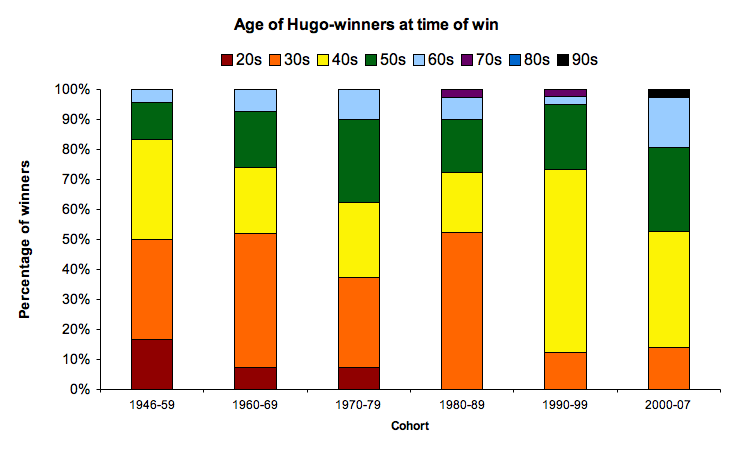
(For some reason, I couldn’t get Excel to export in colour. Don’t ask me why. UPDATE: New graph, courtesy Liz. Praise Liz!)
- In the first three cohorts, between 7% and 17% of Hugos for fiction go to people in their twenties; after that, none do.
- In the first four cohorts, between a third and half of Hugos for fiction go to people in their thirties; once you get to the nineties, that drops to less than 15%.
- The proportion of Hugos for fiction going to writers in their sixties is twice as high in the present decade as it’s ever been previously.
P.S. New site layout — good? Bad?
 vector-bsfa.com