Blindsight and Hard SF

So for a nontrivial chunk of the past 48 hours, I have been trying to write something coherent about Peter Watts’ latest novel, Blindsight. It’s a very good book, and there’s an interesting discussion of its central thesis here — though if you want to pick up a copy it’d probably be best to act sooner rather than later, since Blindsight‘s publication seems to be attended by the sort of fiasco that afflicted the first edition of The Separation. Writing about it is proving difficult, though, and that’s partly because it’s hard to summarise (as a review inevitably must) without compromising the intelligence and rigour of Watts’ story, and partly because one of the things I want to talk about, at least in passing, is what it means to say the book is “hard sf” — which it clearly is — and why the hardness of the sf is part of the reason the book succeeds. And I can’t quite find a way to say it.

So here, for your consideration, are some extracts of other peoples’ opinions about hard sf. We start with Peter Nicholls, in The Encyclopedia of Science Fiction (1993):

Item of sf terminology used by sf FANDOM and readers; it has sometimes overlapped in meaning with “hardcore sf”, often used in the 1960s and 1970s to mean the kind of sf that repeats the themes and (to a degree) the style of the GENRE SF written during the so-called GOLDEN AGE OF SF. Though still sometimes used in a way that implies the element of nostalgia associated with “hardcore sf”, the term “hard sf” now seems to refer to something rather simpler, as summarized by Allen STEELE (in “Hard Again” in NEW YORK REVIEW OF SCIENCE FICTION, June 1992): “Hard sf is the form of imaginative literature that uses either established or carefully extrapolated science as its backbone.” Steele goes on to regret the association in many readers’ minds of hard sf with “a particular political territory — usually located somewhere on the far right”, an association which, while certainly sometimes justifiable, has cultural origins that cannot easily be elucidated.

The thing to say here is that from a cold start I would have said that hard sf is one of the least political of sf’s subgenres, and certainly not predisposed to right-wing ideology; the prototypical hard sf writers in my mind, as a reader who came to sf in the UK in the 1990s, are Stephen Baxter and Greg Egan, with Kim Stanley Robinson’s Mars trilogy sitting as the prototypical example of political hard sf. Anyway, Nicholls continues:

The commonly used distinction between hard and SOFT SCIENCES runs parallel to that between hard and SOFT SF. […] But it is possible to write a kind of hard sf about almost anything, as can be exemplified by Brian M. STABLEFORD’s rationalizing treatment of vampires in The Empire of Fear (1988). Hard sf should not, however, wilfully ignore or break known scientific principles […] While a rigorous definition of “hard sf” may be impossible, perhaps the most important thing about it is, not that it should include real science in any great detail, but that it should respect the scientific spirit; it should seek to provide natural rather than supernatural or transcendental explanations for the events and phenomena it describes.

I basically agree with this. I have no idea whether, say, Ted Chiang considers his work to be hard sf, but I usually think of most of it as such, because even though the central ideas are often fantastical, the rigor with which their consequences are extrapolated seems characteristic of hard sf to me. But it’s not something that tells me much about the value of hard sf as a literary form; the reasons it’s written, the reasons it works.

(As an aside, vampires do seem to come in for the hard-sf treatment rather a lot; Blindsight also features them, and off the top of my head there’s also Octavia Butler’s Fledgling, Scott Westerfeld’s Peeps (I gather, though I haven’t read it), and Joe Ahearne’s 1990s tv series Ultraviolet, somewhat.)

Onward, then, to a datapoint from Gary K. Wolfe’s review of The Ascent of Wonder (ed. David G. Hartwell and Kathryn Cramer, 1994):

The debate over what is and isn’t hard sf probably dates back at least to Jules Verne’s famous put-down of H.G. Wells (“he invents”), but in recent years — with sf seeming to drift all over the literary map — it’s become the focus for arguments over the nature of sf in general. Neither the 1983 Eaton conference on hard sf (and the 1986 critical book derived from it) nor the special hard-sf issue of Science Fiction Studies in 1993 seemed able to arrive at any sort of consensus definition, and yet most science fiction readers would still argue that they know hard sf when they see it.

I include this mostly because it led me to the mentioned issue of SFS. The only substantive part of that online is the introduction, by David N. Samuelson, which says some things that I think have the ring of truth about them:

Barely recognizing the existence of hard SF, however, let alone its generating power, scholars and critics largely fail to deal with either the science or the rhetoric. Relatively ignorant of science, most of us are uncomfortable with it. Those who study SF prefer to deal with Delany and Dick, Le Guin and Lem, whose fictions are more congenial to literary concerns with subtle and plurisignifying characterization, structure, and style. It is perhaps no coincidence that literary critics, as specialists under fire both from outside and inside their own discipline, also favor SF which at least implies the decline of Western civilization. While I share many of their interests, I see attempts to restrict SF to these unrepresentative examples as reductionist and short-sighted.

Picking the flowers that smell sweetest inevitably severs them from their roots, ignoring not only the soil but also the fertilizers that enabled them to grow and blossom. Hard SF does not lack semiotic interest, but its codes and conventions differ from those most of us as critics are trained to understand and appreciate. Style tends to be more direct and limited in signification, characterization more deterministic, standards of judgment for behavior more relativistic.

This, of course, starts to take us in the direction of an “sf exceptionalism” argument: sf that isn’t doing what regular fiction does, and that should therefore not be judged (at least, not be judged entirely) by the same standards. To borrow an image from Blindsight, whenever this comes up I feel like a vampire looking at a Necker cube, in that I think I can see both sides of the argument at once. It seems utterly foolish not to recognise that a story like Baxter’s Ring is addressing concerns that can’t be wholly grasped with what we might call “standard” literary approaches; but at the same time, I’m quite comfortable with the idea that a book like Gwyneth Jones’ Life will acquit itself well whatever yardsticks you measure it by.

I don’t have a copy of The Ascent of Wonder, but I do have a copy of The Cambridge Companion to Science Fiction (ed. Edward James and Farah Mendlesohn, 2003), which includes an essay by Kathryn Cramer which quotes (presumably accurately) Hartwell’s criteria for recognising hard sf:

(1) Hard sf is about the beauty of truth … about the emotional experience of describing and confronting what is scientifically true. (2) Hard sf feels authentic to the experienced reader when the way things work in the story is scientifically plausible. (3) Hard sf relies, at some point in the story, on expository prose rather than literary prose, prose aimed at describing the nature of its particular reality. (4) Hard sf relies on scientific knowledge external to the story. (5) Hard sf achieves its characteristic affect essentially through informing, by being, in fact, didactic. (188)

This is starting to home in on the question of how hard sf actually works, although it’s worth noting that it only does so when you take all the criteria in combination; quite a large set of non-sf novels could be said to be “about the emotional experience of describing and confronting what is scientifically true”, for instance. Cramer also takes a historical perspective, and again talks about the intersection of politics and hard sf; I rather resented statements such as “And the hard sf attitude can be stripped of its scientific underpinnings until what remains is fetisihism — a love of hardware for its own sake — and the hard-nosed Ayn Rand voice that we now identify as libertarian,” although she does also cite David Pringle and Colin Greenland’s 1984 call for “radical hard sf”. I’m not saying that science isn’t a political enterprise, but I can’t see a useful description of hard sf that includes any particular political perspective; it’s surely an add-on.

Onwards! Hartwell and Cramer followed up The Ascent of Wonder with the 2002 anthology The Hard SF Renaissance, reviewing which John Clute commented on the alienating effect of the subgenre, harking back somewhat to the SFS introduction above:

There does seem to be something about problem tales that whiffs of favoritism. A hard-SF story tends to be constructed as a test of its protagonist’s ability to solve some life-threatening problem in a physical environment that has been constructed to offer a solution. To survive such a story is to win. So given the fact that hard-SF writers tend to create really smart characters they agree with and congratulate, the stories they write, these tales whose heroes are winners, tend to read as being boastful. It is a kind of cronyism. It is what makes the beauties and ardors of the best hard SF so difficult for “outsiders” to appreciate, because outsiders (I include myself) tend to feel — perhaps when they do not understand the physics of a hard-SF story, or when they sense that the author has skewed his universe to generate an outcome possible only in a universe so skewed — that they have been failed by the tale, that they have been Disappeared from the author’s world.

Compare this to Hartwell’s criterion 4 above — “Hard sf relies on scientific knowledge external to the story”. Well: to a greater or lesser extent, a lot of it does. Is this a bad thing? I’m not sure it is; to be blunt, the sort of scientific knowledge assumed is usually the sort of thing I would expect most vaguely intelligent adult readers to be familiar with, and if they aren’t I’m not sure it’s the fault of the story. (Which is not to say, of course, that there isn’t hard sf that explains itself badly or insufficiently; but I don’t think it’s so common as to account for the “outsider” position. But then, I’m an insider, so I would say that.) And again, to a certain extent I’m left with the sense that everyone else has read a different body of hard sf than I have; it’s not clear to me, for instance, in what sense most Stephen Baxter or Greg Egan protagonists “win”, since I tend to think of hard sf stories as being about seeking-after-knowledge rather than surviving, and quite often the former trumps the latter.

But from later in the review, this I agree with wholeheartedly:

It is almost an Emperor’s Clothes sort of thing: It is as though everybody in the field pretends not to notice how really depressed most hard SF is, how seriously lacking in affect are most of its protagonists, how lassitudinous are the worlds these protagonists inhabit and transform. Almost every single inhabitant of the modern American hard-SF story seems to be suffering from gray-out, from a subacute depressive condition escapable only through occasional spasms of problem-solving.

If only because it’s one of the things Blindsight addresses most thoroughly. Somewhere in its characters’ ancestral lineage there are Shapers and Mechanists — or Forged; I was reminded quite strongly of the Voyager Lonestar Isol from Justina Robson’s Natural History, whose mind is adapted for deep-space travel in ways that make her, in our terms, insane. The logic is the same in both books, which is that, in terms of what we know about space, and what we know about humans, space does not make a good or natural venue for human stories; and since space ain’t gonna change, we have to.

Lastly, we come to James Gunn on “The Readers of Science Fiction” (from Speculations on Speculation, 2005), who says some things I agree with absolutely:

The insistence that emotion derives from the intellectual in science fiction often confuses the discussion, as if the heart and the mind actually were the location of the humours attributed to them rather than part of a gestalt. An emotional response often is irrational, but a rational response is not always dispassionate. As an example we need only think of Archimedes shouting, “Eureka!” and leaping from his bath to streak the streets of Syracuse. (82)

Although he is also far more bullish about the question of reader-response than I could be:

“The Cold Equations” could have been told only as science fiction, not because the point of the story is science fiction but because every other situation retains an element of hope for rescue. In a contemporary lifeboat story or a story about wagon trains crossing the plains, the sacrifice of an innocent stowaway to save the lives of the remainder brings up images of the Donner party: the point of those stories would be the survivors’ lack of faith and their love of life above honor. Science fiction gave Godwin an unparalleled opportunity to purify the situation in such a way that there was no hope left for last-minute salvation, no possible sight of land or rescue ship, no company of soldiers to ride over the hill. The girl is to blame for her own predicament, her innocence is irrelevant, the universe doesn’t care about her motives, and the others would be as guilty as she if they compounded her fatal mistake by dying with her. The reader who does not understand this has not read the story correctly. The intellectual perception that the girl must die produces the emotional response the reader gets from the story. Perhaps the point of the story is science-fictional after all; where else would such a point be made; by what other audience would it be understood? And considered satisfying? (83-4)

Where does this leave me with Blindsight? Well, I’m still not sure, which is one reason I’ve been writing this post rather than my review. I think part of it is exactly that it doesn’t have the sense of being rigged that Clute talks about above. It has the sense of starting from a set of axioms and inexorably plotting out the consequences; the remorselessness of the possible (hey, I like that) — which I guess takes me back to the adherence to “scientific spirit” that Nicholls describes, or, to frame it in other terms, Blindsight is a book that admits fewer of the conveniences of stories. I don’t know whether I could describe it as “honest”, but it is resolutely not consolatory; and that’s always a powerful thing to read.
One More Quote

Saxon Bullock on Torchwood, Russell T. Davies and sf:

It may say science fiction on the tin, but Torchwood so far has only been as much sci-fi as the new relaunch of Doctor Who has been — i.e., not very much. RTD may love the paraphenalia of sci-fi, but he’s got absolutely no interest in it as a mode of storytelling, and most of the sci-fi devices in Torchwood could be shifted into the realm of ‘magic’ with very little effort. More than anything else, this mode of storytelling is all about avoiding the kind of dislocation that’s at the heart of normal sci-fi — instead, it’s all about emotionalism, wish-fulfilment, and confronting the issue-of-the-week. This has manifested itself in a number of dodgy ways (the supposedly hilarious sequence where the character Owen uses an alien spray that essentially magnifies the ‘Lynx Effect’ up to levels where the phrase ‘date rape’ wouldn’t be completely inappropriate), but it’s also showing up that, at heart, there’s not very much so far that seperates out Torchwood from its influences. With Doctor Who, RTD was performing a relaunch — and as a result he had a history he could play with, things he could react against, and a whole public perception that he could manipulate to his own ends. Now, whether or not I agree with what he did, I think the main trouble with Torchwood is that he’s starting from scratch, and his magpie habits are showing through too strongly.

Articles Online

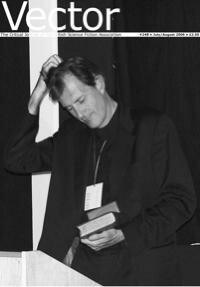
To round off a week of posts made up of other peoples’ words, here are some articles and reviews from the most recent Vector. If you’re a member and still haven’t received this mailing, plans are afoot to get you a copy, but we need to make sure we’ve contacted everyone who might be missing it first. Also, please note that the magazine website URL has changed slightly: it’s now www.vectormagazine.co.uk (no hyphen), so update your bookmarks. On with the show:

Paul Kincaid considers the Clarke Award Twenty Years After:

We didn’t know what we were doing.

Or, to be fair, we knew what we wanted to do. We just weren’t too clear about how to go about achieving it.

The goal was to promote British science fiction. That was the aim laid down by Arthur C. Clarke when Maurice Goldsmith approached him for funds. What that might entail was less clear. A new magazine? But there was already Interzone. So, an award? But there was already the BSFA Award. Would a juried award be different enough? But if we are promoting British science fiction, should this be an award for British sf only? At the time that was unrealistic. Besides, how do you promote British science fiction by fencing it off from the whole of the rest of the world?

Andy Sawyer takes an in-depth look at the winner of this year’s Clarke Award, Geoff Ryman’s Air:

Air took the award, of course, and this means that the science fiction writer, as opposed to the “mainstream” writer with something which looks like science fiction, was the success. In what follows I am, I hope, going to suggest why I feel uncomfortable writing a sentence like that, but also why it’s good for both the Clarke award and that collection of extremely different texts that we point to and call science fiction that it was Ryman who won the award.

Kevin Brockmeier’s The Brief History of the Dead reviewed by Claire Brialey:

In the beginning is the city. Although you might not call it the beginning, or the end, or either customary combination of the two. But there is a city, and it is where people go when they die — at least for a time. Literally, at least, it is an afterlife, but it is not a mythic existence; in the city, people are still people and they still think and feel and behave and –— to all intents and purposes — live as people do in cities everywhere.

James Morrow’s The Last Witchfinder reviewed by Dave M. Roberts:

It is now almost seven years since James Morrow completed his Godhead Trilogy, which took on the death of God and its implications as its subject matter. The Last Witchfinder, his first novel since then, is no less ambitious, taking on the battle between scientific reason and superstition and fear of the unknown.

Robert Charles Wilson’s Spin, reviewed by Gary Dalkin:

One night a few years from now the stars go out. Or so it appears to three young people in the garden of ‘The Big House’ in Washington DC. Jason and Diane Lawton are 14, their father a pioneer in a fledgling communications technology and junior Washington power player. Together with Tyler, son of E. D. Lawton’s former business partner, the trio are inseparable. Narrated by Tyler, Spin chronicles the complex relationship between the three over the next several decades and three billion years.

Next week I’m on holiday, so I might have time to actually write some words of my own.

Convoy Cancelled

Convoy, the 2007 Eastercon, has been cancelled. There’s a brief statement on the website:

The committee of the 2007 Eastercon regrets to announce that Convoy cannot now be held at the Adelphi, and that membership fees will be reimbursed by the beginning of December 2006 to those who had joined the convention.

But that’s all anybody seems to know at the moment. The guests of honour for Convoy were going to be Judith Clute, Peter Dickinson, Robin McKinley, and Sharyn November.

Discuss

This book arrived yesterday, and I spent the better part of yesterday evening, when I should have been doing any number of other things, nosing through it. Here are some of the things I found.

From Paul Kincaid’s introduction:

It is what was left to the jury that has made the Arthur C. Clarke Award both idiosyncratic and controversial, often at the same time. At no point did we decide what was meant by ‘best’, by ‘science fiction’, or even by ‘novel’. Consequently, the jury meetings I’ve taken part in have featured some very lively debates on each of these topics — and no two juries have ever arrived at precisely the same definitions. (12)

(So it shouldn’t be a surprise that a lot of the essays spend some time debating what sf is and does.)

From Justina Robson’s essay on Take Back Plenty (1990) by Colin Greenland:

And there is a final reason not to dismiss Take Back Plenty as less than a revolutionary book. As fantasy is in constant relationship with folktale, so science fiction is in a constant relationship with the history of rational thought. Take Back Plenty follows on from a long dialectical tradition. Like other books of its kind it doesn’t accept the old-order notion, born from religious origins, that humans are clawing their way up a ladder of incremental progress to greatness, or the stars. That core theory and its various miserable brides — the worship of reason over empathy, the position of humans at the summit of a fictitious world order, the belief in the imposition of systems and theories as pathways to moral improvement, the reduction of all calculations to mathematics, the idea of humanity as a single entity — are here subjected to the casual drubbing they deserve. (72-3)

From Adam Roberts’ essay on Fairyland (1995) by Paul J. McAuley:

Fantasy is premised on magic, the supernatural, the spiritual: it articulates a cosmos as a divine quantity, as does religion. The relationship between the individual and the universe in religion is an ‘I-Thou’. That same religion universe [see comments], under the logic of science, is an ‘I-It’. Science fiction, which unsurprisingly begins when ‘science’ begins, is premised on a material, instrumental version of the cosmos. Fantasy happens in Dante’s solar system; sf in Copernicus’ and Kepler’s — indeed, Kepler is the author of what I take to be the first sf novel (the trip-to-the-moon speculation Somnium, published posthumously in 1634). I date the rise of sf from this period, and I see it as no coincidence that it happens about the same time that the effects of the Protestant Reformation established themselves in Europe. Without wishing to be sectarian, I’m fond of using ‘Catholic’ as a descriptor of fantasy: the boss text of fantasy in the twentieth century, The Lord of the Rings, is, amongst many other things, a great Catholic book. ‘Protestant’ writing, on the other hand, was (slightly) more amenable to the new scientific thinking about the cosmos. (119-20)

From Farah Mendlesohn’s essay on Dreaming in Smoke (1998) by Tricia Sullivan:

One of the things that makes cyberpunk distinct from hard sf is that it is the work of what we might call the users rather than the creators of a technological society.

[…]

The age of transparent technology has disappeared in Western Europe and North America. Most of us open the hood of our car to discover a sealed plastic lump. We can no longer play with the material of our world. Apart from perhaps explaining why our Physics and Engineering departments are full of people from parts of the world that still rely on what we might call accessible technology, it also helps explain what cyberpunk is.

Cyberpunk is the science fiction for a generation for whom Clarke’s Law — that any sufficiently advanced technology is indistinguishable from magic — has come true in ways that Clarke did not envisage. It is not the technology of the future that seems magical but that which we work with today. Cyberpunk is the literature of the generation that can move effortlessly through the lit house, but can’t fix the fuses because they’ve all been fitted with a ‘replace after failure’ blue plastic box. (157-8)

From Graham Sleight’s essay on Distraction (1999) by Bruce Sterling:

Secondly, what Sterling really wants to talk about is his future. This is, it has to be said, not a very popular option for sf writers these days. (Judith Berman’s influential essay, ‘Science Fiction Without the Future’, which Sterling has called ‘probably the most important piece of science fiction criticism in the last ten years’, sets out this case in detail.) More and more, science fiction novels want not to be science-fiction novels. They want to be parables of gender or race, or horror novels with ray-guns, or VR fantasyland adventures. To be clear, I don’t have a problem with any of these approaches: they have produced many fine works, several of which join Distraction as Clarke Award winners. But they use the tools and tropes of sf as means rather than an end. The single most striking feature of Distraction is that it wants to be nothing other than an sf novel. (168)

And there’s much more where that lot came from.

Living Next-Door To The God Of Links

Blogging continues to be light around these parts. In the meantime:

EDIT: Good lord, already? Rich Horton has started posting his annual magazine summaries: Asimov’s, Analog, and F&SF. Interesting that the general opinion seems to be that F&SF has pulled away from Asimov’s again; I actually thought the two magazines were more evenly matched than they’ve been for a few years. But then, I’ve been cherry-picking what I read, not going through every story.

Socialism and Social Critique in Science Fiction

A little while ago, we were contacted by Socialism and Democracy about a potential ad swap to highlight their latest issue, which focuses on sf. It didn’t work out because of the timing of the print deadlines, but they very kindly sent me a complimentary copy. The introduction to the issue is available online:

This whole range of potentially subversive processes is grounded in the experience incisively identified by Darko Suvin, more than thirty years ago, as cognitive estrangement. Works conceived in this tradition are the ones in which we find promise. The character of such works, as Carl Freedman has written, “lies neither in chronology nor in technological hardware but in the cognitive presentation of alternatives to actuality and the status quo.” Insofar as we focus on this dimension of science fiction, we encounter a body of work with obvious relevance to the concerns of socialists. This link has been expressed historically in many ways. One striking instance of it, noted by Suvin, is the presence, at key points in Marx’s writings, of figures like vampires, monsters, sorcerers, and specters. The point here is perhaps that even in the most materialist of analyses, there needs to be a vocabulary to encompass the dimensions of behavior that appear, from one limited class-perspective or another, to be beyond the range of calculable human intervention. Beyond this, though, there is a long and proud tradition of consciously radical SF writing or storytelling, some of which is discussed and illustrated in articles in this collection.

And here’s the table of contents:

Issue #42 (Vol 20, No. 3)

  • Preface by the Editors
  • Science Fiction as Popular Culture: A Sense of Wonder by Yusuf Nuruddin
  • Introduction by Victor Wallis

Radical Readings

  • Steven Shaviro, Prophecies of the Present
  • Carl Freedman, Speculative Fiction and International Law: The Marxism of China Mieville
  • Lisa Yaszek, Afrofuturism, Science Fiction, and the History of the Future
  • Alcena Madeline Davis Rogan, Alienation, Estrangement, and the Politics of “Free Individuality” in Two Feminist Science Fictions: A Marxist Feminist Analysis
  • Dennis M. Lensing, The Fecund Androgyne: Gender and the Utopian/Dystopian Imagination of the 1970s
  • Jonathan Scott, Octavia Butler and the Base for American Socialism

Politics & Culture in the US

  • Yusuf Nuruddin, Ancient Black Astronauts and Extraterrestrial Jihads: Islamic Science Fiction as Urban Mythology
  • Marleen S. Barr, Science Fiction and the Cultural Logic of Early Post Postmodernism
  • Robert P. Horstemeier, Flying Saucers Are Real! The US Navy, Unidentified Flying Objects, and the National Security State

Technological Futures

  • Sherryl Vint and Mark Bould, All That Melts Into Air Is Solid: Rematerialising Capital in Cube and Videodrome
  • Michael G Bennett, The Adoxic Adventures of John Henry in the 21st Century

Reviews

  • Fredric Jameson, Archaeologies of the Future: The Desire Called Utopia and Other Science Fictions reviewed by Alcena Madeline Davis Rogan
  • Sheree Thomas, ed., Dark Matter I: A Century of Speculative
    Fiction from the African Diaspora
    ; Sheree Thomas, ed., Dark Matter: Reading the Bones; and Nalo Hopkinson and Uppinder Mehan, eds, So Long
    Been Dreaming: Postcolonial Science Fiction and Fantasy
    reviewed by Yolanda Hood
  • Andrea L. Bell and Yolanda Molina-Gavilan, eds, Cosmos Latinos: An Anthology of Science Fiction from Latin America and Spain reviewed by Aaron Dziubinskyj

Some interesting-looking articles there.

In Brief

Here’s the terrible secret about this blog: the posts don’t just happen. They are planned. I don’t usually read a story, or a book, or watch a film or a tv show, and think, “hey, I want to write about this”. Sometimes that happens — it did with Children of Men, for instance — but those are the exceptions. More often, I’m on the lookout for things I want to write about. Recently, though, my plans have all come to nothing, or at least not very much. What follows are some fragments of aborted posts on some not-as-interesting-as-I’d-hoped failures: some stories, a film, and a tv show. (I’m really selling this, aren’t I?)

“Chu and the Nants” and “Postsingular” by Rudy Rucker

Inspiration is a tricky thing, especially when publicly acknowledged. When, a few years ago, Paul di Filippo wrote Fuzzy Dice, a novel inspired by and intended as a tribute to Rudy Rucker’s tremdous, barmy, transreal exploration of transfinite mathematics, White Light, it seemed somewhat miraculous that he pulled it off: his novel was just as tremendous as, and arguably even barmier than, Rucker’s. More recently, Rucker has in turn been inspired, as he acknowledges in the headnotes to the Asimov’s appearances of these two stories, and in a more-or-less loveletter to the book in question published in the November 2005 NYRSF. But while you can see how di Filippo got from White Light to Fuzzy Dice, if I didn’t know Rucker’s inspiration was Charles Stross’s Accelerando, I don’t think I’d have guessed the lineage. The two writers tell their stories in very different ways.

So far, whatever it is that Rucker’s up to is not very exciting. “Chu and the Nants” and “Postsingular” (note that both links are to excerpts, not complete stories) are set in the same future history. The former is backstory to a forthcoming novel, Postsingular, and explains how a nanotech singularity gets reversed by a clumsy plot gimmmick; the latter is part of the novel, and dramatises a rather more novel singularity, involving the overlay of a digital realm onto the physical, thanks to what amount to smart nanotech tags, which are the sort of thing I’m sure I’ve read Bruce Sterling enthusing about at some time or other.

Rucker’s plainspoken, laid-back style is almost the polar opposite of Stross’s data-dense lingo; if anything, these stories feel more like the work of Cory Doctorow, or like descendants of Vinge’s “True Names”. Which is fine, except when plainspoken becomes simply flat, and it too often does: the explanatory digressions are thinly veiled, and most of the characters are just thin. Ond, the (anti)-hero engineer at the centre of both stories, has motivations that are simplistic at best, and simply embarrassing at worst (his big realisation that bringing on the singularity might not have been a great idea comes when his wife starts electronically cheating on him); and most of the female characters are shrill, except when they’re being stupid. Neither story has the energy or the charm of White Light, and the ideas in them feel tame and familiar, even when they’re not. Probably the most interesting thing about the stories (aside from the use, or possibly invention of, increasingly improbable SI prefixes) is their embrace of the “postsingularity = magic” idea: in “Chu” a computer program is described, with very little irony, as a magic spell, while “Postsingular” features more spells, heaven, and some angels. But the whole enterprise has the sort of curiously weightless feeling that Accelerando was (mostly) notable for avoiding, and doesn’t inspire great confidence in the novel.

Death of a President

Death of a President is the second speculative docudrama about the US that I’ve seen this year, the first being the lower-budget, but more ambitious and more successful, C.S.A.. Writer-director Gabriel Range spins a tale that does exactly what it says on the tin: relates the circumstances surrounding, and the fallout from, the assassination of President George W. Bush in Chicago (which city is lovingly captured in a series of sweeping establishing shots) on October 19, 2007.

The first part of the film, which portrays a Presidential visit that meets with widespread protest, is good. It perhaps tends somewhat towards the hysterical, but arguably that’s necessary to set up a situation in which it’s plausible that the secret service would lose control. The second part of the film, which focuses on the fallout, is much less good, because the only part of the fallout it focuses on is the investigation into whodunit, and because that investigation is about the most predictable and politically heavy-handed you can imagine. A series of archetypal suspects — in particular, the shifty, pasty white man; the black man who may or may not have just been in the wrong place at the wrong time; and, of course, the Syrian — are wheeled out in turn, and I suspect it’s not spoiling anything if I tell you that the last of those three is subjected to a hasty, shoddy trial and a conviction that subsequently turns out to be a mistake. (The identity of the actual assassin is about as big a cop-out as I can imagine.) In the background, Cheney ascends to the Presidency, rattles some sabres, and gets PATRIOT 3 passed, but otherwise seems to do remarkably little. Range is entitled to tell the story he wants to tell, of course, but I can’t help thinking that a slightly broader perspective would have made for a much more interesting film.

Torchwood

What struck me most about Torchwood was how normal the normal bits are. For all the fuss made about the incorporation of Rose’s family into the Russell T. Davies incarnation of Doctor Who, the Tylers and their friends always felt to me like a tv family. By contrast, Gwen, her colleagues and her boyfriend seemed a bit more grounded. Admittedly, part of this perception is probably due to the fact that some of Gwen’s mannerisms and dialogue reminded me alarmingly of someone I knew at university; but even allowing for that, the scene (for example) where Captain Jack takes Gwen for a drink had a sort of incongruous meeting-of-worlds feel to it that recent Who only managed once or twice in two seasons.

As I’m sure most people reading this are more than well aware by now, I haven’t been overly impressed by new Who. It’s had its moments — mostly involving scripts by Steven Moffatt — but not many of them, and they’ve been almost lost in the general mediocrity and occasional outright amateurishness. But I’ve liked much of RTD’s other work (particularly The Second Coming), and wondered whether he might do better starting a show off from scratch. The other notable thing about Torchwood, though, is how much it doesn’t start from scratch. Its genetic makeup seems to be (even leaving aside the elements taken from a certain well-known show) about 10% Doctor Who, 5% Spooks (mostly the soundtrack), 30% Men in Black, 10% Generic British Drama, 5% Buffy, and 40% Angel.

The second episode (the Chris Chibnall-scripted “Day One”), in particular, had an Angel vibe about it — not, as some have said, for the loose similarities the plot bore to “Lonely Hearts” (the similarities were there, but they were very loose), and not particularly in the tone, but rather in the general structure of the show, and the sense of what it was trying to do. Captain Jack has been reinvented, consciously or not, as a more Angel-esque figure: invulnerable, somewhat more brooding, prone to standing on high buildings staring out over “his” city, and power-walking through the opening credits in a long flowing coat. The story took a fantastic element and used it as a metaphor for an aspect of human experience (Modern Life Is Sex); and Jack’s sidekick Gwen, while more of a viewpoint character than Cordelia ever was, offers the same sort of connection-with-common-humanity that the Queen of Sunnydale High provided for Angel. At one point in “Day One”, Jack asks Gwen to tell him “what it means to be human in the 21st century”, which as mission statements for tv shows go is surely ambitious enough for anyone.

The problem for me is not so much that Torchwood‘s influences are so obvious, but that they have been followed in their flaws as well as their virtues, without any real thinking-through. For one thing, the writers seem to be of the “sf doesn’t need consistent plotting” school; and to continue with the theme, Joss Whedon isn’t the strongest plotter in the world, either, but he tends to be much, much better at papering over his holes than RTD or most of his team. Nor do these writers have Whedon’s skill at fleshing out secondary characters: Toshiko and Owen remain cutouts. And the whole of the UK seems to indulge in the sort of mass-denial of alien existence that would put Sunnydale to shame — and as Martin Wisse notes, that kind of denial doesn’t really play in a science-fiction world, particularly on the sort of scale it’s used here. Torchwood may yet develop its own identity — it took Angel almost a season, after all — but at the moment it’s not even close to being a must-watch.

EDIT: Discussion of this post seems to be happening on the lj feed. Which, of course, means it’ll vanish into the ether in about three weeks. Sigh.

London Meeting: Rhiannon Lassiter

The guest at tonight’s BSFA meeting is Rhiannon Lassiter, who will be interviewed by Farah Mendlesohn. Farah says, “Rhiannon Lassiter has been writing sf and fantasy for children and teens for almost a decade. Her sf series Hex is weird and futuristic. Her sf/fantasy crossovers, Borderland, Outland and Shadowland dicuss colonialism, postcolonialsm and Borges. She also writes about superheroes.”

As usual, the meeting will take place in the upstairs room of the Star Tavern in Belgravia (there’s a map here) and people will start gathering from 5.30 or so.

The London Meetings are free to any and all who are interested, whether BSFA members or not. (And there’s a book raffle.) See you there?

Attention BSFA Members

For those of you reading who are actually BSFA members, an important announcement: a chunk of the last mailing (with the Clarke Award issue of Vector) seems to have gone missing. As Peter says:

We therefore urgently need to know which members have received their magazines and which haven’t. If you are not among the 20 or so members who have already let us know, please could you therefore email us, giving your name and (if you have it available) your membership number and whether or not you have received your magazines. If you know any other BSFA members who are unlikely to see this message, please could you also ask them to contact me or one of the other BSFA officers with the same details.

We may also be contacting some members directly over the next few days, particularly ones where the information might give us a clearer view of which members have received their mailings and (in particular) which probably haven’t. We will, however, try to make sure that if you have already been in touch with us about the mailing, we don’t ask you for the information again. But even if we don’t contact you, please do contact us – so we can work out how many members haven’t received the mailing and just who they are.

Note that we want positive and negative datapoints; we need to know the extent of the problem.