The great Jeff Noon will be getting grilled by Matthew de Abaitua in London on 23rd August. All welcome (even non-members). For more information on this and future BSFA meetings, see the BSFA website.

The great Jeff Noon will be getting grilled by Matthew de Abaitua in London on 23rd August. All welcome (even non-members). For more information on this and future BSFA meetings, see the BSFA website.
This revolution in production and distribution gives us, the reader, unfettered access to filth but it also allows publishers to print ultra-niche products and still find an audience.
Martin Lewis, ‘First Impressions: The Book Review Column’
Another scene that would be read as mystical or magical, is the initiation ceremony where Eyvind becomes a Wolfskin, and again I’ve tried very hard not to spell out what happens in that scene. While there is something that is supremely mystical and life-changing, I don’t spell out how much of it is physically real and how much of it is in his head. Even towards the end, where the magical harp plays its music, I’ve tried not to say how it sounds, just that it’s different for each person. It’s not overtly magical, but that magical thread is there throughout.
Juliet Marillier
Litt, on the other hand, made the familiar argument (hey, I’ve made it myself enough times) that fantasy and horror is the tradition, and realism the genre-come-lately. I suspect the fantastic as a term does not make sense until you get a highly developed notion of imitative realism to contrast it with, but I more than take his point. He also riffed nicely on the engraving with the words “the sleep of reason produces monsters,” and discussed the monsters of reason, reasonable monsters. He, like the chap from Time Out, seems to be labouring under the misapprehension that science fiction is about the future, which I don’t find convincing. And because science fiction actually has a rather poor record when it comes to prediction — stopped clock being right twice a day — it only allows you to dismiss the genre. He rightly notes the technomelancholia in Gibson, but melancholy is there in many sf writers, especially the new wave and post-new wave — in particular post-imperial melancholy. Indeed, one of the tones of cyberpunk is nostalgia.
Andrew M. Butler


I fervently hope that the attitude displayed by my previous article for Vector was not that of an embittered, ‘alf-arsed, unsuccessful, menopausal, hard-drinking, drug-taking, chaotic-rather-than-anarchistic, sexually frustrated, mixed-up-never-had-a-decent-teenage, half-and-self-educated, ivory-tower, fascist-middle-class-Bolshy-uptight-aggressive, dilettante, feminist, lesbian, Outsider, misfit, sour-grapes, never-even-had-a-slice-of-the-cake-never-mind-the-whole-bloody-cake, insufficient-self-sufficiency-freak, would-have-been-a-hippy-except-she-was-stuck-with-kids-on-a-housing-estate, been-through-the-mill-and-came-out-milled, doesn’t-give-a-fuck-about-the-proles, Hitler-must-have-been-okay-kids-and-animals-adored-him, talks-to-plants-they-are-the-only-people-who-understand-me, hide-her-head-in-the-sand-it’s-awful-out-there-and-my-bum’s-worth-viewing, apathetic, sit-on-the-fence, apolitical, mystical, nothin-better-to-do-than, why-doesn’t-she-get-a-decent-job, when-I’m-dead-‘they’-will-make-a-fortune, mere-self-indulgent-self-seeking-sensualist, pie-in-the-sky-dreamer, if-she’d-really-suffered-she-wouldn’t-have-time-for-all-that-psycho-surreal-crap, champion-of-lost-causes-better-lost, lives-in-her-own-world, put-on-dressed-as-sham, atavistic, anti-technology, unrealistic, pretentious, portentous, superior, writes-hairy-things-which-would-benefit-from-Occam’s-razor, obscurantist, Madame-Ovary-hides-again, can’t communicate-with-the-masses, thinks-the-world-owes-her-a-living, intellectual-bluestocking, dumb-woman-Chip-Delany-on-shoulder, penis-envying, message-carrying-nothing-relevant-to-say-really-writer sort of person, because, although all of the above descriptions have been made of me at one time or another, and many of them were, are or will be in some measure true, depending upon the point of view, none of them is all of the picture, but they also describe not only myself but all science fiction writers and readers. That above sentence incidentally is not my longest to date; I think the longest counted was 497 words counted by some angry reviewer with a short-attention span but time to count words who was delightfully misprinted as stating that one of my sentences contained ‘497 worlds’ — pretty good going for any science fiction writer. And the reason also for the fervent hopes at the beginning of this article is because, even if most of Science Fiction fandom either disclaims me or has never heard of me, I wish to be recognised as and am, one of the boys – er – sorry, club.
Josephine Saxon
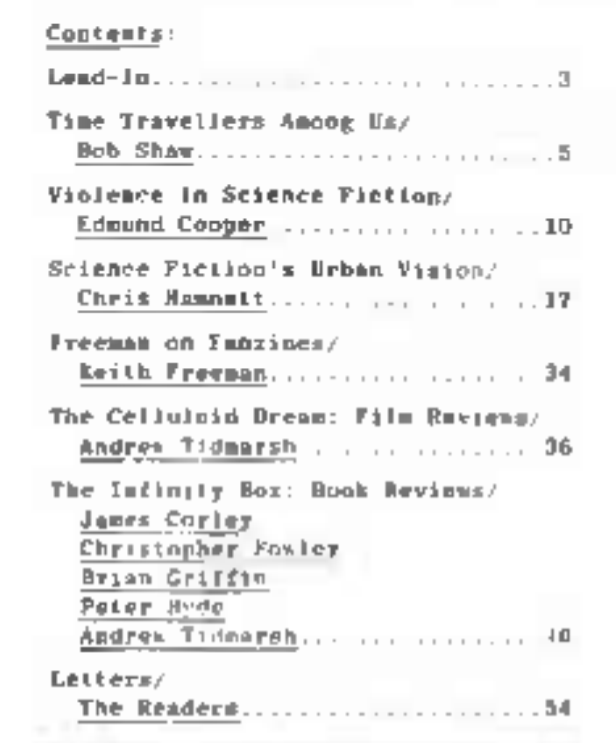
What do we mean by violence? One might paraphrase Bertrand Russel: I am firm, you are aggressive, he is dangerously violent. One has to think in terms of some definition that means something to you that means something to me also. After all, we’re dealing with an[?] abstract noun. I really like abstract nouns, they’re very, very nice: they earn me money. Truth, beauty, honour, integrit, love – all abstract nouns. We now add violence. Good, let’s consider some concrete examples of violence; let’s bring the concept down from the realm of abstraction into the world of reality. One example of violence – let’s make it topical – an American airman in a plane over Vietnam. He presses a button at a given point, down goes the napalm, whether it’s the Vietcong who collect, whether it’s the Vietnamese who collect, it’s the people who collect. The result of pressing the button up there is violence, down there. Another example of violence, and, it seems to me, a rather different kind: a soldier with a fixed bayonet. He’s on a battlefield: his opponent is right in front of him, and with his fixed bayonet, he disembowells his opponent. He sees the blood and guts spill out.
[…]
There is a third kind of violence that one might consider – people will probably argue later. I think I’d describe it as ritual violence. In a repressive state, for example – you can argue about this later: Russia? South Africa? Greece? – the violence imposed by the state has a ritual attached to it. In a country where capital punishment exists, for example, and somebody commits a murder and gets the chop, that is also a form of ritual violence. But we also have milder examples of ritual violence nearer home – after all, what else is soccer, rugby, boxing, wrestling – a ritual violence. It’s one that has its own kind of codes, its own kind of rules, it’s indulged in as a sort of spectacle sport.
Edmund Cooper
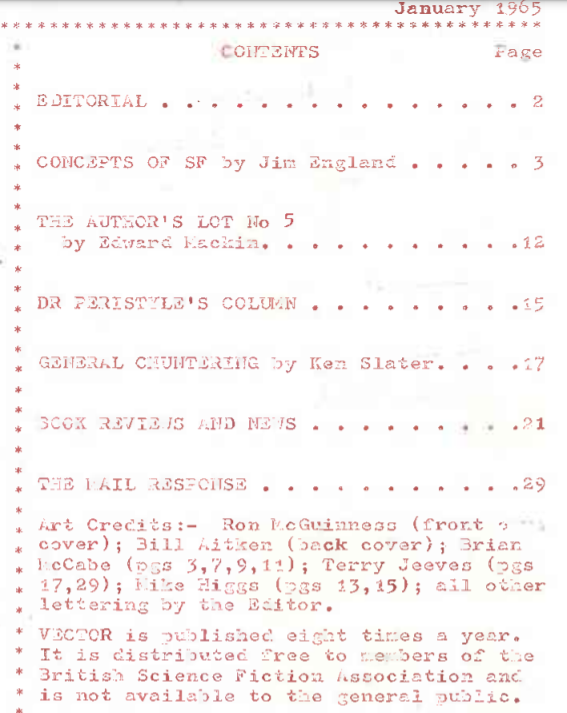
Some science fiction authors and editors are fond of saying that many of the things we are now familiar with were prognosticated by SF authors years in advance. The atomic bomb is often quoted as an example. The submerine and artificial satellite are others. The communication satellite was prognosticated by Arthur C Clark as long ago as 1945, and the inventor of the flexible submarine tanker actually got his idea direct from Frank Herbert’s UNDER PRESSURE (THE DRAGON IN THE SEA). What seems to be forgotten is that, with very few exceptions, SF writers and readers have done little or nothing to make such prognostications come true. Furthermore, a cynic could argue that if one makes enough prognostications, a few of them are almost certain to come true, and there is cause for surprise, not in the fact that so many of them have come true but in the fact that so few of them have. Neveretheless, if we were to examine all the concepts of SF over the past few decades, we would surely find a few needles in the speculative haystack – a few concepts that are useful and can be shown to be useful, a few prognostications that can be helped to come true.
Jim England
 vector-bsfa.com