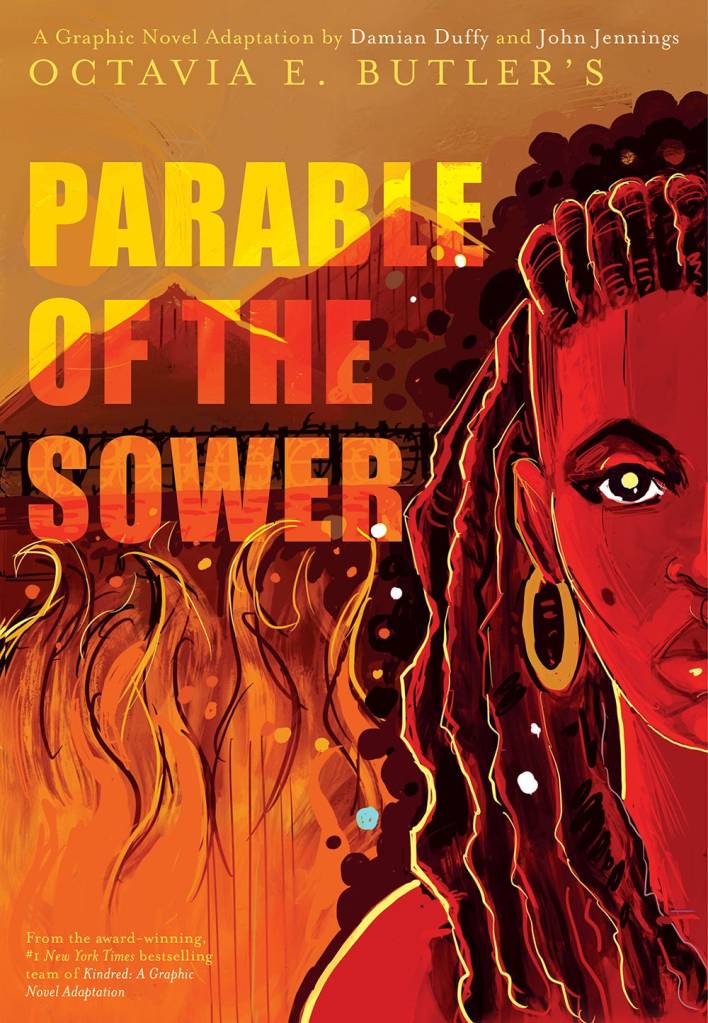
This academic article explores Octavia Butler’s 1993 novel Parable of the Sower and its 2020 graphic novel adaptation by Damian Duffy and John Jennings. It analyzes the medium-specificity of the adaptation by applying a combined theoretical approach that incorporates cognitive narratology and narrative empathy. A discursive dialogue between the two media facilitates a critical evaluation of the potential for Parable to evoke character empathy leading to prosocial action. The prescient themes in Parable, and the timing of the adaptation’s publication facilitates informed ongoing dialogue around change.
Review: This article underwent editorial review from two editors.
“This book lives. It breathes, moves, feels, clamors for your attention, insists on bearing witness, insists on being heard,” declares Nalo Hopkinson in her introduction to Duffy and Jennings’s (2020) graphic novel adaptation of Octavia Butler’s Parable of the Sower. After decades hovering conspicuously on the periphery of literary acceptance, science fiction and graphic novels refute their much-maligned reputations, and produce an alternative canon by joining forces. Narratives of space exploration, time travel, aliens, and meta-human superheroes disturb the grand narratives because they employ such tropes to explore the notion of the ‘other.’ Challenging the presumptions of texts that adhere to the model of white Western hierarchy, many contemporary speculative fiction narratives stage encounters between vastly different perspectives and cultures, and give agency to the ‘other.’
Octavia Butler’s Parable of the Sower (1993)
Graphic novel adaptation by Damian Duffy and John Jennings, with an introduction by Nalo Hopkinson (2020)
An early and powerful influence on Afrofuturism, award-winning author Octavia E. Butler (Womack 2013, 109) proposes a more diverse future through her palimpsestic style of rewriting narratives of race, gender, and disability, thereby challenging the status quo and repositioning previously sidelined characters center-stage. By defamiliarizing human experience, by blurring the lines of ideological expectation, and by broadcasting survival strategies that necessitate major, almost impossible change, Butler complicates the concept of ‘othering’ whilst evoking feelings of empathy for her characters. Suzanne Keen’s (2015) theoretical model of authorial strategic empathy, particularly “broadcast strategic empathy,” is the touchstone for demonstrating how Butler evokes empathic responses in her readers. Since reading is a cognitive action, I combine elements of David Herman’s inquiry into cognitive narratology and Suzanne Keen’s research into narrative empathy to shine light on Butler’s work and its enduring relevance. The remediation of this speculative fiction text into the graphic novel medium, with its metamorphic affordances, facilitates more explicit readings of the tropes of change in Butler’s Parable of the Sower, and opens up empathic dialogue about the medium-specificity of re-reading such a powerful narrative.
Reviewed by Shellie Horst. This review first appeared in The BSFA Review.
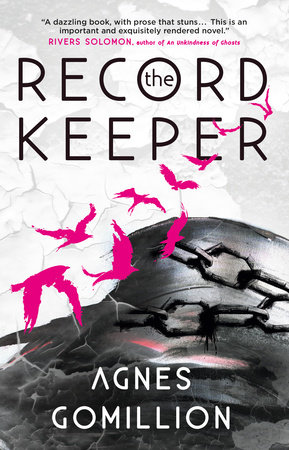
In the acknowledgements, Agnes Gomillion gives credit to Paul Stevens ‘for finding value where others did not.’ I for one am thankful that someone did see a future for The Record Keepers. My only disappointment is that it’s taken me so long to discover it. She also acknowledges Mr Frederick Douglass, from this you can be reassured that The Record Keepers has intensely strong foundations.
The powerful blend of African culture with western consumption set up in a world supposedly devoid of technology makes The Record Keepers a provocative, satisfying read and everything I have come to expect from a work published by Titan Books.
After World War III, Earth is in ruins, and the final armies have come to a reluctant truce. Everyone must obey the law—in every way—or risk shattering the fragile peace and endangering the entire human race.
Arika Cobane is on the threshold of taking her place of privilege as a member of the Kongo elite after ten gruelling years of training. But everything changes when a new student arrives speaking dangerous words of treason: ‘What does peace matter if innocent lives are lost to maintain it?’ As Arika is exposed to new beliefs, she realizes that the laws she has dedicated herself to uphold are the root of her people’s misery. If Arika is to liberate her people, she must unearth her fierce heart and discover the true meaning of freedom: finding the courage to live—or die—without fear.
In this post war world, everybody has their place in the new order. The few who question it are reminded that their sacrifice is for the good of the people. Arika is plucked from her crib, and by comparison to those in the surrounding village, enjoys an easier lifestyle. However, she’s not protected from cruelty. Safety is found by giving practised answers – staying in your lane if you will. Stepping out of line results in violent punishment.
Gomillion recognises that her readers need to understand the powers at play. Because of this, you realise The Record Keepers isn’t a stand-alone novel. It’s an epic stuffed with potential – much like Arika herself. This all makes for an addictively quiet yet tangible build throughout the first half of the book.
The premise of an African territory set in America is unfamiliar, also a worryingly accepted lead into Arika’s world. The challenge the author offers is intelligently crafted, neatly questioning the certainties of life, the roots of colonialism, and the roles we choose around it.
Arika’s wilful and selfish decisions to ensure her seat in the senate drive this book well, to the point of alienating the reader. Arika throws herself into her education, keeping herself away from trouble and the usual playground social battles. She has a single understandable and far-reaching goal, and when she learns of The New Seed she doesn’t sway from it.
Just when you think you know where Gomillion is going, she switches pace, and what could have passed as a fantasy novel reveals itself as complex science fiction. Arika’s character is the strength which radiates throughout the novel. William provides a counterbalance in his steadfast passion to his duty.
Rebellious factions are a threat to the scholarly ways Arika considers normal, but her intellect and fierce desire to do the right thing (even when it’s wrong) leads her through love interests, betrayal, her past coming back to her and attacks. Both despite Arika’s choices and because of them, I found myself hooked.
The Record Keepers is a story of balance, and there’s a great deal of life hanging on Arika’s actions. Arika’s growth throughout the book suits the Young Adult, every chapter subtly complex giving you much to contemplate. There is so much here for the Adult shelf too, ‘grown-ups’ will be missing out.
It’s refreshing to find a book that adheres to its premise, The Record Keepers is outstanding, I don’t doubt the adaptation to the screen will be powerful and the series will be up for awards. Highly recommended.
Muriel Jaeger, known to her friends as ‘Jim’, was a member of the ‘Mutual Admiration Society’, a writing group formed by half a dozen young women at Somerville College, Oxford in 1912, including Dorothy L. Sayers. Jaeger’s own career as a writer, however, was rather less successful; her novels did not, for whatever reason, capture the public fancy, while, according to the Encyclopedia of Science Fiction, Jaeger ‘had an extremely combative response to criticism’. And yet, if the British Library reissues of her first two novels are anything to go by, Jaeger’s writing shouldn’t be dismissed out of hand, even if it wasn’t actually great science fiction.
Her first novel, The Question Mark (1926), a response to the utopian fiction of an earlier generation, showed a world divided between ‘intellectuals’ and ‘normals’, exploring the potential consequences of such a division. Like many utopian fictions, it lacked much in the way of a plot, but Jaeger’s prose was clean and vigorous, and she was clearly sympathetic to the predicament of women in such a setting.
The Man With Six Senses (1927) is a rather more accomplished work, though it would be stretching things to say it’s truly science fiction. The plot ostensibly focuses on Michael Bristowe, a young man with an extraordinarily well-developed skill as a dowser. Or, rather, he experiences everything around him in a completely different way to the rest of us: the sixth sense of the title. Socially awkward, sickly, with only this ill-defined skill to his name, Bristowe has no idea what to do with himself in a post-war society that valorises soldiers returning from France.
Aware of this, Hilda Torrington, a well-educated young woman, determines to help him, for the simple reason that she believes in his ability, and thinks it may prove of value to society in the future. So far, so good, but Jaeger actually tells the story from the point of view of Ralph Standring, the antithesis of Michael, self-assured, successful, and intent on marrying Hilda, not because he loves her, but because it has always assumed by both his family and hers that they would inevitably do so. But Ralph is disturbed at the changes that university seems to have wrought in Hilda. She treats him as an equal, has views of her own, and wants to discuss his writing with him critically rather than admiringly. She has a flat of her own, a job she likes, working as a secretary for a Mrs Hastings, ‘one of the political women who hoped to be in the next Parliament’ (p. 22), and no inclination to abandon any of this for marriage to Ralph.
Indeed, when Hilda does eventually marry, she chooses Michael, because she believes she should have his child and carry his unusual skills forward into a new generation. It is a calculated decision on her part, rationally considered, a very modern moment. And that, I think, is the key to the novel. While Jaeger may genuinely be interested in exploring the idea of extra-sensory perception and the possibility of a better future for humanity, somehow this recedes into the background as the novel unfolds, even despite Hilda’s devotion to promoting Michael’s abilities. Instead, the reader is treated to the full horror of Ralph’s assumptions about an educated woman’s role in society, as a suitable companion for an educated man, to be interested in his work and not her own. There is something almost comical in his nonplussed response when Hilda finally turns him down, even though it’s perfectly clear all along that Hilda knows precisely what she wants from life.
And that is what makes this novel so fascinating: the crisp, sympathetic and utterly uncompromising portrayal of a young woman determinedly making her own decisions about her life, not as an act of defiance but because she does know what she wants.
Copyright Maureen Kincaid Speller. All rights reserved.
Reviewed by Paul Graham Raven.This review first appeared in The BSFA Review.
We all know the riff – y’know, science fiction is “about” the time in which it is written, rather than the time in which it is ostensibly set? Like most truisms, it’s not really true – or rather it’s not true of most science fiction, but it’s nonetheless true of enough science fiction that the truism persists. It’s only when one encounters a fiction that really does nail its Zeitgeist to the page that one realises how rare such stories are. Dave Hutchinson’s Fractured Europe sequence, of which Europe in Winter is the third instalment, is just such a fiction.
Perhaps that seems tautologous: other readers and reviewers much faster to the mark than myself have noted the manner in which Brexit has made Hutchinson look a little like a prophet. But Brexit is merely a symptom of Fractured Europe’s true theme, which we might instead name as neoliberalism, so long as we’re willing to put up with the eye-rolling… but that’s still too narrow. We could say it’s about the collapse of the Westphalian consensus (which would at least allow us to coin the term “Westphaliure”), or the backwash of empire; less grandly, it’s about the exploitation of zero-hours workers under globalisation, or the grimy underside of the global construction industry. But really, it’s about all of these things, and more besides.
That said, Fractured Europe is not without literary precedent. The old po-mo saw about the map not being the territory definitely applies, letting us draw a line from Hutchinson back to Borges. Such a line might claim to sketch out a slim tradition of European magical realism more concerned with a Borgesian urban than with the ruptured rural dreamtimes of Garcia Marquez et al; Jan Morris’s Hav could be a point on that plot, as could Mieville’s The City & The City. I’d also make the case for Jeff Noon’s early books, in particular Pollen, which concretised the old map/territory riff so successfully that it became pure plot. Pollen is also, at least in part, about the relationship between society and its infrastructures, between people and systems – and that’s part of the game being played in Fractured Europe.
I’m just going to come on out and call that game psychogeography – not because it obeys Situationist methodology (such as it ever was), but because the Situationists were responding to the plasticity and fungibility of place, to the churning subjectivities of geography. In response to capital’s rewriting of the city in its own image, they attempted to disrupt that narrative through the creation of counter-stories: narratives assembled from play and randomness; directionless drifts from bar to bar, granted a rationale only in hindsight; theories that contradicted or abnegated themselves (and their creators).
Hutchinson’s Courers live rather like leaderless Situationists avant la lettre, drifting across the patchwork palimpsest of Europe, haunting its liminal spaces and infrastructural interstices, grudgingly resigned to a peripatetic existence playing out on a landscape where money has dissolved all certainties other than itself, where every map is a fiction and every story is a map. But Debord’s motley crew drifted through Paris in the hope of combatting, or perhaps outrunning, the looming hegemony; by the end of Europe in Winter, Rudy and friends are long past such naivete. They drift because drifting is the doom of the marginal, and they understand that understanding is not on the menu – though scraps do fall from taller tables, if you’re fast.
This may explain complaints about the “difficulty” of Fractured Europe, and its parsimony with regard to explanations and denouements: the reader’s experience reflects that of the characters, which is to say that individual agency is constrained, most knowledge is suspect, and the rules have a tendency to changing suddenly on the whim of distant, inscrutable powers. Fractured Europe is not so much difficult as it is perhaps too mimetic for the escapist reader’s taste: the challenge lies not in parsing its world, but in being forced to recognise it as a strip-lit fun-house reflection of the world in which you already live.
How ironic that only science fiction, the genre that helped invent The Future, is capable of documenting The Future’s foreclosure.
When I think about 2020, this is the image I think about most.
It’s from Star Trek: Discovery season 3, episode 8, and it foregrounds a young scientist, Adira, recently recovered from a serious medical procedure and thrown into a new, high-intensity work situation, asleep on their arms at their console. They have been trying for days to resolve a galaxy-brain complexity algorithm that could, simultaneously, explain why the Federation is in chaos, be key to rescuing desperately ill people, and undermine the hold of an exploitative, violent, nativist and populist criminal syndicate.
The series was filmed July 2019-February 2020, with post-production taking place remotely. It’s not hard to see the post-production editors, graders and data wranglers – perhaps home-schooling as they also work from home with a pandemic on the doorstep – feeling reflected in this scene as they finessed it.
But the scene has a background as well as a foreground, in which Adira’s new colleagues / bosses / adoptive parents – Discovery’s doctor Hugh Culber and his partner, scientist Paul Stamets – talk softly and supportively. Not only are they honouring the work of a very young and new crew member, but – for the first time – using Adira’s chosen pronouns in conversation.
In some ways, it feels perilously close to Silicon Valley’s exploitative vocational vision in which young programmers live at their desks for companies that spout liberal-libertarian slogans while maintaining – in terms of both their employment policies and their products – structural and systemic racism, classism, sexism, ableism, homophobia and transphobia. Yet Star Trek: Discovery’s timely frayed and worn take on the original series’ utopianism suggests that this is, instead, the revival of the dream of work that Starfleet has long held out: work with dignity, safety, meaning and import.
Dreaming, Adira works, their unconscious shaping the solution that cracks the code. What ensues also (re)shapes the meaning and function of Starfleet in this distressed and fragmented new universe. This scene places sleep – rest, care, dreaming – front and centre of what might be meant by a utopian vision of labour.
Adira’s snatched nap at their desk feels particularly pertinent because I feel that all I’ve done for the last ten months is work (from home, at a screen) and sleep. Thus, of this year’s reading, it’s been two books about working and sleeping that have haunted me the most. I was electrified by A Memory Called Empire by Arkady Martine, and especially its neuroscience fictions; her invention of the imago, a device that imports the personae of those who previously held a particular job, could be read as similar to Star Trek’s joined Trill: Adira is notably, a human who is hosting a Trill symbiont, previously hosted by their boyfriend Grey, who glitchily haunts them in a manner reminiscent of Mahit Dzmare’s situation in Memory. Dzmare’s imago is also glitching, and her predecessor Yskander is a spectral and often unexpected presence, an embodied unconscious who guides her into intuitive connections that analogise dreamwork.
But it’s two novellas that exemplified for me this idea of oneiric labour as a route out of null exploitative employment: the first, The Employees: A workplace novel of the 22nd century by Danish writer Olga Ravn, translated by Martin Aitken and published by translation specialists Lolli Editions, takes its inspiration from a Barbara Kruger art installation, and is absolutely what its title describes insofar as the workplace is a spaceship that’s also an art gallery, and the novel’s form is that of disordered entries from a report by the parent company’s investigators concerned that the human and humanoid employees are becoming indistinguishable. More on this elusive text in a moment.
The second novella, Finna by Nino Cipri is perhaps the more conventional inclusion, as it’s published by Tor, and its acknowledgements situate it resonantly and clearly within the new queer feminist SFF. Cipri writes that ‘Karin Tidbeck was my Swedish consultant and she came up with the name for FINNA… [and] Rivers Solomon provided a stellar and insightful sensitivity read’, presumably at least in part for the character of Jules, who is Black and non-binary (Solomon’s pronouns are fae/faer and they/them). In homage and solidarity, I should say that I was tipped off to Finna via Twitter by The Bookish Type, an independent queer bookshop in Leeds who opened, utopianly, in September 2020, and survived multiple lockdowns by building incredible community on social media, and are continuing (like a Starfleet for books) to keep things flowing to those in need.
Cipri also notes that ‘Lara Elena Donnelly gave me the premise for this story’, a modelling of creative labour as mutual aid in which mutuality is both pragmatic and in the possibility of a shared unconscious. Rather than Adrienne Rich’s feminist ‘dream of a common language’, Finna attentively marks the sharply distinctive experiences of Black and Muslim characters, of cis and trans characters, of working-class employees and middle-management, in its setting of a big-box Scandi furniture store called LitenVärld. A maze in itself, LitenVärld’s fractured no-place geography makes it a hotspot for maskhål, aka wormholes, which open to LitenVärlds in other dimensions.
Ava, the protagonist, is already having a bad day – covering someone else’s shift, and thus sharing a roster with her recent ex, Jules – when an elderly woman called Ursula Nouri disappears from a room model called the Nihilist Bachelor Cube. The comedic riff on the excruciating language of late capitalism continues when Ava and Jules have to view a workplace instructional videos about wormholes that nods knowingly to the ‘Doublemeat Palace’ episode of Buffy the Vampire Slayer (season 6, episode 12). When Buffy’s campaign for what could be called ‘wages against slayage’ fails, she takes a minimum-wage fast food job that supposedly fits flexibly around her unconventional schedule as well as supplying take-out leftovers for her and her sister, but actually leads to grim disappearances that riff on Soylent Green (Richard Fleischer, 1973).
Finna has a similar flex on messy edges where the real world and the otherworld meet and rip, and how it’s work that crosses over between them. It smartly and tellingly balances the science-fictional otherworlds where, for example, parallel LutenVärld workers are actually vampire-zombies, with the horror of LitenVärld itself, as exemplar of late capitalist dystopia in which work is exploitative, repetitive and meaningless, yet also – because it’s a lived space where others who are also disenfranchised or dislocated find/lose themselves – a site of connection and even love. The dream/nightmare otherworlds analogise, satirise and redistribute the signifiers of work without evacuating them of meaning: Ava has to return to LutenVärld at the end, and it remains as awful as it was, even after confronting vampire-zombie hordes.
But what the otherworlds also offer, or rather highlight, is the possibility of comradeship. Forced to travel through the maskhål with Jules, Ava finds a form of workers’ solidarity in extremis, as their collective decisions and actions are freed from corporate oversight and commerce, and become (as in Starfleet) life-or-death. Ava learns to trust herself through Jules’ trust in her, and realises how the dignity of labour, with its skills and solidarity, is ground down by capitalist employment, but not entirely ground out. The experience of otherworlds raise the possibility that dreaming and imagining are forms of work, on the self and on the world. And perhaps it is an inalienable form of labour whose effects and products cannot be appropriated and capitalised. When Ava gets back, she’s exhausted. So she sleeps – in Jules’ empty apartment, where she feels safe. There’s something tender and unrecognised in this moment, unfamiliar from conventional heroic narratives. Sleeping and dreaming (or entering a maskhål) becomes a kind of redistributive action concerning who deserves security and ease.
The book ends with possibility, one that is located in refusing absolutely the disciplinary frameworks of retail work, including their signposted no-places:
To go where she wanted [Ava realised], she had to get lost, and it seemed almost instinctual to do that now… Ava chased that particular sense of disorientation, recognizable now; somewhere between the feeling of falling in love, and falling out of it… of not knowing and still going forward.
That disorientation is also present, differently, in Star Trek: Discovery and The Employees, in both the conventional sense, and Sara Ahmed’s usage to mark the force exerted on narrative and embodied spaces by queerness. The Employees’ characters are rarely gendered: some mention experiences such as child-bearing or -rearing, but in the same breath may question whether these are implanted memories.
Both the human / humanoid distinction and binary gender collapse productively and, in fact, revolutionarily, as those employees who are – or think they are, or accept they are – humanoid take over the ship. They are acting in concert in response to a disorientation produced by a number of strange objects taken on board from the planet New Discovery. The objects produce multisensory, and even synaesthetic, apprehensions in some employees and not others, sense-memory triggers that cross the human-humanoid boundary to dispense with the Voight-Kampff test.
The Blade Runner reference is not plucked from nowhere. Here’s Statement 097 in full, echoing the famous ‘tears in rain’ monologue as well as the film’s rain-soaked climate dystopia:
You want to know what I think about this arrangement? I think you look down on me. The way I see it, you’re a family that’s built a house. And from the warm rooms of that house you now look out at the pouring rain… I’m standing in the rain that you think can never fall on you. I become one with that rain. I’m the storm you shelter from. This entire house is something you built just to avoid me. So don’t come to me and say I play no part in human lives.
Feelings are feelings (as Roy Batty is arguing), and (as queer feminist Yvonne Rainer says) feelings are – like the impossible objects – facts, however much colonial capitalism supresses and disputes that.
It is in working with – as guards and cleaners, rather than being viewers, curators or scholars – these disorienting objects that the effects occur. Making visible the often-invisibilised labour attendant on producing a cultural sector with which we can engage critically and for pleasure feels especially pointed and poignant after a year when many wealthy national art institutions such as Tate and Southbank Centre made their lowest-paid staff redundant, especially cleaners, security, retail and hospitality workers who were often already on precarious contracts. The Employees considers the work that underlies others’ ability to dream, and the ways in which working with numinous objects may inspire a vision of a self-ownership and self-value in that labour, and beyond it.
The Employees ends with the humanoid survivors of the uprising going planet-side, to experience an organic existence and ecosystem about which they only have implanted memories. It’s a quietly, deeply subversive idea, a bleaker conclusion than Finna’s, almost Beckettian. The penultimate, unnumbered speaker says: ‘If I pull up some grass from the earth and keep it in my hand from now on, will there be a chance then? No, we’re given new bodies. My dead body will have to lie here with the grass in its fist.’
It’s a reminder of the all-too-often inorganic imaginaries of space fiction, a sterile scientism that Star Trek: Discovery has disrupted with its mycelial network and, this season, with a greenhouse ship reminiscent of and also redemptive of Silent Running (Douglas Trumbull, 1972). The paramount survival of a galactic seed vault lush with vegetation (including medicinal plants) takes place in an episode titled ‘Die Trying’ (3.5): multispecies co-existence, indigenous and Black leadership, and ecological urgency are keynotes of the third season. It will be fascinating to see whether this eco-consciousness will be maintained in subsequent seasons.
Rilakkuma and Kaoru
I can’t imagine the informes that hang impossibly in the Six-Thousand Ship in The Employees. When I try to, what I see is my other favourite televisual image of 2020 (although streamed on Netflix since 2019). Rilakkuma and Kaoru is a handmade stop-motion animation based on a popular Japanese bear toy. Its logic is indeed oneiric, with Rilakkuma and his friends’ adventures offset against the predictable humiliations of office life for Kaoru. In one episode, ‘Sleepless Night’, the smaller bear Korilakkuma attempts to contact aliens night after night (by leaving food out for them), and eventually appears to succeed. Transported to their ship, Korilakkuma finally gets some sleep, nestled in the arms of a giant space panda.
Why a panda? How in space? Is the experience (in the terms of the show’s reality) real? Korilakkuma does bring back an object from the spaceship into Kaoru’s apartment, defying the other characters’ insistence that the ship was a dream. But, as The Employees puts it so poignantly, the grass remains in the hand. Under the illogics of global capitalism, what makes sense is the longing – experienced across all five of these texts – to sleep in the welcoming arms of a surviving ecology, soundly and safely, ready for tomorrow’s soft overthrow.
So Mayer is the author of, most recently, A Nazi Word for a Nazi Thing (Peninsula, 2020) and jacked a kaddish (Litmus Publishing, 2018), and contributions to In the Past, the Future Was Better (Cipher Press, 2020) and On Relationships (3ofCups, 2020). They work as a (digital) bookseller for Burley Fisher Books, a programmer and editor with queer feminist film curation collective Club des Femmes, and as a researcher and co-founder with Raising Films, a campaign for parents and carers in the UK screen sector.
Reviewed by Nick Hubble. This review first appeared in The BSFA Review.
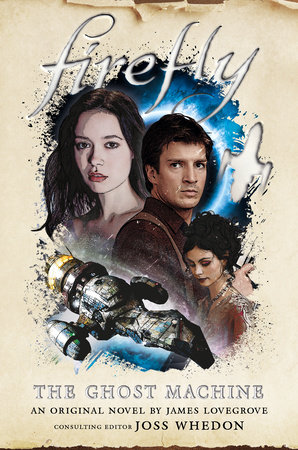
It is now coming up for fourteen years since the one and only series of Joss Whedon’s Firefly first aired but we still want more. If anything the basic premise of a likeable bunch of losers – literally so in the case of Mal and Zoe, veterans of the defeated ‘Browncoat’ side in the recent Unification War – scraping an often less-than-legal living at the edge of the star system speaks more to the present than the early pre-crash years of the century. Forget the brief flurry of hot takes a few years ago that the crew were really the bad guys, camaraderie in resistance is increasingly the only option for many, rather than simply a choice over the corporate progressivism of the Blair and Clinton years made in the name of ‘freedom’.
The Ghost Machine is the third in Titan’s series of Firefly tie-in novels, all of which have so far been written by Lovegrove (and he has another one due to come out next year). An ‘Author’s Note’ informs us that the action is set between the Firefly TV series and the movie Serenity. In an interview with sci_fidelity.co.uk, Lovegrove points out that ‘essentially what I’m doing is fan fiction but by a professional writer’. His love for the characters certainly comes across and the obvious fun he had writing them makes this an entertaining read. I hadn’t seen any of these before and so I wasn’t sure what to expect but I was immediately convinced by the opening scene, in which an exchange of dodgy merchandise in the remote outback of an obscure planet rapidly goes pear-shaped. The voices and characterisation are spot on and I sat back to enjoy the ride but, as with the high points of the series, I also found that the story ended up making me think about some of those fundamental questions, which genre fiction can be better at highlighting than more self-consciously literary work. As Lovegrove says in the interview, if we think of these novels as a mini season two then ‘The Ghost Machine is the season’s “high concept” episode’.
The dodgy merchandise in question turns out to be a bit of black tech developed by the Blue Sun Corporation in an illegal lab for the purposes of social control. Within hours of taking off from the planet where the novel begins, all of the crew except River are hopelessly ensnared in wish-fulfilment fantasies oblivious to the fact that their ship is heading full speed for a direct collision with the nearest moon. As the story progresses, these fantasies break down into overt horror but perhaps the most horrible thing about it all is just how conventional and capitalist the fantasies are in the first place. Mal imagines himself in domestic bliss, married to Inara with two kids; Wash dreams of being the wealthy head of an interplanetary freight corporation, the subject of puff pieces in society magazines; Simon wishes himself back as the privileged son of his wealthy family. Success breeds fear of betrayal as shown by the disintegration in Wash’s fantasy of his marriage with Zoe; while Zoe’s own fantasy of the Browncoats having won the war is to the detriment of her friendship with Mal. Tellingly, Zoe suspects Mal would have been happier if the war had been lost: ‘He defined himself by what he resisted, and therefore without anything to oppose he was nothing’. However, the novel is not critiquing the series for endorsing a loser mentality. Rather, it is reaffirming that oppositional mentality against the truly obscene consequences of adopting a winning mentality in what we might think of as ‘capitalist realism’. In particular, the sequence featuring Simon reveals the sheer violence underpinning patriarchal systems. Fortunately, resistance turns out to be too ingrained in some of the crew members for them to succumb completely. In its own way therefore, Firefly: The Ghost Machine has a very strong moral message: it has certainly put me on my guard against idly indulging in wish-fulfilment daydreams of conventional success.
Reviewed by Paul Graham Raven. This review first appeared in The BSFA Review.
Let me lay my lotería cards on the table: I read little horror, if any. I picked out Silvia Moreno-Garcia’s latest novel because I bought and published some of her earliest stories, back when Futurismic was still a going concern, and I was curious to see what she was capable of with a decade more experience under her belt; suffice to say it’s very clear to see why she’s lasted the course. The novel’s title makes it plain, even to a dilettante interloper, that there’s a direct connection to the earliest manifestations of the horror tradition—but I can’t tell you to what extent Mexican Gothic might be in dialogue with its generic predecessors, because I don’t have the necessary knowledge. As such, I will limit myself to a discussion of the book’s technique, affect and plot.
Let’s start with the latter: Noemí Taboada is a socialite in 1950s Mexico City, and her life of glamorous parties (and carefully distant dalliances with handsome but stupid young men) is interrupted by her father’s receipt of a letter from her cousin; Catalina recently married (unexpectedly, and against the family’s wishes and better judgement) and shipped out to El Triunfo, a faded former silvertown in the eastern state of Hidalgo, and has hardly been heard from since. The letter, full of high-gothic histrionics—cruelty, decay, poison, whispering voices in the night, the full works—suggests to Noemí’s father, already predisposed to disapproval of Catalina’s unsuitable husband Virgil Doyle, that she needs rescuing from her situation, or psychiatric attention, or some combination of the two: Catalina had a traumatic youth before coming to live with Noemí’s side of the family, after all, and has always been a bit flighty, her nose buried in literary Victoriana, a romantic in both the capitalised and lower-case senses of the term. Despite the horrors to come later in the novel, Noemí’s being dispatched on this mission by her stern yet doting father is perhaps the hardest event to swallow in terms of plausibility—but it’s done quickly, and no more than ten pages have passed before Noemí is en route to El Triunfo by train, with instructions to scope out the situation, and (if required) to persuade Virgil that he must either let Catalina see a shrink, or let her go entirely.
The Doyle family pile is the plainly-named High House, some way outside of El Triunfo proper, halfway up the mountain containing the mine that made the town’s (and the Doyles’s) much-diminished fortunes. High House and its cast of residents are as gothic as the title suggests they should be: this lot are, for the most part, monstrous and unpleasant from the get-go. Noemí, who starts confidently—as is her way—with the assumption that she’ll soon have her cousin out of there and onto a train back to the capital, discovers that things are (of course!) rather more complicated than the simple abusive-gold-digger-husband set-up that she and her father had assumed (though that is very much a part of the problem) and is soon entrapped in High House herself.
Now, I’ve never been much of one for deferring to the Spoiler Police, but I will in this case refrain from going deep into the spooky mechanics of the plot, which leavens its classic gothic hauntings and horrors with some scientific speculation and an (un)healthy dose of social psychology. I will say that it’s not a very violent or gory book, which I appreciated, and is perhaps all the more horrific (rather than thrilling or chilling) for that… and I will also note that the horror elements are used to explore, with no small degree of subtlety, the more mundane horrors of racism, colonialism and patriarchy. Mexican Gothic treats these themes with a sort of unflinching care, tracing the toxins without collapsing the veins of the plot. High House may be mostly lit by candles and oil lamps, but there’s a fair amount of gaslight in play, if you catch my drift; the entitled and not-always-passive aggressions of toxic masculinity, and the ways in which it warps and damages its protagonists as well as its victims, is poignantly portrayed, to the point that what might have been a far-too-fairytale ending instead feels both earned and redemptive.
It is telling, perhaps, that Moreno-Garcia chose the era of the post-war “economic miracle” as the temporal setting for the story—a period in which Mexico, like much of the rest of the world, was generally on the up in terms of social progress, particularly for women and those with indigenous (rather than Spanish) roots. Noemí fits both of those categories, and her privilege is contextualised with an appreciation of how much has changed, and how much is still to be done. As such, her distaste both for the obsolete patriarchal mores of the Doyles, and their interest in eugenic “science”, is informed by intellect and experience alike. (The redoubtable Clute would perhaps add something here about the ways in which the Doyles are Bound to the earth and their adopted home, both literally and figuratively, but I’ll leave that sort of theory to the experts.)
In terms of technique, while the gothic informs the imagery, atmosphere and plot, Moreno-Garcia mostly leaves the overwrought prose stylings out of it, writing instead from Noemí’s whipsmart sceptical POV as she figures out the form of the trap she’s wandered into. Furthermore, the way in which Moreno-Garcia displaces the classic gothic tropes to Central America, so as to expand and illuminate both the source genre and its idiosyncratic setting, is handled with deft and understated craft. Is it good horror? I’m really not the man to ask—but it’s a bloody good novel, that’s for sure.
By Smin Smith. This article first appeared in Vector 292.
Defining Science Fiction Art
The term science fiction as critic Adam Roberts states “resists easy definition […] it is always possible to point to texts consensually called SF that fall outside the usual definitions” (2006:1). This makes the process of defining science fiction particularly difficult, especially as an artist. The science fiction art we produce often falls outside of definitions which centre literature, film and television narratives.
When I started Vagina Dentata Zine in 2015 (a print publication documenting the relationship between fashion and science fiction), I had Norman Spinrad’s definition in mind: “science fiction is anything published as science fiction” (quoted in Roberts, 2006:2). I am particularly drawn as an artist to understandings of science fiction that prioritise multiplicity, and ultimately reclamation. Having been involved in queer, feminist zine publishing for a number of years now, I regularly witness visual science fiction beyond film and television — beyond the “mainstream white supremacist capitalist patriarchal cinema” (hooks, 1996:107) that criticism still prioritises. It seems more important than ever to move science fiction studies beyond these constructs, to let the emergent and more generative science fiction happening on the fringes into academia.
Here I think particularly of the Afrofuturist legacy, a potent multimedia project that encompassed “the theoretical and the fictional, the digital and the sonic, the visual and the architectural” (Eshun, 2003:301). We do speculation a disservice when we limit its reach. Thanks to the work of multiple artists, zines and journals like Vector, science fiction criticism is finally expanding its remit to encompass the various modes of science fiction art.
My understanding of science fiction art has also been shaped by convergence culture, a contemporary phenomenon affecting both science fiction and the arts. Transmedia studies of science fiction identify a phenomenon where the “boundaries between media have blurred to the point at which it makes little sense to foreground fundamental distinctions between contemporary media” (Hassler-Forest, 2016:4-5). Narratives are simultaneously built across (but not limited to) films, television shows, books, comic books, video games and toys.
Similarly, contemporary art necessarily involves a convergence of media, building “a general field of activities, actions, tactics, and interventions falling under the umbrella of […] a single temporality” (Medina, 2010:19), that of the contemporary. For both Hassler-Forest and Medina, convergence has liberatory potential; as Medina puts it “[…] there is some radical value in the fact that “the arts” seem to have merged into a single multifarious and nomadic kind of practice that forbids any attempt at specification” (2010:19). As a fashion stylist once confined to the genre of visual culture, blurring the boundaries of art, science fiction, and science fiction art specifically feels especially productive.
Samuel R. Delany once proposed that “we read words differently when we read them as science fiction” (2012:153). This essay declares that we read art differently when we view it as science fiction, specifically fashion design and imaging practices.
Reviewed by Nick Hubble. This review first appeared in The BSFA Review.
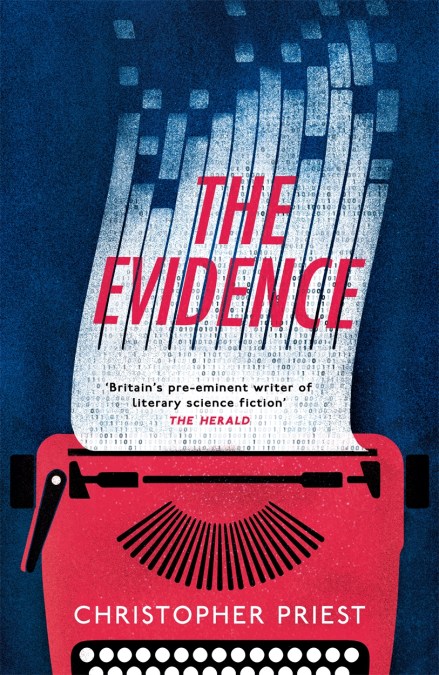
Christopher Priest’s sixteenth novel, his fifth in the last decade, returns to the uneasy setting of the Dream Archipelago, most recently traversed in 2016’s The Gradual. On the one hand, The Evidenceis classic Priest with the full panoply of twins, stage magicians and the endless war between Glaund and Faiandland trundling on in the background. But, on the other, it’s a crime novel with several variants on the locked-room mystery and a particularly violent murder scene. Has Priest sold out to the demands of commercial genre writing or is he sarcastically deconstructing the format?
The novel begins with crime writer, Todd Fremde, on a train on Dearth Island heading to Dearth City, where he will be staying in the Dearth Plaza Hotel, in order to give a keynote lecture, to a conference organised by the University of Dearth Literary and Historical Society, on ‘The Role of the Modern Crime Novel in a Crime-Free Society’. Fremde has accepted the invitation against his better judgment, swayed by the promise of top cuisine, a suite at the hotel, and being driven around in a university car. Therefore, he makes it clear he only has time to give the lecture and then leave the next day. While it would no doubt be a mistake to conflate Fremde with Priest himself, the following fear seems heartfelt: ‘The prospect of prolonged and detailed academic discourse from theoreticians who knew little of the art and craft of writing filled me with dread’. Ouch! Suitably chastened, I shall try and rein in my well-known proclivities to quote large chunks of Derrida, Lacan or Agamben for the duration of this review.
Needless to say, the amenities on Dearth fail to match up to their billing but the real trouble arises from Fremde’s inability to adhere to the ‘Seignioral mutability regulations’ with the consequences that his watch stops, the electrical equipment in his room (not suite) takes on a life of his own, letters disappear from his emails and texts, and he incurs hefty fines for ‘electrical mutability abuse’ and a ‘Seignioral surcharge’ for ‘unauthorized horizontal prejudice’. Fortunately, he is able to offset some of the cost of these by cashing in the return half of his rail ticket and accepting the offer of a lift back across the island from a woman, Frejah Harsent, who attended his talk. But even this has its consequences as Harsent, who drives a gullwing roadster with a barely-concealed automatic weapon in the boot, turns out to be a semi-retired detective in the ‘Transgression Investigation Department, Dearth Seignioral Police’. Not only does she insist on telling him extensive details of a cold case that she was involved in because it will give him material for his writing but it also transpires that she is incredibly prejudiced against serfs leading to his blunt admission that he is a ‘citizen serf’, which provokes the following exchange:
‘I’m embarrassed – I assumed you were a professional, a vassal.’
‘That’s just your assumption,’ I said. ‘Don’t feel sorry for me. I’m a writer. All writers are serfs.’
Subsequently, Fremde gets back to his home island of Salay Raba and over the following days all seems back to normal apart from the fact that there is no sign of his expenses and fee from the University of Dearth. But then, once more against his better judgement, he finds himself slowly dragged into the ongoing fallout of the cold case that Harsent insisted on describing to him and the attendant complications of twins, magicians and illusory perfect crimes. None of which is helped by the financial collapse and run on the banks, which threatens to destabilise the economy of the entire Archipelago that Fremde may have inadvertently triggered through his mutability transgressions. All of this is great fun, narrated with deadpan irony to characteristic understated comic effect; but with a marked political charge.
The feudal class system of the Dream Archipelago has never been laid out so starkly as in the drop-down list of ‘social level’ options that Fremde accesses at one point in the proceedings: ‘Serf, Citizen Serf, Villein, Squire, Vassal, Corvée Provider, Cartage Provider, Demesne Landed, Knight, Manorial Landed, Baron, Seignior.’ Although, amusingly, magicians are categorised as a separate category of ‘Mountebank’. In The Evidence, this outdated class system is linked with finance as a manifestation of mutability, which is both a real and unreal process that happens or is thought to happen: ‘best understood as existing somewhere between quantum physics and psychology’.
The unexpected appearance of the medieval term ‘Vassal’ in contemporary British usage presents an example of this kind of simultaneously real and unreal existence. It is used to express the concern of Brexiteers, such as the Prime Minister of the United Kingdom, not to be reduced to the status of vassals of the European Union regardless of the fact that this is neither a likely outcome nor necessarily an undesirable one. That this kind of absurdity now constitutes the political reality of the UK is a reflection of the state of affairs described in a recent book, This is Not Normal: The Collapse of Liberal Britain (2020), by William Davies, Professor of Political Economy at Goldsmiths, University of London. Davies posits that the mismatch between ever-expanding digital data and timebound analogue frames of meaning is generating ‘escalating opportunities for conflict over the nature of reality’. This strikes me as essentially the same phenomenon that Priest describes as mutability. Fremde might have been tasked with the seemingly paradoxical task of talking about the role of the modern crime novel in a crime-free society but Priest sets himself the even more difficult problem of writing about the relationship between illusion and reality in a world in which the distinction between them has collapsed. Somehow, by sleight of genre and time-honed skill, he achieves this, and order is restored at the end of The Evidence with revels ended as all is mended. The dream still works even as all falls apart around us.





![Europe in Winter (The Fractured Europe Sequence Book 3) by [Dave Hutchinson]](https://m.media-amazon.com/images/I/51MmX2RVRZL.jpg)