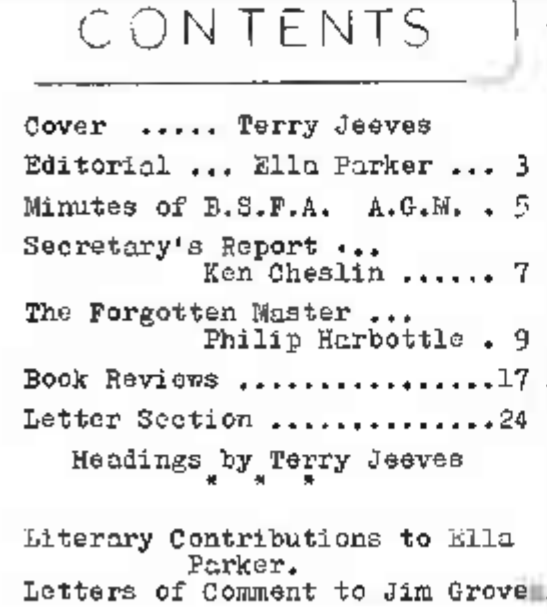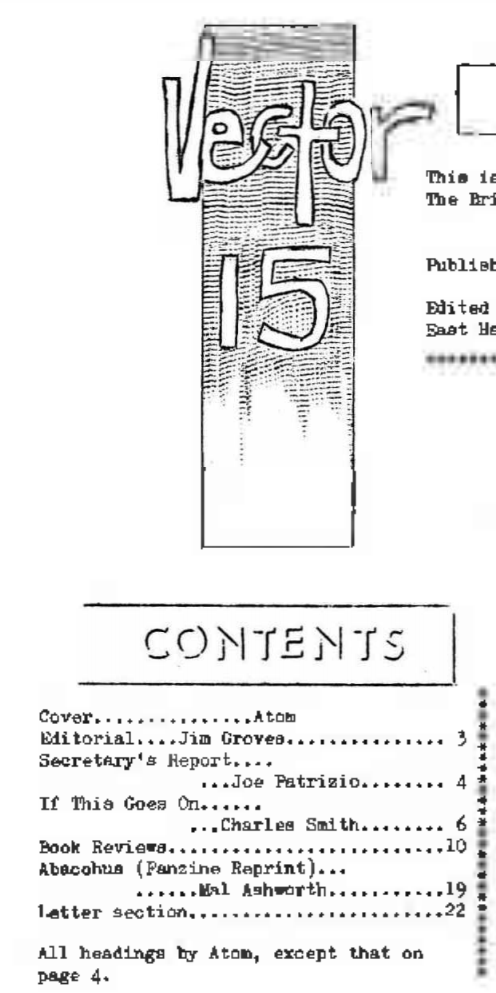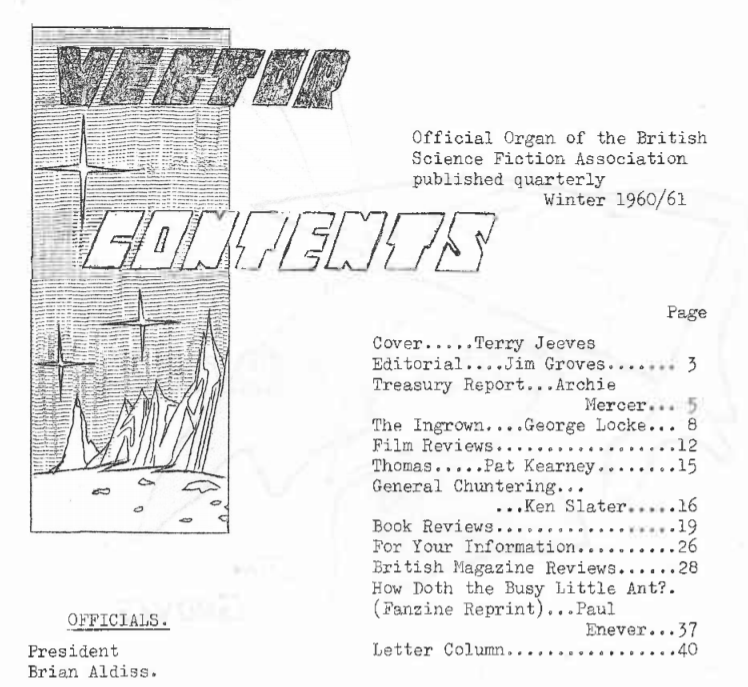
Vector #40

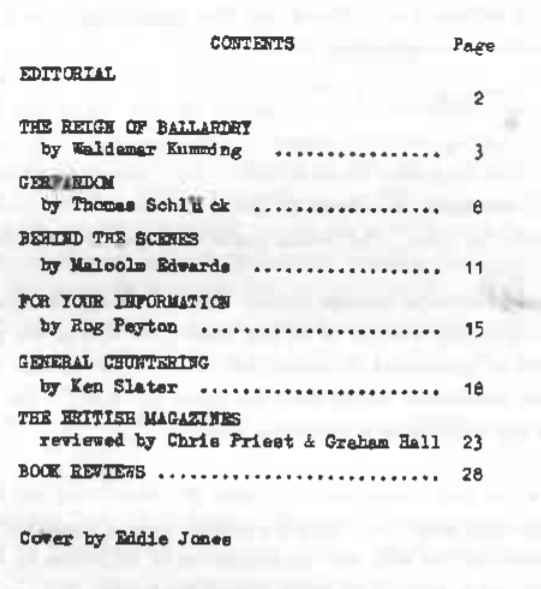
For an allegedly SF work by an allegedly leading writer of the genre this is a somewhat disappointing score. He certainly seems to be leading in a new direction: but it is a direction that speedily leaves the SF field enntirely for plotless and gloomy wasteland. In all of Ballard’s stories something terrible either has already happened or is happening (sometimes with no more rhyme and reason than in the ‘happenings’ that are the opop art answer to the theatre) – or things are going from bad to worse and heading for a frightful crash. The passing of the ‘sense of wonder’ has been much lamented by nostalgic readers, though it has been suggested that this is simply associated with encountering the ideas of SF for the first time, and that it still operates for many new readers. Ballard gives the impression of trying to replace it by a sense of impending doom.

Waldemar Kumming
Vector #16

At least once a year we publish in VECTOR the entire Membership list; it will be in the next issue. Being on the committee, I have had an advance peek and I notice there are quite a few members living within easy reach of each other. This seems like a good time to come up with an idea I had two years ago with disappointing results and see if anything comes of it. When you see the list, take special note of the addresses; at least three of you live in Leeds, two in Glasgow and there are some new members in London, Leeds and Glasgow: If you’d like to meet another member, try dropping a note suggesting a meeting with one another. You may live near enough and like each other well enough to want to meet frequently. It’s worth trying, isn’t it? London: Every Friday night from 7.pm. I hope Open House at my home. Tea, coffee and biscuits are provided as well as plenty of talk that I’m sure you’d find interesting as well as entertaining. Do try and come, won’t you? My address is on the contents page here. We’d love to meet you, really.

Ella Parker

As the years go by, most sf writers, instead of maturing, unhappily degenerate into hacks. […] This may be because they think and are encouraged by their audience to think mainly in terms of conjuring up something nevl – never mind how absurd, how affronting to possibility – instead of bringing increasing experience to bear on translating human fears and aspirations into new forms. In other words, the years tell against them, instead of telling for them as they should. For sf always to be youthful is fine; for it always to be juvenile would be death. […] This need for maturing sf authors may have been expressed crudely. If so, I ask readers to bear with me, for the subject has hardly been broached before.

Brian Aldiss

Vector #14

After getting VECTOR 13 I feel I must defend one of my favourite stories against one of my favourite authors; i.e. “Of Man and Woman” against Brian Aldiss.

This is not a story of “madness, violence and insanity” (what is the difference between madness and insanity anyway?) but the story of a child who, through no fault of his (her?) own is born a monster to normal parents.

Jean Graman

The really fascinating thing about science fiction – and another LXICON surprise for me was that this idea seemed to be so widely appreciated – is that it leads straight into quite specialised fields. i don’t just mean physics, astronomy and the rest, but politics, philosophy, social comment, psychology and (not least) literature. Sf is a meeting-point of all these.

Kingsley Amis

The letter section seems devoted chiefly to a wrangle about the definition of science fiction, a wrangle which to my knowledge was going on nearly thirty years ago, and will doubtless be continueing thirty years hence.

Don R. Smith

I haven’t waded into the ‘Definition’ because with all the ones I’ve seen I can usuall recall stories that lie outside them and yet are usually classified as sf. Being one of the lazy types I can’t really see why people go to such lengths to try and define sf. I mean, why bother? I rarely bother to find out why I like or dislike something.

Mr Doherty’s article was most interesting. I find the idea of a teacher actually teaching sf fascinating. I don’t suppose my English teacher knew it existed. More power to Mr D’s elbow.

Jill Adams

I’d take a guess that most of these people don’t really know what they do want from the Association, they just know it’s missing.

Jill Adams

Vector #13

I have said enough, and Rico too much, to show that this soft-centred soldier should have been recommended for a psychiatric report rather than promotion, and that from a Freudian point of view, “Starship Troopers” is a shower of hoarse horse laughter. Rico longs to be humiliated, searches for trouble and a substitute father figure, both of which he finds of course in the M.I. – referred to significantly as a “Paternalistic organisation”.

Evidence shows that this was not the portrait of Rico that Heinlein intended. There is no sign of awareness (as for instance there was in that fine and authentically tough film “End As A Man”) that this sort of military establishment breeds bullies and bastards and toadies; nor could there be, for the whole novel – whilst passing itself off as a semi-documentary by eschewing plot – is too far from reality.

Brian Aldiss

Assuming, first of all, that SF is definable .. which is probable, since we all know what we mean by SF and argue only about the ‘fringe’ items .. assuming so much, it follows, also, that SF can be, and should be, about anything and everything, past, present, or future, here, there and everywhere. Just as in science itself, there are extremely few matters which can’t be treated in a scientific manner, to some extent, and I know of a few authoritative purists who would go so far as to say that everything … literally .. can be so treated. Certainly, there are very few matters of concern to every day life which are immune to scientific study.

So .. SF can be, and should be free to include everything and anything. The taboos which exist, and there are some, are solely the result of editorial choice, preference, and some nebulous idea as to what ‘the reader’ wants.

John Phillifent

Vector #10

There is no Secretarial Report this time due to pressure of work.

Front matter

I have one serious criticism to make and that came to me almost as soon as I started reading the two to me almost as soon as I started reading the two latest issues of VECTOR. In both there are apologies for lateness of publication, of both the OO and the Newsletter. The reasons given (by Ella) are that the officials are only doing it as a spare time job, that they have lots of private correspondence to attend to and that they have family commitments and social engagements to deal with. Now I submit that this is not the right attitude. If anyone takes on an official job for any organisation, it is their duty to the members to put that job before their own private circumstances (with the exception of illness, of course). There is nothing wrong with an ordinary fanzine being late because the editor usually does not promise his readers a regular schedule and they don’t expect one. But the members of the BSFA have paid their dues and are entitled to a regular OO. This applies especially to those sf readers, not belonging to fandom and living in remote places, to whom theh arrival of BSFA literature must bring a great deal of pleasure.

A more appropriate reason for having a regular schedule, and one I should have put first, is that if the BSFA wishes, as it states, to influence responsible people in the professional sf world, then it won’t be listened to unless it first shows that it or editors were arranged and then one of the officials failed to turn up on the grounds that he/she “had a houseful of fans who had to be shown some hospitality” (as on p.7. V.9). If a person has these other responsibilities then they have no business taking on an office. Unless that is they are prepared to arrange these other things to leave time for their duties.

There is another thing that gives a rather irresponsible air to the magazine and that is the intensely personal atmosphere about it. I notice that all concerned with VECTOR have an implicit attitude that it is on a higher level than a mere fanzine and yet there is a great deal of mentioning of names present at social gatherings, private announcements such as marriage engagements, etc. I am not saying that there is anything wrong with this – I am sure many readers enjoy it – I merely suggest that this puts VECTOR on the level of the ordinary fanzine.

Daphne Buckmaster

Vector #5

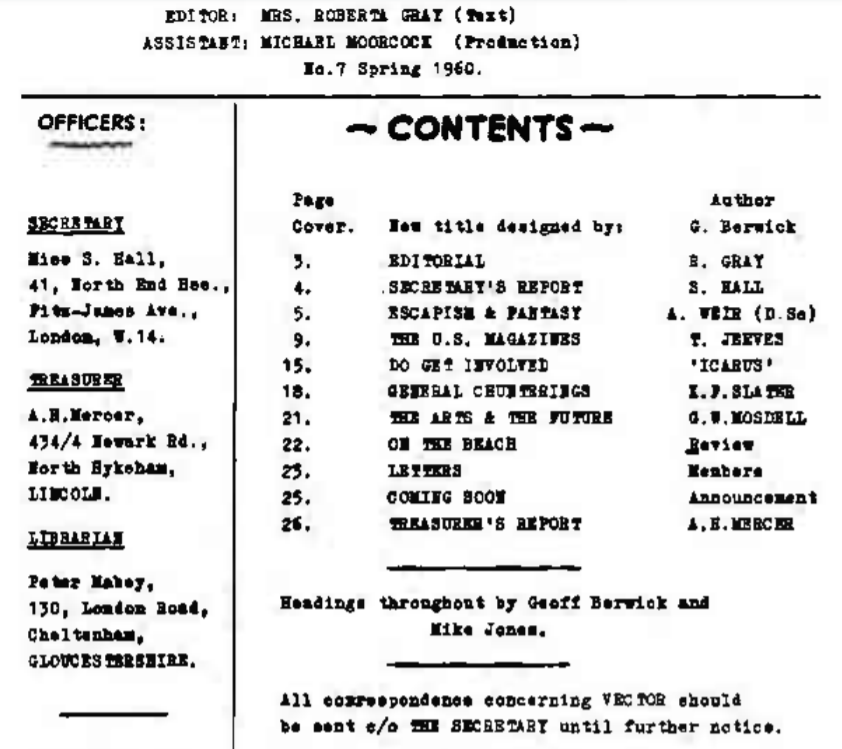
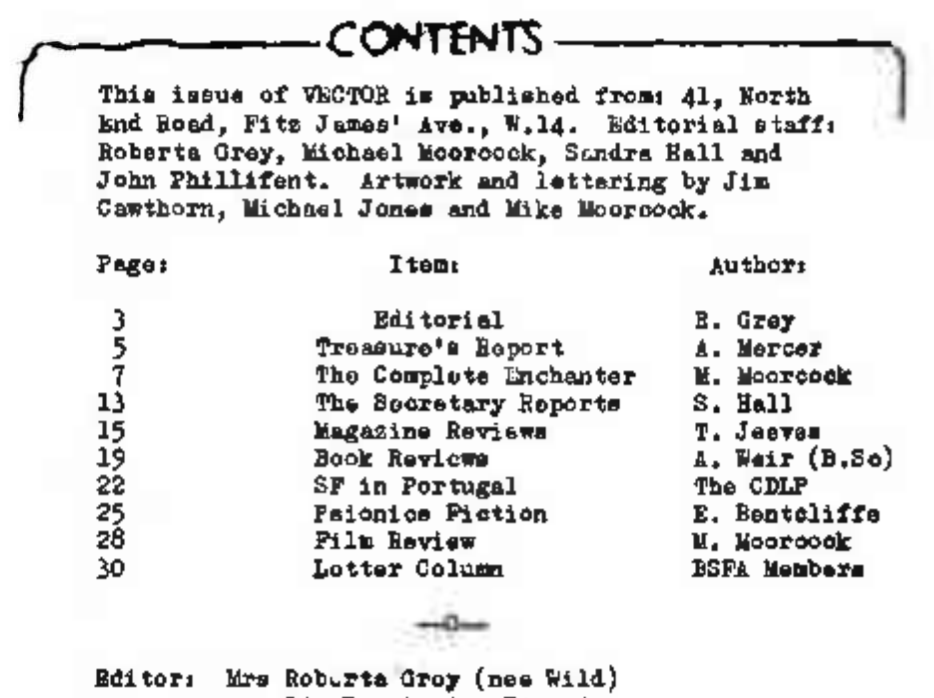
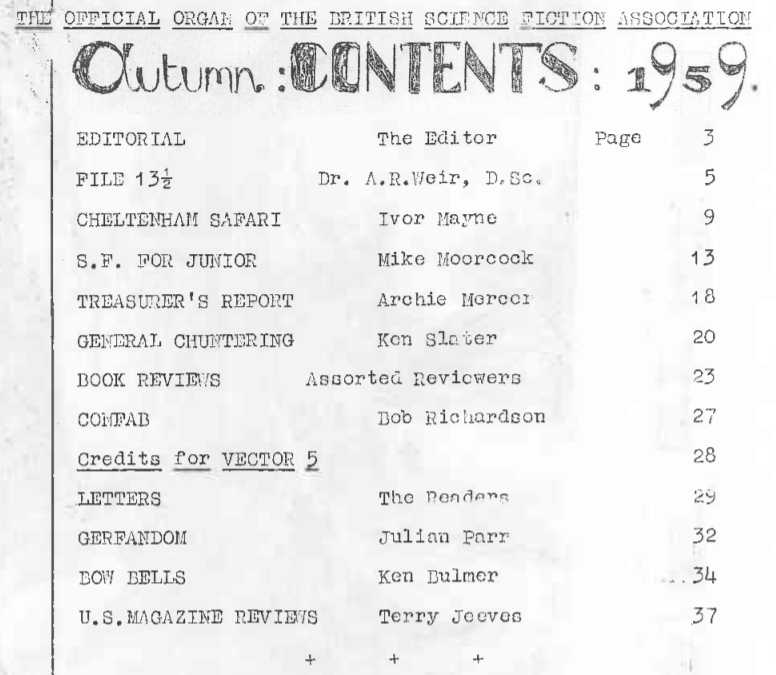
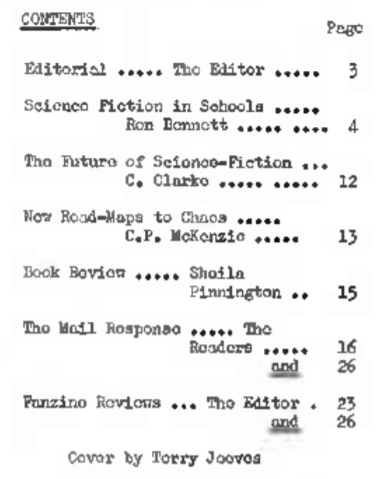
Vector #5, edited by Roberta Wild, with the assistance of Mike Moorcock. It has come to our attention that, because blogs do not yet exist, and because of eddies in the temporal ether, the dates of these “blog posts” may not perfectly align with our print editions. They do materialise within a few months of the correct date. All these difficulties aside, we hope to maintain an approximately quarterly publication schedule, so long as this is compatible with consistent causality.