Aldiss’s Error: Aliens, Science Fiction, and the Problems of Genre

By James C. Bassett

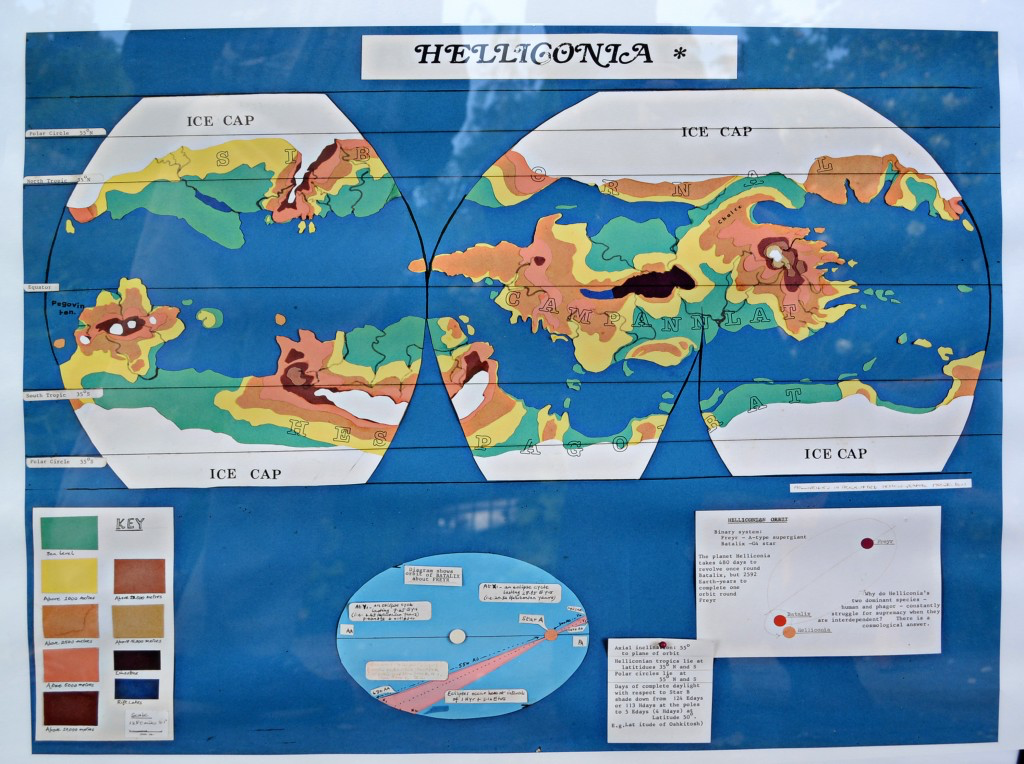
Brian Aldiss, map of ‘Helliconia.’ https://brianaldiss.co.uk/writing/novels/novels-h-l/helliconia/

I recently came across a most curious and unsettling pair of essays by Brian Aldiss that I am still trying to process, because they seem to strike against the very heart of science fiction literature, and even much of Aldiss’s own writing. “As far as we know, we are alone in a universe,” Aldiss points out in the second of these essays on the subject of aliens (Aldiss 1999, 340), and he is absolutely right. As far as we know.1 But although the jury is still out on the Big Question, in this essay Aldiss seems fervidly convinced that extraterrestrial sentience simply does not exist. When Aldiss argues “the case for mankind’s solitary state here [the universe], for which the evidence is plentiful” (Aldiss 1999, 334). He appears to accept an absence of evidence as evidence of absence, an extrapolative leap which defies logic and scientific method.

“There is no scientific evidence that [alien sentience exists], any more than there was ever any evidence for the long-held belief in spontaneous generation”2 (Aldiss 1999, 335), an unfair comparison, because spontaneous generation (the theory that living creatures could arise from nonliving matter—for example, that flies grow from rotting meat or that frogs grow from mud) was disproved by scientific evidence against it, a state of affairs that has not been reached regarding the existence or non-existence of sentient extraterrestrial life.

Still, anyone who believes in aliens absent any definite proof is misleading themselves, according to Aldiss. Such belief “represents a continuation of that venerable credulity” (Aldiss 1999, 340) that cursed our race with gods and monsters. Yet absent any definite proof that aliens do not and have never existed, Aldiss seems to be just as guilty of relying on a type of faith — just as “credulous” — in forming his conclusions.

Whatever the reasons for it, or the reasoning behind it, this personal disbelief in the existence of aliens is of little consequence to anyone but Aldiss himself. Of far greater import, however, and far more troubling to the science fiction genre, is an earlier essay in which Aldiss presents an overview of the development of the role and portrayal of sentient alien life in SF literature from its long pre-Campbellian days to the present, and an examination of the causes and effects of the debased and increasingly “monsterish” concept of aliens and what is alien (Aldiss 1996).

Continue reading “Aldiss’s Error: Aliens, Science Fiction, and the Problems of Genre”

Zoefuturism: Yen Ooi and Stephen Oram, in conversation

Yen Ooi: When I first came across Professor Roger Ames’s lecture on Zoetology, I felt a surge of relief alongside excitement, as finally, there was language to explain my “rationality” – the foundational thought-structure that I had grown up with. This applied easily onto science fiction, since it is literature that is grounded in “rational science,” allowing me to understand and explore why “rationality” in speculative fiction can differ so much from culture to culture, subgenre to subgenre. 

As I discovered Zoetology alongside a depth of other theories (like convergence culture, participation revolution, techno-Orientalism, tabula plena, neo-colonialism, post-colonialism, polymedia, and more), and amidst all the distressing news in the world today (of wars, the climate crisis, the AI bubble, etc.), while my life kept “becoming” (through motherhood, researching and practising Zen, and lots of writing!), everything came together to become Zoefuturism in an organic discovery. Zoefuturism isn’t a new idea inasmuch as zoetology is what Ames calls “a new name for an old way of thinking.”

Stephen Oram: Talking with Yen over coffee about her theories behind Zoefuturism, the phrase she coined, was more than an insight into a new way of approaching science fiction, it chimed beautifully with some of my own thinking.

My cultural background is not one of eastern religions or philosophy, quite the opposite. However, since my teenage years I’ve been sceptical of absolutes, developing a keenness for seeing life as directional. By that I mean keeping an eye on whether things are going in the right direction towards a “notion” rather than setting absolute goals or end-points. More recently, I’ve been actively attempting to hold knowledge and ideology lightly, passionately but with the understanding that both will change and develop. This focus on change is reflected in a lot of my writing.

Continue reading “Zoefuturism: Yen Ooi and Stephen Oram, in conversation”

The (Death) Ray of Destiny: Conspiracy and Speculative Historiography in Early Silent Science Fiction

By Alex Harasymiw

Promotional poster for The Death Ray (1924)

Introduction

There, squatting beside a bush, projecting from the field, like a tilted spotlight precariously balanced atop a porcelain beehive, we behold the death ray, its tentacle-like power cables snaking across the English countryside to somewhere off-frame. Invented in 1923 during the interwar period as the ultimate deterrent to the enemies of England, Harry Grindell-Matthews’ device sits mercifully unused, mysteriously untested, a mere testament to the destructive potential of the modern scientific mind. From the surviving photographs and the rare newsreel footage of the death ray, we can see an eerily thin beam, sweeping across an assortment of objects, a motorcycle engine, a lump of gunpowder, a quivering mouse, like that of a handheld flashlight, only, instead of illuminating each of the objects, the beam slices them like a pair of scissors, severing them from the sense of continuity between one moment and the next. First, there is light and the object, a rupture, and then an explosion to splice the two parts together. In the end, Grindell-Matthews would destroy the device, along with all the related plans, notes, and records, leaving behind only anecdotes, rumours, and film strips as evidence of this great realization of science fiction in the past.

Apart from its strange imagery, like some untimely precursor to the independent exploitation films that would appear decades later, the death ray is fascinating for the way it lingers  in the popular imaginary. Despite the lack of conclusive demonstrations of the device, the way descriptions of it change from one account to another, and Grindell-Matthews’ reticence about its materials and operation, there appears to have been a widespread faith in the real possibility of the invention’s existence, and even today something like a pious agnosticism surrounds the death ray. When we consider the efforts of early silent cinema scholars to confront the often irreparable degeneration or complete loss of the films of so many marginalized filmmakers, and the implications of such loss for our understanding of the history of silent cinema, the persistence of the death ray as the lost work of a modern inventor-genius seems especially questionable. Where the absence of marginalized films and filmmakers from the official canon of silent film history is often attributed to the real material loss of their films in the present, the death ray highlights one of the central ironies of historical writing about this period: namely, that if a narrative is compelling enough to be believed, there is no problem inventing evidence to suit its ends.

Continue reading “The (Death) Ray of Destiny: Conspiracy and Speculative Historiography in Early Silent Science Fiction”

Policing perception: weird fiction, Tony Benn, and the warped borders of the real

by Philip A. Suggars

There’s a moment in the Wachowski’s seminal 1999 movie the Matrix where Keanu Reeves’s elegantly blank Neo sees the same black cat walk past a doorway twice. In the movie, such moments are signals that the nefarious Agents are about to emerge into Neo’s simulated reality and give him the mother of all cardio workouts.

But what if something similar were to happen to you?

Perhaps you have a similar moment of déjà vu, notice that roses now seem to smell like freesias or that the sky suddenly looks a bit purple. Everyone you tell about this discovery, however, insists that everything is the “same as it ever was” (in the words of the old song). Roses smell as sweet as they ever did. The sky is the same old blue.

After a while you might accept that it’s your perception that is at fault, shrug a little, and decide to get on with the gardening. But at the back of your mind there might be a nagging doubt. Perhaps you were never supposed to notice the difference.

Continue reading “Policing perception: weird fiction, Tony Benn, and the warped borders of the real”

Cultivated Meat: Science Fact and Fiction

By James Henstock

 Cultivated (lab-grown) meat has emerged from science fiction into a genuine commercial product. The promise of sustainable, animal-free meat has captured the interest of governments concerned with national food security in a time of rapid and unpredictable climate change. Supported by a rapidly developing $3Bn industry, cultivated meat is now available for limited public consumption.

However, public opinion on cultivated meat is strongly polarised. Since most people haven’t yet tried cultivated meat, preconceptions have instead been formed by its depictions in science fiction which may be either inspiringly utopian or more commonly, starkly dystopian. Real culture-grown products are being introduced to a consumer base with expectations based on imagined realities. 

In this article I will introduce some of the technology that underpins the production of cultivated meat, and how its origins in the biopharmaceutical industry present both opportunities and challenges for manufacturing appetising food. How far does the reality of cultivated meat match the science fiction representation? Can scientists and storytellers work together towards a shared utopian vision of this Future Food?

A new era: the Post-burger 

On Monday 5th August 2013, Dutch pharmacologist Mark Post unveiled the world’s first cultivated beef burger at a press conference in London, thus launching a new era in food. The burger was cooked and eaten, and whilst being described as ‘close to meat, but not as juicy’ and costing around $325,000 nevertheless inspired a boom in investment that saw the creation of over a hundred start-ups and university spin outs, plus a handful of very well-capitalized companies in the USA, Israel, Australia, and the Netherlands (Mead, 2013; Gregory-Manning & Post, 2024). Since 2013 it is widely estimated that over $3.1 billion has been invested into cultivated meat enterprises, with a peak in 2021 (GFI, 2023). New consumer markets are opening up following regulatory approvals in Singapore, China, Australia, New Zealand, the USA, Israel and the UK as governments recognise the value of a diversified ‘Alternative Proteins’ ecosystem in enhancing food security in response to growing population challenges and climate change. 

Yet the concept of ‘synthetic’ meat has been in the public consciousness for generations. Since first being articulated in fiction in 1897 (as a gift from the Martians in Two Planets by Kurd Lasswitz), social and technological revolutions have triggered particular bursts of literary creativity in the 1930s, 1950’s and 1960s, corresponding to increasingly mechanised intensive farming practices and the overall boom of technological progress in the 20th century, not least of which was in biomedicine and laboratory cell culture. In a 1931 essay on the future of science, Winston Churchill wrote:

‘We shall escape the absurdity of growing a whole chicken in order to eat the breast or wing, by growing these parts separately under a suitable medium. Nor need the pleasures of the table be banished. That gloomy Utopia of tabloid meals need never be invaded. The new foods will from the outset be practically indistinguishable from the natural products, and any changes will be so gradual as to escape observation.’ 

Churchill’s predictions and the early optimism of fin de siècle authors in humankind’s salvation through science are admittedly taking some time to realise, yet the technology required to bring cultivated meat to fruition is being developed at pace. 

Continue reading “Cultivated Meat: Science Fact and Fiction”

Energy Economies in Science Fiction

By Jo Lindsay Walton

‘Embers’: Stranded Assets

Wole Talabi’s short story ‘Embers’ (2024) explores the potential consequences of energy transition for a rural community in Nigeria, focusing on one oil worker who cannot let go of dreams of petrochemical prosperity. 

Kawashida fuel cells were invented by a team of scientists at the ShinChi Technology Company of Japan […] By using a proprietary genetic modification technique to rewire the metabolism of a heterotrophic bacterial strain, making it autotrophic, and then further splicing the synthetic microbe with a cocktail of high cell density, rapid reproduction genes, Dr. Haruko Kawashida and her team created a living, breathing, renewable supply of energy for the planet. The synthetic autotroph used concentrated sunlight to efficiently consume carbon dioxide and exchange electrons, creating a steady stream of electricity.1

How convenient! And as if its abundant, net carbon-negative energy weren’t enough, Kawashida cell technology also revolutionizes wastewater treatment. It’s a near-perfect deus ex machina for the climate crisis. 

But not everyone is happy. When Kawashida decimates the oil industry, Uduak is abruptly cut off from his sponsored scholarship. Cast adrift, Uduak becomes a kind of inverted solarpunk protagonist—he uses grit and ingenuity not to jury-rig funky green utopiatech, but rather to attempt to revive the village’s derelict oil refinery. Even though clean energy is widely available, Uduak argues that the village’s real needs remain unmet, and he remains hostile to the post-carbon vision laid out by his idealistic rival, Affiong.

The story comes to a grisly and tragic conclusion—murder, arson, suicide. Without excusing Uduak’s rather OTT response, we can see that there is a clear lack of compassion to support him transition to the era of a stabilised climate. One wonders if Uduak might also have a point: will the village as a whole be left behind by government, industry and civil society? Just as Uduak was left behind by the village?

Uduak becomes what is sometimes called a ‘stranded asset,’ something once valuable, whose value has vanished because of a probably permanent shift in its circumstances. The story’s core tension—between his thwarted social mobility and the new sustainable technology—reflects the current dilemma of green transition for petro-states like Nigeria. 

It also implies broader questions about energy transitions. Within science fiction, transformation of the energy system often forms the hard-to-imagine bridge between the dystopian present and the ambiguously utopian future. There are the dilithium crystals and warp cores in Star Trek, there is the Grid in Iain M. Banks’ Culture novels. But the questions which arise are not just about what energy will power the future. They are also about how societies will allocate and manage such energy.  Could energy itself somehow be the foundation of a just and equitable economy? If the flow of energy were to directly underpin the flow of money, could this support systems that are more cooperative, collective, and liberated, and less exploitative? Systems that are not just energy-based, but also just based pure and simple?

Continue reading “Energy Economies in Science Fiction”

Review: Delicious in Dungeon (2024)

By Marta F. Suarez

Dine or Die, with a Pinch of Comedy

Delicious in Dungeon (2024, Netflix). Season 1, Episode 3. Living-Armour Stir Fry and Soup [00:18:57]

Delicious in Dungeon (Netflix, 2024-present) is Studio Trigger’s adaptation of Ryōko Kui’s eponymous manga (2014-2023). The series is set in a fantasy world that merges and echoes different fantasy and manga traditions popular in Japan. The overall setting takes the viewer to the dungeon crawl genre, which recently experienced a resurgence in the country after Etrian Odyssey Nexus (2018). The characters’ races and skills are shaped by influences of Dungeons and Dragons, the Middle-Earth world set by Tolkien, and even the Final Fantasy universe, which itself draws inspiration from these narrative traditions. However, what makes Delicious in Dungeon significantly different is the resonances of cooking series like Mister Ajikko (1986-1989), a manga series that had several sequel runs over the years, including a recent 2015-2019 one, titled Mister Ajikko Bakumatsu-hen. The first season comprises 24 episodes, with a new second season coming soon this 2025. 

In the world of the story, adventuring parties enter dungeons looking for the legendary Golden Country, a kingdom transported by a sorcerer to the depths of an expansive dungeon, which is said to contain the ultimate treasures. Lured by wealth, fame, and adventure, different guilds enter this dungeon with the hope of finding the lost realm. One of these teams is led by Laios Touden, a tall-man (human) Paladin Knight who starts this quest alongside his sister Falin, a magic wielder; Marcille, a half-elf mage; and Chilchuck, a halfling thief. The opening scenes present the party’s encounter with a magnificent red dragon, against which they are losing. As the beast defeats them one by one, Falin uses her last strength before being ingested by the dragon to teleport the other members of the party out of the dungeon. Still alive but on the surface, the party is now several floors above where the battle took place and too far to attempt to rescue Falin. However, due to the magic of the dungeon, Falin could be resurrected if there are some remains and she has not been fully digested. With this in mind, the group decides to return, defeat the dragon and rescue any remaining parts of Falin. However, with time being of the essence, they realise that they cannot afford to stop to resupply and find provisions, as that would risk their chance to succeed. In a conventional dungeon crawl storytelling, the party would possibly open containers to find cheese and fruit, pick edible mushrooms and seeds, or perhaps kill a rodent and eat a left-behind spoiled pie in a moment of necessity. In contrast, Laios introduces the unconventional idea of eating the monsters they encounter, setting the course for the series. With this decision, the party ensures their survival and the journey becomes also one of gastronomic exploration.

Continue reading “Review: Delicious in Dungeon (2024)”

Torque Control 301

By Phoenix Alexander

The organism is relentless

Calorie demanding, perpetually in need of hydration, oxygen, and a cocktail of other vitamins and minerals, requiring 4-8 hours sleep a night to repair itself from the ravages of the day, day after day. A lifetime’s worth of consumption. 

This unkind—some might say anti humanist—characterization is famously articulated by the nefarious Agent Smith in The Matrix, where he attempts to psychologically break a human rebel leader, Morpheus, by telling him: 

Every mammal on this planet instinctively develops a natural equilibrium with the surrounding environment, but you humans do not. You move to an area and you multiply and multiply until every natural resource is consumed and the only way you can survive is to spread to another area. There is another organism on this planet that follows the same pattern. Do you know what it is? A virus. (The Wachowskis, 1999)

The accusation, while effective for cinema, is not quite true. Smith implies that this “consumption” is a species-specific act, and not one located within a complex and interrelated ecosystem of both human and non-human life. If anything, plants should be the focus of his anger: they are the enablers of this “surviving,” this “spreading,” being masterful spreaders and survivors themselves. More radically: even drawing the lines between species may be a spurious rhetorical move. “A leaf is the only thing in our known world that can manufacture sugar out of materials—light and air—that have never been alive,” Zoë Schlanger reminds us in her recent book The Light Eaters: How the Unseen World of Plant Intelligence Offers a New Understanding of Life on Earth (Schlanger, 2024). “All the rest of us are secondary users, recycling the stuff the plant has made… Think about it: every animal organ was built with sugar from plants” (Schlanger, 2024, pp. 27-28). Her (admittedly simplified) description is useful in exculpating the human organism specifically from the charge of excessive consumption. It is not our fault; we are enabled, built literally by component organisms and their byproducts, both visible and invisible. 

Nevertheless, the human body and its source/s of sustenance tends to take on the nature of a problem to be solved in many science fictional narratives. From the replicators of Star Trek to the hideous ‘pigoons’ of Margaret Atwood’s Mad Addam series to the equally hideous ‘sligs’ of Frank Herbert’s Dune universe to the more mundane efforts of potato-growing in Andy Weir’s The Martian, authors and film-makers offer the gamut of appealing to radically unethical means of keeping the human organism alive in conditions that, even without the lack of food, threaten to kill it. (I am reminded here of the opening crawl to the movie Gravity: “Life in space is impossible”) (Alfonso Cuarón, 2013). 

Continue reading “Torque Control 301”

Eternally Displaced Persons? Territorial Bodies and The Ministry of Time

By Matt Finch

Introduction

What does travel through time and space reveal about the body?

This essay is an invitation to think about bodies moving through time in a work of contemporary literature. What is exposed about a body when it is displaced in time and space? The concept of the territorial body, developed from the pioneering work of Verónica Gago (2020), serves as a lens through which we can understand “the body of the individual person in the context of its entanglement with questions of territory, incorporating the complex multidirectional dynamics which arise between the individual body, the collective, and the various territories they inhabit” (Finch and Mahon, 2025, p.163). I also consider the temporal dimension of how “institutionally and culturally enforced rhythms, or timings, shape flesh into legible, acceptable embodiment” (Freeman, 2010, p.40). In this framing, the body is always the body in context and contexts, in turn, are changed by the bodies which populate them.

This lens is trained, here, on Kaliane Bradley’s 2024 novel The Ministry of Time. Bradley uses a science fiction conceit to bring together bodies from the territories of Britain’s past, present, and future. They populate a narrative which is at once a romance with sophisticated queer dynamics, a techno-thriller, an “odd couple” comedy of cultural misunderstanding, and a meditation on race and national identity in the era of climate crisis.

Kaliane Bradley, The Ministry of Time (Hodder and Stoughton, 2024)

The novel also provides the perfect opportunity for us to move Gago’s concept beyond the limits of “real world” plausibility; as one of Bradley’s characters puts it, “we are interested in the actual feasibility of taking a human body through time. Our concern is if the process of time-travel has major implications for the expat or the expat’s surroundings.” (p.37). From Bradley’s science-fictional vantage points, distinct interrogations of the territorial body can be made.

Continue reading “Eternally Displaced Persons? Territorial Bodies and The Ministry of Time”

Futures Imperfect

Paul Graham Raven

Column/Vector “Community” Special Issue 300

The longer I’ve sat with the assignment to write a column themed on community, the more daunting it has come to seem. This is, ironically, a personal problem: put very simply—and thus avoiding autobiographical sidequests—community is not something with which I am very well acquainted, and what acquaintance I have with it is tainted with distrust. Community has always shown itself to me as being concerned with who’s out as much as who’s in, if not perhaps more so; I thus tend to position community, from which one may be expelled, in contrast to the admittedly more abstract notion of society, of which one is a member by default (though one may of course be an unwilling and/or disenfranchised member of society).

Those who work with language face a perpetual dilemma in what we sometimes still call the ‘information age ’: on the one hand, words have meanings; on the other hand, meanings change with usage, and this process of semantic alteration (or evacuation) seems only to accelerate. In this particular case, I am rather stuck with “community,” but I can surface my discontent by suggesting a fresh distinction between community considered as a noun—a thing which one has or does not have—and community as a verb—a thing which one does, or in which one partakes.

(Readers who detect a Heraclitean distinction between being and becoming, respectively, are not imagining things; those whose philosophy tends more to the vernacular may prefer to think in terms of product and process.)

To be clear, I’m not out to position one or the other of these terms as being “the bad community;” indeed, that’s exactly the sort of monochromatic thinking that I’m trying to get away from in this piece. But I do want to highlight the way in which community-as-noun tends ineluctibly toward in-group-out-group dynamics, while community-as-verb puts the focus instead upon choices and compromises made in the face of constraints whose very commonality might conjure up the spectre of society which Margaret Thatcher once so successfully banished. More plainly, it seems to me that by paying more attention to what we are obliged to do, in the process of making, unmaking and remaking community through our actions, we might better recognise the greater societal ideal that community reproduces at a smaller and more limited scale.

Continue reading “Futures Imperfect”