Yen Ooi: When I first came across Professor Roger Ames’s lecture on Zoetology, I felt a surge of relief alongside excitement, as finally, there was language to explain my “rationality” – the foundational thought-structure that I had grown up with. This applied easily onto science fiction, since it is literature that is grounded in “rational science,” allowing me to understand and explore why “rationality” in speculative fiction can differ so much from culture to culture, subgenre to subgenre.
As I discovered Zoetology alongside a depth of other theories (like convergence culture, participation revolution, techno-Orientalism, tabula plena, neo-colonialism, post-colonialism, polymedia, and more), and amidst all the distressing news in the world today (of wars, the climate crisis, the AI bubble, etc.), while my life kept “becoming” (through motherhood, researching and practising Zen, and lots of writing!), everything came together to become Zoefuturism in an organic discovery. Zoefuturism isn’t a new idea inasmuch as zoetology is what Ames calls “a new name for an old way of thinking.”
Stephen Oram: Talking with Yen over coffee about her theories behind Zoefuturism, the phrase she coined, was more than an insight into a new way of approaching science fiction, it chimed beautifully with some of my own thinking.
My cultural background is not one of eastern religions or philosophy, quite the opposite. However, since my teenage years I’ve been sceptical of absolutes, developing a keenness for seeing life as directional. By that I mean keeping an eye on whether things are going in the right direction towards a “notion” rather than setting absolute goals or end-points. More recently, I’ve been actively attempting to hold knowledge and ideology lightly, passionately but with the understanding that both will change and develop. This focus on change is reflected in a lot of my writing.
Calorie demanding, perpetuallyin need of hydration, oxygen, and a cocktail of other vitamins and minerals, requiring 4-8 hours sleep a night to repair itself from the ravages of the day, day after day. A lifetime’s worth of consumption.
This unkind—some might say anti humanist—characterization is famously articulated by the nefarious Agent Smith in The Matrix, where he attempts to psychologically break a human rebel leader, Morpheus, by telling him:
Every mammal on this planet instinctively develops a natural equilibrium with the surrounding environment, but you humans do not. You move to an area and you multiply and multiply until every natural resource is consumed and the only way you can survive is to spread to another area. There is another organism on this planet that follows the same pattern. Do you know what it is? A virus. (The Wachowskis, 1999)
The accusation, while effective for cinema, is not quite true. Smith implies that this “consumption” is a species-specific act, and not one located within a complex and interrelated ecosystem of both human and non-human life. If anything, plants should be the focus of his anger: they are the enablers of this “surviving,” this “spreading,” being masterful spreaders and survivors themselves. More radically: even drawing the lines between species may be a spurious rhetorical move. “A leaf is the only thing in our known world that can manufacture sugar out of materials—light and air—that have never been alive,” Zoë Schlanger reminds us in her recent book The Light Eaters: How the Unseen World of Plant Intelligence Offers a New Understanding of Life on Earth (Schlanger, 2024). “All the rest of us are secondary users, recycling the stuff the plant has made… Think about it: every animal organ was built with sugar from plants” (Schlanger, 2024, pp. 27-28). Her (admittedly simplified) description is useful in exculpating the human organism specifically from the charge of excessive consumption. It is not our fault; we are enabled, built literally by component organisms and their byproducts, both visible and invisible.
Nevertheless, the human body and its source/s of sustenance tends to take on the nature of a problem to be solved in many science fictional narratives. From the replicators of Star Trek to the hideous ‘pigoons’ of Margaret Atwood’s Mad Addam series to the equally hideous ‘sligs’ of Frank Herbert’s Dune universe to the more mundane efforts of potato-growing in Andy Weir’s The Martian, authors and film-makers offer the gamut of appealing to radically unethical means of keeping the human organism alive in conditions that, even without the lack of food, threaten to kill it. (I am reminded here of the opening crawl to the movie Gravity: “Life in space is impossible”) (Alfonso Cuarón, 2013).
I am sixteen, in a secondary school ‘Introduction to Philosophy’ class, and I am learning of Solipsism for the first time. For the uninitiated and/or the non-skeptics, the Oxford Handbook of Philosophy defines it as follows, at least in its most radical iteration:
[Solipsism posits that] one’s own immediate experience has a fundamental, self-certifying reality and that comparable knowledge of ‘physical’ or ‘public’ items is unobtainable. (Honderich, ed., 1995, p.218).
I am terrified, as any introvert often overwhelmed by the intensity of their inner life would be terrified. The ‘physical’ and the ‘public’ instantly became concepts of doubt, and objects of fallibility. Such concepts are of course cliché in the world of SF: a genre that has, for decades, explored the paradoxes of the self, and the strange new worlds that could exist at the limits of our perception. Drugs, religion, virtual reality, dimensional travel, mind-transference: these are just some avenues via which the self may be expanded—and sometimes even obliterated—in service of access to a greater, or somehow ‘truer,’ experience.
…Of course: you know I don’t romanticize my beloved genre that easily.
SF narratives don’t always elicit the oohs and aahs of cosmic collectivity, as often as we might wish them to. For every astral reunion through realities separated as breath between lips, there are genocidal boys’ stories of colonial derring-do that exterminate entire alien societies; for every mind-altering encounter with an astral god, or any other form of divinity, there is invoked the (laughable) threat of enforced homosexuality, used as a foil to ‘prove’ the degeneracy of human civilization across time. I could go on. For its touted expansiveness and offerings of pleasurable escape, science fiction, as I always tell my students, is perhaps the most nakedly political of all literary genres.
But when we read or watch ‘escapist’ stories, what, exactly, is it that we wish to escape from? It seems to me that to seek escape from something implies at least implicit awareness of one’s guilt. For what reason should we feel guilty? For what, and for whom, should we feel?
Olaf Stapledon’s Star Maker opens with arguably one of the loveliest lines in science fiction: “One night when I had tasted bitterness I went out onto the hill” (Stapledon, 1987, p.1). This ‘bitter’ sensation has spoiled the “decade and a half”-long relationship with the narrator’s wife, and even the births of their two children, in spite (or perhaps because of?) the ghost of divinity, something transcendent in their pairing, in contrast with the banal coziness of their existence together: “There, under that roof, our own two lives, recalcitrant sometimes to one another, were all the while thankfully one, one larger, more conscious life, than either alone” (Stapledon, p.2). Star Maker’s narrator has done everything right: made a home, borne children, become something larger than himself, his relationship, the quartet of ‘I’s’ that form the core of his world. And yet: recalcitrance, unease, even “horror,” lingers.
After traveling through the cosmos and encountering a bewildering array of nonhuman lives, the narrator meets the titular Star Maker—the grand dreamer of the whole universe—and finds, among the love, that there is cruelty, and sympathy, and passion, all “contemplated” by some vast and inscrutable mind. The being is beyond ethics, somehow, having witnessed myriad forms of sentience (including bird-like telepaths that wheel in huge flocks across a planet’s skies), and offers, I suggest, an answer to the question I asked earlier: for what, and for whom, should we feel?
Everything, and everyone.
But the narrator is dissatisfied. Afraid, even. It is perhaps too much to bear witness to, and certainly too much to ask of a human organism.
Talking of fear: I am thirty-seven, and too sad to be concerned by ‘dead internet theory’ that suggests that, in the en-shittified 21st-century internet, the majority of content is produced and consumed by bots ‘speaking’ to one another. The promise of a vast ‘web’ of human consciousness—akin to the multitudes of sentient lives held in Stapledon’s narrative—doesn’t even provide human dross anymore, only dross; language is ingested, hacked up, repeated and linked and relinked to nothingness, speaking of nothing, only making-the-motions-of.
I am thirty-seven, and too amused to be terrified at the Tesla-unveiled robotic companions that may or may not be voiced remotely by an operator responding to vocal inputs, becoming nothing more than humanoid cyberpunk telephones.
I want to be overwhelmed by the conviction of other minds, and their assurance that everything will be alright in the end—and even if it won’t be, I want another human being to tell me that.
This is, of course, a classic philosophical problem—and each of the authors in this landmark issue explore, in their own ways, how knowledge of and connection with others is obtainable. Can reading give us irrefutable access to other minds, and even generate empathy? Is the idea of generating empathy for (especially marginalized) others in fact a “grotesque dynamic,” after Namwali Serpell (The New York Review, 2019)? Do capitalist-alternative video games hold insights into how we can exist without exploiting one another? How does a necktie consolidate community history? What can the horror genre offer to allay (or amplify) our anxieties, and what monstrosities can it bring to light in a Freudian excision of the fears of the id?
This is issue 300 of Vector, on the theme of Community! It should be a celebration! And make no mistake—it is a celebration of that. Community. The people who make, and made, literary life-worlds. It is also a lament at the relentless change that follows us across the years: change that sees friendships cement and fall apart, that sees creative idols shape entire generations and then fall in disgrace, that sees spaces—both physical and ideological—inched open by cracks and then blown open, wide, seemingly overnight, and precious groups forming and falling apart as their members age and pass. It is younger generations struggling to keep alive the physical meeting spaces of conferences and conventions when expenses are so high, and wages are so low. It is a yearning for persistent physicality, because despite the hours we spend straining our eyes ‘connecting’ with others on screens we realize, profoundly, that the screen is not enough.
So: out with it! Let’s have the pages. We are three hundred issues of scholarly inquiry, of impassioned creation and reviews and conversations. (We have the screens, of course, too, as our lively blog attests to). I hope we will be three hundred more issues.
We celebrate community. We celebrate the joy we can bring to each other even as we hold, in our other hand/s, the damage we can do to one another: the bitterness and the spark. I’ll leave you with Stapledon, again, this time with words from his moving novel Death Into Life (Stapledon, 1946, p.48):
“As centers of awareness we remain eternally distinct; but in participation in our ‘we,’ each ‘I’ awakens to be an ampler, richer ‘I,’ whose treasure is not ‘myself,’ but ‘we.’”
Warmth and light,
Phoenix
References
Honderich, T. (1995) The Oxford Companion to Philosophy. Oxford University Press, USA.
Over the course of the last thirty years, the standard model of literary modernism has eroded.
This model offered an origin story, beginning with the fiction of Joseph Conrad and Henry James and the poetry of W.B. Yeats; a consolidation in the figure of Ford Madox Ford and the ethos of Impressionism; a quickening in the face of war and the avant-garde, as represented by Imagism and Vorticism; a fluorescence in the post-war aftermath of T.S. Eliot, James Joyce, and Virginia Woolf; and then a slow decay during the 1930s and `40s, culminating in the endgames of Samuel Beckett. What this narrative described was the rise and fall of a literary doctrine – art for art’s sake – in which the fever dream of history could be cooled by the impersonal application of myth and symbol. The type of artist this narrative valued was austere, detached, ironic and analytical. For John Carey, in his jeremiad The Intellectuals and the Masses (1992), such an image was but an excuse for elitism, social prejudice, and even fascism.
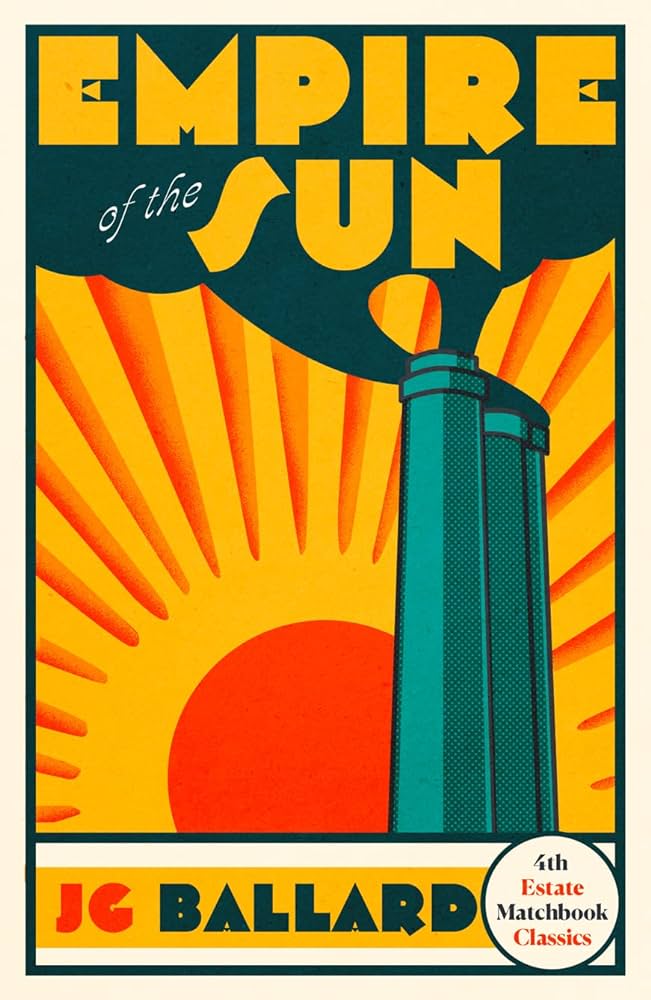
For an undergraduate like myself, though, it seemed a bit rich for the Merton College Professor of English Literature to be condemning other writers as elitists, especially when he pronounced that what the masses really wanted was the middlebrow novels of Anita Brookner. Growing up in working-class Gillingham, in a single-parent family that barely kept itself above the breadline, what I wanted was not Brookner’s insufferable Hotel du Lac but J.G. Ballard’s Empire of the Sun, outmanoeuvred on the 1984 Booker Prize shortlist by that year’s Chair, Professor Richard Cobb.When eight years later I was studying Joyce’s A Portrait of the Artist as a Young Man (1916) and realised that a whole passage had been parodied by Alfred Bester in The Stars My Destination (1955), this received history about modernism and mass culture began to smell decidedly fishy.
As I sit and write this in December 2022, I am surrounded by the excruciating noise of buildings being torn down, knowing that they will be replaced by something similar. The continuous drilling of machines make sounds like the earth is screaming as they cut deeper and deeper into it. The roads are being dug up again to replace or repair cables for our ‘modern’ technology. It’s not so much the abrasiveness of the noise that I find shocking, it’s the sheer waste of precious resources combined with the stark reminder of how we accept and even relish the bashing of nature into submission. Is this really the best we can do? Are we really advancing? Talking of which, the sun is shining bright, possibly a little too much for the time of year, and yet we appear to be unable to stop ourselves from destroying this planet which allows us our precious life. If only we could heed the warnings from fiction, as suggested by various articles in this issue. One step forward, two steps back. Then I reflect some more. I’ve just had a consultation with my doctor without leaving home and I’m preparing for a Cybersalon Christmas event that will be held simultaneously in a physical venue, an online platform and in Virtual Reality. Thankfully though, there are no hoverboards, drones or cars flying past the window of my top floor flat. I revise my pessimism. Two steps forward, one back. Which brings me on to the subject of this issue.
Speculative fiction is one of the sources the media, the general public, scientists and technologists use to frame the future. When asked about guest editing, I was in the midst of wondering whether, as a writer of near-future science fiction, I have a moral duty to reflect potential futures as accurately as possible, rather than simply selling the sensational. I was also beginning a project with King’s College London, writing short stories that raised ethical issues around using AI to automate the prediction of youth mental health problems. Issues such as whether it’s sensible to predict potential problems, whether we should use automated tools to minimise the costs and help clinicians, and whether losing the privacy of data is a price worth paying. At the same time as exploring the questions, I was busy asking myself if speculative fiction affects the future at all. Reading the articles in this issue has made me think that it most certainly does, and I’m not the only one who has been considering this. In 2020 Cory Doctorow published an article, ‘I’m Changing How I Write Fiction—for the Benefit of the Real World.‘ If fiction affects what people do through ‘intuition pumps’, he argues, then it could be a form of activism. For example:
New stories will help us understand the importance of seizing the means of computation and using it to build movements that break up monopolies, fight oligarchy, and demand pluralistic, shared power for a pluralistic, shared world.
Changing our intuition pumps is not easy, but it’s urgent—and overdue.
As I began to read around about the topic, I came across three terms that are often used interchangeably—prediction, forecast and foresight. If you’re not familiar with them, as you read through articles you’ll see how they differ and why we need clarity of definitions. Will Slocombe’s article also points out that speculative fiction has been used to explore how these might work, or not, in different contexts.
In Torque Control, Jo and Polina have taken me further with their four different approaches to applied science fiction. As they suggest, it’s possible that, ‘science fiction does make important differences to the world but that there is simply not yet a comprehensive or consistent theory to articulate how and why.’ So, I ask you to keep an open mind about the role of science fiction as you read on.
A 2013 working paper from the innovation foundation Nesta, ‘Better Made Up: The Mutual Influence of Science Fiction and Innovation,‘ sets out different ways in which speculative fiction might predict or influence the future. Its authors Caroline Bassett, Ed Steinmueller, and Georgina Voss argue, in a nutshell, that speculative fiction can: imagine technology that is then directly translated into reality (emphasising that this is very rare); influence how technology is framed, for example in discussion, regulation and development; inspire innovation industries and certain groups, such as hackers, the military or resistance movements; and influence how science and technology are understood, debated and judged in public.
A quote that is often used to describe the role of sci-fi in extrapolating current trends and their impact on society is from Frederick Pohl: ‘A good science fiction story should be able to predict not the automobile but the traffic jam.’ I would take this further and say that science fiction should enable discussions on whether the car is worth the traffic jam. It should provide us with ideas that can help us reflect on the political and ethical dimensions of the future. After all, science fiction doesn’t always warn us about the right things. For example, it has a tendency to focus on the existential risk of robots taking over and killing us all, when the mundane aspects of artificial intelligence are more likely to have serious consequences for society. Predictions don’t necessarily need to be accurate to encourage useful debate.
I’ve seen this play out through Cybersalon’s 22 Ideas About the Future project, with the subject experts developing their understanding of how science fiction can be used in foresight. As David Birch, thought leader in digital identity and digital money, says, ‘What these stories had in common was that they were not so much about how the money of the future would work, but what it would do to us and our relationships. I like being challenged to think about this because, as is often said, we tend to overestimate the short-term impact of new technology (cf. self-driving cars) but completely underestimate the long-term impact of new technology (cf. MySpace).’
With this in mind, it’s worth considering the long-term questions around how society might evolve. While preparing for a foresighting workshop I settled on four aspects: Firstly, the extent to which we continue to delegate decisions and outsource our agency to technology, mainly because we believe it to be more rational and hence more accurate than us; secondly, whether as a species we take the route of community and collaboration or whether we continue with a competitive ‘survival of the fittest’ worldview; thirdly, how far we continue into the insularity and individualism of neoliberalism and nationalism in contrast to becoming a more open and connected set of societies; and finally, our ability and willingness to shift our thinking, and in particular our planning and actions, from the immediate of the next few years to the longer term view of many decades.
That’s all very well, but how do we discuss these possible futures and how does fiction help us achieve them?
We know that stories are important in helping us imagine. We are a storytelling species. To quote Dr Danbee Kim, the neuroscientist for the wonderful graphic essay in this issue, ‘stories profoundly improve our abilities to remember and pass on complex information, gain perspective on difficult situations, and expand our capacity for empathy.’ And, in 22 Ideas About the Future media theorist Douglas Rushkoff explains that he sees speculative fiction creating ‘space for the novel‘ and ‘revealing truths we have hidden from ourselves.‘
Being inclusive about who takes part, and how, is crucial. Whenever we discuss our future(s) it is vital that we acknowledge who is fortunate enough to have access to conversations or the time to think about it, whether through set-piece projects or by reading and watching speculative fiction. Then, we must ensure those who are excluded become included. If this is not a familiar activity for someone, it can be worth pointing to the fact that, as Sara Stoudt alludes to in her article, many of our day-to-day encounters with statistics have a speculative narrative attached, the different possible impacts of climate change for example. However, we can expect resistance to democratising the future from those with power because, as Andrew Merrie notes in his interview, ‘Saying “that’s implausible” is often a way of cutting people out of the conversation or a power play to preserve or reify the status quo.’
If storytelling is this powerful, shouldn’t it focus more on positive futures, such as AI and humans working together to solve the big problems rather than competing for jobs, or even control of the planet? Solarpunk is a prime example of a subgenre that focuses on positive futures, and if you’re not familiar with it then it’s worth using the QR code in the graphic essay to find out more. However, as we see from the traffic jam argument, storytelling can also play a significant role in imagining the futures we want to avoid. As Douglas Rushkoff observes, ‘My facts and insights don’t penetrate closed minds […] If they would only consider the utterly implausible, even if just for kicks, I know I could take care of the rest.’ But beware. Whether a story is optimistic, realistic or pessimistic, as writer-researcher Yen Ooi notes, ‘It is exciting and romantic to dream about these technologically inspired futurescapes, but what these science fictional worlds often ignore—usually in an effort to create more exciting entertainment—is the fact that technology isn’t and will never be the main star in our reality.’ In a similar vein, Lauren Prater challenges us in her piece for UNHCR’s Project Unsung: ‘Could we embrace nature’s logic of emergence and shift from scaling to seeding change? Would something novel still be innovative if it was built slowly, over many generations and was decorated with our values rather than the capitalist logic of simply moving fast and breaking things? Would you give up efficiency and ease for mutual flourishing? No, really, would you?’
Storytelling in all its forms is important and what these articles and the projects I’m involved in tell me is that at every stage of the life-cycle of a story, from its worldbuilding and narrative, through to it being ‘received’, interpreted and retold, there is the potential for two-way flows of influence between scientists, technologists, writers and readers.
Recently, I was invited to take part in the project described in the article by Allen Stroud with the Defence Science and Technology Lab (DSTL), an executive agency funded by the UK Ministry of Defence (MoD). Deciding whether to get involved helped crystallise the moral issue I was busy thinking about into a real-life decision. One point of view is that it’s better to be in the room than not, another is that mere contact will taint. Having been approached by DSTL after a talk I gave at the Royal Anthropological Institute, I asked around to see if they were to be trusted and was fortunate enough to spend time chatting with their principal anthropologist. This led me to Allen’s project. My natural political inclination is anarchism, towards bottom-up community led action, delegating upwards the things that cannot be dealt with locally, all the way up to the global level. It was from this standpoint that I was making my decision. If my conclusion is that the life-cycle of a piece of speculative fiction does influence the future, then I had to decide if I would be contributing to the UK trying to be ‘top dog’ in a conflict or whether I’d be helping avoid conflict. I believe I made the right decision to get involved, but am keeping a close eye on how the project develops.
Coming back to the practicalities of using speculative fiction overtly to imagine possible futures. It’s important to think carefully about method and structure, and there are articles here that give good insights into how collaborative projects between subject experts and speculative fiction writers can work.
One of the standout problems I’ve already touched on is who gets to influence and be influenced. Therefore, in projects using speculative fiction the paramount issue has to be about creating a ‘level playing field’ for all, including any of the general public who are participating, making it clear that everyone has their own expertise to bring to the table. This can be achieved by equal payments, but often the project is part of a subject expert’s day job for which they are already paid, meaning it is better achieved by structuring the introductions and activities in a way that makes the equality explicit. It’s worth noting here that my experience is UK centric and there may be different difficulties with representation elsewhere that have different solutions.
An important factor in my deliberations has been understanding what’s in it for the authors, because if they’re not on board then we’re sunk before we start. Dr. Christine Aicardi, a Senior Research Fellow at King’s College London, interviewed the sci-fi writers in 22 Ideas about the Future: ‘I write from the perspective of a social scientist concerned with the social and ethical imports of future and emerging technologies […] I propose that through their speculative fictions, the authors are engaging with us to develop an ethics of the future—a fundamentally relational, speculative ethics of the future, which, to borrow from a foundational paper theorising responsible innovation, would aim at “taking care of the future through collective stewardship of science and innovation in the present.”’
It’s also worth noting that Christine and I have been involved in numerous projects over the past 7 years, often with returning experts, so there must be some perceived value in what we’re doing.
And there I am, back at the core question. However, after a wonderful journey of discovery, I have answers to my original questions.
Yes, speculative fiction does influence scientists and technologists in what and how they research, discover and invent. Yes, its predictions do affect the future if you take ‘predictions’ and ‘affect’ in their broadest sense. To an extent, it has a responsibility to be accurate and not sensational, but shouldn’t lose the ‘attractiveness’ of the story because then it’ll be ignored. It doesn’t have to be tech-utopian. For example, I want to warn and inspire, but not demoralise. At the very least, it should generate some action even if that’s only in subtle shifts of understanding and behaviour. And, although the primary purpose of speculative fiction is entertainment, don’t forget that pondering possible futures can also be entertaining.
Finally, to consider our futures through speculative fiction effectively we should avoid using individual stories as a prediction, but rather get a sense from a wide range of stories about the possibilities of where we might be heading, and what we might do about it.
I want to end with supercharged activism, the fourth approach to applied science fiction described by Jo and Polina in Torque Control. Having often been on the ‘fringe of the fringes’ with one foot on the ‘outside’ and one on the ‘inside’ of the mainstream, this is an incredibly attractive notion. After all, the future is ours and it’s up for grabs. So, let’s give it a nudge in the right direction.
Bio:
Stephen Oram writes near-future science fiction. His short story collections have been praised by publications as diverse as The Morning Star and The Financial Times. He is published in many anthologies and has two published novels. He also works with scientists and technologists to explore possible futures through short stories, and has co-edited three anthologies along these lines. He is a writer for sci-fi prototypers SciFutures and a founding curator for near-future fiction at Virtual Futures.
Extracting Humanity and Other Stories will be published in July 2023 by Orchid’s Lantern Press. His latest novel—Machine Nations—is currently looking for a home.
This article first appeared in Vector: Futures, a publication in part supported by the PASTRES programme (Pastoralism, Uncertainty, Resilience: Global Lessons from the Margins, http://www.pastres.org), funded by the European Research Council (ERC) (Grant No. 70432). PASTRES is co-hosted by the Institute of Development Studies (IDS) and the European University Institute (EUI).
Every issue of Vector is special, but this one is especially special. It is guest-edited by science fiction author Stephen Oram, and it was made possible through a collaboration between the British Science Fiction Association (BSFA), the UK’s oldest and largest association for writers, publishers and fans of science fiction1, and the Institute for Development Studies (IDS), an independent think tank affiliated with the University of Sussex.
The theme is ‘futures.’ Plural, obviously: science fiction would never be content with just one future. ‘Futures’ is also shorthand for ‘futures studies‘: horizon-scanning, strategic foresight, scenario planning, anticipatory governance, forecasting and backcasting, red teaming and wargaming, speculative design and diegetic prototyping, experiential futures, futures futures, superforecasting and plenty more besides.
When businesses, governments, financial institutions and other actors seek to peer into the future, they often use some variety of risk management. Risk management overlaps with futures studies, but it is really pretty distinct. As crystal balls go, it’s a prosaic one. It involves identifying risks, assessing (perhaps quantifying) them, monitoring them, and implementing treatment strategies (such as avoiding, reducing, sharing, transferring, or informed acceptance). There is even an International Standard for Risk Management (ISO 31000). By contrast, future studies is a field where the expert and the charlatan can be difficult to distinguish. Many futures practitioners may be unsure themselves which of these they are, or in what proportion they are both.
This issue’s cover was created by an AI. Or … was it?[1]
Machines have made art for a long time. In the mid 19th century, John Clark’s Eureka machine was dropping perfectly okay Latin hexameter bars on the daily. Harold Cohen’s AARON began scribbling in the 1970s and sketching plants and people in the 1980s.
But with the likes of MidJourney, DALL-E, Stable Diffusion, Disco Diffusion, Imagen, and Dream by Wombo, 2022 marks the start of a new era. These AIs accept natural language prompts and produce often startling images. Suddenly the conversation has shifted from what little the AIs can do to what little they can’t do.
The AIs can’t paint complex scenes with many parts, for instance. You’re better off generating the pieces separately and then jiggling them together in Photoshop or GIMP. They can’t paint eyes terribly well, unless your subject happens to be a stoner ghoul. If the moon shines behind your subject’s head, it often bulges strangely, bearing ominous tidings for tonight’s high tide.
Still, the AIs are getting better all the time. Some online art forums are already inundated with spam. There have been instances of AI users setting themselves up as freelance artists, claiming to create the images themselves using traditional methods (Photoshop is now ‘traditional methods’! We are definitely in the future).
Worse still, the rise of AI art has led to the rise of the AI Art Bro. These combat philosophers, who perhaps recently cut their teeth extolling NFTs, love nothing more than to troll freelance artists nervous about next month’s rent.[2] Yet it would be unfair to write off AI art just because it has some disagreeable advocates. Luckily, as science fiction writers and fans, we’re well-equipped to make more nuanced assessments.
Or … are we?
The uncomfortable fact is that science fiction hasn’t been amazingly good at illuminating the ongoing AI revolution. With notable exceptions, we focus on questions like, ‘Can an AI think? Feel? Love? Dream? What does the way we treat machines tell us about how we treat one another?’ These are enchanting and perhaps important questions. But they tend to overshadow AI as it exists within data science and critical data studies, and the huge role it is already playing in everyday life. So maybe science fiction writers could do more to infuse our work with an appreciation of AI as it actually exists?[3]
This is an extended version of the essay that first appeared in volume 50 number 3 of the SFRA Review.
Like a snowball picking up speed, the last year has seen a growing aggregate of academic and popular interest in sinofuturism, both in China and abroad. Writing in a special issue of Screen Bodies on queer sinofuturism, scholar and designer Yunying Huang notes that as of 2020, the only results in Chinese for the term were a conversation between artists aaajiao, scholar Gabriele de Seta, and curator Xuefei Cao, and “a workshop on ‘Wudaokou Futurism’ (Space 2019) which convened a discussion of Sinofuturism in the geo-physical location of the Beijing region” (Huang 59). This Wudaokou futurism workshop, in fact, was the impetus behind the SFRA Review’s 2020 sinofuturism special issue, with many of the same speakers who participated in the workshop — including original workshop organizer Dino Ge Zhang — contributing articles that built on their prior presentations.
The Wudaokou alternative futurisms conference itself was held in December 2019, when China was already in the grips of the pandemic that would soon engulf the United States, the United Kingdom, and the rest of the world. I participated from a dark hotel room at 5 am, Skyping in (this was before Zoom became an omnipresent part of our connectivity — a lifetime ago!) to talk about alternative modes of temporalities to an audience that was, themselves, temporally and geographically disparate. Since then, the technology that sweeps us along towards an increasingly interconnected future has also come under the same orientalist scrutiny that informs so much sinofuturist anxiety in the first place: from then US president Donald Trump’s abortive move to ban both TikTok and WeChat in the States, to the widespread conspiracy that Covid-19 is a Chinese bioweapon deliberately engineered to destabilize Western nations, to the fear of surveillance technologies deployed in Xinjiang and Hong Kong, the role technology plays in China’s place in the future is as central to Western perceptions and fears of global power relations as it ever was.
As I wrote in the introduction to the SFRA Review special issue on sinofuturism that grew out of the Wudaokou workshop, the theory itself has largely emerged as a concept applied externally to China by Western observers. By compartmentalizing sociocultural development as a form uniquely tied to the nation-state while also seeking to maintain both distance and otherness, sinofuturism differs from theorizations such as Afrofuturism (to which it is often compared) through its application to, not development from, the subjects it takes as object. As a result, the very label of “sinofuturism” developed out of the same orientalizing impulses that previously relegated China to a space of backwardsness and barbarism (Niu, Huang, Roh 2015) and which now attribute to it a projected futurity. Yet this Western label is one that Chinese authors and artists have appropriated and weaponized for their own creative ends, without necessarily sharing unified goals.
Authors of science fiction in China have uniquely grappled with this impulse, especially insofar as digital technologies — such as the growing e-publishing industry and networked media platforms — allow for the proliferation of new voices historically barred from traditional publishing venues (Xu 2015). What’s more, contemporary science fiction in China functions as a transnational form that centers a technoscientific process or material object as a means of introducing social change, rendering the aim of science fiction inherently future-oriented even when relying on the past or focused on the present. Because potential future ontologies are expected to be relevant to present extrapolations, they fundamentally rely, to some degree, not only on realistic depictions of possible technologies and circumstantial realism, but also the familiar perceptions of the extant material and digital worlds — a central tenet of sinofuturism’s omnivorous inclusion of technology, labor, art, and the visions it makes possible (Lek 2016).
Lawrence Lek, Geomancer , 2017. Poster from CGI Film. Courtesy Sadie Coles HQ, London
The globalizing effect of the internet and the subsequent rise in wide-scale digital exchange, in particular, has created a space for production in which Chinese authors are writing for an increasingly global audience and shifting their goals correspondingly. As early as the beginning of the 20th century, authors and public reformers in China (such as Liang Qichao, who, in his 1902 unfinished novel The Future of New China, described a utopian 1962 in which China was the dominant global power) were envisioning sinofutures in which China was preeminent on the world stage. The idea of China as a dominant force in the world yet-to-come continues through much Chinese science fiction today, from standout international sensations such as The Three-Body Problem to anonymously published digital short stories like “Olympic Dream.” For science fiction authors describing the Chinese future (or the future as Chinese), an awareness of the fact that American and Western media largely paints China as a place of repression and censorship is an integral part of the worlds they depict.
Guest editorial by Yen Ooi. Published as part of Vector 293 exploring Chinese SF.
Chinese science fiction’s (CSF) growth in popularity has followed the rapid development trend of China itself. In his interview with fellow writer Maggie Shen King, Chen Qiufan (a.k.a. Stanley Chan) highlights that China has over the last four decades achieved the technological and economic advancements that countries in the West achieved in the last century. The speed of modernisation and urbanisation is a remarkable thing to behold, with 100 million people lifted out of poverty just since 2013. China’s rise has been subject to international scrutiny and criticism, which is to be expected. The most unfounded of which plumbed new depths in the past year — 2020 — through the pandemic. While the previous president of the United States of America (among many) used the term “Chinese virus” in his description of Covid-19, East Asian diaspora communities living in Western countries experienced increased instances of racism. What is the connection?
Genres are in general difficult to define, but CSF is especially complicated. Both the terms Chinese and science fiction defy any clear definition, yet are used so commonly that every user has their own pre-assumed definition. One popular assumption in the West is that CSF should always be read in terms of political dissent or complicity with state power. As much as that might be true for some, it is an unhelpful generalisation. After all, we do not assume that British SF is only about Brexit, or American SF only about Trump. In one sense, all storytelling is inherently political, and within Anglophone SF especially, the racist and queerphobic attack on representational diversity is often disguised as a demand to “remove the politics” from our stories. However, the necessarily political nature of storytelling is complicated in the case of the Anglophone reception of CSF. The insistence of many Western readers on interpreting CSF exclusively in relation to government censorship can itself have a paradoxically censoring effect. Some CSF authors have even resisted writing stories set in China, or allowing the translation of their work into English, for fear that readers will ignore its actual aesthetic and intellectual qualities, while using it as material for simplistic speculation: Whose side are you really on? To quote Ken Liu — for what is a publication on CSF without mentioning the writer who, it feels like, has single-handedly brought CSF to Anglo-American readers? —
Like writers everywhere, today’s Chinese writers are concerned with humanism; with globalization; with technological advancement; with development and environmental preservation; with history, rights, freedom, and justice; with family and love; with the beauty of expressing sentiment through words; with language play; with the grandeur of science; with the thrill of discovery; with the ultimate meaning of life.
Ken Liu, Invisible Planets, 2016.
Chinese means many things: culture, ethnicity, nationality, language, people, food, celebrations, traditions, dance, art, tea, etc. It is impossible to talk about all things related to CSF, but we hope that we’ve managed to introduce some key ideas and concepts in this issue, and that you’ll find areas that particularly excite you — as a writer, researcher, or reader — to want to learn more.
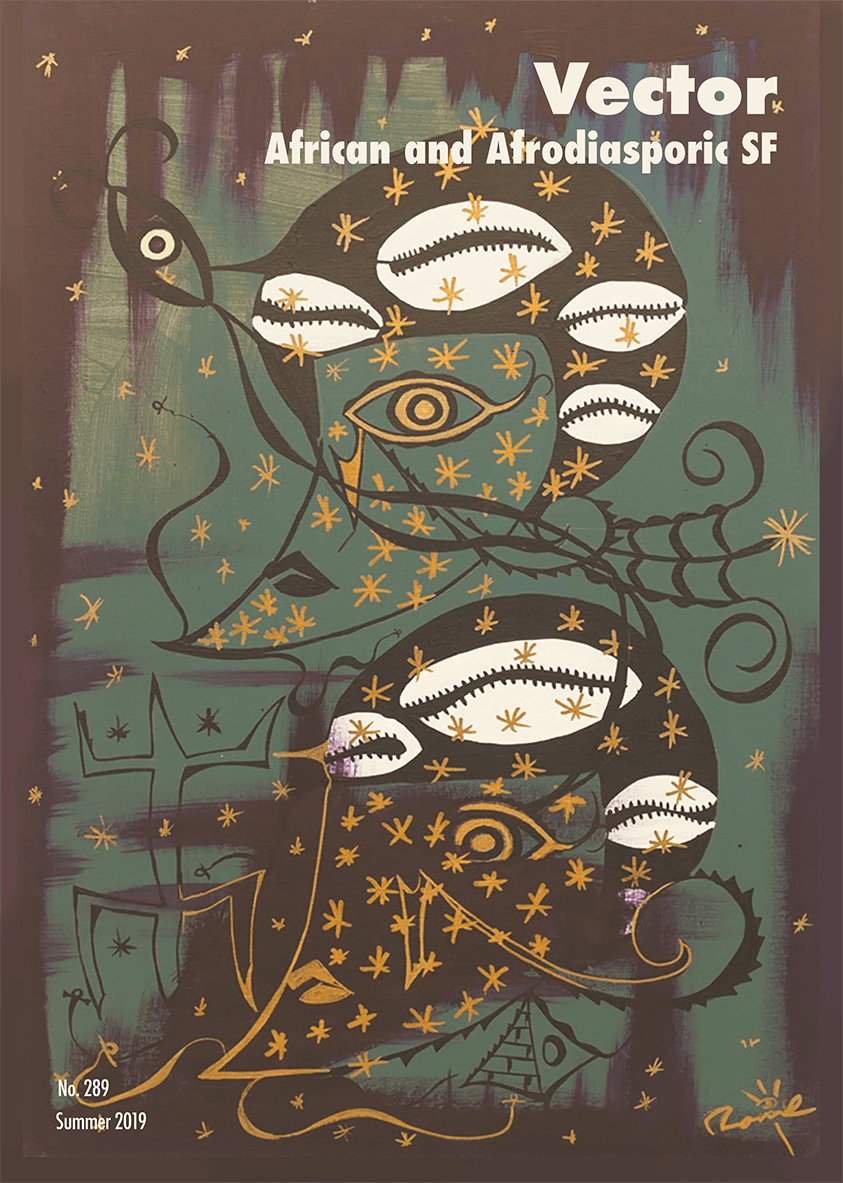
The following academic essay by Michelle Louise Clark is the guest editorial to Vector 289, a special themed issue on African and Afrodiasporic SF. SF from Africa faces contradictory challenges. It must fight on the one hand to be read as SF — and not just something SF-adjacent — to be given full use of the genre’s rich megatext of tropes and conventions. On the other hand, it must fight to be permitted to transform the traditional conventions of the genre, to make SF do new and different things. It must also often contest with the preconceived and reductive notions of Africa nurtured within the Western imagination. This editorial offers a broad and necessarily overview of African and Afrodiasporic SF, emphasising speculative Anglophone texts from sub-Saharan Africa.
License: Copyright Michelle Louise Clark, all rights reserved.
“Over the last two decades, Achimota City’s fast new geography had devoured Accra almost completely while at the same time most of the rest of the country had inexplicably vanished, land and all. Thus, by the year 2020 Achimota was a truncated city bursting to survive and to find the rest of its country soon. The three elders of government, each with a beard the shape of X, Y or Z, had shepherded the city over this deep crisis, directing history as if it were mad traffic. They had rules which helped to form the new ways that the century demanded. Fruit was law: every street had to have dwarf banana trees in belts and lines, buckled with close groups of any other fruit trees, so many guavas and oranges. There was fruit in the toilets, fruit in the halls, and fruit in the aeroplanes, so that you could eat the city.”
Kojo Laing, Major Gentl and the Achimota Wars (1992), p.3.
Realism and Resistance
A golden cockroach, a Grandmother Bomb, elders with beards shaped like letters of the alphabet, and a carrot millionaire are just a few of the eccentric characters which fill the pages of Kojo Laing’s surreal classic of African SF, Major Gentl and the Achimota Wars (1992). Laing’s novel is set in the distant future of 2020, at a time when the Ghanaian city of Achimota is locked in the Second War of Existence, battling Europe and South Africa, which have become a cyberworld where physical existence is deemed unnecessary. These virtual superpowers have decided that the ‘Third World’ is no longer relevant to their modernity, having been used as a toxic dumping ground, a place for germ warfare and genetic engineering and nuclear experiments. The city Achimota fights to recover the rest of its disappearing country, and to exist independently of Europe’s rhetoric and portrayal of it as primitive, reasserting its own worth and agency in the face of neocolonial domination.
The book has been praised as vivid and imaginative, but also characterised as unusual, complicated, and unclassifiable (Ryman, 2017; Klein, 2007; Ngaboh-Smart, 1997; Wright, 1996). T.R. Klein (2007) describes Laing’s work concisely: “Once the initially introduced ‘innocent’ reader decides against prematurely tossing away Laing’s difficult books and is willing to accept an encounter with cartoon-like images, allegories, and projections rather than full-fledged, realistic characters, s/he will be rewarded with the experience of a unique conjunction between technological and aesthetic modernity in African literature” (55).
It’s unfortunate that Laing’s work has so often been overlooked and underappreciated, as it has plenty to contribute to debates surrounding genre and ‘authenticity’ within African literature. He at once defies generic pigeonholing and challenges established norms of the Anglo-African literary canon. His unique prose “confidently defies simple reduction to a single larger theory, agenda or narrative” (Klein, 2007: 38), with its usage of words and phrases from across languages including English, Ga, Haussa, and Italian. He also addresses issues of science and technology before many Ghanaian authors had even begun to move away from nationalist rhetoric of post-independence Ghana (Klein, 2007).
In terms of genre, Laing’s work has been variously described as postmodern, utopian, or magical realism. Ngaboh-Smart (1997) identifies Major Gentl and the Achimota Wars as using “conventional science fictional motifs” to explore the effects of science and technology on humanity, and mentions the inclusion of “galactic travels” and “adventure.” This hesitancy and ambiguity is not uncommon in discussions of speculative fictions from Africa. Mark Bould (2015) suggests that one can come across science fiction from Africa mentioned by critical journals that refuse to use the term, or “would at least prefer not to, deploying instead a de-science-fictionalized discourse of utopia and dystopia, and labelling anything irreal as some kind of postcolonial magic realism or avant-gardist experimentalism”(13).
So SF from Africa faces contradictory challenges. It must fight on the one hand to be read as SF — and not just something SF-adjacent — to be given full use of the genre’s rich megatext of tropes and conventions. On the other hand, it must fight to be permitted to transform the traditional conventions of the genre, to make SF do new and different things. It must also often contest with the preconceived and reductive notions of Africa nurtured within the Western imagination. Jennifer Wenzel (2006) explains that Western readers who encounter ‘strange’ literatures from elsewhere often impose a binary between ”the West and the rest,” and between “a singular European modernity and multifarious worldviews, variously described as pre-modern, prescientific, pre-enlightenment, non-Western, traditional, or indigenous” (456). New readings of classic works such as Laing’s, alongside emerging work from Africa, are paving the way to a more nuanced map of Africa’s diverse speculative literature. This issue of Vector explores varying definitions, and showcases just a few examples from Africa and its diaspora across various mediums: from Nick Wood’s exploration of the South Africa’s comics scene and Joan Grandjean’s research into the Arab-futurist art of Mounir Ayache, to Jonathan Hay’s study of Afrofuturism in hip hop and its political aesthetics built on science fiction tropes of aliens and spaceships. Like artists everywhere, creators of African SF aren’t simply imagining worlds to escape to, but also exploring contemporary and historical reality through the lens of fiction. Gemma Field’s ecocritical reading of Nnedi Okorafor’s Lagoon acknowledges the slow violence of the oil industry in Nigeria. Masimba Musodza’s article opens up important questions about genre, language, and elitism within the African SF genre, through his experiences in writing and publishing his works in ChiShona. Definitions of Africanfuturisms and Afrofuturisms collide and converse in articles from Kate Harlin and Päivi Väätänen. Interviews with award-winning authors Dilman Dila and Wole Talabi give insights into the current movements within African SF directly from the creators’ perspectives.


 vector-bsfa.com