From Our Archive: Judith Berman on Cultural Appropriation

Bears, Bombs and Popcorn

Some considerations when mining other cultures for source materials, by Judith Berman

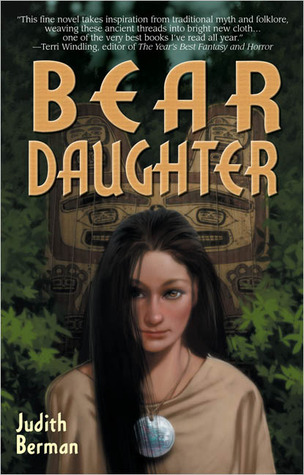
Bear_Daughter[The cover] painting is a made-up decoration merely done in Pacific Northwest style … meant to say to a reader “This novel is based on the mythology of the Pacific Northwest,” just as covers for other kinds of fantasy use images from Celtic, Norse, or Japanese mythologies to signal “pick me up” to the right kind of reader. ([Name withheld], p.c. Feb. 9, 2005)

In the background of the cover for my novel Bear Daughter sits an object that resembles a piece of Native American art. It looks, in fact, quite a bit like a painted wooden screen made by a Tlingit Indian artist in the early 19th century to represent the hereditary Bear crest of the Tlingit Naanyaa.aayí clan. That screen, now in the collections of the Denver Art Museum, formerly embellished the Ground Shark House in what is today Wrangell, Alaska.

Having worked for a number of years with traditional Tlingit art, I immediately recognized the resemblance of the cover image to the Naanyaa.aayí Bear screen. It also resembles, to a lesser degree, two other screens. The first of these, likely a copy of the Naanyaa.aayí screen, was made for the Killer Whale House of the Kaagwaantaan clan of Klukwan, probably in commemoration of the genealogical links between that house and Ground Shark House. The second, which the Naanyaa.aayí screen likely copied, is known only from a fragment preserved at the Burke Museum in Seattle.

Upon seeing the cover, my first concern was that the background object might be another related Bear screen, one I didn’t know about. Tlingit clan heirlooms like these screens are the focus, today as formerly, of deep emotions about one’s connections to past and future generations. The right to display such heraldic designs is a hereditary prerogative often acquired–“paid for,” as it is sometimes said–through the blood of one’s ancestors. In earlier times wars were fought over misuse of crest objects. A validated Tlingit crest object, as I wrote to my publisher, is

like a national flag, a trademarked product logo, a memorial to dead relatives and ancestors, and a family heirloom with strong emotional associations, all rolled into one. There is variation across the [northwest coast] region in what these objects mean and how they are used, but the notion that they are in some fashion property and “copyrighted” is near-universal.

Some crest heirlooms remain in Native custody, like the Klukwan Bear screen. Many others, however, have found their way into museums and private collections. The means by which they have done so are frequently not pretty, and the objects have been the subject of repatriation claims and other legal actions. Given that the cover artist had likely used photographs as the source for the cover image, US copyright law, which extends to so-called “derivative” images of copyright materials, might also have been called into play. In short, using an image of genuine crest art on my book cover could have been problematic.

Continue reading “From Our Archive: Judith Berman on Cultural Appropriation”

From Our Archive: Biographical Fantastic

Framing the Unframeable

What does the fantastic bring to the storying of lives? By Gary K. Wolfe

441px-Novalis2

“Unser Leben ist kein Traum, aber es soll und wird viellicht einer werden”.
(“Our life is no dream; but it ought to become one, and perhaps will.”)

– Novalis (Friedrich von Hardenburg), as quoted in George MacDonald’s Phantastes (1859)

“And do not rely on the fact that in your life, circumscribed, regulated, and prosaic, there are no such spectacular and terrifying things.”
– C. P. Cavafy, “Theodotus,” as quoted in Elizabeth Hand’s Last Summer at Mars Hill (1998)

When one looks at the published memoirs and autobiographical sketches written by science fiction and fantasy authors, mostly for the benefit of their fans – the sort of thing collected in Brian Aldiss and Harry Harrison’s Hell’s Cartographers (1975) or Martin Greenberg’s Fantastic Lives: Autobiographical Essays by Notable Science Fiction Writers (1981) – one is initially struck by the relative thinness and lack of genuine introspection of many of the essays. Typically, such pieces read as a variety of Augustinian conversion tales, depicting a precocious childhood, often solitary and bookish, sometimes sickly, sometimes featuring battles with parents to get into the adult sections of the library, and characteristically leading toward a moment of revelation: “And then came Hugo Gernsback” (Alfred Bester) [1] “Then I saw and bought an issue of something called Amazing Stories” (Damon Knight) [2] “So science fiction entered into and began warping my life from an early age” (Brian Aldiss) [3] etc. In one of the still-comparatively rare autobiographies of SF writers, Wonder’s Child: My Life in Science Fiction, Jack Williamson ends a chapter with the following cliffhanger:

Something else happened, however, in the spring of 1926, the first year I was out of high school. Something that changed my life. Hugo Gernsback launched a new pulp magazine, filled with reprinted stories by Jules Verne and H.G. Wells and A. Merritt and Edgar Rice Burroughs, stories he called “scientifiction.”

The magazine was Amazing Stories. [4]

Following these road-to-Damascus moments, however, these memoirs and autobiographies seldom become genuine testaments, instead amounting to not much more than narrative resumés, filled with anecdotes of encounters with fellow writers and editors and often with almost obsessively detailed accounts of sales figures and payments; one comes away with the sense that (a) science fiction writers all clearly remember the first SF story they read, and (b) they keep really good tax records.
Continue reading “From Our Archive: Biographical Fantastic”

Superhero_ines: Rebooted Comics and Trans* Identity

By Christina Scholz

Centre for Intermediality Studies, University of Graz, Austria

Manteau: Seriously? Bust? – What kind of things’ve you dialed so far? You been a giant metal spring, yet? A super-disco dancer? A boomerang? Now it’s bust because you’ve got ovaries? Every few dials, this happens, Baroness.
(Miéville & Santolouco, Dial H #3, 2012)

In this academic article, Christina Scholz explores trans* identity within comic books. Gender is a discursive and performative construct, and mass media such as comic books play a role in how it is constructed. Problems arise from discrepancies between prescriptive models of gender and individuals’ actual lived experience. Now, in the era of the reboot, comic book writers have the opportunity to change the identity politics inherent within well-known series, reaching a wide audience through iconic figures, and contributing to changing cisnormative perceptions of gender. Comic books are particularly crucially placed in this regard, since superheroes, as established metaphors of otherness, may in some sense already be ‘queer’ figures. However, although important and exciting steps have been taken toward better representation of trans* identities within superhero comics, we still have a long way to go. Drawing in particular on the theory of Judith Butler and Antke Engel, as well as lived experience, this article explores the past and present representation of trans* identities in comic books, and looks with hope toward the future.

Continue reading “Superhero_ines: Rebooted Comics and Trans* Identity”

WorldCon 75

By Jo Lindsay Walton

Vectors tweaked 2.png

It is Wednesday. I am in Helsinki. So is everybody else.

There are a few issues of Vector and FOCUS on the freebies table, courtesy of Dave Lally; but, of course, not for long.

I put in time in Messukeskus 209, the academic track. On Wednesday, Merja Polvinin introduces the Finnish Society for SFF Research (Finfar), its journal Fafnir, and the theme of the next five days. The theme is ‘estrangement.’

Elysium
Neill Blomkamp’s 2013 Elysium

Speculative fiction isn’t about other worlds, it’s about this world! In speculative fiction, we encounter real, familiar things, only made strange! There is a kind of political value to such encounters. In the movie Elysium, we encounter something real and familiar (unjust access to healthcare), only that thing is made strange.

By making the world strange, we can unsettle the distinction between what is possible and what is not. By making the world strange, we can see the world for what it really is, including all its promise and possibility.

At least, that’s the idea. Over the five days, I am struck by how accommodating and flexible and familiar the concept of estrangement has become.

Continue reading “WorldCon 75”

How to Finish a Review

By popular demand! Or at least by one request. It turns out that I don’t think there are neat little identifiable gambits to end a review with, at least not in the same way that I think there can be gambits to open with, so this post is less glib. Endings, at least for any review of more than a few hundred words, are about synthesis, which means they’re probably going to have several of the features identified below. The mix will depend on the focus of the review; I don’t think you can pick most of these and bolt them on to a generic review. It’s more a case of recognising the sort of review you’re going to write, or occasionally the sort of review you’ve written, and what it needs to wrap up satisfactorily.

1. Evaluation.

Not, actually, as important as you might think; it’s going to be hard to get to your conclusion without having made it pretty clear what you think of the book. But a straightforward endorsement or dismissal can be a nicely emphatic full stop.

2. Summation.

Again, more common than it is necessary. After a long — I’m talking several thousand words — review of a book that identifies a goodly number of positives and negatives, you might want to recap. But even then you might just be repeating yourself (perhaps the most boring way to start a conclusion is: “Overall…”) or not examining your own views hard enough: how many books are you really that split-down-the-middle on?

3. Culmination (narrative)

All synopsis, being selective and partial, is criticism. Not all criticism is synoptic, but if yours is, you’ll probably need to talk about the ending of the work being discussed; and structuring your review so that you talk about the book’s ending in your conclusion — even if only in affective terms, rather than in specifics — can be pretty effective.

4. Culmination (thematic)

There’s a good chance that, by the time you reach your conclusion, you’ve already written this: the perfect encapsulation of the book’s central thesis (either what works about it or what doesn’t), the verdict that all your examples point towards. So go back and steal it, and save it for the conclusion, where it will look like everything you’ve been saying about the book coming neatly together.

5. Culmination (yours)

That is, of the argument you’re making — about the book, the author, the genre, whatever — rather than the argument the book is making. Particularly useful for structuring reviews of short story collections, and again, you’d be amazed how often you write it half-way through without realising.

6. Slingshot.

Works particularly well with the Jeopardy opening: you answer your question, and identify the next question, leaving it for the reader to answer

7. Speculation.

In which you suggest answers to the next question. Characteristic of reviews of series fiction: where is it all going?

8. Reframing.

In which your last paragraph attacks the issues you’ve been discussing from a new angle, and hopefully the parallax generates some light. One way of doing this is to save your “A third of the way into the book…” and use it at the end of the review, rather than the start. Another is to talk about The Larger Point: open the review up to consider the author’s body of work, or the genre as a whole, if you haven’t been doing so to that point. In fact, now that I think of it, you could probably use any of the opening gambits in this way, as long as you haven’t deployed them already…

How to start a review

1. Jeopardy.

Think of your conclusion: the one thing you want anyone reading your review to know about the thing you’re discussing. Now think of the question to which your conclusion is the answer. (This works best if you have something more interesting to say than simply, “it’s good” or “it’s bad”.)

2. About a third of the way through the book …

What scene or event encapsulates the book’s strengths (or weaknesses)? Describe it. Make the person reading your review share your enthusiasm (or frustration).

3. Kick it LRB-style (version one).

Potted history of, or meditation on, the author’s career to that point.

4. Kick it LRB-style (version two).

Potted history of, or meditation on, a category of which the book is an example. (Useful when LRB-style version one is inappropriate, e.g. first novels.)

5. Bear with me for a minute …

Anecdote or trivia that illustrates something about the book under review, and thus makes it relatable for the reader. Works best if the nature of the link between the two things remains opaque until the moment you illuminate it. Use with caution in reviews of less than a thousand words.

6. Narcissism

A bit like option 5, but requires a stronger relationship with the audience, since the anecdote or trivia is about you, or your experience with the book (or another book by the writer), which is less likely to be of interest to a passing reader.

7. Here is some brilliant writing.

A bit like option 2, but you’re showing off the specifics of your subject’s prose. If you do this, you have to make at least one substantive point about the writing per sentence quoted. OK, you don’t have to, but you should.

8. Ronseal.

Offer up the most pithy summation of the book you can manage. The danger here is that if it’s too pithy, nobody will read on to get the detail.

9. Previously, on this book …

Ah, the synopsis. Almost always necessary at some point; but if it’s your opening gambit, it’d better be interesting.

10. Everyone else is wrong!

Quote one (or more) other reviewers about the book, then argue with them. The more high-profile the reviewer the better — as long as you can back up your claims. (Everyone else being right is also possible, but for obvious reasons trickier to pull off.)