Dancing Computers and Loom Libraries: Extrapolating Complex Information Delivery Systems from Historical Practices

By Eric Horwitz

Semiosis is second nature to us. The methods by which we transcribe and store information, the processes of creating and reading texts, are so baked into our everyday lives that we barely recognize them as inventions. People who we believe to be ‘ancient’ — civilizations who nevertheless succeeded many thousands of years of prehistory — believed writing to have been a miracle bestowed by heaven (Senner, 10-16). For our part, most of us seldom think about where writing comes from. If we do reflect on it, we might assume that writing is simply the best way (or the only way) to perform all of writing’s functions: our preoccupations are with the many hundreds of millions of bytes processed by a computer instead of the rote conventions of literacy. But that in the English-speaking world there should be some twenty-six visible orthographic marks and a handful of other numbers and symbols, that these should indicate English phonetics and be placed together to make words, that these words should be grouped into sentences with punctuation for clarification, that there should be this number of sentences on a page and that number of pages in a book, that a book should deliver information and move the heart within expectations of convention and genre, that there should be a library to organize these books, and that other languages though they use abjads, abugidas, or syllabaries, should be similar enough for translation — these are not inevitable developments. 

By looking at the early history of writing I hope to isolate key moments of its adoption and development into the primary medium of the literate world today. At the same time I hope to explore other methods of data collection and meaning transference, other systems of semiosis, and speculate on their potential to act as modes of literary communication as complex as the written word. In doing so I risk a Whiggish and deterministic approach to history, I flirt with clumsy teleology and notions of progress. I hope that these extrapolations are understood as not one-to-one equivalences on an imagined great path of history, as they would be in an inelegant alternate history. I don’t intend here to elevate writing above speech, song and dance; nor to imply that my inspirations are in any way lacking their own semiotic richness and complexity. Rather, I intend this article as a playful investigation into possibilities, and as a reminder of how speculative fiction often presents as ‘universal’ what are really just the technologies and practices of a handful of recent powerful empires.   

Continue reading “Dancing Computers and Loom Libraries: Extrapolating Complex Information Delivery Systems from Historical Practices”

Records mark the past, present, and future in Avatar: The Last Airbender

By  Samantha Solomon

Though Avatar: The Last Airbender’s (Nickelodeon, 2005-2008) final episode aired 14 years ago, the television show left an unforgettable mark on its young audience. When the show started streaming on Netflix in 2020, waves of viewers returned to watch, including myself. Perhaps people found comfort in the show during the pandemic, and many new eyes were opened to the incredible art, moving storylines, and powerful social criticism about war, industrialism, and oppression.  

For those who have not watched the show, some people in the world of Avatar are born with “bending” power, or the ability to manipulate one of the four elements (water, earth, fire, and air). Avatar follows the journey of Aang, the most recent reincarnation of the Avatar, the only person who can control all four elements. As the Avatar, Aang is connected to all his past selves and is the bridge between the mortal world and spirit world. In search of a way to defeat the tyrannical Fire Nation and restore balance to the world, Aang travels with water bender Katara and her brother Sokka. They are later joined by Toph, a blind earth bender who can sense motion and objects through the soles of her feet, and much later by Zuko, a reformed Fire Nation prince. 

“Water. Earth. Fire. Air. Long ago, the four nations lived together in harmony. Then everything changed when the Fire Nation attacked.”

Every episode is introduced this way, reminding the audience that despite endearing storylines about love and friendship, the show exists always in the context of war, genocide, and diaspora. That context allowed Avatar: The Last Airbender to explore deeply complicated themes using a speculative world inspired by many cultures, including Japanese, Chinese, Tibetan, and Inuit.

While there are several ways to analyze how that complicated world is rendered across each episode, I will focus on records, record-keeping, and documentation or “information-as-thing.” Information-as-thing applies to all kinds of tangible objects that embody knowledge. Documents are not the only records that contain essential information because “objects that are not documents in the normal sense of being texts can nevertheless be information resources, information-as-thing” (Buckland, 1991). A record can be a book. It can arguably be a fish (Ginsburg, Ruth B., Yates v. United States). Information-as-thing is usually manifested in something material, and people can read, see, interpret, misunderstand, understand, control, and destroy it. 

Finding other forms of resources outside of paper is also important in Avatar. Posters, maps, and scrolls often guide the main characters to an insight, refuge, or even triumph – but these documents are corruptible, easily changed or destroyed. The authoritarian regime of Earth Kingdom city Ba Sing Se disposes of posters and pamphlets that counter the government’s messaging in ‘City of Walls and Secrets’ (2.14). The totalitarian Fire Nation has re-written its history books to better suit its narrative of conquest in ‘The Headband’ (3.2). If these tactics sound familiar from our own world, it’s because they are meant to. And much like in our world, the fragility of paper documents, erasures of history, and domination of information exchange often require the past to be reconstructed through cultural objects, ancient architecture, and other artifacts. Even in a world of earth bending, where someone could use her power to shatter stone carvings and sacred temples, there are many intact structures and objects scattered across the four nations. 

Continue reading “Records mark the past, present, and future in Avatar: The Last Airbender

Just Make-Believe: Assumed Neutrality, Archetypical Exceptionalism, and Performative Progressivism in Dungeons and Dragons

By Kelsey Paige Mason

In a shareholder ‘fireside chat’ with Hasbro CEO Chris Cocks (former president of Wizards of the Coast from 2016-2022), and Cynthia Williams, the current CEO and president of WotC, both parties outlined Wizards’ four-quadrant strategy for investment growth with D&D: offering blockbuster entertainment, AAA high-end gaming, products for tabletop gamers, and products for the more casual fan.[1] Williams begins her response about Dungeons and Dragons by saying, ‘D&D has never been more popular, and we have really great fans and incredible engagement, but the first thing I saw with it is the brand is really under monetized.’[2] From their new acquisition of D&D Beyond giving them market insights into personal games,[3] to creating an environment which encourages ‘recurrent spending,’ much like paid DLCs and pay-to-play models of digital games,[4] Wizards is working towards taking advantage of D&D’s 50-year legacy but also its position as ‘a cultural phenomenon right now.’[5] By ‘engaging and surrounding the consumer’[6] with game products, entertainment media, and personal accessories and collectables, Wizards is building a unified lifestyle brand, under the codename One D&D. Wizards has already seen the success of D&D becoming a ‘generic trademark,’ where Dungeons and Dragons has colloquially become the shorthand or stand-in for the genre of tabletop roleplaying games. With more brand recognition than their most profitable property, Magic: The Gathering,[7] Wizards is working to expand beyond manufacturing simply TTRPG ‘products,’ and instead capitalize on fandom in all its forms – from film and video games to actual play performances[8] and lifestyle accessories.

While the shareholder seminar focused on how to increase spending opportunities for consumers to increase profits, WotC’s outward facing PR has instead – since at least 2014 – marketed the D&D lifestyle as a community, one which sees Wizards’ products as secondary to fostering a community of players and game masters (GMs). In the opening pages of the 5th Edition Player’s Handbook, Mike Mearls writes, ‘Above all else, D&D is yours.’[9] After the recent controversy with proposed replacement of the Open Gaming License (OGL), Kyle Brink echoed a more sheepish form of this sentiment, saying, regardless of whether the community trusts Wizards again or not, “either way, play your game with your friends. You don’t need to have [Wizards] at the table if you don’t want to. You know, your game is for you. We’ll make stuff for it, and if you want it, we’ll be over here making it. You can come get it. But, honestly, we should not be messing up your game. You should be playing your game.’[10] Statements put out by Wizards, Dungeons and Dragons, and D&D Beyond often invoke the community, while often simultaneously diminishing their own role in shaping that community. Wizards of the Coast (WotC) is actively and aggressively working towards, not just strengthening Dungeons and Dragons as a brand, but more importantly, pushing towards greater monetization of Dungeons and Dragons as a lifestyle. The first part of my work in this chapter is an analysis of published game materials, public statements, and recent events since Wizards of the Coast’s commitment to diversity in 2020.

Ultimately, this work aims to uncover what benefits are afforded to Wizards as a result of their push towards diversity and inclusion as part of rebranding and how this commitment allows greater control over reconciling D&D’s problematic history with monetization plans for the future. This reconciliation, tied with a unification and tightening of the ‘community’ of D&D fans, works more towards the security of D&D’s brand than as a platform for political progressivism. While there should not be any expectation for social change emerging out of a multi-million dollar corporation, the importance of my chapter’s intervention is to demonstrate how Wizards has used the language of social justice and progressivism to create an appearance of a utopian D&D community. My focus in analyzing WotC and D&D is not whether WotC’s revisions of game materials to move away from their racist, sexist, and ableist origins are beneficial to the brand. Rather, I investigate whether these utopian moves are demonstrably present in D&D products, in WotC as a workplace, and in the types of social relationships the game promotes.

Continue reading “Just Make-Believe: Assumed Neutrality, Archetypical Exceptionalism, and Performative Progressivism in Dungeons and Dragons”

Rejigging the Algorithm

How Jennifer Walshe is Reinventing the Music of the Past and Reclaiming the Music of the Future

By Paul March-Russell

One of the highlights of the 2022 Proms season was the London premiere of The Site of an Investigation (2018) by the Irish avant-garde composer Jennifer Walshe. This thirty-three minute piece in twenty-six sections offered a synopsis of Walshe’s preoccupations. Walshe herself, sounding like a cross between Laurie Anderson and Diamanda Galas, took the role of soloist, offering an elegiac commentary upon such topics as the race to Mars, the threat to the oceans and the prospect of digital immortality. The orchestra, largely acting as the symphonic backdrop to Walshe’s fragmented monologue, were further inveigled into the proceedings by waving party streamers, building and demolishing a tower of bricks, and wrapping a four-foot high giraffe in crinkly paper. Both the absurdity and incoherence of the piece, culled from an array of internet sources, recalled ‘the blip culture bombardment’ of the mediascape in Don DeLillo’s White Noise (1985).[1]

Jennifer Walshe/Arditti Quartet, EVERYTHING IS IMPORTANT (2019). Credit: IMD 2016/Daniel Pufe

Exactly a hundred years since the first composition of Kurt Schwitters’s sound poem Ursonate (1922-32), a text that Walshe cites as an inspiration,[2] such anti-art performances can still drive audiences either to delight or despair. In Walshe’s case, however, The Site of an Investigation is only an adjunct to her two main projects in recent years. The first, Aisteach, archives an alternate history of an Irish musical avant-garde that never existed, presenting original sound recordings and learned academic discussion. The second, The Text Score Dataset 1.0, involves the compilation of over 3000 text scores with which to retrain machine learning algorithms so that new scores can be generated by AI. This article offers an introduction to these two projects from the perspective of Walshe’s acknowledged debts to science fiction. The final section presents a speculative synthesis since, at the time of writing, Walshe has not linked the two projects together. But what if Aisteach was included as part of the dataset? What kind of future music emerges from an invented set of past sounds? How might we reclaim the future as well as the past? Could we obviate that ‘slow cancellation of the future’ as described by Mark Fisher and others?[3]

Continue reading “Rejigging the Algorithm”

We Will Never Escape Utopia: Gender, Queer, Pragmatic, and Hopeful Utopia in The Treasure at the End of the Dungeon is an Escape From This Dungeon and We Will Never Escape From This Dungeon

By Grace A.T. Worm

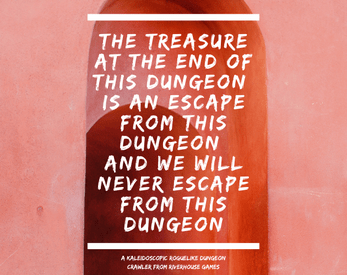
The Treasure

Long game title, white text on red

In the tabletop roleplaying game The Treasure at the End of the Dungeon is an Escape From This Dungeon and We Will Never Escape From This Dungeon (hereafter The Treasure), players enter the game’s imagined world, a dungeon, knowing that the ‘treasure’ they seek by playing the game is impossible to acquire. The game cannot be won, only perhaps eventually abandoned. It may seem counterintuitive to discuss utopia in a game that announces from the beginning that its systems and structures are permanent, and that any attempt to escape them is ultimately futile. However, it is through this surrender to the process that players learn the lessons of continued hope, perseverance, and community that serve as a foundation for much of contemporary utopian thinking. For these reasons, in this chapter I describe The Treasure as a utopia, while also recognising that it may appear dystopian.

The Treasure can be understood as a process for utopia that, through play, invites the players to build their own counternarratives about what is valuable in the world they enter into, and also work together to change that world, even knowing that practically they will never ‘win’ the game. It is necessary to adapt an in-flux knowledge of utopia through a queer and feminist understanding of a future that will never reconcile the painful past. If the players cannot escape the dungeon, then the focus shifts to developing their characters’ relationships through roleplaying. The absurdity of the players’ situation, the cycle of endless dungeon rooms, and the descriptions of characters and rooms, encourage a sense of camaraderie and community. In this sense, the game reflects the structure of utopian hope. For the players, the importance lies in fighting the cycle even when the outcome may never change for, as the game states in the world description, ‘We will never escape this dungeon. We will always try to escape this dungeon.’[1] It is possible to work towards utopia while being pragmatic in the knowledge that a perfect future does not exist. In the rest of this chapter, I examine the function of archetypal characters, the utopian dimensions of the players’ roleplaying, and how the game mobilises themes of pragmatism in relation to its feminist and queer utopian ideals.

Utopia is a complex term, and how different pieces of media create and present utopia varies wildly. For this chapter, I approach utopia as a practice stemming from discontent that arises from problems in the present, and exploration of possible futures where these problems are solved or nonexistent. Later in this chapter, I will explore how this vision of utopia shifts into focus through a queer and feminist lens. As suggested by Lucy Sargisson’s Fool’s Gold?: Utopianism in the Twenty-First Century (2012)and Erin McKenna’s The Task of Utopia: A Pragmatist and Feminist Perspective (2001), utopia can present visions of a future in which deeply entrenched social, economic and political problems are resolved or transformed. Sargisson writes that utopia is working towards ‘identifying core problems with today […] and placing them in a new imaginary context. They thus imagine how the world might be if the core “wrongs” identified by the author were transformed.’[2] McKenna explores utopia in relation to the philosophical tradition of pragmatism, and also emphasizes the centrality of hope in interacting with utopian ideals: ‘Utopian visions are visions of hope that can challenge us to explore a range of possible human conditions.’[3]

Utopia is ostensibly where problems are fixed. The creation of a completely separate and carefully integrated fantasy world has often been central to utopian thinking; and not just that it is separate, but that it is totalising. Fredric Jameson describes the movement away from causal utopias as either obsolete due to an inability to solve any and all social disintegration or due to the unparalleled global wealth and technology; however he argues using utopia as an idea to examine politics is still useful.[4] Thomas Moylan in Demand the Impossible similarly describes this developing idea of utopia as imperfect and rejects utopia as blueprint, he describes utopia as ‘[f]igures of hope’ through opposition where utopia is ‘produced through the fantasizing powers of the imagination, utopia opposes the affirmative culture maintained by dominant ideology’.[5] The completely separate utopian world — with readily available solutions for all the problems it seeks to overcome — has fallen out of favor. As Sargisson writes, ‘Most contemporary utopias tend not to offer visions of complete worlds. And most contemporary utopias avoid depicting a single solution; they decline to offer one complete and finished vision of the good life.’[6] In contemporary society, where political, religious, social, and environmental issues have remained at least as divisive as they have been historically, the idea of a perfect utopia that solves all the major conflicts of our current society seems impractical. The Treasure is fundamentally focused on creation and exploration, while providing enough character descriptions to spurn new identity formation without homogenising identity experiences. For example, there is no perfect solution to climate change, and scientific consensus on its causes has not translated to broad political and public agreement, but this does not preclude the struggle for environmental justice. So progress must be made in a more improvisatory, patchwork way. Similarly, contemporary utopias usually don’t try to articulate one single vision of society that is so compelling nobody could refuse it.

Continue reading “We Will Never Escape Utopia: Gender, Queer, Pragmatic, and Hopeful Utopia in The Treasure at the End of the Dungeon is an Escape From This Dungeon and We Will Never Escape From This Dungeon

“Finding Nothing Can Be Finding Something”: Medievalism, Book History, and Accessing the Archives in Patrick Rothfuss’ Kingkiller Chronicle

By Grace Catherine Greiner

This story begins with a book that was given, and then taken away.  It was Christmas Eve, the night my family and I traditionally exchange gifts.  My youngest sister took her turn doling out packages, many of them small, rectangular—the size of books.  My brother and I were recipients of two such similarly-sized, book-shaped packages.  We were instructed to open them simultaneously (with the caveat that they might be mixed up, that I might be holding his, and vice versa).  I tore off the wrapping paper from my book and behold: it was the wrong book. 

This is how Patrick Rothfuss’ The Name of the Wind (NW) first made its way into my hands:[1] briefly, and only to be snatched away and swapped with another mainstay of contemporary fantasy writing—Brandon Sanderson’s The Way of Kings.  This first encounter, however, is hardly inappropriate given the particular place of books—the ways they circulate, the value they hold, the physical spaces in which they’re stored—in Rothfuss’ Kingkiller Chronicle, a trilogy whose third installment has yet to appear on shelves (though an off-shoot novella, The Slow Regard of Silent Things, has offered readers an interlude while they wait for no. 3).

The Chronicle is, from its earliest chapters, exactly what it says on the box: a chronicle—events which are being written down by the appropriately-monikered Chronicler, who records, by hand, the life events of the narrator, Kvothe—musician, student, and would-be arcanist-turned-innkeeper by the time we meet him in the outer narrative frame of The Name of the Wind.  Kvothe’s life story, as told in The Name of the Wind and its sequel, The Wise Man’s Fear,[2] follows his development as a young boy who grows up among an itinerant troupe of performers (thespians, musicians, and magicians) and is singled out, at a young age, as a prime candidate for education at the (apparently singular) University and instruction in the arcane (read: magical, but also scientific and plastic) arts.  Before the troupe’s massacre by the mysterious Chandrian (a traumatic event which kindles his desire to enter the University in order to gain access to its famous Archives and learn more about his family’s killers), Kvothe begins his training in the art of sympathy with the skilled arcanist who travels with the troupe.  From this arcanist, he inherits a book—a book that he later hocks to fund his first term’s tuition at the University, where he undertakes study in a variety of subjects, quickly passing from one rank of the Arcanum to the next whilst also facing an inordinate number of extracurricular trials and adventures along the way.

As the title of the trilogy and its first installment suggest, names, stories, and storytelling should be at the forefront of our minds as we read the Chronicle—stories which we witness literally coming into being as stories as we listen to Kvothe tell them and watch Chronicler write them down on one broad sheet of paper after another.  But it’s not only stories themselves which fascinate Rothfuss and his characters in the Chronicle.  It is also the physical forms through which stories and histories are transmitted that matter.  That is, for Rothfuss and his characters, books matter

Continue reading ““Finding Nothing Can Be Finding Something”: Medievalism, Book History, and Accessing the Archives in Patrick Rothfuss’ Kingkiller Chronicle

On Tabletop Roleplaying Games and Fictioning 

By Simon O’Sullivan 

Seven purple polyhedral dice

What is at stake with tabletop roleplaying games? That is, besides the entertainment they offer (or besides their status as games)? Although I no longer play them as immersively as I once did (the phase of truly being in those worlds was relatively short, perhaps four years from age twelve or so to sixteen), they have had a determining effect on my imaginary and, I think, on the various life choices I have made (in many ways the art and ‘theory’ worlds I have lived in and moved through seem—in retrospect—a logical progression from those other worlds, albeit these latter worlds are more ‘worldly’ if sometimes less vivid). That said, I have recently taken on the role of a Games Master for my own two sons and have now watched them enter into what always seemed to me another space-time. Put simply they too have become caught up in exploring these other parallel worlds. Indeed, I remember clearly when, as it were, the penny dropped. When the two of them suddenly realised that this was not simply a game, but something else altogether.[1] Something much stranger, but also more magical. It was as if they had gone through a gate and, with that, had entered more fully into the characters (and the landscapes) they were playing. Since then, the eldest of them has been hooked and the refrain that I once spoke is now on their lips: Dungeons and Dragons (which is what we were playing) is not simply a game. It’s a way of life. Quite an over-the-top statement, but for a time it really was as if this were the case for me (as it is for them now). There is much more I could say here about their adventures. About how easy it is for them and their friends to enter these worlds, switch perspectives and so forth (and then also deeply experience various emotions within the game). About the importance of preparation, of setting a context, in order to allow this other kind of inhabitation to effectively take place (although I am also often surprised at how few ‘props’ are needed for the shift in perspective to be made).[2] And then also about how these games relate to other games—that are also more than games—that they play ‘outside’[3] (what is now called LARPing, although, for them, there are not necessarily any costumes or other props, besides that which is found lying around).[4] Some of those observations and reflections might appear in some other writing—some fiction perhaps?—that is, in a more appropriate form to what is happening in those worlds and with those children (and in my own late childhood) especially when on the cusp of adolescence (which, it seems to me, is when our imaginaries are predominantly formed).

In fact, my own experiences with roleplaying games was also split between live play—out on the moors in the North of England in my case—and then playing various tabletop roleplaying games themselves which, in many ways—when I first encountered them—somehow extended that live play and, again, made it more vivid (despite it coming after and being one step removed from the live play). I remember like it was yesterday the first actual tabletop roleplaying experience, which was Dungeons and Dragons. This was the most important game, though others followed.[5] The slight puzzlement about what we were doing (the game was initiated by an older boy) and then the moment it all fell into place—again, the penny dropped. I was hooked. Or we were. For this history I am briefly laying out is not just about me but about my twin brother too. We both entered that world—as we did many others—together.[6] There is also much more to say about this, but it is not just my own story and so I leave it to one side—except to draw something important from this determining factor: there were always two of us (at least) and so there was always already a community and a discourse happening around these experiences and this world creation.[7] The experience of roleplaying was precisely shared (I will, in fact, return to this).

Enough biography. I want, if I can, to move a little deeper in, to shift, perhaps, from the realm of memories and images into something more theoretical. Or, as I said at the beginning of this essay, to think about the importance of these games beyond the games themselves. So, first of all, I mentioned ‘world creation’ above and, clearly, with tabletop roleplaying games there is a kind of world making that goes on beyond fiction per se. In these games one is actually living ‘in’ the fiction to some extent (or, at least, shuttling between the fiction and the reality outside of this). Certainly, as a character in the game one is making decisions that determine outcomes. In fact, even here things are a little more complex as there are two positions to occupy. One is the Games Master who has initially built or, really, written the world—even if they are using a pre-prepared scenario, they need to add detail, narrate the encounters, bring the world to life (I should also say here that my experience was that these worlds were always more successful when written by the Games Master). And then there are the players who then enter into that world and, with that, continue the world building or give it another dimension.

In passing it is interesting—for me at least—that universally it was my twin brother who would function as Game Master whereas I would be the player (or one of them). I think this determines a certain take on the imagination. A focus on construction and a generosity in building a world for another (and then, presumably, the satisfaction of seeing that world being interacted with). And then the other position, more oblivious to the scaffolding and the ‘behind the scenes’ work and so forth. More a sense—and perspective—of just being thrown in. In fact, both are—of course—needed, and, in fact, the two make the game, which is to say without the Game Master there is no world, or if there is, it is one that is chaotic, too spontaneous; and without the players the Game Master has simply penned a fiction.[8] These worlds need building and animating. They need to be invented and then believed in—interacted with ‘as if’ real—in order that everything can take off and, with that, become something that is greater than its parts.

Continue reading “On Tabletop Roleplaying Games and Fictioning “

Two Ideas of Justice

By Gautam Bhatia

As a genre committed to exploring “alternatives to how we live”, questions of justice have always been at the forefront of contemporary SF writing. One of the most frequently recurring themes has been that of crime and punishment: indeed, SF’s focus on technology has allowed writers to explore a range of questions related to criminal justice, from policing (Philip K. Dick’s “precogs” come to mind) to prisons. Some of the most interesting thinking has considered entirely alternative forms of criminal justice altogether: for example, Alastair Reynold’s The Prefect gives us a brief glimpse of a future society where policing takes place through randomly selected civic volunteer militia, which are disbanded as soon as the immediate task is done.

Issues around criminal justice fall within the broad category called “corrective justice”: i.e., at their root, they deal with how to rectify a wrongful harm or injury inflicted by one person (or set of persons) upon another. Corrective justice assumes a prior normative consensus about what constitutes wrongful injury, and then asks: how is this injury best rectified? Variants of this question are at the heart of the many volumes of science fiction that deals with policing, crime, and punishment. They are also present in some of the most famous “courtroom” scenes in SF: for example, in Star Trek: The Next Generation’s The Measure of a Man, Commander Data must establish that he is entitled to a right to self-determination, in order to avoid being dismantled by Starfleet. The establishment of his rights takes place through structured courtroom argument, and it turns upon the interpretation of existing Starfleet law.

There is, however, another set of anterior questions that corrective justice and courtroom set-pieces do not adequately address. These are questions of “distributive justice”: that is, the allocation of resources across society [1]. Questions of distributive justice are embedded within the political economy and the constitutional arrangements that structure a society. It is here that I think that we have not yet seen the variety and diversity of treatment in SF that we have seen when it comes to questions of corrective justice.

Consider, for example, Isaac Asimov’s Foundation Trilogy and Arkady Martine’s A Memory Called Empire and A Desolation Called Peace. The two series are separated by seven decades, and—as Martine has noted in interviews—A Memory Called Empire, in many ways, is in conversation with, and responds to, Foundation. However, while very different in their sensibilities, the two series are united in their starting point: i.e., the choice of Empire as the overarching governing and administrative framework of the galaxy. With this initial choice, a set of other choices inevitably follow: a certain structure of the political economy, centralised administration, the distinction between a core and a periphery, and the flow of resources from the latter to the former. While both series explore a range of questions with great subtlety and thoughtfulness within this context, their basic assumptions—that go to questions of distributive justice—are unshakeable [2].

Iain M. Banks’ Culture novels and the Strugatsky Brothers’ Noon Universe are two SF series where the starting point—in terms of governance and political economy—is very different, and therefore presents us with different questions of justice. Both the Culture and the Noon Universe and imagine a post-scarcity, anti-capitalist society, where there is no more private ownership over the means of production (the root of a lot of distributive injustice). However, both the Culture and the Noon Universe come to us as fully-formed, mature societies, with the writers focusing almost exclusively on external conflict with other societies (and thus dropping us back into the well-traversed terrain of corrective justice: think of Banks’ Look to Windward or the Strugatskies’ Hard To Be A God).

One striking exception is Ursula K. Le Guin’s The Dispossessed. The Dispossessed is an SF meditation on distributive justice par excellence. Le Guin takes us into the nuts and bolts of how Annares—an anarchist, non-capitalist, post-carceral society—would function in practice. The questions she considers range from social production (indeed, running through The Dispossessed there is an open question of whether it is just that the weight of moral consensus effectively compels everyone to spend a certain amount of time engaging in physical labour, regardless of what their other talents might be) to social reproduction (i.e., the range of activities that ensure the continuation of social life, including child-rearing). Indeed, in The Dispossessed, questions of distributive justice are presented particularly starkly, as Annares is a counterpoint to the planet Urras, where a recognisably capitalist and a recognisably state-socialist nation-state are locked in a conflict with each other.

The Dispossessed is not entirely alone in this. There is a tradition of writing—such as Kim Stanley Robinson’s Blue Mars [3]—that has built upon it. It is my impression, however, that as a genre, SF still remains overwhelmingly focused on issues around corrective justice. That is not to suggest that these issues are unimportant or uninteresting; however, as we enter a time in which the climate crisis reveals to a greater and greater degree the unsustainable bases of our current society and political economy, it will therefore be interesting to see if science fiction will respond with a greater, sharper focus on questions of distributive justice.

Notes

[1] The terms “corrective justice” and “distributive justice” are, of course, reductive; I use them here as placeholders for a set of family resemblance concepts. Here I focus on these two concepts of justice, although other important distinctions include those between “retributive justice,” “restorative justice,” and “transformative justice.” Broadly speaking, retributive justice focuses on punishment and compensation, restorative justice focuses on repairing relationships between offenders and victims, and transformative justice focuses on changing both these interpersonal relationships and the wider social and economic structures within which harm occurs.

[2] Although, arguably, they are challenged to an extent at the end of Foundation and Earth, and with First Contact in A Desolation Called Peace.

[3] See e.g. Will There Be Justice? Science Fiction and The Law (2019), Tor.com. www.tor.com/2019/08/07/will-there-be-justice-science-fiction-and-the-law/

Gautam Bhatia is the author of the SF duology, The Wall and The Horizon. He is the co-ordinating editor of Strange Horizons. In his spare time, he is a constitutional lawyer.

Torque Control: Writing Futures

By Jo Lindsay Walton

NightCafe AI’s response to “Sunflowers, Van Gogh”

Klara and The Sunflowers

This issue’s cover was created by an AI. Or … was it?[1]

Machines have made art for a long time. In the mid 19th century, John Clark’s Eureka machine was dropping perfectly okay Latin hexameter bars on the daily. Harold Cohen’s AARON began scribbling in the 1970s and sketching plants and people in the 1980s.

But with the likes of MidJourney, DALL-E, Stable Diffusion, Disco Diffusion, Imagen, and Dream by Wombo, 2022 marks the start of a new era. These AIs accept natural language prompts and produce often startling images. Suddenly the conversation has shifted from what little the AIs can do to what little they can’t do.

The AIs can’t paint complex scenes with many parts, for instance. You’re better off generating the pieces separately and then jiggling them together in Photoshop or GIMP. They can’t paint eyes terribly well, unless your subject happens to be a stoner ghoul. If the moon shines behind your subject’s head, it often bulges strangely, bearing ominous tidings for tonight’s high tide.

Still, the AIs are getting better all the time. Some online art forums are already inundated with spam. There have been instances of AI users setting themselves up as freelance artists, claiming to create the images themselves using traditional methods (Photoshop is now ‘traditional methods’! We are definitely in the future).

Worse still, the rise of AI art has led to the rise of the AI Art Bro. These combat philosophers, who perhaps recently cut their teeth extolling NFTs, love nothing more than to troll freelance artists nervous about next month’s rent.[2] Yet it would be unfair to write off AI art just because it has some disagreeable advocates. Luckily, as science fiction writers and fans, we’re well-equipped to make more nuanced assessments.

Or … are we?

The uncomfortable fact is that science fiction hasn’t been amazingly good at illuminating the ongoing AI revolution. With notable exceptions, we focus on questions like, ‘Can an AI think? Feel? Love? Dream? What does the way we treat machines tell us about how we treat one another?’ These are enchanting and perhaps important questions. But they tend to overshadow AI as it exists within data science and critical data studies, and the huge role it is already playing in everyday life. So maybe science fiction writers could do more to infuse our work with an appreciation of AI as it actually exists?[3]

Continue reading “Torque Control: Writing Futures”

Dialogues Between Science and Fiction in the Creation of an Anthology

Emma Johanna Puranen

Introduction

As Le Guin famously put it, “science fiction is not predictive; it is descriptive”. Science fiction reflects what its writers see in the world around them—often from current scientific discoveries—and it sparks ideas for scientists. Scientists and SF writers endlessly inspire each other in a classic chicken-or-egg scenario. But little research has been done on how exactly this inspiration happens — on the dialogues and interactions between these two often-overlapping groups. Given SF’s reputation for applied speculation and future thinking, these dialogues are key to any studies of the same. I address this gap through analysing qualitative data on the experiences of scientist and writer participants in an SF anthology project which included significant interdisciplinary encounters. 

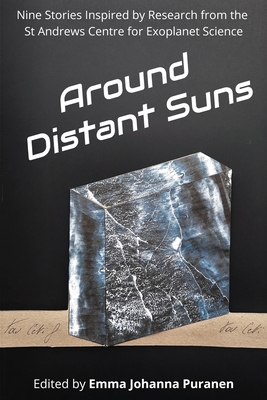
Around Distant Suns: Nine Stories Inspired by Research from the St Andrews Centre for Exoplanet Science (2021) is my recently-published SF anthologycontaining five short stories, two radio play scripts, and two poems. Each contribution was created by a pair of one scientist and one writer, and has a basis in the scientist’s research. The St Andrews Centre for Exoplanet Science produces research addressing questions about the origin of life, planet formation and atmospheric evolution, planet characterisation, which environments might be suitable for extra-terrestrial life, and more – questions that form some of the core themes of SF. Scientists and writers met virtually at least three times as a team in the process of creating their stories, and filled out detailed questionnaire responses after each meeting. My goal was to investigate how scientists and SF writers work together in creating science fiction stories, with a particular focus on the processes of deciding when to stay realistic, when to be plausible, and when to make things up.

I present results from qualitative analysis of the questionnaires, which asked about communication successes and failures, challenges encountered and solved, and when and how story decisions were made and inspired. These results point to a significant role for SF in science communication efforts – a role which introduces concepts and piques curiosity, but, in keeping with Suvin’s idea of estranging the worldviews of the readers (1979), also leaves room for the fantastic and the unknown.

Background

The genre of science fiction has a unique relationship with empiricism in its worldbuilding. This relationship is highlighted by theorist Darko Suvin’s definition of the genre, that SF relies on “estrangement and cognition” and features an “imaginative framework alternative to the author’s empirical environment” (1979, pp. 7-8). In other words, this means that SF features at least one significant change (estrangement) from reality, which is presented cognitively in a way that distinguishes it from fantasy – SF works must account for their worlds rationally within the text. Carl Freedman revises Suvin’s definition to include not cognition per se, but the “cognition effect”, that is, the attitude of the text towards the estrangements being performed must have a cognitive effect on the reader (2000, p. 18). In the worldbuilding of the text, the estrangements are treated as science (whether or not they are consistent with real-world science), rather than being left to magic and mystery. Put differently, the science need not be accurate, but the effect of it being accurate must be there – the cognition effect leaves room for some very ‘soft’ (scientifically inaccurate or implausible) science fiction.

I argue that this aspect of SF, the cognition effect, leads to a distinctive relationship between science and SF writers that is not found in other genres, as well as to the genre’s reputation for being at the forefront of scientific discovery. Sources of scientific inspiration and the degree of superficiality or robustness of the fictional science is as varied as the genre itself. Many scientists write science fiction – Isaac Asimov and E.E. Smith for example – and many SF authors are avid supporters of science programmes and science communication (Stepney, “Real Science”). Creators of SF literature and film and television often refer to science consultants for accuracy, and workshops like the NASA-funded Launchpad, which aimed to teach writers about science for their books, are not uncommon – the Hugo-award winning author N.K. Jemisin was inspired to write the Broken Earth trilogy at a Launchpad workshop (Khatchadourian, “N.K. Jemisin’s Dream Worlds”). Acknowledgements sections of SF novels are often filled with references to e-mail exchanges and similar with science consultants. Physicist Kip Thorne famously made real scientific advances in determining the optical-wavelength appearance of a black hole for the movie Interstellar (James, von Tunzelmann, and Franklin et al 486). However, unless the writer themself is also the science consultant, science consultants rarely play an equal role in story creation. As physicist Sean Carroll, science consultant on several Marvel movies, describes “You talk to the screenwriter or director or producer—whoever asked for your help—and you chat for a couple hours, and you do your best to give them advice, and then you never hear from them again” (“Being a Hollywood Science Consultant”).

What are the benefits of having a science consultant? How does science influence SF? What can SF do for science? Curious about all of the above and inspired by my research into the relationship between science and SF, I decided to set up an experiment to create SF with scientists and writers as equal partners, and to record their thoughts throughout the process. 

Continue reading “Dialogues Between Science and Fiction in the Creation of an Anthology”