Who Wins Hugos?

Elizabeth Bear:

Anyway, I had an epiphany while reading the ToC of the 2007 Year’s Best Science Fiction. Which basically amounted to– “oh.”

We don’t read them. And they don’t read us.

Well, really. I wonder when the last time was that Bob Silverberg read a story by Benjamin Rosenbaum, David Moles, or Yoon Ha Lee?

See, I’m thinking I’m on to something here. There’s a generation gap in SFF; we’re having different conversations, the Greatest Generation, the Baby Boomers, and Generation X. And as the Millennials (really, guys, this Gen Y thing has to stop: grant the kids their own identity) enter the genre, they too will be having their own argument.

Patrick Nielsen Hayden:

Reporting on this year’s Hugos, Nicholas Whyte observed that Elizabeth Bear is only the second person born in the 1970s to win a Hugo Award for fiction. (Tim Pratt was the first, winning the short-story award last year.) I found this stunning. This means that of the 94 people who have ever won fiction Hugo Awards, only two are under 38 years old. When I was a young SF reader, Hugos were regularly won by people in their twenties and early thirties. It’s one thing to murmur about the aging of SF; it’s another to look at the numbers.

Anna Lawrence (in the comments to PNH’s post):

Are we allowing for birth date: date of Hugo ceremony? Maybe authors born in the 50s are ‘old’ now (I would dispute this), but if they had won awards in the 70s and 80s they would have been Young Turks (and, if in the 60s, child prodigies).

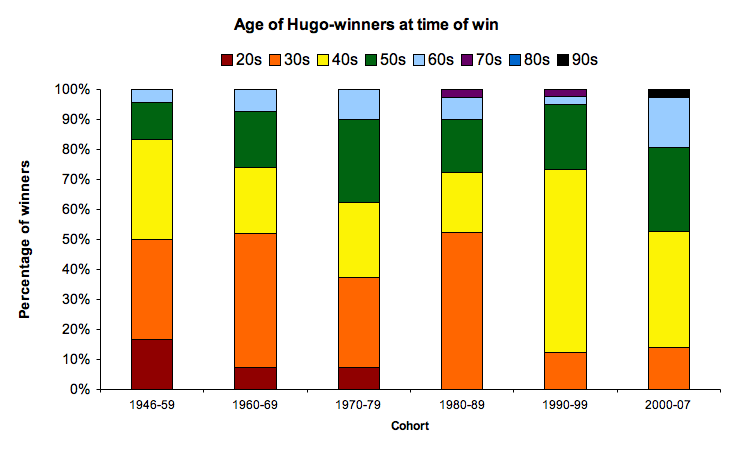
Hence, a graph, based on Nicholas Whyte‘s data, plus this year’s winners.

image119

(For some reason, I couldn’t get Excel to export in colour. Don’t ask me why. UPDATE: New graph, courtesy Liz. Praise Liz!)

  • In the first three cohorts, between 7% and 17% of Hugos for fiction go to people in their twenties; after that, none do.
  • In the first four cohorts, between a third and half of Hugos for fiction go to people in their thirties; once you get to the nineties, that drops to less than 15%.
  • The proportion of Hugos for fiction going to writers in their sixties is twice as high in the present decade as it’s ever been previously.

P.S. New site layout — good? Bad?

Hugo Award Winners

Here they are, then:

NOVEL: The Yiddish Policemen’s Union, Michael Chabon (HarperCollins; Fourth Estate)

I called it! I totally called it. Is this the end of the squandered promise of sf? Well, no; but probably not insignificant, either.

NOVELLA: “All Seated on the Ground”, Connie Willis (Asimov’s Dec 2007; Subterranean Press)

NOVELETTE: “The Merchant and the Alchemist’s Gate”, Ted Chiang (F&SF Sep 2007)

SHORT STORY: “Tideline”, Elizabeth Bear (Asimov’s Jun 2007)

Novella and novelette are as expected, and I’m pleased about the Chiang and less pleased about the Willis. Bear beating Michael Swanwick and Mike Resnick is a bit of a surprise, but not an unwelcome one.

RELATED BOOK: Brave New Words: The Oxford Dictionary of Science Fiction, Jeff Prucher (Oxford University Press)

Well, I thought this was a two-horse race between Barry Malzberg and Shaun Tan. Apparently not! I thought Brave New Words was an admirable project, though, so this is ok with me.

DRAMATIC PRESENTATION: LONG FORM: Stardust (Written by Jane Goldman & Matthew Vaughn, based on the novel by Neil Gaiman. Directed by Matthew Vaughn. Paramount Pictures)

Interesting that it managed to beat out Heroes S1; I look forward to the voting stats on this one.

DRAMATIC PRESENTATION: SHORT FORM: Doctor Who: “Blink” (Written by Stephen Moffat. Directed by Hettie Macdonald. BBC)

Hardly an undeserving winner, although I was rooting for “Human Nature”.

EDITOR, SHORT FORM: Gordon Van Gelder

EDITOR, LONG FORM: David G. Hartwell

I hope Long Form isn’t just going to oscillate between Hartwell and PNH.

PROFESSIONAL ARTIST: Stephan Martiniere

SEMIPROZINE: Locus, Charles N. Brown, Kirsten Gong-Wong & Liza Groen Trombi

FANZINE: File 770, Mike Glyer

FAN WRITER: John Scalzi

I called this, too, and am not unhappy about it. Although hopefully he’s not going to go on to win for the next twenty years straight …

FAN ARTIST: Brad Foster

John W. Campbell Award for Best New Writer (Not a Hugo): Mary Robinette Kowal

Wow. Another surprise — not just that Scott Lynch didn’t win, but that the only short fiction writer on the ballot did — and, again, not an unwelcome one.

So: a decent set of winners for the most part. Cheryl Morgan has a few notes about finishing positions; interesting to see that Scalzi came second in Best Novel (apparently, by nine votes).

Further reactions here, here, here, here, here, here, here, here, here, here, here, here, here.

So long, semiprozines

No, we haven’t had the actual Hugo Awards yet , but SF Awards Watch reports on some changes to the award categories which were passed at the WSFS Business Meeting yesterday – notably, the proposal that the semiprozine category be eliminated, and that a category of Best Graphic Story be added, which I believe will cover online publications as well as paper ones.

I am wholeheartedly in favour of the Best Graphic Story category, as competing with the biographies and critical works which get nominated in Best Related Book always seemed a strange fit, although books which are art collections and not stories will still go there. A category to recognise some of the excellent SF&F graphic novels seems overdue, and hopefully the Montreal shortlist will be filled with some of these. (Sadly, there will be no eligible volumes of Scott Pilgrim for me to nominate.)

Removing the semiprozine category I am less in favour of. It’s true that in recent years (UK Worldcons excepted), it has been dominated by Locus, but there are an increasing number of online venues for short fiction, critical articles, and reviews which fit into this category and don’t fit anywhere else, and under the current proposed change they won’t be eligible as fanzines either. I don’t know the proposers of this change, so I’m not sure what it was about the category they felt was terminally broken and I’ll be interested to hear what happened in the business meeting – it seems strange to me that you remove a category entirely, and then make everything eligible for the now-defunct category specifically ineligible for the one award they might now conceivably fit.

World Fantasy Award Nominees

Over at the Inferior 4+1, Lucius Shepard posts the World Fantasy Award Nominees:

Best Novel
Territory, Emma Bull [Tor]
Ysabel, Guy Gavriel Kay [Viking Canada/Penguin Roc]
Fangland, John Marks [Penguin Press]
Gospel of the Knife, Will Shetterly [Tor]
The Servants, Michael Marshall Smith [Earthling Publications]

I have read, er, none of these (and in fact it looks like a slightly odd list to me, given the available options), so I will report Nic‘s reactions:

On Ysabel: yay!
On Gospel of the Knife: *flat stare*

Best Novella:
The Mermaids, Robert Edric [PS Publishing]
Illyria, Elizabeth Hand [PS Publishing]
“The Master Miller’s Tale”, Ian R. MacLeod [F&SF May 2007]
“Cold Snap”, Kim Newman [The Secret Files of the Diogenes Club, MonkeyBrain Books]
“Stars Seen through Stone”, Lucius Shepard [F&SF July 2007]

Huzzah, to recognition for “The Master Miller’s Tale”. Must get around to reading Illyria, too.

Best Short Fiction
“The Cambist and Lord Iron: A Fairy Tale of Economics”, Daniel Abraham [Logorrhea, Bantam Spectra]
“Singing of Mount Abora”, Theodora Goss [Logorrhea, Bantam Spectra]
“The Evolution of Trickster Stories Among the Dogs of North Park After the Change”, Kij Johnson [The Coyote Road: Trickster Tales, Viking]
“Damned if you Don’t”, Robert Shearman” [Tiny Deaths, Comma Press]
“The Church on the Island”, Simon Kurt Unsworth [At Ease with the Dead, Ash-Tree Press]

Those two Logorrhea stories sure are popular. Not without reason, mind.

Best Anthology:
Five Strokes to Midnight, Gary A. Braunbeck & Hank Schwaeble, Eds. [Haunted Pelican Press]
Wizards: Magical Tales From The Masters of Modern Fantasy, Jack Dann & Gardner Dozois, Eds. [Berkley]
Inferno: New Tales of Terror and the Supernatural, Ellen Datlow, Editor [Tor]
The Coyote Road: Trickster Tales Ellen Datlow & Terri Windling, Eds.[Viking]
Logorrhea: Good Words Make Good Stories John Klima, Editor [Bantam Spectra]

I did not like Inferno (at some length, in NYRSF, if you’re interested). I did like Logorrhea (although it is by no means a pure fantasy collection), and I would like to read The Coyote Road.

Best Collection:
Plots and Misadventures, Stephen Gallagher [Subterranean Press]
Portable Childhoods, Ellen Klages [Tachyon Publications]
The Secret Files of the Diogenes Club Kim Newman [MonkeyBrain Books]
Hart & Boot & Other Stories, Tim Pratt [Night Shade Books]
Tiny Deaths, Robert Shearman [Comma Press]
Dagger Key and Other Stories Lucius Shepard [PS Publishing]

The Klages is good, if a little lightweight; the Shepard is good Shepard; I haven’t read any of the others.

Best Artist:
Ruan Jia
Mikko Kinnunen
Stephan Martiniere
Edward Miller
John Picacio

Special Award—Professional:
Allison Baker and Chris Roberson for MonkeyBrain Books
Alan Beatts and Jude Feldman for Borderlands Books
Peter Crowther for PS Publishing
Gordon Van Gelder for F&SF
Jeremy Lassen and Jason Williams for Night Shade Books
Shawna McCarthy for Realms of Fantasy

Special Award—Non-professional:
Midori Snyder and Terri Windling for Endicott Studios Website
G. S. Evans and Alice Whittenburg for Cafe Irreal
Stephen Jones, Editor for Travellers in Darkness: The Souvenir Book of the World Horror Convention 2007
John Klima for Electric Velocipede
Rosalie Parker and Raymond Russell for Tartarus Press

Not a lot to say about these categories, except congratulations to the nominees. And the winners of the Life Achievement Award are: Leo & Diane Dillon, and Patricia McKillip.

Predicting the Unpredictable: The 2008 Hugo Awards

It’s that Worldcon time of year again, and while I won’t be in Denver and I didn’t vote on them that isn’t going to stop me giving my opinions and speculating wildly on who might get a Hugo this Saturday night. Feel free to question my judgement and attempts to second-guess the voters in the comments; if you are equipped with Livejournal, you can vote in this Hugo poll as well.

Best Novel

  • The Yiddish Policemen’s Union by Michael Chabon
  • Brasyl by Ian McDonald
  • Rollback by Robert J. Sawyer
  • The Last Colony by John Scalzi
  • Halting State by Charles Stross

I hear that Rollback may be one of the best things that Sawyer has ever done I’m not convinced it can actually be good. Based on Old Man’s War, Scalzi certainly has the potential to write great books, but I haven’t read The Last Colony. My vote would go to Brasyl, probably the finest SF book I read last year, and a worthy successor to River of Gods, with the very different but still often great Yiddish Policemen’s Union in second place.

Best Novella

  • “The Fountain of Age” by Nancy Kress
  • “Recovering Apollo 8” by Kristine Kathryn Rusch
  • “Stars Seen Through Stone” by Lucius Shepard
  • “All Seated on the Ground” by Connie Willis
  • “Memorare” by Gene Wolfe

I confess I haven’t read any of these due to lack of time, and it seems unlikely that I will manage to do so before Saturday evening. My wild stab in the dark for this category is Connie Willis, based on her previous Hugo wins.

Best Novelette

  • “The Cambist and Lord Iron: A Fairy Tale of Economics” by Daniel Abraham
  • “The Merchant and the Alchemist’s Gate” by Ted Chiang
  • “Dark Integers” by Greg Egan
  • “Glory” by Greg Egan
  • “Finisterra” by David Moles

I like Greg Egan when he manages to write stories which combine hard science with emotional resonance (see “The Cutie” and ‘Reasons to be Cheeful” for examples), but both of these stories are too filled with science I don’t fully understand and characters I don’t really care about for me to like them. “The Cambist and Lord Iron” and “Finisterra” are both good stories, and only lose out because even a Ted Chiang story which is not his best work is still a very good story. So “The Merchant and the Alchemist’s Gate” gets my vote, and I think it’s going to win.

Best Short Story

  • “Last Contact” by Stephen Baxter
  • “Tideline” by Elizabeth Bear
  • “Who’s Afraid of Wolf 359?” by Ken MacLeod
  • “Distant Replay” by Mike Resnick
  • “A Small Room in Koboldtown” by Michael Swanwick

See previously; I would go for “Tideline”, but I think it’s going to go to Swanwick.

Best Related Book

  • The Company They Keep: C.S. Lewis and J.R.R. Tolkien as Writers in Community by Diana Glyer
  • Breakfast in the Ruins: Science Fiction in the Last Millennium by Barry Malzberg
  • Emshwiller: Infinity x Two by Luis Ortiz, introduction by Carol Emshwiller, forward by Alex Eisenstein
  • Brave New Words: The Oxford Dictionary of Science Fiction by Jeff Prucher
  • The Arrival by Shaun Tan

Even if I had read all these books, I have no idea how I would make a comparison between a book of critical essays, a biography, a dictionary, and a piece of sequential art – if the proposal to creat a sequential art category passes the business meeting, that would take away part of the problem. The only one I have read is Shaun Tan’s The Arrival, which is absolutely gorgeous and wonderful and should be read by everyone, and I think it would be a worthy winner. My actual prediction is the Malzberg, based on it winning the Locus Award.

Best Dramatic Presentation, Long Form

  • Enchanted
  • The Golden Compass
  • Heroes, Season 1
  • Harry Potter and the Order of the Phoenix
  • Stardust

I’m torn between Heroes and Harry Potter on this one (Stardust was good but not that good, The Golden Compass was not very good). Order of the Phoenix is a bloated book made into a surprisingly good film, but I don’t know if I’m giving it extra points for being a much better film than I thought it was possible to make out of that book. Heroes season 1 I don’t mind being in long form, but I would have much less trouble voting for some of the specific really good episodes than trying to judge the season as a whole with all the ups and downsagainst a two hour film. In the end, I think Heroes might edge it for me. Predicting what will actually win is difficult, as I don’t know if the unexpected presence of Heroes in the category will affect the voting. I think Harry Potter might win it, and I won’t be too upset with that.

Best Dramatic Presentation, Short Form

  • Battlestar Galactica “Razor”
  • Doctor Who “Blink”
  • Doctor Who “Human Nature” / “The Family of Blood”
  • Star Trek New Voyages “World Enough and Time”
  • Torchwood “Captain Jack Harkness”

Two-horse race, I suspect for the voters as well as for me, between the two finest episodes new Doctor Who has produced. “Human Nature” / “The Family of Blood” wins for me because David Tennant does a stellar job, but in the end I think this might be a third win for Moffatt, unless the inexplicable Torchwood love is more widespread among Hugo voters than I think.

Best Semiprozine

  • Ansible, edited by David Langford
  • Helix, edited by William Sanders and Lawrence Watt-Evans
  • Interzone, edited by Andy Cox
  • Locus, edited by Charles N. Brown, Kirsten Gong-Wong, and Liza Groen Trombi
  • The New York Review of Science Fiction, edited by Kathryn Cramer, Kristine Dikeman, David Hartwell, and Kevin J. Maroney

Ansible remains one of the best and funniest newsletters I’ve seen in any field, but this is the Locus category and I see no reason why this will change this year. I would prefer it if Helix didn’t win, and I wouldn’t mind seeing some recognition for NYRSF.

Best Fanzine

  • Argentus, edited by Steven H Silver
  • Challenger, edited by Guy Lillian III
  • Drink Tank, edited by Chris Garcia
  • File 770, edited by Mike Glyer
  • Plokta, edited by Alison Scott, Steve Davies, and Mike Scott

I like Plokta, particularly the Facebook-parody cover of their latest issue , but this category is defined for me by the lack of several excellent fanzines, like Banana Wings, Prolapse, and Chunga, which all deserve to be on the ballot. I predict a victory for File 770, because I have a completely unfounded feeling it might be a US ‘zine winning this year and File 770 has past form.

Best Fan Writer

  • Chris Garcia
  • David Langford
  • Cheryl Morgan
  • John Scalzi
  • Steven H Silver

Sure, Dave Langford has won this award many times, but I still think there are very few fan writers to match him. I predict this is the year that John Scalzi swoops it, and I won’t be too disappointed with that even though he wouldn’t be my first choice.
Should the Clarke Award change?

In his column in the latest Vector, following on from the discussion about this year’s Clarke shortlist, Graham Sleight has a suggestion:

I’m thinking, in fact, that the Clarke should adapt the model of the World Fantasy Award: once the award is announced, the jurors should appear on a panel and talk about why they’ve done what they’ve done. Within pre-agreed bounds (civility, moderation by the chair of jurors), they should answer questions from the public. If they, as smart, good-faith people, have reasons why they didn’t think Brasyl was shortlistable, I think it enhances rather than detracts from the conversation to hear them. All I’m suggesting is that we need a forum where an issue like that can be debated transparently rather than guessed at.

Over on the BSFA forum, Martin has already started a thread (with a poll), so if you want to discuss Graham’s arguments for the change you can either comment there or here. Or, of course, you can send a letter to Vector.

This Looks Promising

University launches £50,000 writing prize, with sci-fi author named as chief judge:

How does writing evolve? Where is its moving edge? Is all writing – at its very best – a type of creative writing? To explore these questions, and to identify excellence and innovation in new writing, the UK’s University of Warwick has just launched the £50,000 Warwick Prize for Writing.

Sci-fi author China Miéville (pictured), award-winning writer of what he calls ‘weird fiction’, is to head the panel of five judges. Other judges include mathematician Professor Ian Stewart and literary blogger Stephen Mitchelmore.

A list of 15 to 20 titles will be announced in October followed by a short-list of six titles in January 2009. The winner will be announced in February 2009 in Warwick.

This substantial prize stands out as an international and cross-disciplinary award. It will be given biennially for an excellent and substantial piece of writing in the English language, in any genre or form. The theme will change with every prize: the 2009 theme is Complexity.

(via.)

And in better awards news …

Strange day, when the John W Campbell Memorial Award is the award I feel positive about. The winner is:

In War Times by Kathleen Ann Goonan

This actually looks like a sane, solid choice; the reviews that I’ve seen have ranged from mixed to positively glowing (although see also). Anyway, I have a copy, and I’ve bumped it up the TBR stack, so there may be a review in the near-ish future.

UPDATE: Chris Mckitterick reports that Michael Chabon’s The Yiddish Policemen’s Union came second, and The Execution Channel came third.

Meanwhile, the Sturgeon Award choices are equally solid — choices because, for the first time, there are joint winners, and solid because those winners are:

Tideline” by Elizabeth Bear
Finisterra” by David Moles

See Abigail Nussbaum’s thoughts on the Bear here, and the Moles here; and congratulations to all three winners.

(While I’m here, have some links to other Locus Awards discussion.)

Locus Pocus

Gazumped! Neil Clarke posts about the change to the Locus poll scoring system, as described alongside the results in the July 2008 issue:

However, the next thing I see really bothers me and completely invalidates any year-to-year analysis I had planned:

“Results were tabulated using the system put together by webmaster Mark Kelly, with Locus staffers entering votes from mail-in ballots. Results were available almost as soon as the voting closed, much sooner than back in the days of hand-counting. Non-subscribers outnumbered subscribers by so much that, in an attempt to better reflect the Locus magazine readership, we decided to change the counting system, so now subscriber votes count double. (Non-subscribers still managed to out-vote subscribers in most cases where there was disagreement.)”

They changed the vote counting system after the polls closed. If they were so concerned about the results reflecting reader opinion, why allow non-subscribers the chance to vote in the first place? Doing something like this makes it seem like they were unhappy with the results and put a fix in. Given their long-standing reputation, I’m sure that wasn’t their plan, but what were they thinking?

For obvious reasons, Neil is most interested in the effect this has on the “best magazine” category; he also notes the one that first caught my eye, which is the result of Best First Novel. As described by Locus:

Heart-Shaped Box by Joe Hill won by a slim 10 points over The Name of the Wind by Patrick Rothfuss. This is one place where the doubled subscriber votes made a difference; the Rothfuss had more votes and more first-place votes but subscribers put the Hill first, and their doubled points gave it the edge.

Similarly, in Best Collection:

Connie Willis’s The Winds of Marble Arch and Other Stories won with a lead of just over 70 points, followed by Jack Vance’s The Jack Vance Treasury in second. Cory Doctorow’s Overclocked came in third — despite having the most votes and the most first-place votes. The doubled subscriber votes made Willis, ever a favourite with Locus subscribers, the winner; without the extra points, she would have come in second behind Doctorow, who has a large online fan base.

I have to say I’m deeply disappointed by this. The big selling point of the Locus Awards is, or always has been to me at least, their representativeness, precisely the fact that anyone can vote and that they are thus the best barometer of community-wide opinion that we have. As the notes at the start of this year’s result somewhat smugly put it, “We get more votes than the Hugo, Nebula, and World Fantasy nominations combined … Nominees need at least 20 votes to make the final list, even though it frequently takes less to make the Hugo or Nebula publishing ballots.” All of that is still true, but it seems wrong to imply (as I think it’s intended to imply) that this legitimizes the results when you’ve just changed the scoring system to make some voters more equal than others — particularly if you only make the change after voting has closed, particularly if you only mention it in the print version of the magazine.

Locus Award Winners

See here; finalists here.

SF Novel
The Yiddish Policemen’s Union, Michael Chabon (HarperCollins)

I think this puts paid to the repeated suggestions that Chabon doesn’t have enough popular support to be a viable candidate for the Hugo. I think he’s going to win.

Fantasy novel
Making Money, Terry Pratchett (Doubleday UK; HarperCollins)

Young adults book
Un Lun Dun, China Miéville (Ballantine Del Rey; Macmillan UK)

First novel
Heart-Shaped Box, Joe Hill (Morrow; Gollancz)

Novella
“After the Siege”, Cory Doctorow (The Infinite Matrix Jan 2007)

Novelette
“The Witch’s Headstone”, Neil Gaiman (Wizards)

I admit to a feeling of relief that this one didn’t go to “Trunk and Disorderly”. That’s a bad story. But to be honest, “The Witch’s Headstone” felt too much like the novel-excerpt it is to really deserve this.

Short story
“A Small Room in Koboldtown”, Michael Swanwick (Asimov’s Apr/May 2007)

Collection
The Winds of Marble Arch and Other Stories, Connie Willis (Subterranean)

I’m a little surprised Doctorow didn’t win this category as well; I think I also would have preferred it to go to a new collection, rather than a retrospective. Still, Connie Willis Always Wins, I guess.

Anthology
The New Space Opera, Gardner Dozois & Jonathan Strahan, eds. (Eos)

Non-fiction
Breakfast in the Ruins, Barry N. Malzberg (Baen)

I’d have gone with (and indeed voted for) the collection of Russ’s reviews; but this is good too.

Art book
The Arrival, Shaun Tan (Lothian 2006; Scholastic)

Editor
Ellen Datlow

Magazine
F&SF

Publisher
Tor

Artist
Charles Vess

Overall: for me a solid list of winners, but — particularly in the short fiction categories — not a particularly exciting one.