Ruminations on Place, Fantasy, and Nkereuwem Albert’s The Bone River

“I wanted to capture the essence of the place.” 

Nkereuwem Albert

A review by Jesutomisin Ipinmoye

The Bone River by Nkereuwem Albert is an urban fantasy published by Phoenix, an imprint of Ouida Books focused on Science Fiction and Fantasy stories. 

There are many things to love about The Bone River.

There is the magic system, the sense of a thick and present world bubbling away beneath the fabric of our own world. In Nkereuwem’s Calabar, miracles are the work of Pastors contorting magic in front of a blind congregation, and penises can, in fact, be stolen. By virtue of your initiation and belonging to one of four houses, you become a conduit to magic and mystery seeping out of the earth. You can command the dead, kindle fire from within you, and form familiars out of bone. You can shape it into beasts and seal gods. It is a land of infinite possibility. If you’re creative enough, you can conjure magic in service of peace—or to deceive.

This brings me to the story itself. By the time you put down Nkereuwem’s The Bone River, you would have witnessed how fragile peace can be, while war remains a latent possibility. This in itself should not be a discovery. We are well familiar with the flexibility of politicised narratives, the speculative reality of a truth wielded by authority. Surely, it should not take too much imagination to condense the abstraction of the lie beneath Calabar’s secret peace into a manner of critique about the cities we inhabit or the stories we tell about the blood that soaks our collective memories. After all, there is even greater violence than a certain bastard’s deception that is used every day as a tool to maintain a semblance of “status quo,” a peace with which no one is comfortable. And yet, the discovery of deception, as you read, grabs you. You know things like this happen, and yet, you are shocked. Why wouldn’t you be? It is the job of good fantasy to re-expose us to reality afresh. When you have seen and seen and seen with all your seeing eyes, the world unseen can and should shock you in new ways. 

And then there is a stressful sapphic romance.

Continue reading “Ruminations on Place, Fantasy, and Nkereuwem Albert’s The Bone River”

Policing perception: weird fiction, Tony Benn, and the warped borders of the real

by Philip A. Suggars

There’s a moment in the Wachowski’s seminal 1999 movie the Matrix where Keanu Reeves’s elegantly blank Neo sees the same black cat walk past a doorway twice. In the movie, such moments are signals that the nefarious Agents are about to emerge into Neo’s simulated reality and give him the mother of all cardio workouts.

But what if something similar were to happen to you?

Perhaps you have a similar moment of déjà vu, notice that roses now seem to smell like freesias or that the sky suddenly looks a bit purple. Everyone you tell about this discovery, however, insists that everything is the “same as it ever was” (in the words of the old song). Roses smell as sweet as they ever did. The sky is the same old blue.

After a while you might accept that it’s your perception that is at fault, shrug a little, and decide to get on with the gardening. But at the back of your mind there might be a nagging doubt. Perhaps you were never supposed to notice the difference.

Continue reading “Policing perception: weird fiction, Tony Benn, and the warped borders of the real”

Review: Delicious in Dungeon (2024)

By Marta F. Suarez

Dine or Die, with a Pinch of Comedy

Delicious in Dungeon (2024, Netflix). Season 1, Episode 3. Living-Armour Stir Fry and Soup [00:18:57]

Delicious in Dungeon (Netflix, 2024-present) is Studio Trigger’s adaptation of Ryōko Kui’s eponymous manga (2014-2023). The series is set in a fantasy world that merges and echoes different fantasy and manga traditions popular in Japan. The overall setting takes the viewer to the dungeon crawl genre, which recently experienced a resurgence in the country after Etrian Odyssey Nexus (2018). The characters’ races and skills are shaped by influences of Dungeons and Dragons, the Middle-Earth world set by Tolkien, and even the Final Fantasy universe, which itself draws inspiration from these narrative traditions. However, what makes Delicious in Dungeon significantly different is the resonances of cooking series like Mister Ajikko (1986-1989), a manga series that had several sequel runs over the years, including a recent 2015-2019 one, titled Mister Ajikko Bakumatsu-hen. The first season comprises 24 episodes, with a new second season coming soon this 2025. 

In the world of the story, adventuring parties enter dungeons looking for the legendary Golden Country, a kingdom transported by a sorcerer to the depths of an expansive dungeon, which is said to contain the ultimate treasures. Lured by wealth, fame, and adventure, different guilds enter this dungeon with the hope of finding the lost realm. One of these teams is led by Laios Touden, a tall-man (human) Paladin Knight who starts this quest alongside his sister Falin, a magic wielder; Marcille, a half-elf mage; and Chilchuck, a halfling thief. The opening scenes present the party’s encounter with a magnificent red dragon, against which they are losing. As the beast defeats them one by one, Falin uses her last strength before being ingested by the dragon to teleport the other members of the party out of the dungeon. Still alive but on the surface, the party is now several floors above where the battle took place and too far to attempt to rescue Falin. However, due to the magic of the dungeon, Falin could be resurrected if there are some remains and she has not been fully digested. With this in mind, the group decides to return, defeat the dragon and rescue any remaining parts of Falin. However, with time being of the essence, they realise that they cannot afford to stop to resupply and find provisions, as that would risk their chance to succeed. In a conventional dungeon crawl storytelling, the party would possibly open containers to find cheese and fruit, pick edible mushrooms and seeds, or perhaps kill a rodent and eat a left-behind spoiled pie in a moment of necessity. In contrast, Laios introduces the unconventional idea of eating the monsters they encounter, setting the course for the series. With this decision, the party ensures their survival and the journey becomes also one of gastronomic exploration.

Continue reading “Review: Delicious in Dungeon (2024)”

Torque Control 301

By Phoenix Alexander

The organism is relentless

Calorie demanding, perpetually in need of hydration, oxygen, and a cocktail of other vitamins and minerals, requiring 4-8 hours sleep a night to repair itself from the ravages of the day, day after day. A lifetime’s worth of consumption. 

This unkind—some might say anti humanist—characterization is famously articulated by the nefarious Agent Smith in The Matrix, where he attempts to psychologically break a human rebel leader, Morpheus, by telling him: 

Every mammal on this planet instinctively develops a natural equilibrium with the surrounding environment, but you humans do not. You move to an area and you multiply and multiply until every natural resource is consumed and the only way you can survive is to spread to another area. There is another organism on this planet that follows the same pattern. Do you know what it is? A virus. (The Wachowskis, 1999)

The accusation, while effective for cinema, is not quite true. Smith implies that this “consumption” is a species-specific act, and not one located within a complex and interrelated ecosystem of both human and non-human life. If anything, plants should be the focus of his anger: they are the enablers of this “surviving,” this “spreading,” being masterful spreaders and survivors themselves. More radically: even drawing the lines between species may be a spurious rhetorical move. “A leaf is the only thing in our known world that can manufacture sugar out of materials—light and air—that have never been alive,” Zoë Schlanger reminds us in her recent book The Light Eaters: How the Unseen World of Plant Intelligence Offers a New Understanding of Life on Earth (Schlanger, 2024). “All the rest of us are secondary users, recycling the stuff the plant has made… Think about it: every animal organ was built with sugar from plants” (Schlanger, 2024, pp. 27-28). Her (admittedly simplified) description is useful in exculpating the human organism specifically from the charge of excessive consumption. It is not our fault; we are enabled, built literally by component organisms and their byproducts, both visible and invisible. 

Nevertheless, the human body and its source/s of sustenance tends to take on the nature of a problem to be solved in many science fictional narratives. From the replicators of Star Trek to the hideous ‘pigoons’ of Margaret Atwood’s Mad Addam series to the equally hideous ‘sligs’ of Frank Herbert’s Dune universe to the more mundane efforts of potato-growing in Andy Weir’s The Martian, authors and film-makers offer the gamut of appealing to radically unethical means of keeping the human organism alive in conditions that, even without the lack of food, threaten to kill it. (I am reminded here of the opening crawl to the movie Gravity: “Life in space is impossible”) (Alfonso Cuarón, 2013). 

Continue reading “Torque Control 301”

Wave IX: a compressed essay-review by Carter Kaplan

Jean-Paul L. Garnier, ed. Wave IX. Joshua Tree, CA: Space Cowboy Books, 2024.

By Carter Kaplan

Wave IX

J.G. Ballard’s story “Studio 5, The Stars” appeared in Science Fantasy magazine in 1961. The story is set in “Vermilion Sands”, a desert art colony suggesting the post-war “hothouse” desert compounds created in the American Southwest by painters like Max Ernst and Georgia O’Keefe. In Ballard’s Vermillion Sands, art, artists, poetry and landscape blend in remarkable ways, and the possibility of elements of virtual reality appear to be an operative dynamic, though this possibility remains unexplained, or anyway is deliberately obscured to enhance the futuristic feel of the community, and as well represent the confusion that should properly attend a world that is in contact with computers, simulation, and muddled human perceptions.  The setting is thus an opportune field for blending a broad—indeed unlimited—range of aesthetic figures and themes. The plot follows the adventures of Paul Ransom, editor of the poetry magazine Wave IX. He is beset by submissions of bad writing (fragments in the form of computer tapes are often floating through the sky above Vermilion Sands). The poetry is produced by computers styled as Verse Transcribers or VT’s. The stale submissions form a point of departure for exploring the subject of poor writing, and how the production of poor writing is driven by complacency, intellectual laziness, cliché, formulae, cultural homogenization, stale involvement, theoretical strictures, official channelings, academic repetition, market forces, fossilized traditions, and so on.  

Jean-Paul L. Garnier, the editor of Wave IX the book before us, presented Ballard’s story to the contributors and asked for submissions. There were very little instructions; contributors were simply encouraged to follow their inspiration. A variety of graphic images, poems and fictions were submitted. Here is a review of these pieces, followed by suggestions for further exploration and discussion. I am a contributor to the project, as described below.

Continue reading “Wave IX: a compressed essay-review by Carter Kaplan”

Dev Agarwal reviews ‘Pavane: a Critical Companion’ by Paul Kincaid

ISSN 2662-8562 ISSN 2662-8570 (electronic) Palgrave Science Fiction and Fantasy: A New Canon ISBN 978-3-031-71566-2 ISBN 978-3-031-71567-9 (eBook)

A review by Dev Agarwal

With his latest work, Paul Kincaid looks critically and in-depth at Keith Roberts’s novel, Pavane. 

Keith Roberts (20 September 1935 – 5 October 2000) was a science fiction writer and illustrator. His work on Pavane appeared first as a series of novellas from 1966 and then as a collected book in 1968. 

Kincaid notes that Roberts’ work is often admired by his fellow writers but neglected more widely as science fiction. In part, this could be due to reactions to the artist rather than his art itself. While his work is respected by those already familiar with it, Roberts’s personality probably damaged his wider lasting recognition. Kincaid observes that Roberts may have been “incapable of friendship, someone who distrusted everyone on principle, and fell out with everyone who became close to him.” 

We must go back a generation to find writers discussing Roberts’ work. Both AJ Budrys and Kingsley Amis lavished praise on Roberts. Trillion Year Spree by Brian Aldiss and David Wingrove also cites him positively, but Roberts is otherwise “almost entirely absent from other surveys of the genre.” 

This deficit of attention has only grown in the years since Roberts’ death, which makes Kincaid’s literary appreciation particularly relevant. Kincaid speculates that Pavane may suffer in genre terms from being neither fish nor fowl. It does not sit easily “in the technological territory of science fiction,” yet it is also not modern fantasy. Pavane is a particularly British work, a book made up of a cycle of stories, and one imbued by religion, sense of place, and the mythical past of the English countryside.

Continue reading “Dev Agarwal reviews ‘Pavane: a Critical Companion’ by Paul Kincaid”

Solarpunk and Guild Socialism

A lo-fi, low-key critique of solarpunk

By Jo Lindsay Walton

Joyce Ch’ng’s ‘The Barricade’ (2024) is a solarpunk short story in which nothing much happens. The lack of incident is probably deliberate: a gentle rejection of the idea that all narratives need conflict. Put your characters in horrible situations and watch them struggle to survive: this is standard creative writing advice. It may be more steeped in capitalist ideology than we care to admit.

By contrast, the closest Ch’ng’s story gets to real jeopardy is a flock of birds smacking into a solar panel. The solar panel is easily repaired. The bird strike could even be taken as a positive sign. It implies a lot of birds. Rachel Carson’s Silent Spring, which helped to kick off (or revive) the environmental movement in the 1960s, takes its title from imagining the loss of birdsong.

Ida loved birds. Their songs would wake her up every morning. There were no more cases of poaching (or so the newspapers said). Native birds were returning. Numbers were climbing up once more, helped by careful husbandry and re-introduction of species.

Solarpunk is an eclectic genre. It typically envisions hopeful futures, where humans live in harmony with nature, and often with one-another as well. Solarpunk communities are often multi-species communities. The term solarpunk seems to have originated in an anonymous 2008 blog post, ‘From Steampunk to Solarpunk,’ imagining the widespread return of wind-powered sea freight. This contemplative excitement about technology, old or new—or both old and new—has continued to characterise solarpunk.

Crucially, solarpunk prefers to tackle technical problems and ecological crises in ways that serve social justice. Hannah Steinkopf-Frank writes, “imagining Solarpunk purely as a pleasant aesthetic undermines its inherently radical implications. At its core, and despite its appropriation, Solarpunk imagines an end to the global capitalist system that has resulted in the environmental destruction seen today.”[1] The genre may not have a consistent set of politics, but it often resonates with degrowth and postgrowth perspectives, as well as pluriversal politics — that is, mobilising local, traditional, and Indigenous worldviews in ways that may diverge from mainstream sustainable development discourse.

Continue reading “Solarpunk and Guild Socialism”

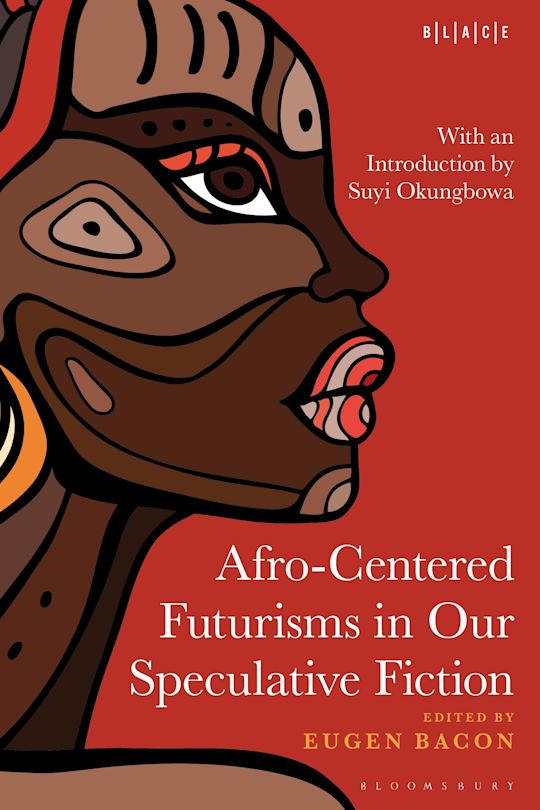
Amirah Muhammad reviews ‘Afro-Centered Futurisms in Our Speculative Fiction’

Edited by Eugen Bacon, Afro-Centered Futurisms in Our Speculative Fiction (2024) is an anthology of award-winning African speculative fiction writers, including Suyi Okingbowa, Cheryl S. Ntumy, and Dilman Dila.

The anthology pushes us to question the genre labels we take for granted – namely, Afrofuturism, Africanfuturism, and futurism – alongside introducing us to new terms, fusing specificity with inclusivity. Key to the anthology is the concept of the ‘gaze’: of looking in order to name, and the tension between fixity and fluidity that comes from it. With a blend of fiction and nonfiction, Bloomsbury describes the anthology as offering “excerpts from their work and creative reflections on futurisms with original essays.”

Afrofuturism, Africanfuturism and Afro-centred Futurisms

There are many names for speculative fiction by African writers. The anthology is chiefly concerned with differentiating Afrofuturism, Africanfuturism, and introduces Afro-centred Futurisms. ‘Afrofuturism’ often refers to Black speculative fiction, although the anthology reminds us of its origins in the United States of America through Mark Dery’s coinage. ‘Africanfuturism’ is Nnedi Okorafor’s invention to describe speculative fiction invested in African histories, presents and futures. ‘Afro-centred Futurisms,’ as Suyi Okungbowa defines it, is a plural term with an “active consciousness and open-armed framework — the privileging of the Afrodescendant self, an investment in timelessness, and an embrace of the spirituality-to-science spectrum” (18).

Continue reading “Amirah Muhammad reviews ‘Afro-Centered Futurisms in Our Speculative Fiction’”

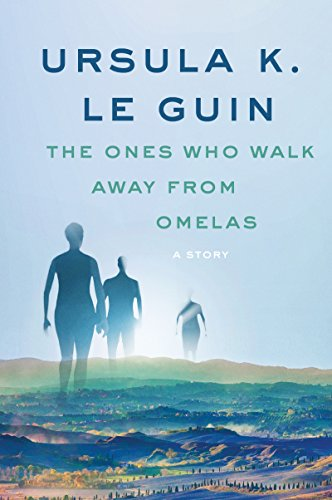
Leaving Omelas

By Christopher Kanski

Chris Kanski, “a reluctant yuppie who dances often and writes sporadically”, encounters Omelas for the first time.

In amateur philosophy, thought experiments try to get to the core of questions, usually ethical ones, by stripping them of context; the trolley problem that’s taught in high schools has faceless victims and no perpetrator and you, the imagined agent at the lever, have no context for your being there. I think they’re useless. I think every thought experiment I’ve ever encountered makes an assumption that stripped context isn’t a context itself. What you would do in the imagined, ‘pure’ scenario is relegated to that scenario; whatever conclusions about ethical choices you come to become largely null and void when presented with the countless variables that real-life context provides.

None of us, ever, will find ourselves in a context where we make an ethical decision based purely on rational thought with a total lack of feeling. But when I was young and coddled by private school and a loving, secure home life, I didn’t have much use for deep feeling and, spurned at the time by both girls and boys, I felt my intelligence grew far beyond my years if I chased exactly that kind of unburdened rational thought. Which is why if I’d stumbled across Ursula K. Le Guin’s story, “The Ones Who Walk Away From Omelas”, as a young teen, I’d probably have trained my critical thinking skills a little, and if my musings about that trolley problem didn’t impress my peers I would’ve dropped the pretences and told them that I’d read a story that had sex and drugs in it, and that would be that.

That isn’t how I first experienced the story: I heard its synopsis over a breakfast table and then, weeks later as I was shopping with a friend and she asked me if I eat pork, I saw the Omelasian child in front of me, whimpering and bleeding and moaning –  a feeling of guilt that I’ve been nurturing for years was given imagery. I knew then in the supermarket, even before reading the story, that I’d write about it and give expression to the pain of complicity that affects me daily, to tide me over until the pain boils up again and demands repeated expression with new words or through a new medium.

In “The Ones Who Walk Away From Omelas, the city of Omelas is a utopia; throughout the story Le Guin breaks the fourth wall to explicitly point out the fiction of it and encourages us as readers to flex and bend certain aspects of the utopia to our own preferences. She tuned in to our base, perpetually unfulfillable desires of comradeship, sex, highs, and joys and it’s intoxicating, when reading, to be asked to participate in constructing Omelas with exactly the building blocks most of us strongly desire. It makes the twist that much sharper: our utopia which has made our hearts swell and sparked our carnal desires, Le Guin tells us, is only made possible because of a single child’s suffering. Le Guin isn’t the sole architect here either, the choice of where the child’s tiny cell is held in the city is the reader’s choice. What’s cemented is that for the utopia to exist, the child must exist with open sores untreated and exposed to its own shit forever. The sacrificial child is vividly, disgustingly described in its perpetual state of suffering and we’re horrified not only by its pain but by ourselves, as at this point in the story we’re invested in the fantasy of our utopia that we helped build, our heads are still fuzzy with ideas of art, sex, feasts, and dance; we’re already wondering soon after the first glance into the cell if we’d let the child suffer for our perpetual comfort, ecstasy, and happiness.

Continue reading “Leaving Omelas”

Mary Branscombe reviews All Tomorrow’s Futures: Fictions that Disrupt

Explore where technology might take us and what that might mean for how we live with this anthology that brings together experts and writers. 

It’s easy to view fiction as merely entertainment and escapism (both important in their own right), but stories – especially science and speculative fiction (SFF) – are also wonderful tools for exploring and learning, imagining possibilities and seeing how they might work. It is serious play and playful thinking. 

It’s almost a tenet of SFF that technology is secondary to the story. While SFF writers tend to explore ideas and the stories those ideas generate, their technology may be plausible but there’s no requirement for it to be. There are, however, countless movies and TV shows where an interesting premise is undermined by technology that absolutely doesn’t work. Futurists and researchers explore possibilities and trends, making predictions that are intended as realistic extrapolations of real or expected technology, with none of the Hollywood handwaving and convenient MacGuffins, but while fictional case studies illustrating predictions are so common that you’ll find them in IKEA’s latest research about homes and living, they rarely have the kind of characters, plot and drama that makes for compelling fiction.

What if you could combine the two, with experts and authors collaborating to write about possible futures in ways that are not just plausible but creative, with equally strong stories and technical chops? Like Cybersalon’s previous anthology, 22 Ideas About the Future, All Tomorrow’s Futures is predicated on (mostly) plausible technology and the impacts such technological developments might have on justice, energy, digital money, health and education. 

Continue reading “Mary Branscombe reviews All Tomorrow’s Futures: Fictions that Disrupt”