The Doomed City by Arkady and Boris Strugatsky

Reviewed by Kerry Dodd. This review first appeared in The BSFA Review.

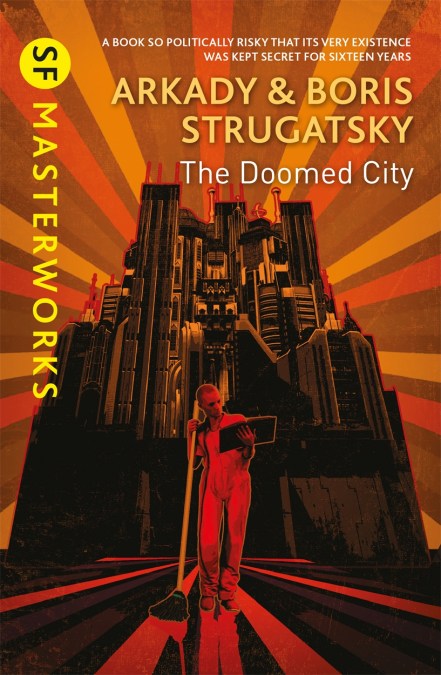
The Strugatsky brothers are often synonymised with their most famous novel Roadside Picnic – which is hardly surprising as it certainly is a breath-taking read. Until fairly recently finding copies of their less well-known works, such as Hard to be a God or Monday Starts on Saturday, has been a veritable challenge. SF Masterworks’ re-publication of these iconic classics is both a joy and a tribute to the rich literary output of the brothers. Particularly timely given last year’s re-release of Stalker, an adaptation of Roadside Picnic directed by Andrei Tchaikovsky, these novels offer a thrilling window into SF written during the Soviet era whose core messages still have an urgency that resonate in the modern day. Indeed, Dmitry Glukhovsky, who himself has become a key figure in Russian SF following the cult success of Metro 2033, writes in his introduction to the new release of The Doomed City that ‘there comes a point at which science fiction is transformed into a means for at least hinting at the true state of affairs.’. Proudly declaring on its front cover that this is a book that was ‘so politically risky that its very existence was kept secret for sixteen years’, The Doomed City evidently is unafraid to challenge systematic hegemony and re-inscribes how SF offers not only poignant messages about the future, but equally the present. 

The Doomed City

The Doomed City centres around ‘The Experiment’ in which people from different countries and time-periods within the twentieth century are separated from their previous lives and forced to co-exist in an artificial new city, where the sun is akin to a giant lightbulb that can be turned off in an instant, and the occupants can mysteriously understand each other, regardless of language barriers. As the title suggests, this social experiment is one which is not marked for success. Each occupant must take part in the job lottery, a system which dictates every person’s function and place within the metropolis. Following the political rise of Andrei Voronin, an astronomer from 1950s Leningrad, who transitions from garbage collector, police investigator, newspaper editor and eventually bureaucrat, The Doomed City interrogates the core conceptualisations of social hierarchy. Each chapter focuses on the challenges that Andrei faces within these roles, from a hoard of baboons that descend upon the city to the Red Building that uncannily appears and abducts people seemingly at random. The novel is overtly one with many questions, few of which are concretely resolved. For although the city’s quirks add a sense of intrigue to the narrative, the Strugatskys’ writing really shines in the realistic conversations that simultaneously affirm and expose the social stratification which the experiment has artificially induced.  As the novel progresses, some of the critiques are evidently closer to the surface than others. The stark contrast in Andrei’s disposition to professions he deems as being ‘lower’, as he rises through society, has overt classist overtones; meanwhile, the apparent lack of any creative industry within the city is mentioned in an almost ephemeral aside that has a chilling parallel to modern anxieties towards arts funding cuts. The concluding expedition to discover what lies beyond the city, as well as the mythical supposition of an anti-city, is one which seeks to push the human to its extreme – to analyse what the term ‘human’ even means. As Andrei reaches the ‘final understanding’ at the novel’s close this is clearly the opening of one small area amongst a much wider vista. Each of the sections has a wistfully vignette style to them, for while at times they may be all too brief, the small allusions have a pervasively haunting nature. The Doomed City is a robust novel that is not just a gateway to Russian SF or Soviet censorship but one whose core ideas will retain a continuing relevance as the human race scrutinises social stratification against the enduring backdrop refrain that ‘the experiment is the experiment’. 

Copyright Kerry Dodd. All rights reserved.

Green Utopias: Environmental Hope Before and After Nature reviewed by Paul Graham Raven

Lisa Garforth, Green Utopias: Environmental Hope Before and After Nature (Polity Press, 2018)

One grows accustomed, as someone working on one facet of the challenge of climate change, to keeping an anxious and wary eye out for one’s opponents. 

I don’t mean climate change deniers—who it seems may always have been a lot rarer than their well-funded PR campaigns made them appear, and in any case were always fairly scarce in academia. We are now into a different and more difficult struggle, namely the struggle over what to do and how to do it. 

To put it another way, while there is broad unity on the challenge itself, there is prodigious disunity on the matter of the response. This has arguably been brewing for a while—ever since the splintering (around the time of the UN’s Brundtland report of 1987) of “sustainable development” (SD) into two conceptual camps, ‘strong’ and ‘weak.’ The camp that elected to hollow out the “sustainability” bit while firmly emphasising the “development” part, predictably enough, has proven far more popular with the worsted-clad elves of the policy machine and the Davosean clades of Business Thought Leadership. Strong SD demanded hard limits on development. Weak SD implied soft limits, so soft that they, along with the evacuated and increasingly unqualified concept of sustainability itself—“sustainable” for exactly how long, and with exactly what consequences, to exactly whose benefit, one might well ask—might be stretched like warm caramel in the hands of a dextrous accountant. (For a more thoroughgoing look at the Strong / Weak split, still very much a live conflict, this briefing paper toward the UN’s 2015 Global Sustainable Development Report sets it out fairly concisely from the perspective of the Strong camp).

We might see this as a struggle between two paradigms of response to anthropogenic climate change—though as with most such binaries, it’s probably better thought of as a spectrum strung out between two extreme positions that almost no one holds as such. Their difference might be illustrated by the current spat over carbon capture and storage (CCS) technologies. Are CCS technologies a necessary and shovel-ready slab in the path to successful mitigation, or a vaporware accounting fudge from the business-as-usual (BAU) crowd that very deliberately leaves the door open for continued fossil fuel usage? From my phrasing, the reader may well be able to deduce which side of that particular fence I am positioned, though how far from the fence I’m stood is more a matter of perspective, as well as of time: the fence has moved many times. Indeed, if somewhat paradoxically, BAU seldom wears the same outfit twice, and corporations today are feverishly at work implementing their novel Net Zero strategies, no doubt innovating exciting new forms of heel-dragging, buck-passing, subterfuge, and slipshod dei ex machina as they go. For BAU has never really been a synonym for “do nothing”; doing nothing is anathema to the busyness of business. Rather, BAU refers to a tacit refusal to consider that the fundamental rules of the game are the problem, rather than the fouls of any particular player(s): new approaches to extraction and production in light of the reality of anthropogenic climate change are more than welcome, so long as opportunities for the accumulation of surplus value are left intact.

To reiterate: the struggle between two different paradigms of social and environmental transformation is an old one, with the role of CCS being only one of its latest battlefields. Yet though venerable, it is not timeless. The stakes have been ever-changing, as emissions pump out and temperatures rise. The upper hand has changed many times, and so too have the terms of engagement. And it is this dialectic of green hope that Garforth so thoroughly delineates in Green Utopias: Environmental Hope Before and After Nature in policy, in philosophy, in climate science, and in science fiction. 

It’s not a struggle unique to academia, by any means—and for all the accusations of tribalist spats within the ivory tower, I doubt it’s any worse in here than it is elsewhere (particularly given that the remunerative stakes are far higher outside). Besides, the obligatory interface of climate change academia with “policy”—which the more cynical among us might define as the escheresque process that has come to replace governance in the neoliberal era—means that many researchers are far closer to the political machinery than they might prefer, particularly the hard-science types (who are justifiably somewhat leery of being dragged out into the kangaroo court of public scrutiny, thanks to underhanded exploits such as Climategate, way back in 2009). As Bruno Latour has so elegantly argued, the sciences were somewhat themselves to blame for this, having enjoyed and profited from a closeness to policy during an earlier period when policymakers were glad to encourage a deliberately distorted perception of science as a process by which “truth” (and thus policy itself) might be rubberstamped with an inarguable sense of impartial authority. That relationship started to sour when scientific “truths” began to misalign with policy goals already chosen for other reasons. Climate change is perhaps the most significant and obvious arena in which this ugly public break-up played out.

Continue reading Green Utopias: Environmental Hope Before and After Nature reviewed by Paul Graham Raven”

The Djinn Falls in Love (and other short stories) ed. by Mahvesh Murad and Jared Shurin

Reviewed by Dan Hartland. This review first appeared in The BSFA Review.

In the introduction to their excellent anthology The Djinn Falls In Love, Mahvesh Murad and Jared Shurin write that “every culture, every author, has their own djinn, jinn or genie”. This is another way of saying not just that all cultures have fairies, but that jinn have long been bowdlerised by other cultures; the anthology’s great strength, and occasionally its only weakness, is that it appears unconcerned by this thorny inheritance of tradition.

The Djinn Falls in Love and Other Stories

In Helene Wecker’s “Majnun”, for instance, jinn are far from existentially hidebound, perfectly able to convert to precisely the faith whose verses also exorcise them. In Kuzhali Manickavel’s menacing “How We Remember You”, it is the jinni who is tortured and beset, the humans who are the sadistic tricksters. In Kirsty Logan’s “The Spite House”, the djinn have been emancipated, but remain only half-admitted to wider society.

The tricky ghost of appropriation is sometimes present in all this garrulous invention. There’s a queasy Orientalism in Claire North’s rollicking “Hurrem and the Djinn” – sultans and harems, evil viziers and powerful sorcerers – which seems not to reinvent the jinn so much as rehash Agrabah. Maria Dahvana Headley’s atmospheric “Black Powder”, on the other hand, transplants the jinn to the Western, reconfiguring them as bullets in a mystical gun; but it’s not clear what we gain from this, other than a tightly and evocatively written story.

I sound more equivocal than I mean to. In Amal El-Mohtar’s elegiac “A Tale of Ash in Seven Birds” alone, this collection earns its keep: as the jinn shapeshift from one avian form to another, desperately seeking one which can survive first a thriving and then a collapsing human society, the reader experiences in a few brief pages all the magic that one might expect to flow from a realm of smoke and flame. In EJ Swift’s science fiction “The Jinn Hunter’s Apprentice”, meanwhile, the jinn have made it to the stars – and cause as much havoc and horror onboard a spaceship as any Giger-ish nightmare.

Indeed, the anthology is often on safer ground when looking towards one future or another. In Saad Z. Hossain’s memorable “Bring Your Own Spoon”, for example, the jinn awake after a long sleep to find a post-collapse human civilisation made habitable only by air-cleaning nanotechnology with which they feel an odd kinship. In “Duende 2077” by Jamal Mahjoub, meanwhile, capitalism has “spiralled into social anarchy, chaos and moral bankruptcy” (p. 207), and an Islamic Great Britain has emerged from the wreckage; here, too, the jinn appear as a sort of meme, a symbol of rebellion and refusal (jinn don’t feature in KJ Parker’s high fantasy “Message In A Bottle”, either – except as a Schrodinger’s mist).

Where the jinn are made contemporary, too, these stories shine. In the claustrophobic horror of “Reap”, US military drone operators encounter a force beyond them; Sophia Al-Maria pointedly makes domestic violence the consequence of her protagonist’s belief in a jinni’s capacity to possess and corrupt his wife; JY Yang’s bittersweet “Glass Lights” focuses on a woman descended from jinn who perceives desires and enables others to fulfil them, but is powerless to achieve her own. These are all powerful statements and exceptional stories. It is a sign of their quality that they eclipse arguably more minor contributions from names like Gaiman, Smythe and Okorafor.

One of the most exciting developments in SF of recent years is its opening-out to global perspectives and traditions. Murad and Shurin’s collection is at the vanguard of this movement, its polyphony testament to the refreshing power of diversity. In Kamila Shamsie’s “The Congregation”, the narrator is half-human, half-jinn. “All he’s ever wanted is to be possessed,” an exorcist remarks of him, “There is no evil here, only love” (p. 22). In its most creative and thoughtful recreations of the jinn, this collection of very high literary merit also brings us closer together in understanding and endeavour.

Copyright Dan Hartland. All rights reserved.

The House of Binding Thorns by Aliette de Bodard

Reviewed by Nick Hubble. This review first appeared in The BSFA Review.

The House of Binding Thorns follows on from the BSFA Best Novel winner of 2015, The House of Shattered Wings but both is and isn’t a sequel to that earlier book. While key characters, such as the addicted alchemist, Madeleine, and weak-willed immortal, Philippe, are still central to the proceedings, they are joined by a range of new protagonists, such as the heavily-pregnant Françoise, who lives with the dying ‘Fallen’ (magical returned angel), Berith, outside the big ‘House’ system through which the Fallen exert their power over this alternate Paris, and Thuan, a nephew of Ngoc Bich, the ruler of the Dragon kingdom under the Seine. While the first novel concerned the fortunes of House Silverspires, the action in the second is centred – as its title suggests – on House Hawthorn, headed by the enigmatic and deliciously evil Asmodeus. 

The House of Binding Thorns

The advantage of unabashed genre fiction over mainstream realist fiction is that it enables a much clearer depiction of how power relations, both at individual and societal level, function. In a modern society with the ideological veneer of the political equality of citizens, Asmodeus would no doubt be the epitome of the manipulative centrist politician who is truly monstrous. However, as de Bodard gradually reveals to us, the seemingly absolute power of the House system actually forces him to take responsibility for his actions. By the end of the novel, his relationship with his dependant, Madeleine, who is initially terrified of him, has been transformed into something mutually meaningful in subtle and complex ways. 

Of course, the idea that relationships in a feudal system might be both richer and more human than those in a capitalist democracy has been a mainstay of genre since Walter Scott’s historical novels of the early nineteenth century. But while this understanding is central to The Lord of the Rings and the subsequent works it influenced, this doesn’t mean that all fantasy writers employing feudal elements share the politics of Tolkien. De Bodard takes pains to show us the difficulties but also the possibilities of building a community outside the Houses in the poor dockside region of La Goute d’Or, where Françoise, Berith and Philippe are trying to make their lives amongst the Vietnamese Community. More significantly, however, the world she depicts is devoid of the patriarchal and compulsory-heterosexual logic that once upon a time was taken for granted as the natural mechanism of fantasy.

A queer feudal society in which power relationships are openly visible and consent proves central to meaningful relationships turns out to be highly seductive. It is not fear alone that maintains the loyalty of House Hawthorn dependants to Asmodeus. Indeed, in perhaps the most important political dimension to the novel, de Bodard shows how fear corrupts the potential for dynamic consensual relationships in her society. Fear is shown to be self-perpetuating and immune even to attempts to begin with a clean sheet, as the revolutionary terror at the beginning of Asmodeus’s reign as Head is retrospectively revealed to have been. Instead, we are offered the prospect of a future with no promises other than the opportunity to live in it and see what happens.

The House of Binding Thorns blends the power plays and magical exchanges of classic fantasy with intriguing mystery, queer romance, Parisian settings, Vietnamese legends, and the sensibility of the nineteenth-century gothic novel into an intoxicating potion. While the plot is skilfully constructed to move the protagonists through a series of interlocking climaxes, the overall effect is not so much resolution as a delirious feeling of sensory overload. The reader is left with that kind of hangover in which dizziness and pain are experienced as sensual pleasures; still able to feel the burn of angel essence at the back of their throat and in thrall to the orange-blossom-and-bergamot scent of desire.

Copyright Nick Hubble. All rights reserved

Lost Gods by Micha Yongo

Reviewed by David Lascelles. This review first appeared in The BSFA Review.

It is sometimes weird how coincidence works. I went to the launch of Lost Gods in Manchester, Micah’s home city, on a mission to take some photos of the event and decided on the strength of the reading to buy a copy and get the man himself to scribble in it. The next morning, I get the list of BSFA books to review and prominent on that list was Lost Gods.

Naturally, I leapt on the chance to review it. After all, I’d already read the first chapter so I was already ahead of the game.

Lost Gods by Micah Yongo

Lost Gods is set in a fantasy realm that is based on stories that Micah loved as a child. This means a mix of Middle Eastern and East African mythology mixed in with a number of typical fantasy ideas. The novel introduces us to a ‘Sovereignty’ of different countries. Each of them, apart from one, conquered and brought under the aegis of one Sharif or Sovereign hundreds of years ago. The exception, Dumea, maintains an uneasy independence thanks mostly to it being the location of a famous library and the clever diplomacy of a succession of Stewards. There is no religion in the Sovereignty. The first Sharif banned worship of the gods and killed all the priests.

Our story follows Neythan, a teenage assassin. He is a member of a secret order of assassins based vaguely on the real world Hashashin, called the Shedaim. This brotherhood has been used by the Sovereign for centuries to prevent rebellion and unrest and to basically keep the Sovereignty together. We join Neythan as he completes his training and is about to embark on his first ‘decree’ (assassination) along with his fellow recent trainees – Arianna, Yannick, Josef and Daneel. However, things do not go exactly as planned and Neythan ends up on the run, accused of murdering one of his friends.

What follows is a richly written political thriller set in a fantasy kingdom. Imagine the Bourne films only set in a fantasy Persia rather than modern day Europe and with Bourne replaced by a teenage boy looking for the answers to why people are trying to kill him. Initially, I found some of the political sections a little tedious as they seemed to bear no real relevance to Neythan’s plight, which is the exciting central plot and I was keen to see how that progressed. However, as the layers of the deeper background built and the relevance of those scenes began to emerge, you start to see the full story develop. Some of this I was able to predict. However, there were still surprises and twists to be seen. 

Neythan himself is a relatable character. Far more mature and competent than many teenagers put in similar situations but that is testament to the training he has endured, which has turned him into an independent person. This isn’t Hogworts for assassins, no trustworthy tutors to help out, just Neythan and some people he meets and never fully trusts. He still manages to have some naivete. In fact, you see him develop through the story from loyal assassin to rogue operative reacting to what others are doing to him but not really knowing what is going on and finally to a character who takes control of their own fate. The other characters are also well written and have solid personalities and backgrounds.

Overall, this is an entertaining debut novel and shows much promise for the sequels and is part of an exciting and long overdue recent trend for the stories of Africa and the Middle East in fantasy.

Copyright David Lascelles. All rights reserved

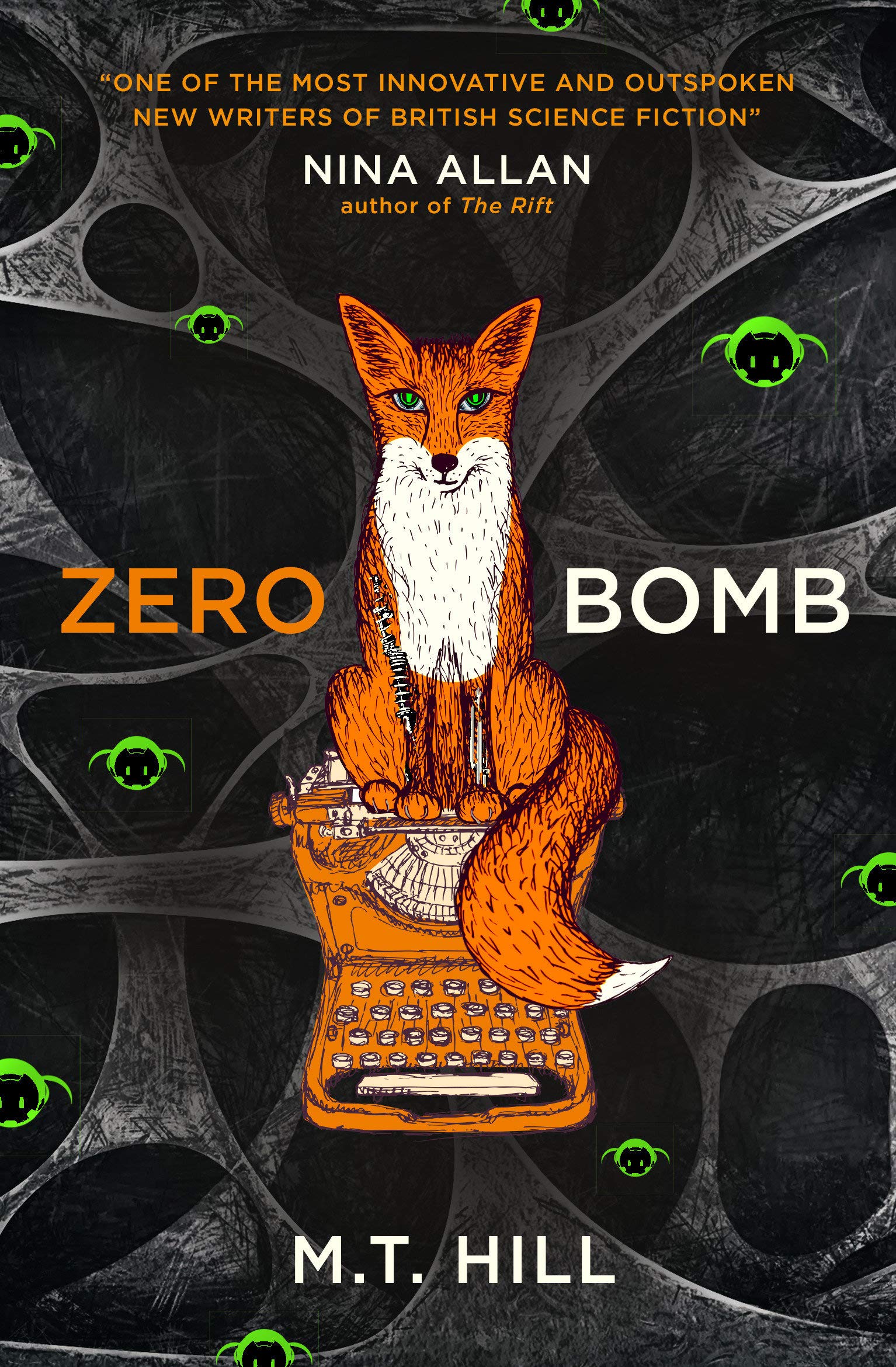
Zero Bomb by M T Hill

Reviewed by Paul Graham Raven. This review first appeared in The BSFA Review.

You wait years for a horribly plausible novel about imminent civilisational collapse, and then two come along at once. In terms of topicality, M T Hill’s Zero Bomb can – and should – be read as a companion piece alongside Tim Maughan’s Infinite Detail, dealing as it does with an end-of-the-world inflicted by misguided infrastructural terrorism. But these are wildly different books in almost every other way: Zero Bomb is more focussed on the sociological dimension, more concerned with character and the role of alienation and bad-news anomie in producing would-be world-enders; it’s also structurally stranger, comprising three distinct elements which might easily have been bulked out into separate novels in their own right. (Indeed, one section *is* a novel in its own right, albeit one reduced to a synoptic summary of itself by the secret resistance network for whom it is both gospel and recruitment tool.) But don’t expect a fat tome; Zero Bomb is surprisingly short, refreshingly so in an age of wrist-snapping epics – the sort of length that you could realistically scarf down in an afternoon.

First we follow the fall from grace (and sanity) of Remi, a naturalised European immigrant in the north of a bleak and brutal post-Brexit Britain, as he quite literally runs away from his life and seeks out a new career in a new town, riding courier bikes and delivering clandestine dead-tree manuscripts across a near-future London that reads like Jeff Noon remixing Jeff Bezos, a glitchy bit-rotted prospectus for the “smart city” that we’re constantly told is coming to solve all our problems. Remi’s recruitment into what he sees as a resistance movement is achieved in a manner which leaves the reader sympathetic to both him and it, before the novel hinges on the heavily excerpted (and convincingly anachronistic) novel of robot uprising already mentioned. 

The second half of the book switches characters and locations to follow the life of Remi’s estranged daughter, whiling away her late teens on an allotment of refuseniks, harvesting biotechnological replacement limbs for an all-but-vestigial National Health Service. Here, in a small northern town far from the political or technological centre of anything, as sympathies become harder to sustain, the threads draw themselves into a terrifying tangle as the book (and its world) take a definite turn for the terminal… or maybe not? As in Infinite Detail, there’s some shafts of hope at the close of Zero Bomb, but they pierce a dark and gloomy future that could realistically result from our increasing over-reliance upon the technologies of automation and algorithmic analysis, and from the solipsistic alienation that is their seemingly inevitable consequence.

Hill’s obvious authorial affinity for the hinterlands combines with his concerns for the intimate human cost of surveillance capitalism (and the ease with which it enables the scared and the angry to manipulate others, as well as themselves) to mark out Zero Bomb as something quite special and (dare I say it?) distinctly British, as well as more knowingly of-its-time than science fiction usually dares to be. The end of the world is always a local and personal experience, taking different forms depending on who it’s happening to, and the technological apocalypse of Zero Bomb feels significantly secondary to the very personal tragedies of its three focal figures, even as it offers a caution to a nation on the brink of a socio-political breach of unprecedented scale and depth: decisions made now in haste and frustration may never be undone, and indeed might be the undoing of everything they were meant to protect.

It’s not a happy book – though perhaps the epilogue will sweeten the last few sips? – but it’s a thrilling, twisted trip across this septic isle, and an exemplar of a sort of science fiction which, at times, has seemed all but extinct. Do yourself a favour and get a copy right away, while there’s still light by which to read it.

Copyright Paul Graham Raven. All rights reserved

Infinite Detail by Tim Maughan

Reviewed by Paul Graham Raven. This review first appeared in The BSFA Review.

You might know Tim Maughan for his BSFA Award-nominated story “Havana Augmented”, or for his lengthening list of by-lines on articles about the imminent future. (Or perhaps for his caustic yet compassionate presence on the birdsite.) But from now on, you should know him for his debut novel Infinite Detail, a tapestry of near-term prognostication that stuns you with its contextual implications, while its streetwise prose gets to work on picking your emotional pockets. 

“You would say that, Paul,” I hear you mutter, “he’s a friend of yours.” Well, that’s true – but you should see the thousands of words of seething envy I discarded in the process of drafting this review, and read some of the blurbs from writers far better known than me. I say it because I believe it; if I didn’t, I’d say nothing. It’s a question of trust: do you consider me honest, or am I just another algorithm in the surveillance-consumerism panopticon? (Answers on a postcard, please.)

Infinite Detail

This is a central issue in Infinite Detail, which is – at least in part – about the mediation of social relations by global infrastructural networks of inscrutable complexity. It’s not just about who (or rather what) you trust to recommend things, but who you trust to keep you safe, to keep the lights on and the shops stocked. In a very-near-future Bristol, a gang of smart young techies and artists have reached such a point of distrust that they start trying to build an alternative system… and in the same world, a handful of years later, everyone is dealing with the consequences of another group of smart young techies having decided that the best solution was to throw a global kill-switch and hope it all comes out in the wash. (Spoilers: it doesn’t all come out in the wash.)

Infinite Detail is an angry, tragic plea for a more intimate and local sort of connection than we’ve become accustomed to. It’s perhaps also nostalgic for a lost past in a way that might seem unimaginable coming from a relatively young writer… until you think back to the 1990s (if you can remember them) and recall, with a sharp lurch of anxiety and confusion, how different the world now seems. But that’s actually an illusion, and Maughan and I (and others of our generation) are just now getting our own serving of the futureshock that so animated middle-aged people in the 1970s, the golden age of the critical utopia in sf. That movement was a bitter yet hopeful flinch from a transformation which must have felt sudden and totalising, but was really just the first flourish of a long, slow three-card trick: ARPANET, microprocessors, containerised logistics. Infinite Detail is about the end of that game, which not even the house can win in the long run.

It’s not unremittingly dark; there’s as much hope here as in Gibson’s The Peripheral, if not more. But in both cases, it’s a hope that emerges from Pandora’s box, among a flood of horrors which cannot be re-contained. The ghost at the feast is climate change, of course – but it’s in no way a work of denial. Instead of using the warming world as his backdrop, Maughan has foregrounded the global machine whose consequences are climate change: the optical fibres and sub-arctic server farms, yes, but also the mines and power stations, the retail palaces and container ports, the logistical systems which create and distribute the disposable crap that arrives to fill our jam-packed lives before we know we want it. 

It’s a novel of failed utopias, then: the technological utopia of Silicon Valley, whose gloss is turning to tarnish, but also the counter-utopia which is its negation. Maughan locates this latter in Stokes Croft, the gentrified but defiantly countercultural zone of Bristol which is his personal Mecca: a vibrant strip of street art, galleries and hipster hangouts whose cool is nonetheless parasitic upon the overlooked poverty of the city’s underclass, from whom much of its now-mainstream cultural cachet – hip-hop, drum’n’bass, grime, graffiti – was originally appropriated long ago. 

It’s about the failure of utopias, but it’s also about why utopias fail: about the cruel efficiency of networks, and the role of power and significance therein, but also about the cruelty of removing them suddenly without an adequate plan for their replacement. It’s billed as a novel of “the end of the internet”, but it’s important to understand that “the internet”, despite the reductive way we talk about it, isn’t just Twitter and Snapchat and smartphones but, well, everything – the systems that feed us, light us, keep us warm and connected, keep us from a life of clothes patched and re-patched over decades, from jerk-seasoned seagull roasted over an oil-drum barbecue. And it’s scary, because it’s true… though I wonder if it reads as far-fetched to anyone who hasn’t spent the last decade learning how this stuff all fits together.

But therein lies the redemption of the bits of the book that can feel a little like lectures on the fragility of our hypermediated just-in-time-and-always-on society: in a sense, this is the hardest of hard science fiction. There’s nothing in Infinite Detail which isn’t plausible as well as possible; Maughan knows networks and supply chains inside out, and that knowledge is reflected in the Janus faces of awe and horror with which the novel considers the crystallisation of a world which we don’t yet quite inhabit, but are nonetheless rushing toward with arms open and eyes closed. So read it as a cautionary tale – but read it also as a searing debut novel from a writer who couldn’t be more relevant to these troubled and troubling times. You can trust me on that.

Copyright Paul Graham Raven. All rights reserved

This is How You Lose the Time War by Amal El-Mohtar and Max Gladstone

Reviewed by Andy Sawyer. This review first appeared in The BSFA Review.

There’s something fascinating about the “Time War” scenario which we find in, for instance, Fritz Leiber’s The Big Time and the stories from the 50s and 60s published as The Change War, or Poul Anderson’s Guardians of Time. In El-Mohtar and Gladstone’s short but emotionally-packed novel we get something similar to Leiber, in which the Change War is fought by two forces, the “Spiders” and the “Snakes” who never quite reach the dynamic of “good guys” versus “bad guys”. Here, we have two agents in a battle fought throughout tangled braids of human alternate-history/parallel-worlds between the Agency and the Garden: whose characteristics—material, technological, militaristic versus organic, insidious, ruthless—become part of the conflict. Following a cataclysmic battle, the Agency operative, Red, savours her victory, and finds ambiguity in it. She picks up a letter from her Garden adversary Blue; a mocking taunt to an opponent, to which, in a sense that this is a tournament and a tease, she replies in the same vein.

This Is How You Lose the Time War

And thus begins another always-fascinating scenario, the battle between two opponents in a war who come to find a kindred-spirit in the enemy: the secret-agents who find in the to-and-fro of the “game” a personal satisfaction more attractive than ideological commitment. Already there is much to like in the novel, and as Red and Blue exchange ever more ingenious letters and self-revelations after each of their confrontations, this becomes a love story playfully referencing Ghengis Khan, Atlantis, Romeo and Juliet, the poet Thomas Chatterton, Wordsworth’s “Marvellous Boy”, and the Russian Front during World War Two (or at least, versions of all these, and more.) From mocking adversaries, Red and Blue become passionate if distanced lovers. At one point, Red writes “I veer rhapsodic: my prose purples”, and there are certainly times when playfulness hovers over whimsey without (for this reader at least), ever tipping in the wrong direction. There are enough asides, mini-digressions (Naomi Mitchison’s novel Travel Light at one point becomes part of the conversation) and sharply-if-briefly imagined alternative “strands” to make up a dozen novels in the Leiber/Anderson tradition, but the focus is upon the tension and teasing which never stops until it becomes clear that their superiors suspect that something is going on between their top agents, and something drastic is going to have to happen. 

We know from our extra-generic reading that secret agents groom and attempt to “turn” each other. This is a novel of traps and tangles, duels and seduction, as if a writer of eighteenth-century epistolary romances had suddenly discovered Golden Age science fiction, though it is considerably sharper and more snapshot than the one and much, much more lyrical than the other. The methods with which the “letters” are written and exchanged are themselves beautifully and baroquely imagined, and worth the price of admission. But as we progress towards the inevitable denouement, there are scenes and evocations that are the distinct opposite from the cuteness and sentimentality that a brief summary of the plot might suggest. You suddenly find yourself seeing “Red” and “Blue” as characters rather than symbols in a highly literary confection, and actively want to see how this will work out. At this point, the authors deliver, and we find that we have been reading not a series of highly-wrought vignettes, but a carefully plotted novel. I would not be surprised to see it among the competitors for at least one major award; nor would I be particularly surprised to see it waved aside as “too clever for its own good”. So I shall come down with an opinion: this is almost certainly the best book I have read this year and one that I intend to re-read for the third time. Behind the playfulness, there’s a dark humour, an aspiration for passion, and, yes, a science-fictional inventiveness that comes along too rarely.

(c) Andy Sawyer. All rights reserved.

See also:

From the editor of Focus: Best of the Year 2020

By Dev Agarwal, Focus editor

As 2020 recedes from us, we look forward to the world opening up and restarting from lockdown safely. While 2020 was obviously the year of Covid-19, it was also a year of community and solidarity. I hope that readers had those experiences as well.

Friend to Focus and writer, Leigh Kennedy, described the grip of Covid-19 as eerie and familiar, like “being in a science fiction novel we all read long ago.”

On top of the pandemic, 2020 was a year packed with political drama. The year started a month after a significant general election in December 2019 in the UK. By the end of 2020, the US had had one of its most important and defining presidential elections ever (where the election of a Black and Asian American woman as Vice President was one of many significant moments). And that’s without us even commenting on the death of George Floyd and Black Lives Matter, the drone assassination of Qassem Soleimani, the poisoning of Alexei Navalny, major conflicts in Armenia, Afghanistan, Yemen, Ethiopia and elsewhere, wildfires across Australia, the attempted violent overthrow in the US on 6 January 2021, and the ongoing fight to vaccinate the planet.

That’s a lot to process and a tough year for writers and artists to make their voices heard and their work noticed. For readers, the challenge was possibly to concentrate long enough to fully enjoy the fiction and art available. A further struggle for writers and artists was to create art in the first place. Despite these challenges there were many successes to celebrate.

Continue reading “From the editor of Focus: Best of the Year 2020″

Uyghur Folklore

Reviewed by Sandra Unerman. Published as part of Vector 293 exploring Chinese SF.

Uyghur Folklore & Legend, compiled by Abela Publishing, 2009. 
The Effendi and the Pregnant Pot, Uyghur Folktales from China, translated by Primerose Gigliesi and Robert C. Friend, New World Press, 1982. 

These books both contain collections of Uyghur folktales. Both have their limitations but it is very difficult to find translations of any speculative fiction from the Uyghur community in China. Some basic information about Uyghur history can be found in a few references in The Silk Roads by Peter Frankopan (Bloomsbury, 2015). These outline Uyghur origins in Central Asia, their role during the Mongol Empire and their current position in Xinjiang province, but that is all. I know very little about the culture of the Uyghurs, so I hoped to learn something about them from these books.

A young man will only go near his bride in the dark and leaves the house before she can see him by daylight. But this is not the story of Cupid and Psyche and the resolution owes more to the man’s cleverness than an ordeal undergone by the woman. 

A sheep and her lamb travel from a valley in Tibet to a high plateau for the summer grass. On the way, they meet a wolf, who wants to eat them both. The sheep persuades him to wait until they are on their way back down, when they will be much fatter. They return according to their promise but trick the wolf, with the help of a hare, who pretends to be on a mission from the Emperor of China to collect wolfskins.

These examples indicate the range of stories in the 2009 collection and their similarity to folktales from other cultures across the world. There are fifty-eight entries, although some are variants of the same basic tale. The book’s title is somewhat misleading, in that no information is provided about folk customs or legends in the sense of tales about specific places or figures from history. The names of storytellers are given and dates, ranging from the 1870s to the 1920s, so presumably these were oral tales, written down by folktale collectors during that period. However, we are given no information about who the collectors were, the circumstances of collecting or the basis of selection of these particular tales. No editor or translator is identified. The similarities between these tales and those from elsewhere may result from universal human responses, the influence of the collectors or from long-standing historical connections among the people who told the tales. No introduction could have disentangled those strands completely but background information could have helped the reader understand the context and the kind of community to which the stories belong. 

The stories do read as versions authentically collected from oral sources, rather than polished up for literary purposes. This can be seen from the gaps and flaws in some of them. In the first, a fox brings grass for a lamb to eat and is betrayed by a wolf, on whom she takes revenge. It looks as though the fox has taken over the role which ought to belong to a sheep, at least in the opening action. Some of the references are difficult to understand, without further information, especially the figure of the ‘pyhrqan,’ who appears in several tales. This is translated in a footnote as ‘monk’ but the stories suggest a being with supernatural powers. 

The narratives have the terse, direct strength of oral tales. The descriptions of settings are minimal but the background of sheep pastures and mountains evoke a landscape of open spaces and long journeys. A hare plays the trickster in several of the animal fables, reflecting the role of the hare as a significant mythological figure in many cultures, as discussed in Marianne Taylor’s The Way of the Hare (Bloomsbury, 2017). Other stories, set in villages or towns, provide glimpses of the daily life of ordinary people and their concerns, about family relationships, making a living and oppression by the powerful. They are set in what might be described as a timeless past, with a social and religious framework that appears to draw on more than one tradition.

Oppression of the workers by the powerful is the theme of the stories in the 1982 collection, which all feature Nasreddin, the Effendi of the title. As the translators explain in their introduction, he is a legendary figure widely known in traditions from Turkey, North Africa and Asia. They say that stories about him have spread from the Uyghur community to become popular throughout China. They are not themselves folklore collectors, so their versions of the tales are not directly taken from Uyghur oral tradition. Their translation is made from Chinese and was published in Beijing.

Visit to a Prison

One day the padishah took the effendi with him on a visit to the prison. “What crime did you commit?” the padishah asked the prisoners. 

“None!” yelled the men in unison. 

The padisha began questioning each by turn and, it seemed, there was only one guilty person among them.

“Protector of the Universe,” the effendi said to the padisha, “please order this man kicked out of here at once! How could he have gotten himself into this place? It is inadmissible that there are people like him in your prison!” 

The translators claim explicitly that the Nasreddin stories can help to create a new, socialist culture, because they highlight the abuses of rulers, together with the humour and wisdom of the poor. The sixty-five brief stories in their collection reflect these ideas accordingly. Like those in the 2009 collection, they are set in a timeless past but with a social structure more specifically focused on Moslem traditions. In most, the effendi gets the better of an important official, who attempts to insult or bully him. In one typical example, the padishah (the ruler) blames Nasreddin, who has accurately predicted the death of his prime minister. He threatens Nasreddin with death, unless he can say how long the padishah himself will live. The reply is that the padishah will live two days longer than Nasreddin, who is released as a result.

These stories are more polished than those in the 2009 collection and put more emphasis on urban life, although sheep and wolves do appear in several tales. They reflect one strand of the wider tradition about Nasreddin. However, he is a more complex figure than is expressed here, someone who can be stupid as well as clever and whose exploits are not always directed against the ruling classes. (His relationship to the traditional figure of the fool or jester is outlined in Enid Welsford’s The Fool, a social and literary history [Faber & Faber, 1935]). By reducing his ambiguity, this book flattens his character and reduces the implications of the stories to a single, basic message, although that is expressed with humour. 

Taken together, these two collections give an impression of one historical aspect of Uyghur culture, as it shares folk traditions from elsewhere. Both are readable and lively but tell us very little about that community today.

Sandra Unerman is studying for an MA in Folklore at the University of Hertfordshire. Her article about folklore and fiction appeared recently in Focus and she writes for the BSFA Review and the BFS Journal. She is the author of two fantasy novels, Spellhaven and ghosts and exiles, and is a member of london clockhouse writers. 
Creative Commons License
This work is licensed under a Creative Commons Attribution-NonCommercial-NoDerivatives 4.0 International License