Salon Fantastique: Femaville 29

If I tell you that on the second page of this story a tsunami is described as looking “like a liquid mountain mounted on a rocket sled”, it probably sounds like I’m saying “Femaville 29” is typical Paul di Filippo: slightly parodic, slightly manic, with some big boffo concept at its core. And to an extent that’s true, since it’s a story where plot is king, and characters hook up with an almost charming disregard for anything so prosaic as motivation, and the protagonist does have the rather daft name of Parrish Hedges. But, as it turns out, that tsunami is headed west across the Atlantic. It smashes into an unnamed city on the Eastern seaboard of the US, Parrish’s home, and the rest of the story takes place in the titular refugee camp (FEMA being the Federal Emergency Management Agency). The political sentiment is clear, if somewhat self-flagellating.

But that’s not the core of the story, either. Lip-service is paid to the sense of trauma such a catastrophe must cause, but if anything, for the survivors it turns out to have been a boon, by clearing away the detritus of their world. “The first week after the disaster”, we learn, felt like “an open-ended New Year’s Eve, the portal to some as-yet undefined millennium where all our good resolutions would come to pass.” When Parrish is interviewed by the FEMA reallocation officials, he rejects the placements they offer him, explicitly because he doesn’t want to leave the “interzone of infinite possibility” that the camp represents. And it’s not just him; nobody in the camp, it seems, wants to move on. Parrish’s explanation for why nobody wants to go somewhere secure and sensible is that everyone “wants to be reborn as phoenixes” because that’s what it would take to justify the loss they’ve suffered.

Written down so plainly, such a scenario looks crass and juvenile, because it is; yet in di Filippo’s hands, it somehow becomes breezy and infectious. It’s a gift that can sometimes make di Filippo seem an old-fashioned writer, and something of a big kid. You sense that, for him, sf is, genuinely and largely unironically, a toybox — that being an sf writer is, to borrow the phrase Bruce Sterling used in the introduction to his most recent collection, “a golden opportunity to get up to most any mischief imaginable”. And he’s good enough at it that we keep turning the pages, and while we do we don’t notice that the plot is running on convenience (Parrish hooks up with a woman called Nia, but said hooking is entirely irrelevant except that it brings him into the orbit of Nia’s daughter Izzy). Or if we notice we don’t care. In most Paul di Filippo stories, we’re on first-name terms with all the characters, and we like it that way.

If “Femaville 29” is a kind of wish-fulfillment, though, it’s not an entirely uncomplicated one. The members of the camp get restless; their enthusiasm for limitless possibility turns to dissatisfaction with their very limited present. Fights and arguments break out — at least, so we are told. We stay with Parrish, who by this time is too busy watching the children of the camp create a new city out of stones and twigs and leaves. Izzy is one of the “designers, engineers, imagineers” running the show, and it quickly becomes clear that the last of those categories is the most important. The children are filling the space left in the world with something better than the world (perhaps a polder). Inevitably, when FEMA loses patience, and decides to forcibly relocate the refugees, the city is ready and willing to take them instead — with the caveat that they have to let go of their past enough to cross the threshold. Parrish (I’m about to give the ending away) doesn’t make it (if he did, the story really would be too generous to like), but he accepts his lot without rancour. It’s enough for him to know that he might be able to get there someday. For a few moments, it’s enough for us, too.

Salon Fantastique: The Lepidopterist

When I think of Lucius Shepard’s writing, I think first of a voice. It’s a voice filled with experience and confidence, speaking in long, fluid sentences, knowing that it’s telling me a story I need to hear. It’s the voice of stories like “Barnacle Bill the Spacer” or “Jailwise“. Of course, Shepard modulates this voice according to the character using it (Senor Volto, for instance, uses almost as many long words as the narrator of either story above, but clearly to somewhat different effect), and on occasion he uses other, more colloquial voices as well. But it’s that rich, mellifluous tone I think of first when I think of Shepard, to the point where it comes as a bit of a shock to start reading “The Lepidopterist” and encounter (after a brief opening paragraph that frames the story as a transcript of a recording made thirty years ago, and the narrator we’re about to hear as “short, in his sixties, as wizened and brown as an apricot seed, and […] very drunk”) this:

I’m goin to tell you bout a storm, cause it please me to do so. You cotch me in the tellin mood, and when John Anderson McCrae get in the tellin mood, ain’t nobody on this little island better suited for the job. I been foolin with storms one way or the other since time first came to town, and this storm I goin to speak of, it ain’t the biggest, it don’t have the stiffest winds, but it bring a strange cargo to our shores.

It’s different, but well-executed. There’s still poetry here, albeit of a rougher kind than is usual for Shepard — “I been foolin with storms one way or the other since time first came to town” is a lovely, clever expression, and there are lines like it throughout the story. But while McCrae is clearly still a Shepardian storyteller, experienced and confident, to me at least he never rang as true as someone like Tommy Penhaligon or Billy Long Gone. That’s partly because I never quite got the hang of the dialect — as with any writing so stylised, you expect it to take a few pages to get acclimated, but I found myself re-reading passages even up to the end — but also, I think, a function of the relative brevity of the tale. Shepard always seems most comfortable to me with some elbow-room in his stories, but he doesn’t (arguably can’t allow himself to) have any here, and beyond being a storyteller, it’s never really clear who McCrae is. A voice is an indication of character, but also a vehicle; which is to say that what the voice says matters.

So my problem with McCrae is compounded by the fact that the plot is nothing to write home about. Indeed, if the voice is something of a departure for Shepard, the story it tells verges on being overly familiar. The trajectory is one we’ve followed before, a tale of an encounter with the fantastic: the protagonist is drawn by stages away from the consensus reality we know, is confronted by a hallucinatory vision, and dazedly withdraws into normality. This is the basic shape of Shepard stories such as “Eternity and Afterward”, “The Park Sweeper”, and “Crocodile Rock”, and even “Only Partly Here” (probably the best thing Shepard has written in the past five years, though “Over Yonder” runs it close). In “The Lepidopterist” McCrae tells how, as a youth, he worked with his father as a wrecker, drawing storm-lashed ships astray onto rocks; how on one such job they encountered Arthur Jessup, an American transporting some unusual butterflies (“Whether they the Devil’s work or one of God’s miracles, I cannot tell you,” McCrae says. “But it for certain they unusual butterflies”); how the butterflies wove silken cocoons large enough to hatch a person; and what happened next.

But at no point does “The Lepidopterist” have the astonishing intensity of a story like “Eternity and Afterward”, or, at the other end of the scale, the delicacy of a story like “Only Partly Here”. What’s left? There’s a nod to the politics of the situation in the fact that Jessup engineers McCrae’s encounter with one of the butterfly-creatures as a gift, saying that he wants to take away some of the boy’s courage for his own good. But McCrae’s subsequent assessment — “So if Mister Jessup make me a present, it were like most Yankee presents and take away more than it give” — feels oddly half-hearted. As allegory it doesn’t catch, and the sense that McCrae hasn’t lived the life he was meant for doesn’t sting as it should. So while my presumptuous guess would be that it’s the voice for which David Hartwell and Kathryn Cramer have picked the story up for their year’s best fantasy, I can also see why some reviews haven’t mentioned the story at all. It’s strange: McCrae’s voice is classic Shepard in a number of ways, but seems to be missing the one thing that can usually be taken for granted: a burning need to tell. I enjoyed “The Lepidopterist”, but I don’t know why it had to be told.

Salon Fantastique: The Night Whiskey

I got my hands on a copy of Salon Fantastique, the latest Ellen Datlow/Terri Windling anthology, a couple of days ago, and the probably-foolish idea of reading at least a story a day from the book, and writing short blog posts about them, has germinated in my head. “Short” being the operative word; if these start ballooning into 1500-word essays I’m going to start running out of time. I might write about every story in the book, I might just write about a handful, or just this one. We’ll see how it goes.

First up (but not the first story in the book) is Jeffrey Ford’s entry, “The Night Whiskey”, which Nic singled out as one of the best stories in the book in her review, and which Jonathan Strahan has picked up for his year’s best. It’s certainly a strong story, although for me I think not quite first-rank Ford — which should be taken as praising the story with a faint damn, since Ford is so reliably good. It’s also quite interesting as “a Jeffrey Ford story”. In a (slightly rushed) piece for the LBC when Ford’s novel The Girl in the Glass was under discussion earlier this year, I tried dividing Ford’s stories into two types, loud (exuberantly fantastic) and quiet (liminal). In those terms, “The Night Whiskey” is one of the stories that don’t really fit into either category; a quiet story about someone on the edge of a loud one.

The story is set in a small American town called Gatchfield, which would be like any other such town (“one of those places you pass but never stop in while on vacation to some National Park”) except for a unique local flora, the deathberry. Deathberry plants grow only out of dead bodies: once a year some of the townsfolk harvest them and distill the berries into the titular whiskey. There’s only enough in each harvest to produce eight shots of night whiskey, so a lottery is held to determine who gets to drink them. Winning tickets are prized, because in addition to being sufficiently intoxicating that just the one shot gets the person who consumes it blind drunk, the whiskey transports the drinker to a fugue state, or possibly an actual alternate dimension, in which they can talk with dead relatives. The protagonist, Ernest, doesn’t win the lottery, and isn’t involved in the production of the whiskey. Instead, he’s an apprentice for the drunk harvest, helping to round up the whiskey-drinkers the morning after the night before — not the easiest feat in the world, given that for some unknown reason drinkers always climb a tree before they pass out.

Tonally, the first part of the story is surreal, even lighthearted. But there is, inevitably, a shift: a darker side to the drink is revealed. To borrow a phrase that Graham used when reviewing 20th Century Ghosts, “The Night Whiskey” is a masterclass in the rhetoric of endings. (It may not be a coincidence that, like most of Joe Hill’s work, “The Night Whiskey” is ultimately a horrific story; endings are always important, but arguably they’re essential for horror stories to work.) Details from the first part of the story are picked up and paid off; the reader’s understanding of what’s happening is stage-managed so precisely that recognition arrives barely a sentence or two ahead of the explanation (at least, that was the effect for me); and the shift in the positioning of the fantastic, with Ernest never drawn all the way into the wildest happenings at the centre of the tale, but drawn in further than we think he will be, and dealt a sort of glancing blow that reorients his life, is beautifully handled.

My main reservation is the pacing of the opening pages, which seemed to take just a little too long to get to where they were going, without ever quite making Gatchfield either real enough or Twin Peaks enough to compensate. Thinking about it, I would also have liked, just this once, the articulation of the story’s theme to carry a bit more force. The idea — that Gatchfield is a town in unnatural stasis, and the deathberry and its consequences are a sort of re-assertion of a natural law of change — resonates strongly with me, and forms the basis of the ending. Ernest and his girlfriend escape to “the biggest brightest city” they can find, where “Every day there was change and progress and crazy news on the television”. That seems to me a neat inversion of a common fantasy arc, and it deserved to stand on slightly more solid ground, to have more to balance it than the theorising of an eccentric doctor.

The Links Our Stuff Is Made Of

1. News from Novacon: Convoy is dead; long live Contemplation.

2. Is there a backlash against Year’s Best books? See recent reviews by Dan Hartland and Paul Kincaid. In the meantime, Jonathan Strahan has announced the table of contents for the book I’ve been waiting for, his Nightshade Year’s Best Science Fiction and Fantasy:

1. “How to Talk to Girls at Parties” by Neil Gaiman
2. “El Regalo” by Peter S. Beagle
3. “I, Row-Boat” by Cory Doctorow
4. “In the House of the Seven Librarians” by Ellen Klages
5. “Another Word for Map is Faith” by Christopher Rowe*
6. “Under Hell, Over Heaven” by Margo Lanagan
7. “Incarnation Day” by Walter Jon Williams
8. “The Night Whiskey” by Jeffrey Ford
9. “A Siege of Cranes” by Benjamin Rosenbaum*
10. “Halfway House” by Frances Hardinge
11. “The Bible Repairman” by Tim Powers
12. “Yellow Card Man” by Paolo Bacigalupi*
13. “Pol Pot’s Beautiful Daughter” (Fantasy) by Geoff Ryman*
14. “The American Dead” by Jay Lake*
15. “The Cartesian Theater” by Robert Charles Wilson
16. “Journey into the Kingdom” by M. Rickert*
17. “Eight Episodes” by Robert Reed*
18. “The Wizards of Perfil” by Kelly Link
19. “The Saffron Gatherers” by Elizabeth Hand
20. “D.A.” by Connie Willis
21. “Femaville 29” by Paul di Filippo
22. “Sob in the Silence” by Gene Wolfe
23. “The House Beyond Your Sky” by Benjamin Rosenbaum*
24. “The Djinn’s Wife” by Ian McDonald*

I haven’t really read enough short fiction this year to have an opinion about this list. I’ve marked the stories I’ve read, all nine of them, with asterisks; some I would definitely have picked (“The Djinn’s Wife” is probably the best of Ian McDonald’s three River of Gods-related stories; “Yellow Card Man” is probably the best story Paolo Bacigalupi has published so far, full stop), some I’m pretty sure I wouldn’t (including, and I recognise I’m in a small minority here, “Journey Into the Kingdom”, which seemed quite a bit below M. Rickert’s best to me; ditto “The American Dead”). But it’s long past time we had an all-under-one-roof Year’s Best book, so I’m still eager to get my hands on this.

3. Miscellaneous links: John Clute reviews Nova Swing, M. John Harrison’s latest novel (in the Guardian!); a very disturbing video for any Calvin and Hobbes fans; the history of SFBC original anthologies; an interview with Catherynne M. Valente; I Read A Short Story Today; Charlie Brooker on UK SF TV (and BBC4’s SF season in particular); Abigail Nussbaum on Wintersmith by Terry Pratchett.

4. The Prestige. I saw this on Friday and have been processing it since. It’s a good film, very neatly put together, with good performances from Christian Bale and Rebecca Hall, and it does, I think, a remarkably good job of translating Christopher Priest’s novel to the screen. Given that I had some reservations about the book, this means I also have some reservations about the film, such as the fact that when you get down to it the whole thing is a Star Trek “transporter malfunction” episode in fancy dress. Of course, Nolan’s cut out the present-day frame. The replacement frame, and the nesting of other frames within that, works well, but necessitates some changes in emphasis that I think, on balance, makes the film’s portrayal of magic less sophisticated than the novel’s. Some elements that are quite obvious from early on in the book are obscured in the film. Arguably, Nolan actually does a better job than Priest of handling the inevitability of the prestige, the fact that you know you’re going to be tricked — in fact, you know what the trick is going to be: the girl is going to get out of the locked box — and remain impressed when it happens anyway. But the way he does so is somewhat at the expense of the analysis and critique of storytelling that I liked in the book. And not everyone gets it. Here’s Peter Bradshaw, for instance, missing the point entirely:

“Prestige”, a magicians’ technical term invented by author Christopher Priest for his original 1995 novel, means the crowning moment of a trick. It’s the gasp-inducing climactic flourish, the moment whose devastating impact has to be guarded as closely as possible before detonation. So it is odd that the prestige of this film, the trick ending, is gradually given away over the final 40 or so minutes in a series of extended takes and giveaway closeups. Why? Because the director figured we were going to guess anyway?

If you’ve already read the book and seen the film, see Gary Westfahl’s review at Locus Online for a more thorough and interesting take.

The Color of Neanderthal Eyes

Everyone knows what they say about the work of James Tiptree, Jr: that the longer his stories, and the later written, the weaker. So that is what was in my mind when I started reading Tiptree’s penultimate story, “The Color of Neanderthal Eyes” (written 1986, published in the May 1988 F&SF; page numbers here come from 2000’s this-and-that book Meet Me At Infinity). It was, they say, the revelation of his true identity that marked the change. After all, only a few stories written after made it into Her Smoke Rose Up Forever, and though one of them (“Slow Music”) is a favourite of mine, another is perhaps the least satisfactory Tiptree I’ve read, being a story that does indeed seem to be weaker because it is longer. The pace of “With Delicate Mad Hands” is uneven, sagging in the middle, and the content seems stretched thin over the page count. They say that Tiptree’s stories are intense, but “With Delicate Mad Hands” is not.

And neither, by and large, is “The Color of Neanderthal Eyes”, although it is much more evenly constructed. It starts as, more or less, an idyll. A telepath by the name of Tom Jared, whose job is (for obvious reasons) alien contact missions, is enjoying (for obvious reasons) the solitude of shore leave on a nearly empty waterworld called Wet. He encounters one of Wet’s inhabitants, Kamir, who seems entirely too good to be true: a natural telepath, friendly, childlike in her innocence, and beautiful. As in “And I Awoke And Found Me Here On The Cold Hill’s Side”, Tiptree’s evocation of alien beauty is skillful; there is no doubt that Kamir, with her green skin and flat, non-mammalian body, is alien, but there is no doubt either that Tom is entranced by her. And so they end up on an island together, in a storm, and Tom breaks Rule One of alien contact: “There is a feeling of clasping. […] It isn’t Human, but exciting beyond words, and finally, somehow, fulfilling” (116).

But although the story is told with present-tense uncertainty, we know that something has gone wrong. A note at the start warns us that “It’s my fault, all of it and Kamir is dead. […] I am too torn up and tired to make a formal report. I am simply talking out what happened so you will see that something must be done” (112). And though Tom and Kamir spend some happy days together, travelling between various islands — indeed, Tom tells us they are the happiest days of his life — before too long Tiptree starts unweaving her paradise. The first shadow to fall over the map is Kamir’s prediction for the future: “When you love, you die,” she says. “The woman dies. The man lives, to feed the babies” (129). (Because this is a Tiptree story, we take her entirely literally.) The second shadow is Tom’s growing suspicion that Kamir has, in fact, miraculously, become pregnant: and that he has therefore caused her death. The third — after Kamir’s brother catches up with the couple, and leads them back to their peoples’ nearest camp — is the revelation that there is another people on Wet, golden-skinned, who have attacked others of Kamir’s kind. “A dreadful parallel” comes into Tom’s mind. Thanks to the story’s title, we already know what it is, and we watch as Tom resolves first to explain the situation to the Mnerrin (they are a people with no word for “peace”, because they do not know war), and then to help them.

“The point is this. You and your people are very different from the great majority of races. In my life of traveling and learning of travels, I have never encountered a race who so hated killing. You have not even the words for what is the daily occupation of many peoples — war, aggression, fighting, invasion, attack. Here, let me show you.” And I send out horrible images, to him and the other men who were leaning to hear. I saw their faces change. (143)

This is all, more or less, Tiptree stuff. But it’s true that there is something different about it, and I think it’s in the languid landscape of Wet. With the possible exception of “Slow Music”, I don’t think any of the stories in Her Smoke Rose Up Forever take place in such a peaceful environment; Wet seems independent from the convulsions of the story taking place on its surface in a way that Earth (or what we see of it) is explicitly not in stories like “The Last Flight of Doctor Ain” and “On The Last Afternoon”. Or to put it another way, Tiptree’s earlier stories feel more intense because either everything hangs in the balance, or the things that hang in the balance are made to feel as big as the world. “The Color of Neanderthal Eyes” steps back a little. It has, perhaps, more room for detail — and for tenderness. You suspect that the early Tiptree would have spent much less time establishing Tom and Kamir’s contentment. According to the endnotes in Meet Me At Infinity there is actually an earlier draft which is somewhat compressed along these lines.

Which is not to say that the story as it currently exists is bad. The ending, which makes the Neanderthal comparison explicit, is massively unnecessary (like the awkward final sentence of “The Screwfly Solution” to the nth degree), but the journey is memorable. Tom succeeds in arming and leading the Mnerrin; and if Tom never quite seems to feel the qualms about involving himself in the struggles of aliens that we are told (and feel) he ought to, the unease that comes from watching his deliberate removal of the Mnerrin’s innocence is some compensation. Most striking of all is the scene where Kamir gives birth, in which the full alienness of Mnerrin physiology is revealed:

Kamir puts her hands with mine up on her great belly. It is hot, hot. Then she pushes at it again.

Suddenly, with a dreadful caving-in feeling, her whole belly, containing the fetuses, starts to separate from the rest of her body! It tips forward, away from her, as the scarlike “lips” open. Agna is furiously working at this line, pushing his hands under her. She whimpers again. I see that the lips are actually a deep separation line, circling her whole belly, from ribs to pelvis. Oh gods, what is happening here?

[…]

But I have a horrifying look at the shell of her body left after the fetal mass tore loose. From diaphragm to hips it is empty, covered by a rapidly thickening gel membrane. Through it I can see, under her ribs, a dark mass pulsing: her heart. Below that, by her spine, I can see the great cords of nerve and blood vessel running along her backbone, inside her empty flanks, to her hips and pelvis. Nothing more. (166)

It is, to put it mildly, a contrast to the initial romanticised descriptions of Kamir. It’s not really surprising that the one mention of “The Color of Neanderthal Eyes” in Julie Phillips’ biography highlights this scene, putting it in a context of Alice Sheldon’s ongoing engagement with the concept of motherhood: “In it a mother dies happily in childbirth, knowing that her children will go on. This time Alli seemed almost wiling to accept instinct as an explanation” (390). And perhaps the scene is, in fact, the scene my hypothetical early Tiptree would have structured the story around, because it seems to me the sort of unflinching image we associate with Tiptree. But in the story as written it’s part of a larger whole, a more general exploration of the limits of biology, the in-built frameworks of weakness and strength that shape a culture.

“The Color of Neanderthal Eyes” isn’t unique in the way that early Tiptree is, there isn’t the sense that only Tiptree could have written it — but it is a good story, and makes me interested in seeking out that final collection, Crown of Stars. The value of the story, I think, is in that step back, in the way it portrays a broader situation. It ends with death, but not with the death of hope. One of the Mnerrin puts it best, as Tom is preparing to leave, to return to the Federation and petition for the people he has fallen in love with to be saved from their attackers. “It has been for you a happy time, out of your real life, which we cannot imagine,” he says. “But for us this is real life, with all its good and evil.”

In Brief

Here’s the terrible secret about this blog: the posts don’t just happen. They are planned. I don’t usually read a story, or a book, or watch a film or a tv show, and think, “hey, I want to write about this”. Sometimes that happens — it did with Children of Men, for instance — but those are the exceptions. More often, I’m on the lookout for things I want to write about. Recently, though, my plans have all come to nothing, or at least not very much. What follows are some fragments of aborted posts on some not-as-interesting-as-I’d-hoped failures: some stories, a film, and a tv show. (I’m really selling this, aren’t I?)

“Chu and the Nants” and “Postsingular” by Rudy Rucker

Inspiration is a tricky thing, especially when publicly acknowledged. When, a few years ago, Paul di Filippo wrote Fuzzy Dice, a novel inspired by and intended as a tribute to Rudy Rucker’s tremdous, barmy, transreal exploration of transfinite mathematics, White Light, it seemed somewhat miraculous that he pulled it off: his novel was just as tremendous as, and arguably even barmier than, Rucker’s. More recently, Rucker has in turn been inspired, as he acknowledges in the headnotes to the Asimov’s appearances of these two stories, and in a more-or-less loveletter to the book in question published in the November 2005 NYRSF. But while you can see how di Filippo got from White Light to Fuzzy Dice, if I didn’t know Rucker’s inspiration was Charles Stross’s Accelerando, I don’t think I’d have guessed the lineage. The two writers tell their stories in very different ways.

So far, whatever it is that Rucker’s up to is not very exciting. “Chu and the Nants” and “Postsingular” (note that both links are to excerpts, not complete stories) are set in the same future history. The former is backstory to a forthcoming novel, Postsingular, and explains how a nanotech singularity gets reversed by a clumsy plot gimmmick; the latter is part of the novel, and dramatises a rather more novel singularity, involving the overlay of a digital realm onto the physical, thanks to what amount to smart nanotech tags, which are the sort of thing I’m sure I’ve read Bruce Sterling enthusing about at some time or other.

Rucker’s plainspoken, laid-back style is almost the polar opposite of Stross’s data-dense lingo; if anything, these stories feel more like the work of Cory Doctorow, or like descendants of Vinge’s “True Names”. Which is fine, except when plainspoken becomes simply flat, and it too often does: the explanatory digressions are thinly veiled, and most of the characters are just thin. Ond, the (anti)-hero engineer at the centre of both stories, has motivations that are simplistic at best, and simply embarrassing at worst (his big realisation that bringing on the singularity might not have been a great idea comes when his wife starts electronically cheating on him); and most of the female characters are shrill, except when they’re being stupid. Neither story has the energy or the charm of White Light, and the ideas in them feel tame and familiar, even when they’re not. Probably the most interesting thing about the stories (aside from the use, or possibly invention of, increasingly improbable SI prefixes) is their embrace of the “postsingularity = magic” idea: in “Chu” a computer program is described, with very little irony, as a magic spell, while “Postsingular” features more spells, heaven, and some angels. But the whole enterprise has the sort of curiously weightless feeling that Accelerando was (mostly) notable for avoiding, and doesn’t inspire great confidence in the novel.

Death of a President

Death of a President is the second speculative docudrama about the US that I’ve seen this year, the first being the lower-budget, but more ambitious and more successful, C.S.A.. Writer-director Gabriel Range spins a tale that does exactly what it says on the tin: relates the circumstances surrounding, and the fallout from, the assassination of President George W. Bush in Chicago (which city is lovingly captured in a series of sweeping establishing shots) on October 19, 2007.

The first part of the film, which portrays a Presidential visit that meets with widespread protest, is good. It perhaps tends somewhat towards the hysterical, but arguably that’s necessary to set up a situation in which it’s plausible that the secret service would lose control. The second part of the film, which focuses on the fallout, is much less good, because the only part of the fallout it focuses on is the investigation into whodunit, and because that investigation is about the most predictable and politically heavy-handed you can imagine. A series of archetypal suspects — in particular, the shifty, pasty white man; the black man who may or may not have just been in the wrong place at the wrong time; and, of course, the Syrian — are wheeled out in turn, and I suspect it’s not spoiling anything if I tell you that the last of those three is subjected to a hasty, shoddy trial and a conviction that subsequently turns out to be a mistake. (The identity of the actual assassin is about as big a cop-out as I can imagine.) In the background, Cheney ascends to the Presidency, rattles some sabres, and gets PATRIOT 3 passed, but otherwise seems to do remarkably little. Range is entitled to tell the story he wants to tell, of course, but I can’t help thinking that a slightly broader perspective would have made for a much more interesting film.

Torchwood

What struck me most about Torchwood was how normal the normal bits are. For all the fuss made about the incorporation of Rose’s family into the Russell T. Davies incarnation of Doctor Who, the Tylers and their friends always felt to me like a tv family. By contrast, Gwen, her colleagues and her boyfriend seemed a bit more grounded. Admittedly, part of this perception is probably due to the fact that some of Gwen’s mannerisms and dialogue reminded me alarmingly of someone I knew at university; but even allowing for that, the scene (for example) where Captain Jack takes Gwen for a drink had a sort of incongruous meeting-of-worlds feel to it that recent Who only managed once or twice in two seasons.

As I’m sure most people reading this are more than well aware by now, I haven’t been overly impressed by new Who. It’s had its moments — mostly involving scripts by Steven Moffatt — but not many of them, and they’ve been almost lost in the general mediocrity and occasional outright amateurishness. But I’ve liked much of RTD’s other work (particularly The Second Coming), and wondered whether he might do better starting a show off from scratch. The other notable thing about Torchwood, though, is how much it doesn’t start from scratch. Its genetic makeup seems to be (even leaving aside the elements taken from a certain well-known show) about 10% Doctor Who, 5% Spooks (mostly the soundtrack), 30% Men in Black, 10% Generic British Drama, 5% Buffy, and 40% Angel.

The second episode (the Chris Chibnall-scripted “Day One”), in particular, had an Angel vibe about it — not, as some have said, for the loose similarities the plot bore to “Lonely Hearts” (the similarities were there, but they were very loose), and not particularly in the tone, but rather in the general structure of the show, and the sense of what it was trying to do. Captain Jack has been reinvented, consciously or not, as a more Angel-esque figure: invulnerable, somewhat more brooding, prone to standing on high buildings staring out over “his” city, and power-walking through the opening credits in a long flowing coat. The story took a fantastic element and used it as a metaphor for an aspect of human experience (Modern Life Is Sex); and Jack’s sidekick Gwen, while more of a viewpoint character than Cordelia ever was, offers the same sort of connection-with-common-humanity that the Queen of Sunnydale High provided for Angel. At one point in “Day One”, Jack asks Gwen to tell him “what it means to be human in the 21st century”, which as mission statements for tv shows go is surely ambitious enough for anyone.

The problem for me is not so much that Torchwood‘s influences are so obvious, but that they have been followed in their flaws as well as their virtues, without any real thinking-through. For one thing, the writers seem to be of the “sf doesn’t need consistent plotting” school; and to continue with the theme, Joss Whedon isn’t the strongest plotter in the world, either, but he tends to be much, much better at papering over his holes than RTD or most of his team. Nor do these writers have Whedon’s skill at fleshing out secondary characters: Toshiko and Owen remain cutouts. And the whole of the UK seems to indulge in the sort of mass-denial of alien existence that would put Sunnydale to shame — and as Martin Wisse notes, that kind of denial doesn’t really play in a science-fiction world, particularly on the sort of scale it’s used here. Torchwood may yet develop its own identity — it took Angel almost a season, after all — but at the moment it’s not even close to being a must-watch.

EDIT: Discussion of this post seems to be happening on the lj feed. Which, of course, means it’ll vanish into the ether in about three weeks. Sigh.

A Billion Eves

There are three obvious things to say about Robert Reed, and they get said all the time. One: he is prolific. Two: he writes (mostly) traditional science fiction stories. Three: his work is highly competent. In isolation, none of these qualities is particularly remarkable, but the combination marks him out.

To take the question of productivity first, for instance, there are plenty of sf writers who produce a book a year, and more than a few who seem to manage a book every nine months or so; and of that cohort, there’s a depressing number I can’t help wishing would slow down a little. Not because it’s hard work trying to keep up, although it can be, but because there is often a sense that such productivity—whether driven by the market or by the writer’s own need to get their stories told—comes somewhat at the expense of the final product. There are a lot of sf books (to be fair, probably a lot of books in general) that feel as though they have escaped from their writers’ desk just a little too early, that seem to have needed just one more draft, just that extra bit of care. But that’s almost never the case with Reed’s work. He is, admittedly, most visible a writer of short stories. In twenty years or so of writing, he’s produced eleven novels, but more noticeable is the fact that it seems barely a month goes by without him cropping up in some magazine or other (“The Cure”, in the December 2005 F&SF, was his fiftieth story for that venue), not infrequently with substantial novellas. The stories I’ve encountered have been, almost without exception, smart, tidy, well-put-together—competent—work.

And to my mind, at least, the most interesting of them have been science fiction. I was recently involved in a discussion about what current sf it would be best to recommend to someone who used to read in the genre, drifted away a decade or two ago, and now wanted to try it again. One immediate problem with the question, of course, that a lot of the high-profile writers at the moment (China Mieville, Kelly Link) are best-known for recombinative, border-case work, which may not be the most effective starting point. Reed’s work was suggested as one way in, which makes sense to me: although the settings and themes of his stories vary widely, they tend to work like traditional sf, being usually either idea-driven, or on a grand scale, or both. In 2004, to pick a year more-or-less at random, Reed stories included “A Plague of Life” (Asimov’s, March), which is essentially a family saga, but set in a world where humans are vastly longer-lived than us; “Hexagons” (Asimov’s, June, later Hugo-nominated), which reveals an alternate history through its depiction of a strategy game and real political machinations; and several entries in his “Marrow” sequence (“River of the Queen”, F&SF, February; Mere; and The Well of Stars), which relates the story of a Great Ship, an environment so vast it contains a planet at its centre.

“A Billion Eves”, in the October/November issue of Asimov’s this year, is one of the aforementioned substantial novellas. It works in a similar way to “A Plague of Life”, which is to say that it opens on a recognisable, even familiar scene (a family preparing to go on holiday, their daughter sceptical, expecting things to go wrong) with a few odd details (character names like Kala, the daughter, and Sandor, her brother; place names like the Mother Ocean), and then pulls back by stages to reveal how drastically the story’s world differs from our own. In the foreground, though, sure enough trouble strikes the holiday: they leave on Friday, but the family car soon breaks down. Luckily, it’s not too far to the nearest garage.

Despite its being the Sabbath, the traffic was heavy—freight trucks and tiny cars and everything between. Traveling men and a few women bought fuel and sweet drinks. The women were always quick to pay and eager to leave; most were nearly as old as Mom, but where was the point in taking chances? The male customers lingered, and the fix-it man seemed to relish their company, discussing every possible subject with each of them. The weather was a vital topic, as were sports teams and the boring district news. A glum little truck driver argued that the world was already too crowded and cluttered for his tastes, and the old gentleman couldn’t agree more. Yet the next customer was a happy salesman, and, in front of him, the fix-it man couldn’t stop praising their wise government and the rapid expansion of the population.

As prose, this paragraph is not particularly special, but what’s nice about it is that it raises questions and provokes assumptions through its choice of details, without stepping outside the scene. Friday is widely accepted as the Sabbath; there is either a specific or general situation that’s putting women in danger; population growth is encouraged by the government; and sports and local news continue as usual. Before too long, a repurposed school bus pulls in for fuel. Sandor interrogates the driver about his intentions. It is a tense scene, but we don’t quite know why—in fact, it’s a tense scene because we don’t quite know what’s going on, and its resolution evokes a complex mix of relief that the family are ok, and horror as the implications of what’s just happened become clearer. The driver is a member of something called the Church of Eden, and planning to leave (where to, we don’t know). When Sandor asks him how he’s going to maintain his gene pool, the man replies, “You think I should take along another? Just to be safe?” Kala starts to wonder who else is on the man’s bus, and whether they’re there voluntarily. But though it’s clearly a fate to be avoided, it also appears to be business as usual. It may not be a practice officially endorsed by the government, but the abduction of women isn’t very actively policed against, either.

For a while after this, the story devotes itself to making such a situation plausible, and exploring how things got this way. We learn that, despite the apparently twentieth-century levels of technology, we’re a long way in the future: at least 20,000 years. We learn that we may not be on Old Earth, but we’re certainly on An Earth: humanity has been expanding sideways, into parallel Earths uninhabited by humans or other intelligent species, using machines known as “rippers”. We learn that the man from the Church of Eden was on his way to finding a new Earth of his own, using a stolen ripper only powerful enough to relocate the bus and a few surrounding metres; bigger rippers can move whole city blocks. And we learn how it started: a young man named Owen, from our Earth, stole one of the larger rippers, loaded up three trucks with essential supplies, and transported them, himself, and a local sorority house to another world. Kala and Sandor’s world is just one of hundreds of worlds downstream of that initial shift, and Owen’s story—the story of the First Father—has long since become myth, forming the basis of a whole spectrum of religions.

The most devoted wives left behind written accounts of their adventures on the new world—the seven essential books in the First Father’s Testament. Quite a few churches also included the two Sarah diaries, while the more progressive faiths, such as the one Kala’s family belonged to, made room for the Six Angry Wives. Adding to the confusion were the dozens if not hundreds of texts and fragmentary accounts let behind by lesser-known voices, as well as those infamous documents generally regarded to be fictions at best and, at worst, pure heresies.

The worst of those heresies is The First Mother’s Tale, which relates the story of Claire, the fifty-something widow who had overseen the sorority house. No major church recognises Claire’s existence, but we are given every indication that her testament is, in fact, the closest to the truth. In the aftermath of the shift from Old Earth, Claire confronts Owen. In every official testament, Owen unlocks the supplies in the trucks he’d brought through, and his new wives give themselves to him willingly; in The First Mother’s Tale, Claire rejects Owen’s demand of three women out of hand, offering only herself instead, and pointing out that “You don’t know us […] Everyone here is going to realize that you’re just a very ignorant creature. If they don’t know it already, that is. And if you think you’ve got power over us … well, let’s just say you have some very strange illusions that need to die.” But despite the fact that she gets her way—and in fact seems to be instrumental in the survival of the colony, and its establishment as a functioning society—history has swept her under the rug. Owen has a tomb; Claire does not.

Relating all of this takes time, during which Kala is growing up. But it’s the former rather than the latter that drives the story. We don’t turn the pages to find out what happens to Kala (which is just as well, because Reed’s characterisation of her is only serviceable); we turn them to find out what has already happened to her world, and how. The answer to that second question is that a sort of memetic Founder Effect holds sway: uprooting civilisation and starting from scratch every couple of thousand years doesn’t just restrict genetic diversity, in Reed’s model of history, it restricts the ideologies that people carry with them. This is clearly an arguable premise, at best, but much like the conservation of the path of progress in a book like Kim Stanley Robinson’s The Years of Rice and Salt, it makes for an interesting story. There is progress, but of a limited kind, and heavily dependent on starting assumptions. So by Kala’s time, establishing new colonies is part of religious practice, and the founders are equal numbers men and women, who undergo formal group marriages the day before they depart; but it’s still accepted that some men will kidnap some women, because that’s the way things are. When Sandor saves his younger sister from just such an abduction, and castrates the would-be kidnapper to boot, the reaction of the family’s friends and colleagues is incomprehension: Kala’s friends can’t understand why she would stand by her brother, when he’s committed such a horrible act.

At about the half-way mark, then, the story seems to be headed for the neat ending, to wit that Kala and her brother will find a way to Do It Right. There would be nothing wrong with this, as such, but it wouldn’t be doing anything we haven’t seen before; and given Reed’s commitment elsewhere in the story to the logic of his premise, it would have the mark of contrivance. To have Kala go all the way, by herself, would seem (I think) too much. So Reed throws another idea into the mix, with the result that what we more-or-less expect is more-or-less what happens, but it doesn’t happen entirely for the reasons we think it’s going to happen. Kala is concerned about the oppression of women in her world, but she’s even more concerned about something else: the fact that her world is dying.

“Computer models point to the possibility,” she explained. “Low diversity means fragile ecosystems. And it’s more than just having too few species. It’s the nature of these species. Wherever we go, we bring weed species. Biological thugs, essentially.
[…]
Do you ever wonder why so many earths don’t have decent air for us? Do you?” Kala gave [Sandor] a rough pat on the shoulder, asking, “What if a lot of pioneers have been moving across the multiverse? Humans and things that aren’t human, too. And what if most of these intrepid pioneers eventually kick their worlds out of equlibrium, killing them as a consequence?”

It’s a theme that could easily become heavy-handed, but Reed balances it against the already-established conservative nature of the story’s setting. Both the social and the environmental elements of the story underscore Reed’s basic argument—that human nature really doesn’t change, even across thousands of years; that thinking outside your immediate world really is hard, even when you know for certain that your world is only one of an infinite number of possible worlds. The scale of the story exposes the bleakness of the sentiment.

Kala’s world, like all the other worlds descended from the First Father’s colony, is inherently out of balance. So, not unlike the early garage scene, the end of “A Billion Eves” plays two emotions—what we feel, and what we know the characters feel—against each other. The joyous release provided by the fact that Kala and her brother eventually do escape from history (perhaps) is tempered by the knowledge that they are not really doing it for (what to us are) the obvious reasons, even if they’re doing it for perfectly good reasons. “I don’t want virility and stupidity,” says Kala. “I want wisdom and youth.” There is something comfortable in this, too, because all the strategies Reed has used in getting to this point—the initial use of strangeness as a hook, the narrative emphasis on uncovering history, the clean but unadventurous prose, the viewpoint character who grows to understand the world at the same pace as the reader, the generation of story through the collision of two different speculations—are classic science fiction strategies. But in the end, they still work. Robert Reed knows how to make them work.
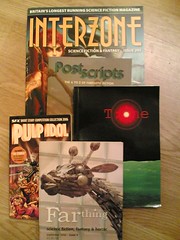
I Want My 21st-Century William Atheling Jr

Oh dear. In a discussion of Rich Horton’s Locus review of Salon Fantastique, Kelly Shaw says:

If I’m remembering correctly, Horton also gave the Trujillo collection a lukewarm review. To each their own — but a Shepard story is a Shepard story, and a reviewer has an obligation to comment on it, positively or negatively.

I like Kelly, but I (and most of the commenters in the ensuing thread) think he’s dead wrong about this. He raises an interesting question in his later comments, about the purpose of Locus reviews, but I don’t think there are many cases where a reviewer has an obligation to comment on any particular aspect of a book. Sometimes you can see that there are aspects of the book that many people reading the review are going to want to know about (I suspect a lot of people reading reviews of Accelerando, for instance, were interested in whether the stories worked as a novel, rather than as a magazine serial), but I don’t think there are many such cases. If Lucius Shepard published as infrequently as, say, Ted Chiang, Kelly would have more of a case—but at the moment, Shepard is publishing quite a lot, if not as much as a few years ago.

Actually, I’m probably even further away from Kelly’s position than that would suggest. I’ll explain why in a minute, but first a question, tangential to the discussion, that’s been bouncing around in my head for a while: how healthy do you think sf short fiction reviewing is?

Take this review of Interzone 205, at Tangent Online. I think it’s reasonably representative of the majority of short fiction reviews out there at the moment. It takes Kelly’s position to its logical conclusion: runs through each story in the issue, tells you what each is about, whether or not the reviewer (Paul Iutzi) thought it worked, and why. I don’t want to knock Tangent, because its breadth of coverage is something we need, because some of the reviews it publishes are more involved, and I don’t want to knock this review specifically, because it’s fine as far as it goes; of the reviews of stories that I’ve read, Iutzi’s observations seem fair (and he’s spot-on about David Mace’s “This Happens”).

My problem with it is that it just doesn’t go very far. Moreover, Mark Watson’s review at BestSF takes the same approach. As does Lois Tilton’s review at IROSF. Which is to say that my problem with it isn’t a problem with the approach per se, but with the fact that it’s the only approach that anyone seems to be using. They are all driven by the need to say something about every story.

And here we come back to Locus, which is probably the most significant source of short fiction reviews we have. Locus runs two short fiction columns each month, one by Horton and one by Nick Gevers. They usually cover a different-but-overlapping selection of magazine issues and anthologies each month. And they do it in a few thousand words, which means they can’t cover every story, unless they go down the Gary-Wolfe-reviewing-Year’s-Best-books route and allot each story its single sentence, phrase or adjective of assessment. They also tend to do a better job than most of the other reviewers out there of jerry-rigging the separate reviews into something resembling a continuous piece of prose. But like all of the reviews I’ve mentioned so far, they consciously trade depth for breadth.

I don’t think they should. Now, this is where the argument about the nature of Locus comes in: it’s a magazine that exists, more or less explicitly, to provide a record of the field. A venue like NYRSF can afford to be somewhat eclectic in its choices, but Locus is expected to—and, I think, aims to—review every major book and story published; to the point where there can be a danger of assuming that if Locus hasn’t covered it, it’s probably not worth covering. I still don’t think Horton has an obligation to mention a new Lucius Shepard story, but you can see how the nature of Locus could give rise to that expectation.

But in all honesty, I’d prefer they go the other way. Or if it’s not appropriate for Locus, I wish someone was going the other way. None of the reviews I’ve mentioned so far, including Horton’s and Gever’s, offer much context about either the subjects the stories tackle, or about the body of work of the writers who produced them—indeed, some of the reviews linked above arguably are not reviews of Interzone 205 at all, since they take each of the magazine’s component parts in isolation, and never address the question of whether they work together. As I said above, it’s useful that these sort of reviews exist, and I don’t dispute the amount of work that goes into writing them. But I’m sceptical about their value to the reader, as opposed to, say, the genre historian.

Over the past few months, I’ve been dipping in and out of James Blish’s two collections of criticism, The Issue at Hand and More Issues at Hand (1964 and 1970, both as by William Atheling, Jr). I’ve also read, relatively recently, Transformations, the second volume of Mike Ashley’s history of sf magazines. Ashley likes lists, and whole chapters of his book read like immensely long reviews of the type I’ve been discussing above, with brief summaries of up to fifty stories in one go. Blish, on the other hand, did what none of the reviewers above do: picked out a handful of stories for each column that he thought were worth talking about (these were not always the good stories), and talked about them in detail and in context. And he is by turns perceptive, trenchant, infuriating, and entertaining—but most of all, he has things to say, above and beyond a prospector’s report. Here’s the punchline: I get far more of a sense of the shape and state of the short fiction field in the mid-twentieth century from Blish than I do from Ashley. Or to put it another way, I can’t see anyone putting any of the current crop of short fiction reviewers between covers, and I think that’s a reflection on the format they’re working to, not on their ability. Laundry lists don’t really last.

Short fiction may not be the center of the field in the way that it was when Blish was writing, but as long as there are writers doing notable work primarily or exclusively at shorter lengths—and there are; Kelly Link, Ted Chiang, M. Rickert, Theodora Goss and Paolo Bacigalupi are just the first examples who come to mind—it will be a vital part of the field. At present, the detailed reviews of these writers only come when they put together a collection, and I can’t help feeling that’s something of a shame. For one thing, short fiction markets can be more responsive than publishing at large (the first good 9/11 fiction I saw was Shepard’s “Only Partly Here”, in Asimov’s); for another, even reviews of collections can be skimpy on analysis of individual stories. In short, we don’t have anyone writing regular Atheling-style columns at the moment, and I think we’re the poorer for it.

Although I say all of the above as a reader of reviews, clearly I’m not a neutral party here. Most of the content (as opposed to lists of links) I’ve been putting up here has been reviews of individual short stories. And while there are several reasons for that—for example, I can justify reading a short story now and then, but taking time out to read a non-review non-Clarke novel is somewhat harder (yes, the writing takes up a fair bit of time too, but that comes out of a separate budget, see?)—an important one is that yes, I’ve been trying to write the sort of review that I would like to read, on the assumption that if I’d like to read them, some other people would as well. I’m emphatically not saying my reviews are as insightful or useful as those of James Blish, and neither am I saying that they’re better than all the other short fiction reviews out there. If nothing else, I’m not reading widely enough in short fiction at the moment to have the sort of perspective that a modern Atheling would need.

And maybe I’m just plain wrong about this. Maybe everyone else is happy with the coverage that sf short fiction is getting; maybe short fiction reviews aren’t relevant to you because you never read it before it reaches book form, anyway, or maybe you think the sort of context that Blish provided is surplus to requirements, and all you want is to know whether a given issue of a magazine is worth reading or not. Hence the question at the start of this post: how healthy do you think sf short fiction reviewing is? Is it doing what you want?

Pop Squad

At some point in the next few years, Paolo Bacigalupi is going to put together a very good collection of very grubby futures. It will not be a book for the faint-hearted. For starters, Bacigalupi’s stories, almost all of which are set in worlds coping with one or more varieties of ecological collapse, from the desertified midwest of “The Tamarisk Hunter” (2006) to the post-petroleum bioeconomy of “The Calorie Man” (2005), typically need unpacking. This is not to say they are linguistically complex—Bacigalupi’s prose can be striking, but it tends to be fluid rather than ornate—but more that they tend to be narrated by characters who have no reason to explain their assumptions to us. All science fiction stories offer that particular pleasure of unfamiliarity—the challenge of learning the ropes—but Bacigalupi’s stories are often more unfamiliar than most. At the start of “The People of Sand and Slag” (2004), for instance, the characters jump from a hovering airship and land in a pile of breaking bones with no suggestion that this is any more remarkable than the bleak weather. By the time they’re eating sand for dinner, if not before, we’ve worked out that we’re in a world where humans have been rendered virtually invincible through the judicious use of nanotech, but for a few paragraphs we’re in free-fall. Moreover, Bacigalupi can be stunningly unsentimental: where similar technology in a story by Cory Doctorow might lead to a post-scarcity utopia, in “The People of Sand and Slag,” with no need to preserve the land for their own benefit, humanity has allowed all to fall into ruin.

“Pop Squad,” from the October/November issue of F&SF, is in a similar vein. It reads like the work of a writer playing chicken with the abyss. I don’t usually have much time for spoiler warnings, on the grounds that if a piece of prose fiction can be truly spoiled by knowing what happens, then it’s probably not a very good example of the form. But there are a couple of first-rate jolts in “Pop Squad”; I’m going to have to talk about them, because they’re integral to the story’s success or failure, but it would be unfair to deny anyone the chance to experience them first-hand. So here’s the warning: to say what I want to say about the story I’m going to talk about all of it, up to and including the ending. If you were planning to read it, skip this post for now, and come back when you’re done.

For everyone who’s left, here’s the opening paragraph:

The familiar stench of unwashed bodies, cooked food, and shit washes over me as I come through the door. Cruiserlights flicker through the blinds, sparkling in rain and illuminating the crime scene with strobes of red and blue fire. A kitchen. A humid mess. A chunky woman huddles in the corner, clutching closed her nightgown. Fat thighs and swaying breasts under stained silk. Squad goons crowding her, pushing her around, making her sit, making her cower. Another woman, young-looking and pretty, pregnant and black-haired, is slumped against the opposite wall, her blouse spackled with spaghetti remains. Screams from the next room: kids.

My comments about unfamiliarity above notwithstanding, this scene, and the confident rhythm with which it’s sketched, are basically familiar. The narrator is a police officer, possibly slightly shady, and he’s visiting a slumland crime scene. We don’t know the nature of the crime, or why the kids are screaming, but that’s ok; these are things we expect to not know. We do know how this sort of procedural unfolds. And we could easily be in the here-and-now. The narrator’s judgement on the women (“It amazes me that women can end up like this, seduced so far down into gutter life that they arrive here, fugitives from everyone who would have kept them and held them and loved them and let them see the world outside”) has a depressing familiarity about it. The only indications that we’re in an elsewhen are a passing reference to wallscreens and, a few paragraphs later, a suggestion of high-tech uniformity in the flat’s design.

Needless to say, this opening is a trap. In retrospect the signs are there: in the way the narrator’s partner hustles the women, but not their children, out the door, for instance, and in the reference to a toy dinosaur as funny “because when you think about it, a dinosaur toy is really extinct twice.” But even on a second reading, we’re not ready for what happens next. The narrator stands in front of the children:

I pull out my Grange. Their heads kick back in successive jerks, bang bang bang down the line, holes appearing on their foreheads like paint and their brains spattering out the back. Their bodies flip and skid on the black mirror floor. They land in jumbled piles of misaligned limbs. For a second, gunpowder burn makes the stench bearable.

With the possible exception of some of Joe Hill’s work, I can’t recall having experienced such a spectacularly effective drop-kick of readerly sympathies for years. We can’t see it coming, because Bacigalupi plays the lead-in straight. But he gives us just enough hints to develop, in the aftermath, a suspicion—which is quickly confirmed—that this isn’t a depiction of a maniac, it is normal. This is his job. While we’re in free-fall, the narrator is going up in the world. Literally: in a vertiginous paragraph he rushes from the slum out of the urban sprawl, out of the jungle, up one hundred and eighty-eight stories of an immense spire, where his girlfriend Alice is playing lead viola in a classical concert. We follow in his wake, dazed. The music is beautiful; notes “spill like water and burst like ice flowers”. The contrast with the scene we have just left could not be more brutal. And it sinks in that the trap has sprung: we are caught in a world we don’t understand with a reliable narrator we absolutely cannot trust.

Inevitably, the story calms down a bit. We start to get more information. Details here and there allow us to build up a picture of how the world is and, maybe, how it got to be that way. It’s a darker, more damaged world than our own; it has warmed, and New York has flooded—hence the spires and the slums. And, via the revelation that Alice’s concert was much like a world-record challenge, an attempt to knock the acknowledged virtuoso from his pedestal, we learn that this is a world of immortals, which in turn suggests a reason for the kid-killing. The price of eternal life is voluntary sterility. But for the people at the concert, the narrator’s job is remote, its implications abstract:

Alice makes a face of distaste. “Can you imagine trying to perform Telogo without rejoo? We wouldn’t have had the time. Half of us would have been past our prime, and we’d have needed understudies, and then the understudies would have had to find understudies. Fifteen years. And these women throw it all away. How can they throw away something as beautiful as Telogo?”

I said that Bacigalupi was playing chicken with the abyss, and I think passages like the above make the point. The incomprehension demonstrated of the true choice being made is chilling, the more so because the authorial handling of the conversation is so deadpan: despite the yawning gap between the story’s world and ours, we are never nudged towards an opinion. The facts of the case speak for themselves. Combined with the memory of the narrator’s murderous actions, we are left thoroughly unsettled.

Unfortunately for the story, however, Bacigalupi ultimately blinks first. In the second half of “Pop Squad”, the narrator makes two more home visits. In the first, he kills a baby—but this time the kill is less because he believes in his job, and more because he can’t work out what else to do with the child. It’s more instinctive, an attempt to ignore the doubts growing inside him. He attempts to rationalise the actions of the women his squad tracks down, arguing to himself that “the whole breeding thing is an anachronism—twenty-first century ritual torture we don’t need anymore”, but we can see that it’s not working. (As an aside, we only ever see single mothers: the men, it is implied, are cowards who prefer to participate in the process from afar, by donation, rather than risk pop squad retribution themselves.) To quash the nag in the back of his mind, he sets out to track down the supplier of the toy dinosaur he saw at the start of the story. These days, it seems, they’re marketed as “collectibles,” at which point we understand why it was extinct twice: once as a dinosaur, once as a toy. The third home visit occurs when the narrator decides to track down a woman he bumps into in the collectible shop, and is the climactic scene of the story.

There are good things about this confrontation. It is tense. The inevitable cute child is not unrealistically or unbearably cute. The scene doesn’t break character, and indeed continues to reveal character: confronted with an obviously fertile woman, the narrator responds with involuntary sexual attraction that we can understand (and find somewhat disturbing, admittedly), but which he is only confused by. “She sags,” he observes, “she’s round, she’s breasty and hippy and sloppy, I can barely sit because my pants are so tight.” The mother doesn’t waste time asking the narrator why because she already knows, even if we don’t. The incomprehension is all on the narrator’s side. And the mother’s outrage is delivered with a conviction that frees it from cliche:

She looks at me, hard. Angry. “You know what I’m thinking? I’m thinking we need something new. I’ve been alive for one hundred and eighteen years and I’m thinking that it’s not just about me. I’m thinking I want a baby and I want to see what she sees today when she wakes up and what she’ll find and see that I’ve never seen before because that’s new. Finally, something new. I love seeing things through her little eyes and not through dead eyes like yours.”

But at the end of the confrontation, the narrator walks away, leaving mother and child unharmed. “And for the first time in a long time,” he tells us, “the rain feels new.” We should be relieved: this sort of awakening is exactly the sort of ending we should want. It’s where the story has been obviously heading from around the half-way mark. The problem is that although seeing the dinosaur was clearly the trigger, it’s not clear why. Why does the narrator wake up now, why this case above all others?

In “The People of Sand and Slag,” the plot revolves around the discovery of a dog, an animal previously thought extinct. It has no place in the new world, and the characters don’t know what to do with it or how to care for it; in a beautifully alien sentiment, one of them describes it as being “as fragile as a rock.” So at the end of the story, they eat it. Bacigalupi allows his protagonists the hint of a realisation that something valuable might have been lost, but that’s all: they never wake up to the state of the world. The narrator of “Pop Squad” does, but he seems to do so only because to not do so would be unthinkable. He wakes because morality demands it, not because the story does. The result is that the obvious skill employed in the first half of the story in creating the world, the situation, and the character feels somewhat wasted. Bacigalupi has done such a good job of interrelating the three that to short-change one is to short-change them all, and what could have been truly haunting becomes a momentary discomfort, not so unfamiliar after all. “Pop Squad”, we realise, is just another story about the development of conscience in a fallen world. We don’t need to struggle out of the trap; we are let out and, despite the narrator’s claims, it feels quite the opposite of new.