Blindsight and Hard SF

So for a nontrivial chunk of the past 48 hours, I have been trying to write something coherent about Peter Watts’ latest novel, Blindsight. It’s a very good book, and there’s an interesting discussion of its central thesis here — though if you want to pick up a copy it’d probably be best to act sooner rather than later, since Blindsight‘s publication seems to be attended by the sort of fiasco that afflicted the first edition of The Separation. Writing about it is proving difficult, though, and that’s partly because it’s hard to summarise (as a review inevitably must) without compromising the intelligence and rigour of Watts’ story, and partly because one of the things I want to talk about, at least in passing, is what it means to say the book is “hard sf” — which it clearly is — and why the hardness of the sf is part of the reason the book succeeds. And I can’t quite find a way to say it.

So here, for your consideration, are some extracts of other peoples’ opinions about hard sf. We start with Peter Nicholls, in The Encyclopedia of Science Fiction (1993):

Item of sf terminology used by sf FANDOM and readers; it has sometimes overlapped in meaning with “hardcore sf”, often used in the 1960s and 1970s to mean the kind of sf that repeats the themes and (to a degree) the style of the GENRE SF written during the so-called GOLDEN AGE OF SF. Though still sometimes used in a way that implies the element of nostalgia associated with “hardcore sf”, the term “hard sf” now seems to refer to something rather simpler, as summarized by Allen STEELE (in “Hard Again” in NEW YORK REVIEW OF SCIENCE FICTION, June 1992): “Hard sf is the form of imaginative literature that uses either established or carefully extrapolated science as its backbone.” Steele goes on to regret the association in many readers’ minds of hard sf with “a particular political territory — usually located somewhere on the far right”, an association which, while certainly sometimes justifiable, has cultural origins that cannot easily be elucidated.

The thing to say here is that from a cold start I would have said that hard sf is one of the least political of sf’s subgenres, and certainly not predisposed to right-wing ideology; the prototypical hard sf writers in my mind, as a reader who came to sf in the UK in the 1990s, are Stephen Baxter and Greg Egan, with Kim Stanley Robinson’s Mars trilogy sitting as the prototypical example of political hard sf. Anyway, Nicholls continues:

The commonly used distinction between hard and SOFT SCIENCES runs parallel to that between hard and SOFT SF. […] But it is possible to write a kind of hard sf about almost anything, as can be exemplified by Brian M. STABLEFORD’s rationalizing treatment of vampires in The Empire of Fear (1988). Hard sf should not, however, wilfully ignore or break known scientific principles […] While a rigorous definition of “hard sf” may be impossible, perhaps the most important thing about it is, not that it should include real science in any great detail, but that it should respect the scientific spirit; it should seek to provide natural rather than supernatural or transcendental explanations for the events and phenomena it describes.

I basically agree with this. I have no idea whether, say, Ted Chiang considers his work to be hard sf, but I usually think of most of it as such, because even though the central ideas are often fantastical, the rigor with which their consequences are extrapolated seems characteristic of hard sf to me. But it’s not something that tells me much about the value of hard sf as a literary form; the reasons it’s written, the reasons it works.

(As an aside, vampires do seem to come in for the hard-sf treatment rather a lot; Blindsight also features them, and off the top of my head there’s also Octavia Butler’s Fledgling, Scott Westerfeld’s Peeps (I gather, though I haven’t read it), and Joe Ahearne’s 1990s tv series Ultraviolet, somewhat.)

Onward, then, to a datapoint from Gary K. Wolfe’s review of The Ascent of Wonder (ed. David G. Hartwell and Kathryn Cramer, 1994):

The debate over what is and isn’t hard sf probably dates back at least to Jules Verne’s famous put-down of H.G. Wells (“he invents”), but in recent years — with sf seeming to drift all over the literary map — it’s become the focus for arguments over the nature of sf in general. Neither the 1983 Eaton conference on hard sf (and the 1986 critical book derived from it) nor the special hard-sf issue of Science Fiction Studies in 1993 seemed able to arrive at any sort of consensus definition, and yet most science fiction readers would still argue that they know hard sf when they see it.

I include this mostly because it led me to the mentioned issue of SFS. The only substantive part of that online is the introduction, by David N. Samuelson, which says some things that I think have the ring of truth about them:

Barely recognizing the existence of hard SF, however, let alone its generating power, scholars and critics largely fail to deal with either the science or the rhetoric. Relatively ignorant of science, most of us are uncomfortable with it. Those who study SF prefer to deal with Delany and Dick, Le Guin and Lem, whose fictions are more congenial to literary concerns with subtle and plurisignifying characterization, structure, and style. It is perhaps no coincidence that literary critics, as specialists under fire both from outside and inside their own discipline, also favor SF which at least implies the decline of Western civilization. While I share many of their interests, I see attempts to restrict SF to these unrepresentative examples as reductionist and short-sighted.

Picking the flowers that smell sweetest inevitably severs them from their roots, ignoring not only the soil but also the fertilizers that enabled them to grow and blossom. Hard SF does not lack semiotic interest, but its codes and conventions differ from those most of us as critics are trained to understand and appreciate. Style tends to be more direct and limited in signification, characterization more deterministic, standards of judgment for behavior more relativistic.

This, of course, starts to take us in the direction of an “sf exceptionalism” argument: sf that isn’t doing what regular fiction does, and that should therefore not be judged (at least, not be judged entirely) by the same standards. To borrow an image from Blindsight, whenever this comes up I feel like a vampire looking at a Necker cube, in that I think I can see both sides of the argument at once. It seems utterly foolish not to recognise that a story like Baxter’s Ring is addressing concerns that can’t be wholly grasped with what we might call “standard” literary approaches; but at the same time, I’m quite comfortable with the idea that a book like Gwyneth Jones’ Life will acquit itself well whatever yardsticks you measure it by.

I don’t have a copy of The Ascent of Wonder, but I do have a copy of The Cambridge Companion to Science Fiction (ed. Edward James and Farah Mendlesohn, 2003), which includes an essay by Kathryn Cramer which quotes (presumably accurately) Hartwell’s criteria for recognising hard sf:

(1) Hard sf is about the beauty of truth … about the emotional experience of describing and confronting what is scientifically true. (2) Hard sf feels authentic to the experienced reader when the way things work in the story is scientifically plausible. (3) Hard sf relies, at some point in the story, on expository prose rather than literary prose, prose aimed at describing the nature of its particular reality. (4) Hard sf relies on scientific knowledge external to the story. (5) Hard sf achieves its characteristic affect essentially through informing, by being, in fact, didactic. (188)

This is starting to home in on the question of how hard sf actually works, although it’s worth noting that it only does so when you take all the criteria in combination; quite a large set of non-sf novels could be said to be “about the emotional experience of describing and confronting what is scientifically true”, for instance. Cramer also takes a historical perspective, and again talks about the intersection of politics and hard sf; I rather resented statements such as “And the hard sf attitude can be stripped of its scientific underpinnings until what remains is fetisihism — a love of hardware for its own sake — and the hard-nosed Ayn Rand voice that we now identify as libertarian,” although she does also cite David Pringle and Colin Greenland’s 1984 call for “radical hard sf”. I’m not saying that science isn’t a political enterprise, but I can’t see a useful description of hard sf that includes any particular political perspective; it’s surely an add-on.

Onwards! Hartwell and Cramer followed up The Ascent of Wonder with the 2002 anthology The Hard SF Renaissance, reviewing which John Clute commented on the alienating effect of the subgenre, harking back somewhat to the SFS introduction above:

There does seem to be something about problem tales that whiffs of favoritism. A hard-SF story tends to be constructed as a test of its protagonist’s ability to solve some life-threatening problem in a physical environment that has been constructed to offer a solution. To survive such a story is to win. So given the fact that hard-SF writers tend to create really smart characters they agree with and congratulate, the stories they write, these tales whose heroes are winners, tend to read as being boastful. It is a kind of cronyism. It is what makes the beauties and ardors of the best hard SF so difficult for “outsiders” to appreciate, because outsiders (I include myself) tend to feel — perhaps when they do not understand the physics of a hard-SF story, or when they sense that the author has skewed his universe to generate an outcome possible only in a universe so skewed — that they have been failed by the tale, that they have been Disappeared from the author’s world.

Compare this to Hartwell’s criterion 4 above — “Hard sf relies on scientific knowledge external to the story”. Well: to a greater or lesser extent, a lot of it does. Is this a bad thing? I’m not sure it is; to be blunt, the sort of scientific knowledge assumed is usually the sort of thing I would expect most vaguely intelligent adult readers to be familiar with, and if they aren’t I’m not sure it’s the fault of the story. (Which is not to say, of course, that there isn’t hard sf that explains itself badly or insufficiently; but I don’t think it’s so common as to account for the “outsider” position. But then, I’m an insider, so I would say that.) And again, to a certain extent I’m left with the sense that everyone else has read a different body of hard sf than I have; it’s not clear to me, for instance, in what sense most Stephen Baxter or Greg Egan protagonists “win”, since I tend to think of hard sf stories as being about seeking-after-knowledge rather than surviving, and quite often the former trumps the latter.

But from later in the review, this I agree with wholeheartedly:

It is almost an Emperor’s Clothes sort of thing: It is as though everybody in the field pretends not to notice how really depressed most hard SF is, how seriously lacking in affect are most of its protagonists, how lassitudinous are the worlds these protagonists inhabit and transform. Almost every single inhabitant of the modern American hard-SF story seems to be suffering from gray-out, from a subacute depressive condition escapable only through occasional spasms of problem-solving.

If only because it’s one of the things Blindsight addresses most thoroughly. Somewhere in its characters’ ancestral lineage there are Shapers and Mechanists — or Forged; I was reminded quite strongly of the Voyager Lonestar Isol from Justina Robson’s Natural History, whose mind is adapted for deep-space travel in ways that make her, in our terms, insane. The logic is the same in both books, which is that, in terms of what we know about space, and what we know about humans, space does not make a good or natural venue for human stories; and since space ain’t gonna change, we have to.

Lastly, we come to James Gunn on “The Readers of Science Fiction” (from Speculations on Speculation, 2005), who says some things I agree with absolutely:

The insistence that emotion derives from the intellectual in science fiction often confuses the discussion, as if the heart and the mind actually were the location of the humours attributed to them rather than part of a gestalt. An emotional response often is irrational, but a rational response is not always dispassionate. As an example we need only think of Archimedes shouting, “Eureka!” and leaping from his bath to streak the streets of Syracuse. (82)

Although he is also far more bullish about the question of reader-response than I could be:

“The Cold Equations” could have been told only as science fiction, not because the point of the story is science fiction but because every other situation retains an element of hope for rescue. In a contemporary lifeboat story or a story about wagon trains crossing the plains, the sacrifice of an innocent stowaway to save the lives of the remainder brings up images of the Donner party: the point of those stories would be the survivors’ lack of faith and their love of life above honor. Science fiction gave Godwin an unparalleled opportunity to purify the situation in such a way that there was no hope left for last-minute salvation, no possible sight of land or rescue ship, no company of soldiers to ride over the hill. The girl is to blame for her own predicament, her innocence is irrelevant, the universe doesn’t care about her motives, and the others would be as guilty as she if they compounded her fatal mistake by dying with her. The reader who does not understand this has not read the story correctly. The intellectual perception that the girl must die produces the emotional response the reader gets from the story. Perhaps the point of the story is science-fictional after all; where else would such a point be made; by what other audience would it be understood? And considered satisfying? (83-4)

Where does this leave me with Blindsight? Well, I’m still not sure, which is one reason I’ve been writing this post rather than my review. I think part of it is exactly that it doesn’t have the sense of being rigged that Clute talks about above. It has the sense of starting from a set of axioms and inexorably plotting out the consequences; the remorselessness of the possible (hey, I like that) — which I guess takes me back to the adherence to “scientific spirit” that Nicholls describes, or, to frame it in other terms, Blindsight is a book that admits fewer of the conveniences of stories. I don’t know whether I could describe it as “honest”, but it is resolutely not consolatory; and that’s always a powerful thing to read.
Articles Online

To round off a week of posts made up of other peoples’ words, here are some articles and reviews from the most recent Vector. If you’re a member and still haven’t received this mailing, plans are afoot to get you a copy, but we need to make sure we’ve contacted everyone who might be missing it first. Also, please note that the magazine website URL has changed slightly: it’s now www.vectormagazine.co.uk (no hyphen), so update your bookmarks. On with the show:

Paul Kincaid considers the Clarke Award Twenty Years After:

We didn’t know what we were doing.

Or, to be fair, we knew what we wanted to do. We just weren’t too clear about how to go about achieving it.

The goal was to promote British science fiction. That was the aim laid down by Arthur C. Clarke when Maurice Goldsmith approached him for funds. What that might entail was less clear. A new magazine? But there was already Interzone. So, an award? But there was already the BSFA Award. Would a juried award be different enough? But if we are promoting British science fiction, should this be an award for British sf only? At the time that was unrealistic. Besides, how do you promote British science fiction by fencing it off from the whole of the rest of the world?

Andy Sawyer takes an in-depth look at the winner of this year’s Clarke Award, Geoff Ryman’s Air:

Air took the award, of course, and this means that the science fiction writer, as opposed to the “mainstream” writer with something which looks like science fiction, was the success. In what follows I am, I hope, going to suggest why I feel uncomfortable writing a sentence like that, but also why it’s good for both the Clarke award and that collection of extremely different texts that we point to and call science fiction that it was Ryman who won the award.

Kevin Brockmeier’s The Brief History of the Dead reviewed by Claire Brialey:

In the beginning is the city. Although you might not call it the beginning, or the end, or either customary combination of the two. But there is a city, and it is where people go when they die — at least for a time. Literally, at least, it is an afterlife, but it is not a mythic existence; in the city, people are still people and they still think and feel and behave and –— to all intents and purposes — live as people do in cities everywhere.

James Morrow’s The Last Witchfinder reviewed by Dave M. Roberts:

It is now almost seven years since James Morrow completed his Godhead Trilogy, which took on the death of God and its implications as its subject matter. The Last Witchfinder, his first novel since then, is no less ambitious, taking on the battle between scientific reason and superstition and fear of the unknown.

Robert Charles Wilson’s Spin, reviewed by Gary Dalkin:

One night a few years from now the stars go out. Or so it appears to three young people in the garden of ‘The Big House’ in Washington DC. Jason and Diane Lawton are 14, their father a pioneer in a fledgling communications technology and junior Washington power player. Together with Tyler, son of E. D. Lawton’s former business partner, the trio are inseparable. Narrated by Tyler, Spin chronicles the complex relationship between the three over the next several decades and three billion years.

Next week I’m on holiday, so I might have time to actually write some words of my own.

Discuss

This book arrived yesterday, and I spent the better part of yesterday evening, when I should have been doing any number of other things, nosing through it. Here are some of the things I found.

From Paul Kincaid’s introduction:

It is what was left to the jury that has made the Arthur C. Clarke Award both idiosyncratic and controversial, often at the same time. At no point did we decide what was meant by ‘best’, by ‘science fiction’, or even by ‘novel’. Consequently, the jury meetings I’ve taken part in have featured some very lively debates on each of these topics — and no two juries have ever arrived at precisely the same definitions. (12)

(So it shouldn’t be a surprise that a lot of the essays spend some time debating what sf is and does.)

From Justina Robson’s essay on Take Back Plenty (1990) by Colin Greenland:

And there is a final reason not to dismiss Take Back Plenty as less than a revolutionary book. As fantasy is in constant relationship with folktale, so science fiction is in a constant relationship with the history of rational thought. Take Back Plenty follows on from a long dialectical tradition. Like other books of its kind it doesn’t accept the old-order notion, born from religious origins, that humans are clawing their way up a ladder of incremental progress to greatness, or the stars. That core theory and its various miserable brides — the worship of reason over empathy, the position of humans at the summit of a fictitious world order, the belief in the imposition of systems and theories as pathways to moral improvement, the reduction of all calculations to mathematics, the idea of humanity as a single entity — are here subjected to the casual drubbing they deserve. (72-3)

From Adam Roberts’ essay on Fairyland (1995) by Paul J. McAuley:

Fantasy is premised on magic, the supernatural, the spiritual: it articulates a cosmos as a divine quantity, as does religion. The relationship between the individual and the universe in religion is an ‘I-Thou’. That same religion universe [see comments], under the logic of science, is an ‘I-It’. Science fiction, which unsurprisingly begins when ‘science’ begins, is premised on a material, instrumental version of the cosmos. Fantasy happens in Dante’s solar system; sf in Copernicus’ and Kepler’s — indeed, Kepler is the author of what I take to be the first sf novel (the trip-to-the-moon speculation Somnium, published posthumously in 1634). I date the rise of sf from this period, and I see it as no coincidence that it happens about the same time that the effects of the Protestant Reformation established themselves in Europe. Without wishing to be sectarian, I’m fond of using ‘Catholic’ as a descriptor of fantasy: the boss text of fantasy in the twentieth century, The Lord of the Rings, is, amongst many other things, a great Catholic book. ‘Protestant’ writing, on the other hand, was (slightly) more amenable to the new scientific thinking about the cosmos. (119-20)

From Farah Mendlesohn’s essay on Dreaming in Smoke (1998) by Tricia Sullivan:

One of the things that makes cyberpunk distinct from hard sf is that it is the work of what we might call the users rather than the creators of a technological society.

[…]

The age of transparent technology has disappeared in Western Europe and North America. Most of us open the hood of our car to discover a sealed plastic lump. We can no longer play with the material of our world. Apart from perhaps explaining why our Physics and Engineering departments are full of people from parts of the world that still rely on what we might call accessible technology, it also helps explain what cyberpunk is.

Cyberpunk is the science fiction for a generation for whom Clarke’s Law — that any sufficiently advanced technology is indistinguishable from magic — has come true in ways that Clarke did not envisage. It is not the technology of the future that seems magical but that which we work with today. Cyberpunk is the literature of the generation that can move effortlessly through the lit house, but can’t fix the fuses because they’ve all been fitted with a ‘replace after failure’ blue plastic box. (157-8)

From Graham Sleight’s essay on Distraction (1999) by Bruce Sterling:

Secondly, what Sterling really wants to talk about is his future. This is, it has to be said, not a very popular option for sf writers these days. (Judith Berman’s influential essay, ‘Science Fiction Without the Future’, which Sterling has called ‘probably the most important piece of science fiction criticism in the last ten years’, sets out this case in detail.) More and more, science fiction novels want not to be science-fiction novels. They want to be parables of gender or race, or horror novels with ray-guns, or VR fantasyland adventures. To be clear, I don’t have a problem with any of these approaches: they have produced many fine works, several of which join Distraction as Clarke Award winners. But they use the tools and tropes of sf as means rather than an end. The single most striking feature of Distraction is that it wants to be nothing other than an sf novel. (168)

And there’s much more where that lot came from.

Attention BSFA Members

For those of you reading who are actually BSFA members, an important announcement: a chunk of the last mailing (with the Clarke Award issue of Vector) seems to have gone missing. As Peter says:

We therefore urgently need to know which members have received their magazines and which haven’t. If you are not among the 20 or so members who have already let us know, please could you therefore email us, giving your name and (if you have it available) your membership number and whether or not you have received your magazines. If you know any other BSFA members who are unlikely to see this message, please could you also ask them to contact me or one of the other BSFA officers with the same details.

We may also be contacting some members directly over the next few days, particularly ones where the information might give us a clearer view of which members have received their mailings and (in particular) which probably haven’t. We will, however, try to make sure that if you have already been in touch with us about the mailing, we don’t ask you for the information again. But even if we don’t contact you, please do contact us – so we can work out how many members haven’t received the mailing and just who they are.

Note that we want positive and negative datapoints; we need to know the extent of the problem.

Slashdot SF

Charles Stross:

Things are fast, chaotic, cheap, and out of control. Ad hoc is the new plan. There’s a new cultural strange attractor at work, sucking in the young, smart, deracinated mechanistically-minded readers who used to be the natural prey of the SF movement. It’s geek culture. You can find it in the pages of Wired (although it’s a pale shadow of what it used to be) and on Boing!Boing! and Slashdot. You can find them playing MMORPGs and hacking their game consoles. These people have different interests from the old generation of SF readers. And unfortunately they don’t buy many [fiction] books, because we aren’t, for the most part, writing for them.

This isn’t to say that they don’t read. There is a literary culture that switches on the geeks: it started out as a branch of SF. Yes, I’m talking about cyberpunk. But while cyberpunk was a seven day wonder within the SF field, which subsequently lost interest, the geeks recognized themselves in its magic mirror and made it their own. This is the future they live in, not the future of Star Wars and its imitators, of the futures of Isaac Asimov and Robert Heinlein. And in addition to cyberpunk — the golden age SF taproots of their field — some of us are beginning to address their concerns. Among the quintessentially geek authors, the brightest names are Neal Stephenson and Cory Doctorow and Douglas Coupland and (in his latest incarnation) Bruce Sterling. (I’d like to append my own name to that list, if only to bask in their reflected glory.)

The authors I listed above are not writing SF for your traditional SF readers. They are writing something quite different, even if the forms are similar, because the underlying assumptions about the way the universe works are different.

I’ll happily quibble with some of the detail in Stross’ post — in particular, I think it’s a bit misleading to imply that everyone who isn’t writing slashdot sf is writing about obsolete First-sf futures — but I think he’s spot-on about the nature of the geek audience.

Unauthorised Stories

Apologies for the lack of blogging this week; the real world has been kicking my ass somewhat. In lieu of content, I’m going to steal shamelessly a question I was asked in an email recently: is it unethical to fictionalise historical figures? Here are some thoughts.

  1. Guy Gavriel Kay has an essay on his website (actually a transcript of a speech), in which he argues that the use of real people in fiction is symptomatic of an ongoing erosion of privacy:

    What I’m suggesting is this: with all the variations of purpose and craft, what we can see in all of these works — and countless inferior ones — is an expanded perception of entitlement. And this, I ask you to consider as being of a piece with other elements of our place and time.

    We end up back, or my whimsy for today takes us back, to Yogi Berra: 90% of the exercise is half mental. We writers like to wrap ourselves in the cloak of liberty, defenders of free speech and the individual voice against the tyranny of state or fashion. What happens when we shift the mental perspective — as I am suggesting today that we do — and consider ourselves as tools of tyrant fashion, instruments against individuals, not defenders of them? This, I begin to suspect, is what might be happening when so many important writers embrace this co-opting of real lives. Instead of challenging or querying, those who anchor their fictions in the co-opted lives of the real may be subscribing to the the erosion of the private that I see as a defining component of our society.

    Ladies and gentlemen, I am suggesting, as respectfully as I can, that we may be suffering a loss. That a through line, a direct continuum, exists between the unwanted gaze of the media or of the high tech industry, or the solicited gaze embodied in the jennycam and ‘Big Brother’ and daytime talk shows … and those works of fiction that use the living and the dead as elements and instruments.

  2. I’m not sure I can go quite as far as Kay, but take Geoff Ryman’s short story “Pol Pot’s Beautiful Daughter (Fantasy)”, from the October/November F&SF. A sort of fantastical pendant to his mimetic novel The King’s Last Song, it claims to be “a completely untrue story about someone who must exist”. In a way, this is only an extension of the reader-as-tourist strategy that The King’s Last Song employs; the characters in that novel do not exist, but they are types who, Ryman makes clear, do exist. (“You could very easily meet William” is the first line of the novel; a few pages later, we’re told, “You would meet Map easily as well”.) What threw me, as someone who knows only the broad strokes of Cambodian history, was reading Lois Tilton’s review of the story:

    Several times during the course of the narrative, Ryman reminds us that this is not a true story. Of course it is a fantasy, in a fantasy magazine. There are ghosts. What bothers me is the truth that Pol Pot did have a daughter named Sitha, but she was born six years before the Sith of Ryman’s story, and does not seem to have lived the sort of self-indulgent, moneyed life he describes. Perhaps I am being too literal-minded, but I do have to wonder what the real Sitha would think of this tale, which makes such unauthorized use of her life in a story that is not true to it.

    I had taken Ryman’s story at its word, but it had been lying to me. And I think, to an extent, the story plays on the fact that a lot of people will probably be in the same boat as me; it’s a sting, a reminder that we don’t know as much as maybe we should. But is it ethical?

  3. Lydia Millet’s novel Oh Pure and Radiant Heart revolves around a simple conceit: at the moment of the first test of the atomic bomb, Leo Szilard, Robert Oppenheimer and Enrico Fermi are transported forward in time to California in 2003. A moderate Google did not turn up any reviews that question whether or not this is an ethical narrative strategy; it’s certainly not something that occurred to me when I was reading it. I am not an expert on any of the three scientists, but the book is full of biographical details that seem to be accurate, and as characters they seem to start from where their real-world counterparts were at the moment of divergence. (They grow along their own path, of course, just as — and I can’t quite believe that I’m about to use this example — a double created in a transporter malfunction would soon become their own person.) I think I felt that these scientists are already in the public domain, in a way that someone like Sitha isn’t.
  4. At the very least there is, I think, an obligation to try to get it right if you’re using historical characters; they have to fit within our understanding of the real person. I vaguely recall some debate about this with reference to Julian Barnes’ Arthur & George, and I think it’s why I am so thoroughly creeped out by the concept of real-person slash fiction, which seems a deliberate attempt to get it wrong (or to put it another way, to utterly divorce the persona from the person).
  5. From an interview carried out at the last Eastercon (forthcoming in Vector):

    Graham Sleight: You talked a bit about the relationship between, let’s say, autobiography and story. Do you consciously set down and say, “right, I’m going to write an autobiographical story,” or do you find material transforming itself as you write, or do you think, “oh, I can use the time I visited place X” and plug it in?

    Elizabeth Hand: Well, I’m not good at making stuff up. I’m really not. But I’ve got a very good memory. So I like to experience things so that I can then use them for work. I think all writers and artists do that. But for me, I really am not able to just make things up out of whole cloth, which is why I don’t think I’d ever really be able to write a successful secondary-world fantasy or science fiction book. And the things that I’ve tried that are like that are not successful. I think what I can do is tap into my own experience or story and change the details enough to make a narrative out of it. And when I’m not doing it for myself I’m doing it with other people who I know. So I’m very big on mining friends, not family so much, but friends … I find it much easier to remember them, I have a good ear for dialogue and can remember how they talk, and what they look like. I started out wanting to be a playwright. I was a terrible playwright, but I pay attention to how people speak, just sort of the habit of listening to the rhythms that people fall into when they’re speaking and use those.

  6. So perhaps (and this is not really surprising) it’s a question that has to be evaluated on a case-by-case basis. Walt Whitman’s cameo in Michael Cunningham’s Specimen Days is objectionable because it is a cameo only, he’s there to lend weight, to prop up an argument; Jim Lovell’s appearance in Simon Ings’ The Weight of Numbers works despite its brevity because there’s a sense that while he’s on-screen it’s Jim Lovell’s story, he’s there because Ings is telling a story that reaches out into real history. I don’t know for sure, but I suspect none of the characters in Sean McMullen’s “Electrisarian” mind being there (and, unusually, I could actually find out for sure if I wanted to). The splurge of walk-ons in most Harry Turtledove books, on the other hand, has an air of voyeurism about it — but you could also argue that historical fiction, and alternate history, can’t afford to divorce itself from the world entirely. In Stephen Baxter’s Voyage, Joe Muldoon takes the place of Buzz Aldrin, and new characters are hustled on-stage almost as fast as is decently possible; but he couldn’t have written about a post-Apollo Mars programme without including, to at least some extent, people who existed.

Announcement

So it turns out I’m useless as a blogger. This blog has basically been all Niall for the past couple of months, so it’s about time I made it official and gave up pretending I’m still a contributor here.

This is probably also an opportune moment to mention that I’ll shortly be standing down as co-editor of Vector. The official announcement will be made in the editorial of the forthcoming issue 249, so this is just a heads up that after that issue I’ll be leaving the magazine in Niall’s capable hands.

You will now be returned to your scheduled broadcast.

Geneva

An Open Thread

I’ve set up a static page as a forum for general comments; you can find it here.

This is something of an experiment. I don’t know if anyone will feel inspired to use it (or, indeed, if anyone will even notice it, though it is right at the top of the sidebar), but it seems like it can’t hurt to have the option available. So there it is.

Twenty Years of the Arthur C. Clarke Award

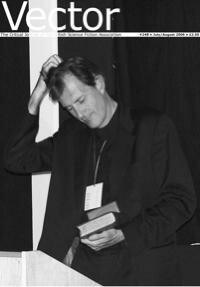
It’s that time again: there’s a new BSFA mailing out. Vector 248 is a celebration of 20 years of the Arthur C. Clarke Award. As usual, we’ll be posting some articles and reviews from the issue on the website over the next couple of weeks, but for now here’s the table of contents:

Torque Control — editorial
Finding Tomorrow’s Futures — Angie Edwards on the history of the Clarke Award
Twenty Years After — a retrospective by Paul Kincaid
A Brief Survey — perspectives on the Clarke
Preface to The Arthur C. Clarke Award: A Critical Anthology — by Neil Gaiman
Air by Geoff Ryman — an extended review by Andy Sawyer
The Clarke and Me — by Geoff Ryman
Clarke Award Has Winner Written All Over It — by Tom Hunter
Archipelago — reviews of short stories by Clarke-winning authors
First Impressions — book reviews edited by Paul N. Billinger
Particles — by Paul N. Billinger
The New X: All Shall Have Prizes — a column by Graham Sleight

As the editorial of Vector and an article in Matrix explain, we’ve been having ongoing problems with printing and distribution, so this issue is appearing somewhat later than originally planned. (I don’t want to tempt fate by saying that everything’s ok now, even if it is.) As chance would have it, though, that means it’s appearing at more-or-less the same time as The Arthur C. Clarke Award: A Critical Anthology (alternate link), a collection of essays about Clarke-winning books that should be well worth your time and money. (Much like the BSFA.)

Another result of the delays is that this issue is the first to announce the existence of this blog. So if there are any BSFA members checking in for the first time, welcome! Feel free to have a poke around. Some things you may find of interest:

The RSS feed for entries is here, and for comments is here; if you have a livejournal, the feeds are syndicated here and here, respectively.

Libraries

The Velcro City Tourist Board wants to know your thoughts on libraries:

Over the last week we’ve been doing a survey of library users – I’ll leave my thoughts on the methodology employed to the side, as I’m not a sociologist (or indeed a ‘proper’ librarian). The survey is designed to uncover people’s ’satisfaction levels’ with the service we provide. Which is all well and good, but it strikes me as intrinsically limited in that it only covers people who actually come into the building.

I assume that most regular visitors to VCTB are regular readers of books, of whatever type. What I want to find out is what people who are passionate about books (to the extent that they read websites about books) think of the modern library service, as they have experienced it. So I’d like to ask you all a few questions:

And here are my answers.

Do you use your local library, or any national libraries (eg British Library)?

I barely use my town library. I occasionally still use Oxford’s libraries.

If you do use libraries, how often and what for? What do you feel would make your local library even better than it already is, as far as fulfilling your own personal needs is concerned?

I use libraries for reference, rather than for fiction. I have used my town library to look up local history, when researching holidays, and for other similar matters. What I would like to have access to a library for is more specialised material: scientific journals (both work-related and non-work-related), american and other non-British sf, and non-fiction about sf. None of which are particularly well-served by my local library. On the other hand, I don’t think my local library necessarily should be trying to serve those needs, because I’m probably the only person in town that has them.

If you don’t use libraries, why not? (Don’t be afraid to be seriously critical here, I want to know the truth – do the buildings suck, are the staff rubbish, do they never have what you want, do you prefer to buy your own books?)

I don’t use my local library either because it doesn’t have the material I’m interested in (scientific references, american sf) or because I don’t need to (pretty much any sf, which I can usually get for review if I put my mind to it), or because I don’t want to (most other fiction, including sf that I don’t review; I like owning books).

The staff have seemed friendly and capable whenever I’ve used my local library. The building itself doesn’t seem terribly friendly — it’s big and brown and seventies — although that may be a hangover from visiting it as a child, and being overawed by it.

What do you feel libraries represent? Or to put it another way: what is the prime function of a library, in your opinion?

To provide public access to as much information as possible as easily as possible. Libraries are good things.

What would you like to see change in the way library services are provided for you?

Online subscriptions to journals and the provision of cheap printing would be one way of providing me with access to the scientific materials I want, without making absurd demands on storage space, even more so if they could provide library members with some way to remotely log in; but I suspect it would still be prohibitively expensive. For reasons noted above, though, I’m probably not typical of users of my local library.

Now it’s everyone else’s turn. If you’re going to take it as a meme for your own blog (and please do!), please remember to also email your responses to info[at]velcro-city.co.uk.