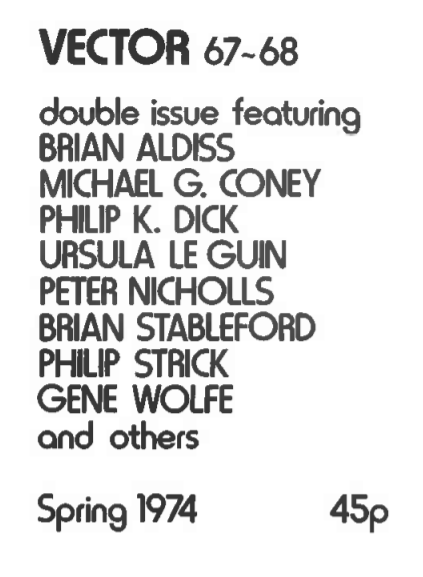
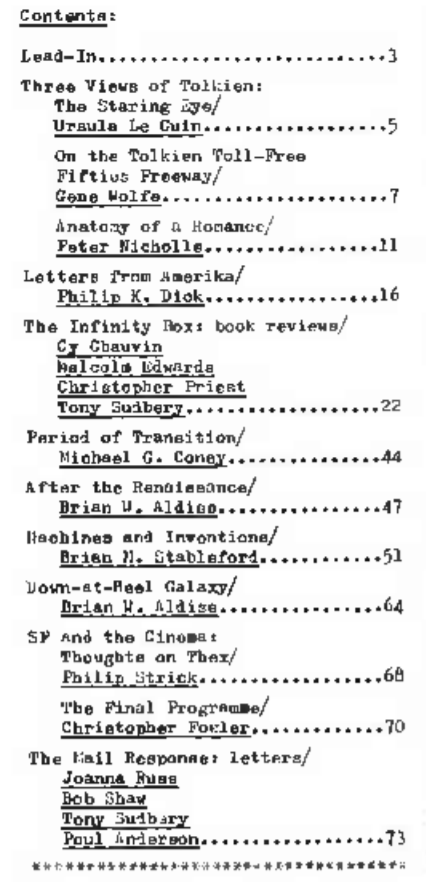
Vector #67/68

Yet I believe that my hestitation, my instinctive distrust of these three volumes in the university library, was well-founded. To put it in the book’s own terms: Something of great inherent power, even if wholly good in itself, may work destruction if used in ignorance, or at the wrong time. One must be ready; one must be strong enough.

I envy those who, born later than I, read Tolkien as children — my own children among them. I certainly have had no scruples about exposing them to it at a tender age, when their resistance is minimal. To have known, at age ten or thirteen, of the existence of Ents, and of Lothlorian — what luck!

But very few children (fortunately) are going to grow up to write fantastic novels; and despite my envy, I count it lucky that I, personally, did not, and could not have, read Tolkien before I was twenty-five. Because I really wonder if I could have handled it.

From the age of nine, I was writing fantasy, and I never wrote anything else. It wasn’t in the least like anybody else’s fantasy. I read whatever imaginative fiction I could get hold of then — Astounding Stories, and this and that: Dunsany was the master, the man with the keys to the gates of horn and ivory, so far as I knew. But I read everything else too, and by twenty-five, if I had any admitted masters or models in the art of fiction, in the craft of writing, they were Tolstoy and Dickens. But my immodesty was equalled by my evasiveness, for I had kept my imagination quite to myself. I had no models there. I never tried to write like Dunsany, nor even like Astounding, once I was older than twelve. I had somewhere to go and, as I saw it, I had to get there by myself.

If I had known that one was there before me, one very much greater than myself, I wonder if I would have had the witless courage to go on.

But the time I read Tolkien, however, though I had not yet written anything of merit, I was old enough, and had worked long and hard enough at my craft, to be set in my ways: to know my own way. even the sweep and force of that incredible imagination could not dislodge me from my own little rut and carry me, like Gollum, scuttling and whimpering along behind. — So far as writing is concerned, I mean. When it comes to reading, there’s a different matter. I open the book, the great wind blows, the Quest begins, I follow. . . .

It is no matter of wonder that so many people are bored by, or detest, The Lord of the Rings. For one thing, there was the faddism of a few years ago — Go Go Gandalf — enough to turn anybody against it. Judged by any of the Seven Types of Ambiguity that haunt the groves of Academe, it is totally inadequate. For those who seek allegory, it must be maddening. (It must be an allegory! Of course Frodo is Christ! — Or is Gollum Christ?) For those whose grasp on reality is so tenuous that they crave ever-increasing doses of ‘realism’ in their reading, it offers nothing — unless, perhaps, a shortcut to the looney bin. And there are many subtler reasons for disliking it; for instance the peculiar rhythm of the book, its continual alternation of distress and relief, threat and reassurance, tension and relaxation: this rocking-horse gait (which is precisely what makes the huge book readable to a child of nine or ten) may well not suit a jet-age adult. And there’s Aragon, who is a stuffed shirt; and Sam, who keeps saying ‘sir’ to Frodo until one begins to have mad visions of founding a Hobbit Socialist Party; and there isn’t any sex. And there is the Problem of Evil, which some people think Tolkien muffs completely. Their arguments are superficially very good. They are the same arguments which Tolkien completely exploded, thereby freeing Beowulf forever from the dead hands of the pedants, in his brilliant 1934 article, “The Monsters and the Critics” — an article which anyone who sees Tolkien as a Sweet Old Dear, by the way, would do well to read.

Those who fault Tolkien on the Problem of Evil are usually those who have an answer to the Problem of Evil — which he did not. What kind of answer, after all, is it to drop a magic ring into an imaginary volcano? No ideologues, not even religious ones, are going to be happy with Tolkien, unless they manage it by misreading him. For like all great artists he escapes ideology by being too quick for its nets, too complex for its grand simplicities, too fantastic for its rationality, too real for its generalisations. They will no more keep Tolkien labelled and pickled in a bottle than they will Beowulf, or the Elder Edda, or the Odyssey.

It does not seem right to grieve at the end of so fulfilled a life. Only, when we get to the end of the book, I know I will have to put on a stiff frown so that little Ted will not notice that I am in tears when I read the last lines:

“…. He went on, and there was yellow light, and fire within; and the evening meal was ready, and he was expected. And Home drew him in, and set him in his chair, and put little Elanor upon his lap.

“He drew a deep breath. ‘Well, I’m back,’ he said.”

Ursula Le Guin

A comment or two on Brian Aldiss’ excellent essay on H.G. Wells ((in V65)). I wouldn’t agree that William Golding’s The Inheritors is the first masterpiece dealing with prehistoric man. There are at least two earlier, one French — La Guerre du Feu by H-H. Rosny Aîné, first published in 1908 — and one Danish, the earlier sections of Den Lange Rejse by Johannes V. Jensen, which appeared not many years later. A fairly good English translation of the latter exists under the title The Longest Journey. I don’t know about English versions of the Rosny (except for its not quite so good sequel) but a handsome reissue of it was published in 1956 and may still be in print. Both deserve the highest recommendation.

Then elsewhere Brian declares: “A mass audience expects to be pandered to. Wells never pandered.” But he had a mass audience — as did Shakespeare, Conrad, Kipling, and any number of others — which seems to deny the first sentence. It isn’t only hucksters who underrate the public taste; the intelligentsia do it even more.

Poul Anderson

I hate being pushed into the position of defending Causes but somebody’s got to. I am a coward at this, but I’m also offended. On p.6 ((of VECTOR 64) I got to a joke in Phil Dick’s article about rape — which is about as funny as lynching — and wondered why female sexuality is such a tittery subject. It isn’t for women (although we sometimes laugh at men’s jokes about rape, usually nervously), and women never tell such jokes among themselves/ourselves, nor do we find rape funny at all when talking among ourselves. “Let us hope it is a female sewing machine” — the obligatory nervous/macho assurance that he isn’t queer, by God! (although many of the readers of VECTOR must be, by simple statistics) […]

Joanna Russ

[…] Honest to God, the blasted inanity of it! “Regrettably” past the menopause. Tee hee again. What on earth is regrettable about it or magical about it or so utterly embarrassing about it that grown men revert back to nine-year-olds? I am tempted to say, rather savagely, that if Dick (or Lem) had any idea of what it means to live in a society which has no reliable (or until recently legal) method of allowing you to control your fertility and all sorts of exquisitely awful ways of punishing you for it (from botched abortions to illegitimacy to losing your job to sole care of any and all children for 18 or more years after birth to viciously enforced guilt over not keeping a baby) they would not make these jokes. But if they had any idea of the above they would, of course, be feminists like me & would be writing letters like this to other idiots.

Joanna Russ
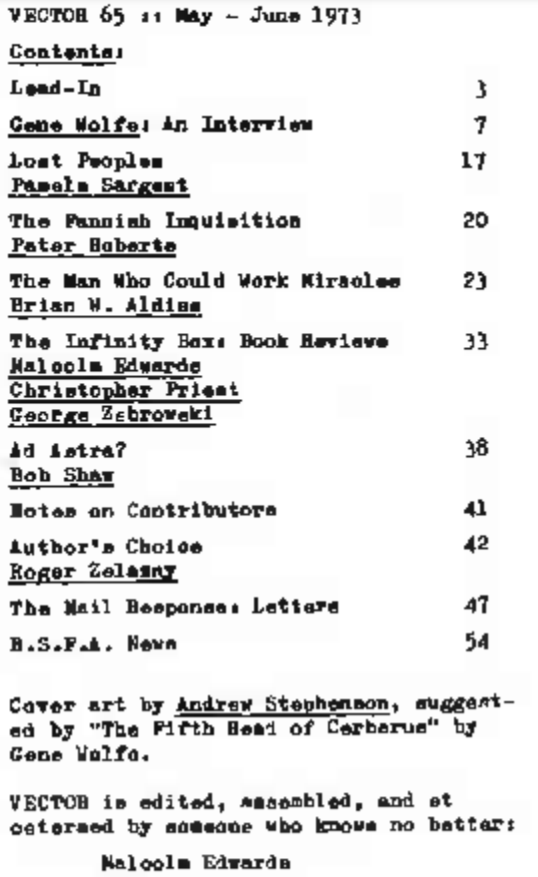
Vector #65

Dear Malcolm,

I really don’t understand James Blish: is his memory failing him, is he fishing for compliments in a very curious way, or has his dislike for me reached such heights that his reasoning powers have suffered? (++ Puzzled readers are referred to Vector 62, p. 34 ++) I could answer him that he underrates me: he has no idea of what expressions of contempt I am capable when he thinks I have treated him with the utmost contempt “up to now”. But such flippancy probably isn’t necessary. Besides, what he says simply isn’t true; for one thing, James Blish hardly is in a position to pass any judgement on all I have written about him, for the simple reason that there undoubtedly is much that he has never seen; and while most of it is unfavourable, not everything is unfavourable. As to the specific case of Solaris, I have quite explicitly commented (in a letter to him) on several points of his F&SF review that I thought especially perceptive; so why should Blish now be “stunned” to find his name included in an enumeration of people who liked Solaris; or indeed, why should he think such a mere listing has any special significance either for him or me? And that makes me the devil who would quote Scriptures?

I must also deny that my favourite word “for the rest of us” is “dishonesty”: my favourite word probably is “hack”. I may have used “dishonesty” one or two times, and if Blish wants to assert that I used it more often than that, or more often than hack, he is invited to count it. It seems to me that Blish may be allergic to this word since he himself likes to apply it to such journals as Time Magazine or Partisan Review; but I certainly once accused him of literary cheating.

What I’d like to know of Mr Blish now is whether he includes the fact that I translated his “Cathedrals in Space” in my German language fanzine, or that we made him a German offer for A Case Of Conscience among the alleged “expressions of utmost contempt”? It’s of course Mr Blish’s privilege as an author to prefer bad translations to good, a paperback deal to a combined hardcover/paperback sale, and the publisher of Lewis B. Patton, Dorothy Eden and Poul Anderson to the publisher of T.S. Eliot, Hermann Hesse and James Joyce; but the fact that we made him an offer is hardly evidence for his claims and I should also think that offering somebody a contract is of somewhat greater significance than a few remarks in the most ephemeral of publications, the sf fanzines.

Franz Rottensteiner

Dear Malcolm, I was glad to see your discussion of the last Hugo awards, disseminating the information Locus gave us. I have felt extremely unhappy about the whole thing, ever since I read that Locus. It is almost impossible to say anything about it, though, and I don’t know who to say it to. I do immensely appreciate the honor — it is a real honor — of being nominated and voted for by all those people, all those strangers who have “met” one only in one’s book — it gives me a pleasure that no nomination or award from a selected jury could give. But this “Australian ballot” (my conviction is that it’s called that because it turns everything upside down) spoils it all. My novel, which clearly placed a poor third, comes in second; Anne McCaffrey’s, which as clearly placed first, comes in third! Well, all that juggling and recounting is supposed, I suppose, to insure justice. But it doesn’t. First place is first place, and when people vote for it that’s what they want — and that is the only place the business end of science fiction, the editors ad publishers, are going to pay any attention to at all. They couldn’t care less who makes second, third, and fourth; all they care about is The Prize. I think the book that received the most votes for The Prize should get the prize. And, if justice or consolation is what the Hugo committee are after, then perhaps they could designate all the second-third-fourth-fifth people, the runners-up, as “Hugo Honor Books” or something, as the Newbery Awards committee has recently taken to doing.

As it is, I haven’t been able to bring myself to vote on the Hugo nomination at all yet this year, because I have this feeling that however I vote they will add it up to come out to just the opposite of what I meant!

Your reply to Chistopher Evans’ letter in No.62 is absolutely right — for England! — but alas, not for America. There are a few excellent reviews (Horn Book for instance) and reviewers, but in egneral writing for children puts one in a ghetto just as writing sf does: and people say to me with hearty camaraderie, “I know you write for children, do you write real books too?” In fact, to put it rather crudely but I think accurately, literature for children here is considered woman’s work — in every sense of the word.

Ursula Le Guin

Vector #60

Science fiction, it seems to me, is like a mirror — a distorting mirror, admittedly, yet one which like all mirrors reflects what is set before it: our hopes and fears, our aspirations and our doubts.

Although, ostensibly, it deals with the future, when I am writing I am always conscious of the fact that I am thinking in the present and by the time my reader sees what I have written it will belong to his past. Already, in the twenty years or so I’ve been writing SF, I have seen many, many of my imaginary futures overtaken by events, so that they belong neither to the future nor to the past, but to a limbo of unrealisable possibilities.

John Brunner

Vector #40

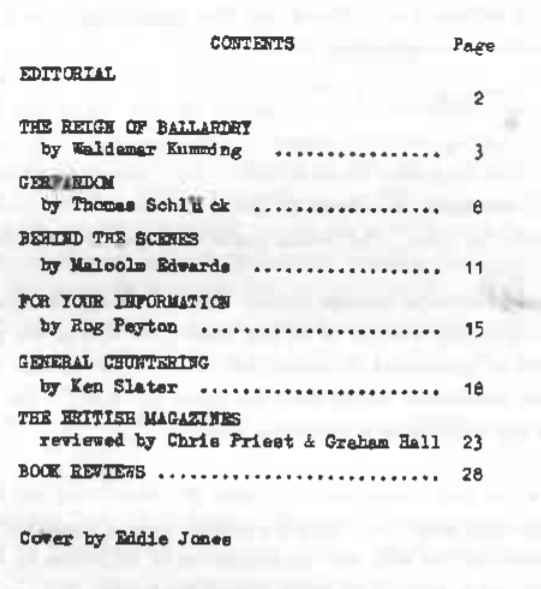
For an allegedly SF work by an allegedly leading writer of the genre this is a somewhat disappointing score. He certainly seems to be leading in a new direction: but it is a direction that speedily leaves the SF field enntirely for plotless and gloomy wasteland. In all of Ballard’s stories something terrible either has already happened or is happening (sometimes with no more rhyme and reason than in the ‘happenings’ that are the opop art answer to the theatre) – or things are going from bad to worse and heading for a frightful crash. The passing of the ‘sense of wonder’ has been much lamented by nostalgic readers, though it has been suggested that this is simply associated with encountering the ideas of SF for the first time, and that it still operates for many new readers. Ballard gives the impression of trying to replace it by a sense of impending doom.

Waldemar Kumming

Vector #30

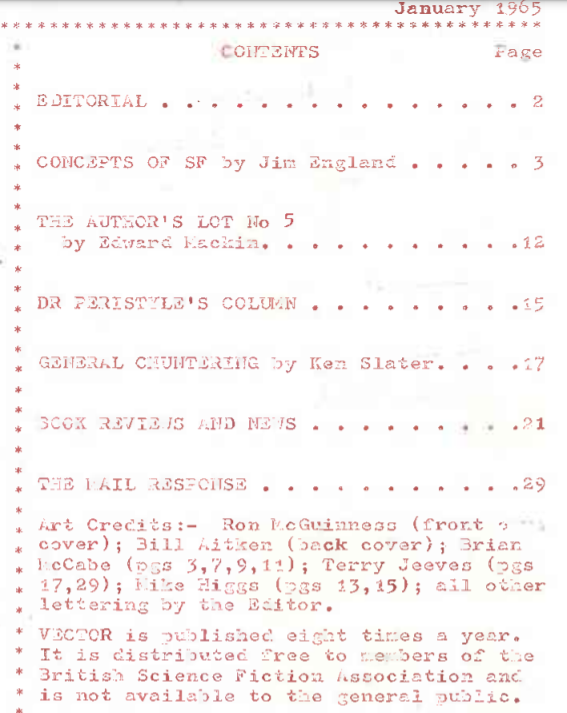
Some science fiction authors and editors are fond of saying that many of the things we are now familiar with were prognosticated by SF authors years in advance. The atomic bomb is often quoted as an example. The submerine and artificial satellite are others. The communication satellite was prognosticated by Arthur C Clark as long ago as 1945, and the inventor of the flexible submarine tanker actually got his idea direct from Frank Herbert’s UNDER PRESSURE (THE DRAGON IN THE SEA). What seems to be forgotten is that, with very few exceptions, SF writers and readers have done little or nothing to make such prognostications come true. Furthermore, a cynic could argue that if one makes enough prognostications, a few of them are almost certain to come true, and there is cause for surprise, not in the fact that so many of them have come true but in the fact that so few of them have. Neveretheless, if we were to examine all the concepts of SF over the past few decades, we would surely find a few needles in the speculative haystack – a few concepts that are useful and can be shown to be useful, a few prognostications that can be helped to come true.

Jim England

Vector #16

At least once a year we publish in VECTOR the entire Membership list; it will be in the next issue. Being on the committee, I have had an advance peek and I notice there are quite a few members living within easy reach of each other. This seems like a good time to come up with an idea I had two years ago with disappointing results and see if anything comes of it. When you see the list, take special note of the addresses; at least three of you live in Leeds, two in Glasgow and there are some new members in London, Leeds and Glasgow: If you’d like to meet another member, try dropping a note suggesting a meeting with one another. You may live near enough and like each other well enough to want to meet frequently. It’s worth trying, isn’t it? London: Every Friday night from 7.pm. I hope Open House at my home. Tea, coffee and biscuits are provided as well as plenty of talk that I’m sure you’d find interesting as well as entertaining. Do try and come, won’t you? My address is on the contents page here. We’d love to meet you, really.

Ella Parker

As the years go by, most sf writers, instead of maturing, unhappily degenerate into hacks. […] This may be because they think and are encouraged by their audience to think mainly in terms of conjuring up something nevl – never mind how absurd, how affronting to possibility – instead of bringing increasing experience to bear on translating human fears and aspirations into new forms. In other words, the years tell against them, instead of telling for them as they should. For sf always to be youthful is fine; for it always to be juvenile would be death. […] This need for maturing sf authors may have been expressed crudely. If so, I ask readers to bear with me, for the subject has hardly been broached before.

Brian Aldiss

Vector #14

After getting VECTOR 13 I feel I must defend one of my favourite stories against one of my favourite authors; i.e. “Of Man and Woman” against Brian Aldiss.

This is not a story of “madness, violence and insanity” (what is the difference between madness and insanity anyway?) but the story of a child who, through no fault of his (her?) own is born a monster to normal parents.

Jean Graman

The really fascinating thing about science fiction – and another LXICON surprise for me was that this idea seemed to be so widely appreciated – is that it leads straight into quite specialised fields. i don’t just mean physics, astronomy and the rest, but politics, philosophy, social comment, psychology and (not least) literature. Sf is a meeting-point of all these.

Kingsley Amis

The letter section seems devoted chiefly to a wrangle about the definition of science fiction, a wrangle which to my knowledge was going on nearly thirty years ago, and will doubtless be continueing thirty years hence.

Don R. Smith

I haven’t waded into the ‘Definition’ because with all the ones I’ve seen I can usuall recall stories that lie outside them and yet are usually classified as sf. Being one of the lazy types I can’t really see why people go to such lengths to try and define sf. I mean, why bother? I rarely bother to find out why I like or dislike something.

Mr Doherty’s article was most interesting. I find the idea of a teacher actually teaching sf fascinating. I don’t suppose my English teacher knew it existed. More power to Mr D’s elbow.

Jill Adams

I’d take a guess that most of these people don’t really know what they do want from the Association, they just know it’s missing.

Jill Adams