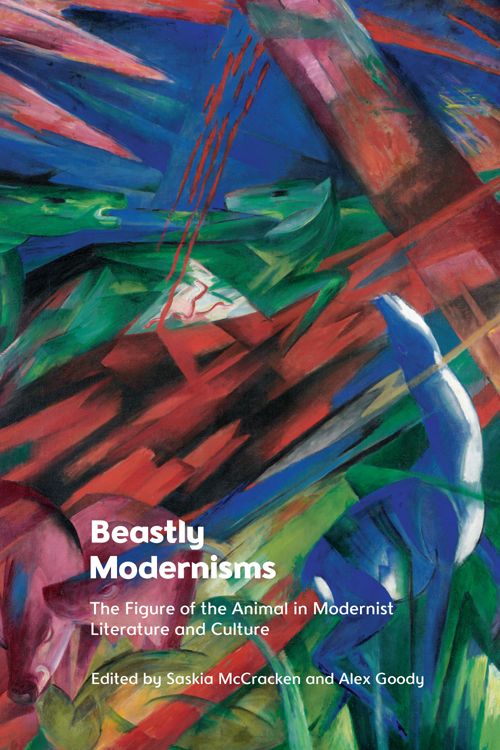
Beastly Modernisms: The Figure of the Animal in Modernist Literature and Culture, eds. Saskia McCracken and Alex Goody (Edinburgh University Press, 2023)
Reviewed by Paul March-Russell
At face value, this collection of essays may not seem to be of immediate interest to the sf reader. It is primarily concerned with the development of Animal Studies – a sub-discipline that has already been significantly explored in relation to sf in the work of Sherryl Vint, Joan Gordon, and others – with reference to literary modernism, a diverse movement already noted for its challenge to traditional notions of identity and individual autonomy. The potential, though, for creative overlaps between modernism, sf and Animal Studies is already indicated by the fact that one of the co-editors, Alex Goody, was a keynote speaker at the 2019 Corroding the Now conference at Birkbeck College, London. Seen through a science-fictional lens, the encounter between human and non-human animals, the slippages between them, and their mutual affinities and kinships immediately invoke the First Contacts and uncanny relations between humans and aliens which are the stuff of genre sf. As the introduction’s reference to Jorge Luis Borges and Karen Eckersley’s chapter on Leonora Carrington make clear, imagined bestiaries are common to both Animal Studies and speculative fiction.
Without seeking to be a guide, the introduction nonetheless touches upon many of the key moments in the evolution of Animal Theory: from Peter Singer’s pioneering Animal Liberation (1975) and Donna Haraway’s ‘cyborg manifesto’ (1985) to Gilles Deleuze and Félix Guattari’s concept of ‘becoming animal’ (1982) and Jacques Derrida’s pivotal essay ‘The Animal That Therefore I Am’ (2002). The introduction also registers many of the other posthuman thinkers whose ideas have contributed both to Animal Studies and this volume in particular; from Giorgio Agamben and Rosi Braidotti to Michel Foucault and Cary Wolfe. The editors however, beginning their account with an exchange between Djuna Barnes and James Joyce (two modernists in exile, both of whom would flit between the centres and margins of the modernist canon), emphasise the affinities between Animal Studies, the revaluation of women’s writing and the decolonising of the curriculum. All such practices foreground and deconstruct the historic imposition of borders, the arbitrary gatekeeping that has characterised academic protocols and the maintenance of cultural shibboleths. To that end, the editors also note the collapsing boundary between ‘high’ and ‘low’ cultures, an elision that not only permits the entry of sf into the conversation, but which would also have appealed to such modernists as Barnes (boxing fan and purveyor of crime fiction) and Joyce (publican’s son, cineaste, and Anita Loos devotee).
Continue reading “Beastly Modernisms reviewed by Paul March-Russell” vector-bsfa.com