BSFA Nominees So Far: Best Short Fiction

Not surprisingly, the longest list so far: here’s all the works of short fiction that have received at least one nomination from BSFA members. Send yours to awards@bsfa.co.uk by the end of the day.

  • “Flying in the Face of God” by Nina Allan (Interzone 227)
  • “The Phoney War” by Nina Allan (Catastrophia)
  • “Feet of Clay” by Nina Allan (Never Again)
  • “Darwin Anathema” by Stephen Baxter (The Mammoth Book of Alternate History)
  • “Our Land” by Chris Beckett (Conflicts)
  • The Heart of a Mouse” by KJ Bishop (Subterranean)
  • “Hanging Around” by Neil K Bond (Shoes, Ships and Cadavers)
  • Hothouse Flowers” by Chaz Brenchley (The Bitten Word)
  • “Sussed” by Keith Brooke (Conflicts)
  • “Have Guitar Will Travel” by Chris Butler (The Immersion Book of SF)
  • The Nightmare of You and Death in the Room” by Christopher Adam (Hub 126)
  • “In the Long Run” by David L Clements (Conflicts)
  • “A War of Stars” by David L Clements (Analog Jan/Feb 2010)
  • “The Maker’s Mark” by Michael Cobley (Conflicts)
  • “Where the Vampires Live” by Storm Constantine (The Bitten Word)
  • “The Shoe Factory” by Michael Cook (Interzone 231)
  • “The Shipmaker” by Aliette de Bodard (Interzone 231)
  • “Spare Change” by Jay Eales (Murky Depths 12)
  • On Not Going Extinct” by Carol Emshwiller (Strange Horizons)
  • The Mad Scientist’s Daughter” by Theodora Goss (Strange Horizons)
  • Flower, Mercy, Needle, Chain” by Yoon Ha Lee (Lightspeed 4)
  • The Issuance of One Hundred and Thirty-Six” by Mark Harding (Future Fire 21)
  • The Red Bride” by Samantha Henderson (Strange Horizons)
  • “The Pearl Diver with the Gold Chain” by Paul Hogan (GUD 5)
  • “Ne Cadant in Obscurum” by David Hoing (The Company He Keeps)
  • Dali’s Clocks” by Dave Hutchinson (Daybreak)
  • On the Banks of the River Lex” by NK Jemisin (Clarkesworld)
  • Reflection” by Jessica E Kaiser (Future Fire 19)
  • “Hibakusha” by Keevil Tyler (Interzone 226)
  • “The Earth Beneath My Feet” by James Lecky (Jupiter 29)
  • “Torhec the Sculptor” by Tanith Lee (Asimov’s Oct/Nov)
  • “Alternate Girl’s Expatriate Life” by Rochita Luenen-Ruiz (Interzone 229)
  • Second Journey of the Magus” by Ian R MacLeod (Subterranean)
  • Havana Augmented” by Tim Maughan (M-Brane 12)
  • “War Without End” by Una McCormack (Conflicts)
  • Seven Sexy Cowboy Robots” by Sandra McDonald (Strange Horizons)
  • “Hirasol” by Melissa Mead (Bull Spec 2)
  • The Isthmus Variation” by Kris Millering (Beneath Ceaseless Skies)
  • “The Untied States of America” by Mario Milosevic (Interzone 228)
  • “The Raft of the Titanic” by James Morrow (The Mammoth Book of Alternate History)
  • “Trouble with Telebrations” by Tim Nickels (Catastrophia)
  • “The Cloth From Which She is Cut” by Gareth Owens (Fun With Rainbows)
  • Abandonware” by An Owomoyela (Fantasy)
  • “Fallout” by Gareth L Powell (Conflicts)
  • “Pallbearer” by Robert Reed (The Mammoth Book of Alternate History)
  • “Psi.Copath” by Andy Remic (Conflicts)
  • “Partly ES” by Uncle River (Albedo One)
  • A Serpent in the Gears” by Margaret Ronald (Beneath Ceaseless Skies)
  • “Red Letter Day” by Kristine Kathryn Rusch (Analog)
  • “In the Face of Disaster” by Ian Sales (Catastrophia)
  • Somadeva: A Sky River Sutra” by Vandana Singh (Strange Horizons)
  • “A Winter’s Tale” by Sarah Singleton (The Bitten Word)
  • “Songbirds” by Martin Sketchley (Conflicts)
  • “Coldrush” by Kari Sperring (The Bitten Word)
  • “Star in a Glass” by Vaughan Stanger (Music for Another World)
  • “The Shostakovich Ensemble” by Jim Steel (Music for Another World)
  • “That Leviathan, Whom Thou Hast Made” by Eric James Stone (Analog)
  • “I Won the Earth Evacuation Lottery” by Tim C Taylor (Shoes, Ships and Cadavers)
  • To Soar Free” by Todd Thorne (Lorelei Signal)
  • “The Insurance Agent” by Lavie Tidhar (Interzone 230)
  • Cloud Permutations by Lavie Tidhar (PS Publishing)
  • “Lode Stars” by Lavie Tidhar (The Immersion Book of SF)
  • Thirteen Ways of Looking at Space/Time” by Catherynne M Valente (Clarkesworld)
  • “Dark Mirrors” by John Walters (Warrior Wisewoman 3)
  • “A Walk of Solace with my Dead Baby” by Ian Watson (Shoes, Ships and Cadavers)
  • The Things” by Peter Watts (Clarkesworld)
  • “The Cruel Ship’s Captain” by Harvey Welles and Philip Raines (Lady Churchill’s Rosebud Wristlet)
  • “Mano Mart” by Andy West (Shoes, Ships and Cadavers)
  • “The Abomination of Beauty” by Ian Whates (The Bitten Word)
  • “Several Items of Interest” by Rick Wilber (Asimov’s)
  • “Arrhythmia” by Neil Williamson (Music for Another World)
  • “A to Z in the Ultimate Big Company Superhero Universe (Villains Too)” by Bill Willingham (Masked)

BSFA Nominees So Far: Best Non-Fiction

Slightly later than planned, here’s the current list of works which have received at least one nomination in the Best Non-Fiction category.

  • The The Wonderful Future That Never Was: Flying Cars, Mail Delivery by Parachute, and Other Predictions from the Past by Gregory Benford (Hearst)
  • Blogging the Hugos” parts 1-4 by Paul Kincaid (Big Other)
  • Review of With Both Feet in the Clouds: Fantasy in Hebrew Literature, edited by Hagar Yanai and Danielle Gurevitch, by Abigail Nussbaum
  • From Utopia to Apocalypse: Science Fiction and the Politics of Catastrophe by Peter Y Paik (University of Minnesota Press)
  • The Outer Alliance Podcast 1, Julia Rios
  • Packing for Mars: The Curious Science of Life in Space by Mary Roach (Oneworld Publications)
  • Review of The Wheel of Time by Robert Jordan, by Adam Roberts (Punkadiddle)
  • Red Plenty by Francis Spufford (Faber)
  • The Notes From Coode Street podcast, by Jonathan Strahan and Gary K Wolfe
  • Chicks Dig Time Lords ed. Lynne M. Thomas and Tara O’Shea. (Mad Norwegian Press)

Some interesting nominations there, notably Red Plenty and the podcasts. Wonder if any of them will make the ballot? But also a relatively small selection compared to some previous years. What’s missing? There’s still time to send your nominations to awards@bsfa.co.uk.

BSFA Nominees So Far: Best Artwork

With just a few days to go (midnight on Friday) until nominations close for this year’s BSFA Awards, the Awards Administrator Donna Scott has been diligently posting lists of the nominees so far on the BSFA forum. To provide an excuse to remind you all several times to email her with your nominations, I’m going to post one category per day here, starting with Best Artwork — for which you can find some additional suggestions here and here.

So, the list of all artworks that have received at least one nomination currently looks like this:

  • Cover of Conflicts, ed. Ian Whates (Newcon Press) by Andy Bigwood
  • Cover of A Capella Zoo 5 (“Acrobats”) by Martha Brouer
  • Cover of Silversands by Gareth L Powell (Pendragon Press) by Vincent Chong
  • Cover of Shine ed. Jetse de Vries (Solaris) by Vincent Chong
  • Illustration for “Flying in the Face of God” by Nina Allen (in Interzone)
  • Cover of Crossed Genres 21 (“A Deafened Plea for Peace”) by Ben Greene
  • Cover of Fun with Rainbows by Gareth Owens (Immersion Press), by Charlie Harbour
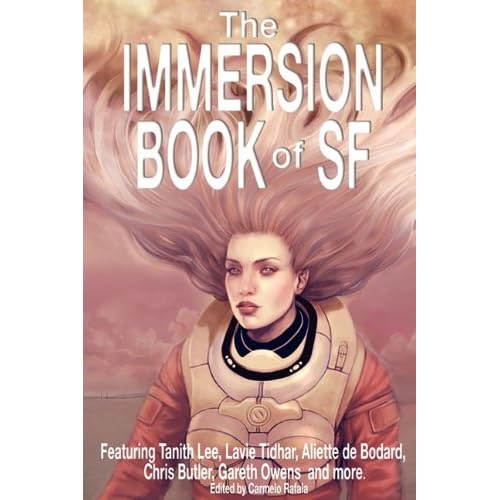
  • Cover of The Immersion Book of SF ed. Carmelo Rafala (Immersion Press), by Charlie Harbour
  • Cover of Engineman by Eric Brown (Solaris), by Dominic Harman
  • Cover of The Noise Within by Ian Whates (Solaris), by Dominic Harman
  • Cover of Cats Cradle by Kurt Vonnegut (Gollancz), by Dominic Harman
  • Cover of Zoo City by Lauren Beukes (Angry Robot), by Joey Hifi
  • Cover of Rigor Amortis (Absolute Xpress) by Robert Nixon
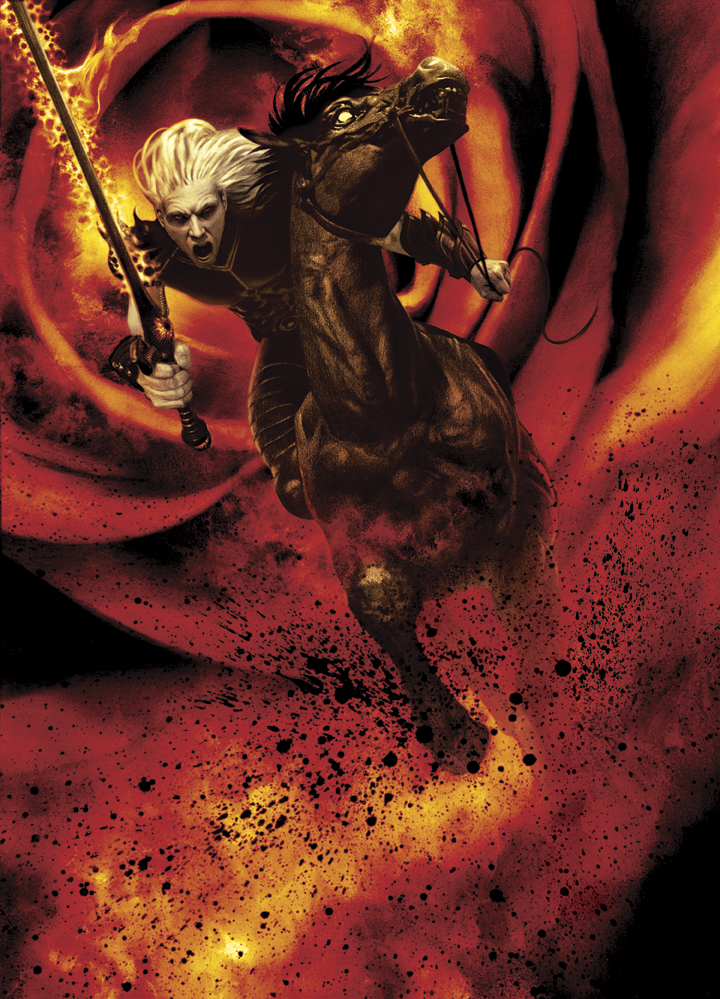
  • Cover of Elric: Swords and Roses by Michael Moorcock (Del Rey), by Jon Picacio
  • Cover of Clarkesworld 44, by Rodrigo Ramos
  • Cover of Go Mutants by Larry Doyle (HarperCollins), by Owen Smith
  • Cover of Crossed Genres 17 (“Our Hell”) by Tania Sousa Ribeiro
  • Cover of The Voyage of the Sable Keech by Neil Asher (Tor UK), by Jon Sullivan
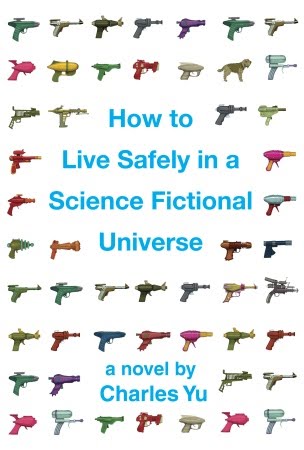
  • Cover of How to Live Safely in a Science Fictional Universe by Charles Yu (Corvus), Unknown
  • Cover of The Holy Machine by Chris Beckett (Corvus), Unknown
  • Cover of Finch by Jeff VanderMeer (Corvus), Unknown
  • Cover of Lightborn by Tricia Sullivan (Orbit), Unknown
  • Cover of The Lifecycle of Software Objects by Ted Chiang (Subterranean), Christian Pearce
  • Cover of The Stories of Ibis by Hiroshi Yamamoto (Haikasoru), by Natsuki Lee
  • Cover of Music for Another World ed. Mark Harding (Mutation), Unknown
  • Cover of The Habitation of the Blessed by Catherynne M Valente (Night Shade Books), by Rebecca Guay, design by Cody Tilson.
  • Cover of Feed by Mira Grant (Orbit), Unknown
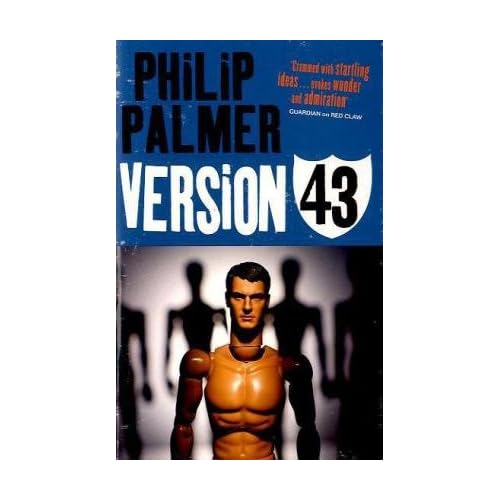
  • Cover of Version 43 by Philip Palmer, Unknown
  • Cover of Cthulhurotica (Dagon Books), by Oliver Wetter
  • Cover of The Future Fire 20, by Rebecca Whitaker
  • Cover of New Model Army by Adam Roberts (Gollancz), by Blacksheep

An Open Letter From The Arthur C Clarke Award

Per the subject line, something a bit different for a Monday morning. Please do give Tom feedback on the questions he asks below, whether in a comment here, or by email or another route. And spread the link to this post far and wide! Thanks — Niall

The Arthur C Clarke Award

An open letter to all fans of Science Fiction from Tom Hunter, Director of the Arthur C. Clarke Award

In 2011 we’ll be presenting the prize for the 25th winner of the Arthur C. Clarke Award.

A lot has changed in 25 years, and the Award has not been immune to that change.

In many ways the Award is now at one of its strongest points ever. Its profile has never been wider, its organisational and community ties are strong, endorsement and support is high both within the SF community and the broader cultural sphere, and increased sophistication in electronic point of sale tracking is now showing direct correlations between Award announcements and increased book sales.

However the Award has also proven notably vulnerable to change at various points in its history, especially in terms of its reliance on volunteer governance and its historic lack of core financial stability in terms of assets, revenue generation or its ability to capitalise on far reaching fundraising or partnership opportunities.

Following the death of Sir Arthur and the subsequent winding up of Rocket Publishing (Sir Arthur’s UK company which funded the Award’s prize) the Award is now faced with an immediate and pressing need to change, adapt and re-evaluate its role and function as it moves into 2012 and its next quarter century.

This is a process that is happening now, and this letter to you all is a big part of taking my plans and those of Serendip, the Award’s governing body, to the next level.

The Arthur C. Clarke Award is built around three core values:

  • To recognise the best science fiction novels of the year published in the UK.
  • To promote science fiction and science fiction literature both within the UK and internationally.
  • To honour the memory and legacy of Sir Arthur.

I don’t believe that our current resources should define the pursuit of this vision, and rather I see our previous funding model slipping away as a necessary transition and the first step on the road to transforming the Award into a more deeply engaged social enterprise.

The good news is everyone involved with the Award has already been doing a lot of work in this area, looking at consultation, starting new conversations and setting up new partnerships, and the next stage of that process is to open up that dialogue more widely and start sharing our thoughts in places like this blog.

For me, the success of the Clarke Award and Serendip beyond 2011 means more connections with new and existing fans and organisations, and working with them to further raise the profile of the Award. We are also creating ways to quantify the value of the Award and assess its impact. The idea being that from this we can then meaningfully judge its success and demonstrate its continued significance as a key voice within the SF community, the publishing industry and beyond.

The questions we’ve been asking ourselves mostly look like this:

What value does the Award bring to the SF community and what role should it play in its future?

How important is a UK focused prize in an increasingly international and digital marketplace?

What more could the Award do as part of its broader advocacy remit to promote science fiction?

How much does the success and the credibility of the Award depend on it having a cash prize?

What new partnerships and opportunities could we create to generate seed funding for the future?

What do you think? What does the Arthur C. Clarke Award mean to you, how important a part of the SF landscape is it, and where would you like it to go from here?

I’m looking forward to hearing everyone’s thoughts and ideas here, and I’ll aim to answer every question as best I can.

I’d also invite anyone who wants to contact me to discuss these issues or to get involved to find me on Twitter, LinkedIn or drop me an email at ClarkeAward@gmail.com.

People are already asking how they can get involved, and all offers of help, advice or useful connections are greatly appreciated.

Three things people can do to get involved right now are help us show the size of our audience by Liking us on Facebook or following @ClarkeAward on Twitter, re-posting the link to this page and, of course, by letting us know your thoughts in the comments here.

Thank you for reading and for your continued support of the Arthur C. Clarke Award.

Tom Hunter
Award Director, December 2010

World Fantasy Award Winners

Have been announced:

Best Novel: The City & The City by China Mieville
Best Novella: “Sea-Hearts” by Margo Lanagan
Best Short Fiction: “The Pelican Bar” by Karen Joy Fowler
Best Anthology: American Fantastic Tales ed. Peter Straub
Best Collection: TIE: There Once Lived a Woman Who Tried To Kill Her Neighbor’s Baby: Scary Fairy Tales by Ludmilla Petrushevskaya and The Very Best of Gene Wolfe by Gene Wolfe
Best Artist: Charles Vess
Special Award — Professional: Jonathan Strahan (for editing anthologies)
Special Award — Non-Professional: Susan Marie Groppi (for Strange Horizons)

Not, perhaps, the most surprising list of winners there’s ever been, but a good list for all that. Congratulations to all. I’m much more a fan of giving The City & The City awards as fantasy than as science fiction, although in my heart of hearts I’d still have liked In Great Waters to take it. And I am, of course, absolutely delighted with Susan’s win, which is both thoroughly deserved personally, and a brilliant cap to the magazine’s tenth year.

Women and the Clarke

There’s an interview with Tricia Sullivan at Geek Syndicate that’s worth a look; it covers her new novel, Lightborn, but one of Sullivan’s longest answers comes in response to a question about the Arthur C Clarke Award:

8. I’ve just checked on the winners of the last ten years’ Clarke Awards and I must admit to being shocked. Nine male winners, one female winner. Something about this quota strikes me as wrong. I’ve double checked and female authors have been shortlisted, which is nice, yet no one else has won. I find this peculiar. Where do you stand on this perceived “unequality”?

I went and looked it up and here’s what I found: gender parity in the judges has been spotty over time, but in recent years there’s generally pretty good ratio of women:men on the juries. One would think this would mean more women on the shortlist and winning awards. Not so.

For the first ten years from the award’s inception in 1987 until 1996, the genders were balanced, five female winners and five male. Between 1997-2006 there were three female winners out of ten (Mary Doria Russell, Gwyneth Jones, and me) and between 2006-2010 there have been no female winners. The shortlist since 2000 has included Gwyneth Jones a whole bunch of times, Sheri Tepper, Sarah Hall, Lydia Millet, Jan Morris, Liz Williams, Audry Niffeneger, me, Elizabeth Moon, Connie Willis, Justina Robson twice, Octavia Butler, Mary Gentle, and Kathleen Ann Goonan. Yet, since 2003 there has been only one year with more than one female author on the ballot. What are the odds of a woman being chosen when the judges’s shortlist is 80% male or more?

I do not know why this is the case, but I wonder whether, with science fiction declining greatly in the US, there may not be enough women playing the SF game right now. Only the most successful writers can survive in this climate, and that probably means women are being forced out at a higher rate than men. Without much input from women in North America or Australia, the burden may be falling on UK SF writers.

I think this diagnosis is broadly accurate. Certainly we can say that the number of books by women being submitted for the award is pretty low. For the last award, 20% of submissions were by women; for the 2009 award it was 13%; and for the 2008 award, 13%. Before that the submissions weren’t published, but as a judge I can tell you that the submissions for the 2007 award were in the same ball park. My perception is that the first half of the decade was slightly better, although I don’t really know. Over the whole decade, however, 13 of 60 nominations, or 22%, have gone to women, which seems to be proportional.

That said, at that sort of rate you’d also expect to have had two women win over the decade, and there’s only been one, Gwyneth Jones in 2002. As Sullivan notes, I don’t think this can be attributed to an imbalance in judges, although there is room for improvement there; 34% of 50 judges over the period have been women. Women have made up the majority of the panel (i.e. 3 of 5 judges) twice in the last ten years, for the 2008 and 2009 awards; for the 2002 award, 2 of 5 judges were women.

Another way of looking at whether there are “enough women playing the SF game right now” is to consider how the boundaries are drawn, as Sullivan goes on to do:

We have a strong crop of men in writing SF in the UK now, and of course we have Karen Traviss and Jaine Fenn doing very well with commercial SF. But on the more literary side, only Gwyneth Jones has had recent recognition with many nominations and a win–and she’s achieved this despite the fact that she divides her energy with her alter ego, Ann Halam. Liz Williams’ work tends to be regarded as fantasy despite its cool SF elements; same with Stephanie Swainston. Sadly, Pat Cadigan hasn’t published an SF novel in nearly ten years. Justina and I have been dealing with pregnancies and babies and toddlers–I can’t speak for her, but for myself: been wrecked, for years. Brain and body and time, seriously drained. In this country we have women like Claire Weaver and Heather Bradshaw and I’m sure there are many others publishing short fiction, and abroad Aliette de Bodard looks like she’s going to be a major force. Still, in SF there aren’t enough women to fill in the gaps when one steps back for whatever reason.

And of course, since 2001 China Mieville has won three times. That does skew things toward the boys. But he has won with two fantasies and what is purported to be a crime novel, so that rather stretches the idea of what a science fiction prize is all about. I’m not sure why Stephanie Swainston’s work or Cathryn M. Valente’s Palimpset isn’t received as SF on the same basis as China’s, for example–or is it? I don’t know.

I’m guessing that literary novels employing SF ideas are more likely to be recognized than urban fantasy–which has loads of female authors–because science fiction ideas have wormed their way into the mainstream and now seep into literary fiction. The problem then becomes, where do the new ideas come from?

If we ask how many British women are publishing original adult science fiction with a major genre publisher in Britain, the answer is pretty bleak: with neither Liz Williams nor Gwyneth Jones having contracts at the moment, I think the answer may be just one writer, Jaine Fenn. [Edit: As of next year, thanks to a change in publisher, Sophia McDougall will meet these criteria; there is also the mysterious RJ Frith.] This is from one point of view a fairly restrictive way of drawing the boundaries, since if you drop out any one of those criteria you can easily think of more women, but in another sense it’s not strict at all, because it’s easy to identify a substantial cohort of male writers that fit the equivalent question: Neal Asher, Iain Banks, Stephen Baxter, Eric Brown, Ken MacLeod, Paul McAuley, Ian McDonald, Alastair Reynolds, Adam Roberts, Charles Stross, etc etc.

Of course, the Clarke doesn’t care about the nationality of the writer, or about who a writer’s publisher is. (Indeed, although the numbers involved are fairly small, I find it striking that “non-genre” books account for 1 in 3 Clarke Award nominations for women [4 of 13, or 31%] compared to 1 in 8 for men [6 of 47, or 13%].) It also already has a fairly flexible definition of sf, although not so flexible as to admit pure urban fantasy; but Liz Williams’ books have (I think) always been submitted, and shortlisted several times; Justina Robson’s recent fantasy/sf hybrids have also been submitted, although not shortlisted; and I’m guessing Gollancz will submit Sarah Pinborough’s near future supernatural horror A Matter of Blood this year. (Steph Swainston does not seem to be submitted, although I think Sullivan is right that she could be — some books more than others; The Modern World is her most sfnal, for me, this year’s Above the Snowline probably her least.) These factors account for most of the other submitted books by women. The Award could probably give broader consideration to YA fiction than it currently does; Gemma Malley’s books don’t seem to be have submitted, for instance, or Malorie Blackman’s. And there are, as Sullivan notes, some writers whose tie-in fiction who may be worth considering, such as Karen Traviss — her original fiction has still not been published in the UK. But I don’t think this would raise the submission statistics to parity, or anything like it, and it does not address the apparent imbalance in UK genre publishing.

The Clarke Award has not produced an all-male shortlist since its second year, but unless something changes, I imagine we’ll see another quite soon. To be positive, however, I don’t think it will be this year; here’s a list of all the books by women that I can think of that are eligible for this year’s award.

Candor, Pam Bachorz
Zoo City, Lauren Beukes
Servant of the Underworld, Aliette de Bodard
Alice in Time, Penelope Bush
Transformation Space, Marianne de Pierres
Mockingjay, Suzanne Collins
Guardians of Paradise, Jaine Fenn
[The Nemesis List, RJ Frith?]
Feed, Mira Grant
The Carbon Diaries 2017, Saci Lloyd
The Birth of Love, Joanna Kavenna
The Returners, Gemma Malley
The Legacy, Gemma Malley
[The Folding Knife, KJ Parker?]
A Matter of Blood, Sarah Pinborough
The Dead-Tossed Waves, Carrie Ryan
Birdbrain, Johanna Sinisalo
2017, Olga Slavnikova
Lightborn, Tricia Sullivan
Our Tragic Universe, Scarlett Thomas
Walking the Tree, Kaaron Warren

Who have I missed?

The Hugos

The internet being what it is, even a post as marginally belated as this one feels a little redundant. Still, it would feel stranger not to set down my thoughts on this year’s winners at all, if only because I can’t agree with Cory Doctorow that these are “some of the best results in recent memory”; they seem to me, as usual, a mixed bag, and perhaps more than usual an inconsistent bag.

The only explanation I can come up with for, say, the two Best Dramatic Presentation results – setting the immensely pleasing recognition for the low-key, nuanced Moon against the downright distressing award for the bombastically nonsensical The Waters of Mars, not just the worst nominee and bad by the standards of all TV, but bad by the standards even of the Doctor Who specials – is that completely separate groups of people won the day in each category. (This is just about possible, although not very likely, based on the voting statistics [pdf]: from 1094 ballots cast, after redistribution of preferences Moon won its category with 418 ballots, while The Waters of Mars won with 350.) More seriously, Jonathan Strahan, who worked on two of the nominees for Best Novellette, loses out in Best Editor: Short Form to Ellen Datlow, who didn’t work on any nominees this year; and Juliet Ulman, who edited two of the Best Novels, only got as many first-preference votes as No Award in Best Editor: Long Form. You can, of course, say that the Best Editor categories are for consistency over a body of work, rather than acquiring a few standouts, but that doesn’t seem to explain the continued overlooking of Sheila Williams, whose Asimov’s has in recent years dominated the short fiction categories – 10 of 15 nominees in 2007; 7 of 15 in 2008 and 2009; and while 3 of 15 nominees this year looks like a slump, it’s still more than any other single publication managed – yet who has never won in her category.

It was satisfying to see a new Best Semiprozine – that is, the voters neither went back to their old Locus habit, nor settled into a new pattern with Weird Tales – and Clarkesworld certainly had a good year. (Although as Mark Kelly notes, it is a bit odd that Weird Tales dropped so far down the ranking.) I can only hope the award continues to move around, since I, like Abigail Nussbaum, am starting to feel a little bothered by the number of recusals. (My suggestion? The New York Review of Science Fiction, which is long overdue and having a good year.) Best Related Book was not a surprise, although This is Me, Jack Vance! is the only nominee in the category I haven’t sampled; neither was Best Graphic Story, to the point where it’s quickly becoming clear that voters don’t really know what to do with the category as it’s currently constituted. I’d be in favour of Liz Batty and Nick Honeywell’s proposal, in The Drink Tank [pdf], to change the category to Best Graphic Novel.

The winner of Best Fanzine, meanwhile, and for the second year running, is a winner within the letter of the rules rather than what I consider to be the spirit of them. Contra Jason Sanford, the only boundaries that StarShipSofa pushes for me are the ones I don’t really want to see pushed: ‘zines that publish fiction may be eligible within the current wording, but I don’t want to see them become the norm; ditto podcasts, if only because I’m too much of a written-word junkie; and nor do I want to see it become common for eligible ‘zines to campaign for their nominations. As Mike Glyer points out, however, the voting statistics don’t yet suggest that these two winners represent a sea-change in how the category is treated; and it’s good to see ‘zines like Journey Planet and group blogs like SF Signal bubbling under, not to mention Steam Engine Time, which I’d have dearly loved to see on the ballot.

And looming over everything else there’s that improbable tie for Best Novel, only the third in the history of the Hugos. As others have noted, it’s hard not to feel there’s a certain cosmic rightness in it, either because, like Jonathan McCalmont, you take it as a reflection of the fact that neither is quite polished enough to merit a full Hugo, or simply because these are the two novels that have been sharing out awards between them all year, and it’s appropriate to have that competition captured in this way. I tend to the latter view.

2009 Shirley Jackson Award Winners

The winners of this year’s Shirley Jackson Awards were announced at Readercon last weekend:

Best Novel: Big Machine by Victor LaValle (Speigel & Grau)
Best Novella: Midnight Picnic by Nick Antosca (Word Riot Press)
Best Novelette: “Morality” by Stephen King (in Esquire)
Best Short Story: “The Pelican Bar” by Karen Joy Fowler (in Eclipse 3)
Best Single-Author Collection: Tunneling to the Center of the Earth by Kevin Wilson (Harper Perennial), and Love Songs for the Shy and Cynical by Robert Shearman (Big Finish)
Best Edited Anthology: Poe, ed. Ellen Datlow (Solaris)

I’m cautiously optimistic about the SJAs, which are awarded “for outstanding achievement in the literature of psychological suspense, horror, and the dark fantastic.” This is their third year, and as for 2007 and 2008, the 2009 winners — and even more so the shortlists — strike me as interesting and inclusive. Partly this just means they’re playing to my taste. I’d had my eye on Big Machine, for instance, since Elizabeth Hand’s glowing review; I was half-hoping for a UK edition, but the award has given me the necessary nudge to order a US copy. Several other nominees and winners are also on the “actually, yes, I’d like to read that” list, which gives me a certain amount of confidence that the ones I haven’t encountered before will also be worth looking at. And Richard Larson’s shortlist review, the first part of which is up at Strange Horizons today (second part on Friday) makes all six of the Best Novel nominees sound worthwhile.

I have a couple of reservations. It’s a juried award, which is good, but I believe that two of the judges for this year’s awards also served for the previous two years. I prefer to see a bit more turnover among the judges — a World Fantasy Award or Clarke Award replacement rate rather than a Campbell Award replacement rate, if you like. I wouldn’t want to see too many ties like this year’s for Best Collection, either. And part of me wishes there were fewer categories, if only to increase my confidence that the jurors are making a thorough survey of the eligible work in each category; but this is a genre award, so everyone must get their spotlight. Still, they’ve had a good track record so far, and I look forward to next year’s shortlists.

In a related confession, I’ve barely read any Shirley Jackson. The recent Library of America volume seems like a good place to start; there’s a review of that at SH this week, too, by L. Timmel Duchamp:

Two themes run through most of the fiction in the volume: the volatility of group dynamics and the collusion of social silence with psychological and even physical violence against individuals who are outsiders or have been excluded from the in-group. Jackson’s fiction is for the most part not actually fantastic, but she frequently depicts behavior and psychological violence that is not acknowledged as such at the conscious level of the narrative, and in doing so presents mundane reality as troubled with sinister currents that can lead, unpredictably, to bizarre and even dangerous situations beyond the individual’s control. Jackson’s treatment of mundane reality, that is to say, casts into sharp relief the artificiality of the style known as “realism.”

(I hadn’t realised LoA use such thin paper, though! I’m afraid to start reading my copy for fear I’ll tear the pages.)

EDIT: See also Laura Miller on is Shirley Jackson a great American writer?

Nebula Award Winners

Novel: The Windup Girl – Paolo Bacigalupi (Night Shade Books, Sept. 2009)

Novella: The Women of Nell Gwynne’s – Kage Baker (Subterranean Press, June 2009)

Novelette:Sinner, Baker, Fabulist, Priest; Red Mask, Black Mask, Gentleman, Beast,” Eugie Foster (Interzone, Feb. 2009)

Short Story:Spar,” Kij Johnson (Clarkesworld, Oct. 2009)

Ray Bradbury Award: District 9, Neill Blomkamp and Terri Tatchell (Tri-Star, Aug. 2009)

Andre Norton Award: The Girl Who Circumnavigated Fairyland in a Ship of Her Own Making, Catherynne M. Valente (Catherynne M. Valente, June 2009)

The ballot is here; I pretty much failed to call any of the winners, although despite still feeling a bit sulky that District 9 beat Moon, I think this is a pretty good set. Interesting that they’re all first-time winners, and none are from “big” publishers or magazines. All of the winners are on the Hugo ballot (except Fairyland, but Valente’s in Best Novel with Palimpsest; I think “Spar” is the only one likely to do a double, however.