Who Wins Hugos?

Elizabeth Bear:

Anyway, I had an epiphany while reading the ToC of the 2007 Year’s Best Science Fiction. Which basically amounted to– “oh.”

We don’t read them. And they don’t read us.

Well, really. I wonder when the last time was that Bob Silverberg read a story by Benjamin Rosenbaum, David Moles, or Yoon Ha Lee?

See, I’m thinking I’m on to something here. There’s a generation gap in SFF; we’re having different conversations, the Greatest Generation, the Baby Boomers, and Generation X. And as the Millennials (really, guys, this Gen Y thing has to stop: grant the kids their own identity) enter the genre, they too will be having their own argument.

Patrick Nielsen Hayden:

Reporting on this year’s Hugos, Nicholas Whyte observed that Elizabeth Bear is only the second person born in the 1970s to win a Hugo Award for fiction. (Tim Pratt was the first, winning the short-story award last year.) I found this stunning. This means that of the 94 people who have ever won fiction Hugo Awards, only two are under 38 years old. When I was a young SF reader, Hugos were regularly won by people in their twenties and early thirties. It’s one thing to murmur about the aging of SF; it’s another to look at the numbers.

Anna Lawrence (in the comments to PNH’s post):

Are we allowing for birth date: date of Hugo ceremony? Maybe authors born in the 50s are ‘old’ now (I would dispute this), but if they had won awards in the 70s and 80s they would have been Young Turks (and, if in the 60s, child prodigies).

Hence, a graph, based on Nicholas Whyte‘s data, plus this year’s winners.
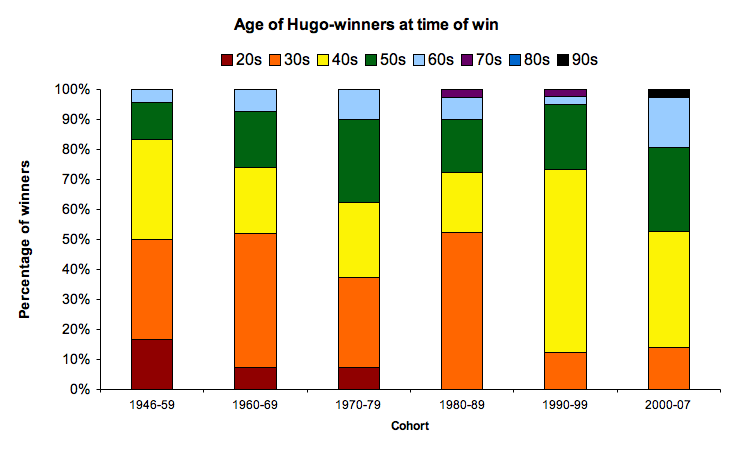
image119

(For some reason, I couldn’t get Excel to export in colour. Don’t ask me why. UPDATE: New graph, courtesy Liz. Praise Liz!)

  • In the first three cohorts, between 7% and 17% of Hugos for fiction go to people in their twenties; after that, none do.
  • In the first four cohorts, between a third and half of Hugos for fiction go to people in their thirties; once you get to the nineties, that drops to less than 15%.
  • The proportion of Hugos for fiction going to writers in their sixties is twice as high in the present decade as it’s ever been previously.

P.S. New site layout — good? Bad?
World Fantasy Award Nominees

Over at the Inferior 4+1, Lucius Shepard posts the World Fantasy Award Nominees:

Best Novel
Territory, Emma Bull [Tor]
Ysabel, Guy Gavriel Kay [Viking Canada/Penguin Roc]
Fangland, John Marks [Penguin Press]
Gospel of the Knife, Will Shetterly [Tor]
The Servants, Michael Marshall Smith [Earthling Publications]

I have read, er, none of these (and in fact it looks like a slightly odd list to me, given the available options), so I will report Nic‘s reactions:

On Ysabel: yay!
On Gospel of the Knife: *flat stare*

Best Novella:
The Mermaids, Robert Edric [PS Publishing]
Illyria, Elizabeth Hand [PS Publishing]
“The Master Miller’s Tale”, Ian R. MacLeod [F&SF May 2007]
“Cold Snap”, Kim Newman [The Secret Files of the Diogenes Club, MonkeyBrain Books]
“Stars Seen through Stone”, Lucius Shepard [F&SF July 2007]

Huzzah, to recognition for “The Master Miller’s Tale”. Must get around to reading Illyria, too.

Best Short Fiction
“The Cambist and Lord Iron: A Fairy Tale of Economics”, Daniel Abraham [Logorrhea, Bantam Spectra]
“Singing of Mount Abora”, Theodora Goss [Logorrhea, Bantam Spectra]
“The Evolution of Trickster Stories Among the Dogs of North Park After the Change”, Kij Johnson [The Coyote Road: Trickster Tales, Viking]
“Damned if you Don’t”, Robert Shearman” [Tiny Deaths, Comma Press]
“The Church on the Island”, Simon Kurt Unsworth [At Ease with the Dead, Ash-Tree Press]

Those two Logorrhea stories sure are popular. Not without reason, mind.

Best Anthology:
Five Strokes to Midnight, Gary A. Braunbeck & Hank Schwaeble, Eds. [Haunted Pelican Press]
Wizards: Magical Tales From The Masters of Modern Fantasy, Jack Dann & Gardner Dozois, Eds. [Berkley]
Inferno: New Tales of Terror and the Supernatural, Ellen Datlow, Editor [Tor]
The Coyote Road: Trickster Tales Ellen Datlow & Terri Windling, Eds.[Viking]
Logorrhea: Good Words Make Good Stories John Klima, Editor [Bantam Spectra]

I did not like Inferno (at some length, in NYRSF, if you’re interested). I did like Logorrhea (although it is by no means a pure fantasy collection), and I would like to read The Coyote Road.

Best Collection:
Plots and Misadventures, Stephen Gallagher [Subterranean Press]
Portable Childhoods, Ellen Klages [Tachyon Publications]
The Secret Files of the Diogenes Club Kim Newman [MonkeyBrain Books]
Hart & Boot & Other Stories, Tim Pratt [Night Shade Books]
Tiny Deaths, Robert Shearman [Comma Press]
Dagger Key and Other Stories Lucius Shepard [PS Publishing]

The Klages is good, if a little lightweight; the Shepard is good Shepard; I haven’t read any of the others.

Best Artist:
Ruan Jia
Mikko Kinnunen
Stephan Martiniere
Edward Miller
John Picacio

Special Award—Professional:
Allison Baker and Chris Roberson for MonkeyBrain Books
Alan Beatts and Jude Feldman for Borderlands Books
Peter Crowther for PS Publishing
Gordon Van Gelder for F&SF
Jeremy Lassen and Jason Williams for Night Shade Books
Shawna McCarthy for Realms of Fantasy

Special Award—Non-professional:
Midori Snyder and Terri Windling for Endicott Studios Website
G. S. Evans and Alice Whittenburg for Cafe Irreal
Stephen Jones, Editor for Travellers in Darkness: The Souvenir Book of the World Horror Convention 2007
John Klima for Electric Velocipede
Rosalie Parker and Raymond Russell for Tartarus Press

Not a lot to say about these categories, except congratulations to the nominees. And the winners of the Life Achievement Award are: Leo & Diane Dillon, and Patricia McKillip.

The Short Story Nominees

I am usually underwhelmed by the Hugo short story nominees. I accept that my tastes are out of step with the pool of Hugo voters, as I am not a big fan of Michael Burstein’s short fiction, and the less said about most of Mike Resnick and Robert J. Sawyer’s previous nominees the better, but the one time I voted in the Hugos I put No Award first as a protest against how uniformly terrible the stories on that year’s ballot were. So it’s pleasing to report that the short stories, while not all great, range from pretty decent to really pretty damn good. Here’s my ranking:

Bottom of my ballot I would put Mike Resnick’s ‘Distant Replay‘. It’s the best Mike Resnick story I have ever read, and that’s why it wouldn’t end up below No Award, but the appeal of his work remains a total mystery to me. Yet another story about science fiction being used in some way to reunite a man with his love, (in this case, a man meets a young man and woman who are exactly like him and his (dead) wife, and hooks them up), it’s less cloyingly sentimental than usual and has a couple of nice ideas, and that’s about it.

‘A Small Room in Koboldtown,’ by Michael Swanwick, is a locked-room mystery noir in a fantasy setting. The internet informs me it’s a universe he’s written in before, and the setting is interesting, but then it uses the fantasy setting to pull a big cheat. I like mysteries, and they work best when they are clever enough that you can’t work out exactly how it was done but all the clues are there. When the resolution of the mystery is a magical solution I couldn’t predict, I feel cheated out of my ending.

Having dispatched with the bottom two, we get to two stalwarts of the UK SF scene who are harder to separate – Ken MacLeod’s ‘Who’s Afraid of Wolf 359?’ and Stephen Baxter’s ‘Last Contact.’ Who’s Afraid of Wolf 359? is space opera from Ken MacLeod, in the same setting as his BSFA-award-winning Lighting Out. Proper hard SF, it has AIs and seedships and lots of future civilizations, I can’t quite put my finger on why I don’t like it as much as I expected. I think it could do with being longer, to flesh out the events around the ending, and give us more of the central character. There’s just nothing which particularly grabs me, so I put it at number three.

Last Contact is a very English disaster story – the big SFnal idea is the end of the world, but the story is about two women preparing for the end in Oxfodshire, planting flowers that will never grow and sitting in the garden drinking tea while they wait for the ground to be ripped apart under them. It’s a cosy catastrophe, with a much lower degree of looting and general chaos and anarchy than what I think would actually happen if you announced the world was going to end in six month’s time, but I found it rather charming. I don’t think Baxter quite pulls it off, but it’s in second place for me.

My pick of the short stories is Elizabeth Bear’s ‘Tideline,’ which is a great example of how a small SF idea can turn into a lovely story. Lovely is the appropriate word, as it’s a heartwarming little tale of a shipwrecked war-machine, alone on a beach mourning her lost compatriots, and the human boy she meets and takes care of. The hints of worldbuilding fit around the well-drawn characters, filling out enough of the background to satisfy but leaving parts of it unknown, and Bear’s prose is probably the best of all the stories, bar maybe the Swanwick. It pulls off beautifully what Last Contact can’t quite do.

So I’d like the Best Short Story Hugo to go to Elizabeth Bear, but I won’t be upset if it goes to MacLeod or Baxter.

Other views:
Abigail Nussbaum mostly agrees with me, but doesn’t like Baxter as much. Nicholas Whyte doesn’t like the MacLeod at all, but agrees with my top pick. Karen Burnham agrees with my top two, but hasn’t read any of the others. John at SF Signal also isn’t fond of the Macleod, and likes the Resnick much more.

This Looks Promising

University launches £50,000 writing prize, with sci-fi author named as chief judge:

How does writing evolve? Where is its moving edge? Is all writing – at its very best – a type of creative writing? To explore these questions, and to identify excellence and innovation in new writing, the UK’s University of Warwick has just launched the £50,000 Warwick Prize for Writing.

Sci-fi author China Miéville (pictured), award-winning writer of what he calls ‘weird fiction’, is to head the panel of five judges. Other judges include mathematician Professor Ian Stewart and literary blogger Stephen Mitchelmore.

A list of 15 to 20 titles will be announced in October followed by a short-list of six titles in January 2009. The winner will be announced in February 2009 in Warwick.

This substantial prize stands out as an international and cross-disciplinary award. It will be given biennially for an excellent and substantial piece of writing in the English language, in any genre or form. The theme will change with every prize: the 2009 theme is Complexity.

(via.)

And in better awards news …

Strange day, when the John W Campbell Memorial Award is the award I feel positive about. The winner is:

In War Times by Kathleen Ann Goonan

This actually looks like a sane, solid choice; the reviews that I’ve seen have ranged from mixed to positively glowing (although see also). Anyway, I have a copy, and I’ve bumped it up the TBR stack, so there may be a review in the near-ish future.

UPDATE: Chris Mckitterick reports that Michael Chabon’s The Yiddish Policemen’s Union came second, and The Execution Channel came third.

Meanwhile, the Sturgeon Award choices are equally solid — choices because, for the first time, there are joint winners, and solid because those winners are:

Tideline” by Elizabeth Bear
Finisterra” by David Moles

See Abigail Nussbaum’s thoughts on the Bear here, and the Moles here; and congratulations to all three winners.

(While I’m here, have some links to other Locus Awards discussion.)

Locus Pocus

Gazumped! Neil Clarke posts about the change to the Locus poll scoring system, as described alongside the results in the July 2008 issue:

However, the next thing I see really bothers me and completely invalidates any year-to-year analysis I had planned:

“Results were tabulated using the system put together by webmaster Mark Kelly, with Locus staffers entering votes from mail-in ballots. Results were available almost as soon as the voting closed, much sooner than back in the days of hand-counting. Non-subscribers outnumbered subscribers by so much that, in an attempt to better reflect the Locus magazine readership, we decided to change the counting system, so now subscriber votes count double. (Non-subscribers still managed to out-vote subscribers in most cases where there was disagreement.)”

They changed the vote counting system after the polls closed. If they were so concerned about the results reflecting reader opinion, why allow non-subscribers the chance to vote in the first place? Doing something like this makes it seem like they were unhappy with the results and put a fix in. Given their long-standing reputation, I’m sure that wasn’t their plan, but what were they thinking?

For obvious reasons, Neil is most interested in the effect this has on the “best magazine” category; he also notes the one that first caught my eye, which is the result of Best First Novel. As described by Locus:

Heart-Shaped Box by Joe Hill won by a slim 10 points over The Name of the Wind by Patrick Rothfuss. This is one place where the doubled subscriber votes made a difference; the Rothfuss had more votes and more first-place votes but subscribers put the Hill first, and their doubled points gave it the edge.

Similarly, in Best Collection:

Connie Willis’s The Winds of Marble Arch and Other Stories won with a lead of just over 70 points, followed by Jack Vance’s The Jack Vance Treasury in second. Cory Doctorow’s Overclocked came in third — despite having the most votes and the most first-place votes. The doubled subscriber votes made Willis, ever a favourite with Locus subscribers, the winner; without the extra points, she would have come in second behind Doctorow, who has a large online fan base.

I have to say I’m deeply disappointed by this. The big selling point of the Locus Awards is, or always has been to me at least, their representativeness, precisely the fact that anyone can vote and that they are thus the best barometer of community-wide opinion that we have. As the notes at the start of this year’s result somewhat smugly put it, “We get more votes than the Hugo, Nebula, and World Fantasy nominations combined … Nominees need at least 20 votes to make the final list, even though it frequently takes less to make the Hugo or Nebula publishing ballots.” All of that is still true, but it seems wrong to imply (as I think it’s intended to imply) that this legitimizes the results when you’ve just changed the scoring system to make some voters more equal than others — particularly if you only make the change after voting has closed, particularly if you only mention it in the print version of the magazine.

Locus Award Winners

See here; finalists here.

SF Novel
The Yiddish Policemen’s Union, Michael Chabon (HarperCollins)

I think this puts paid to the repeated suggestions that Chabon doesn’t have enough popular support to be a viable candidate for the Hugo. I think he’s going to win.

Fantasy novel
Making Money, Terry Pratchett (Doubleday UK; HarperCollins)

Young adults book
Un Lun Dun, China Miéville (Ballantine Del Rey; Macmillan UK)

First novel
Heart-Shaped Box, Joe Hill (Morrow; Gollancz)

Novella
“After the Siege”, Cory Doctorow (The Infinite Matrix Jan 2007)

Novelette
“The Witch’s Headstone”, Neil Gaiman (Wizards)

I admit to a feeling of relief that this one didn’t go to “Trunk and Disorderly”. That’s a bad story. But to be honest, “The Witch’s Headstone” felt too much like the novel-excerpt it is to really deserve this.

Short story
“A Small Room in Koboldtown”, Michael Swanwick (Asimov’s Apr/May 2007)

Collection
The Winds of Marble Arch and Other Stories, Connie Willis (Subterranean)

I’m a little surprised Doctorow didn’t win this category as well; I think I also would have preferred it to go to a new collection, rather than a retrospective. Still, Connie Willis Always Wins, I guess.

Anthology
The New Space Opera, Gardner Dozois & Jonathan Strahan, eds. (Eos)

Non-fiction
Breakfast in the Ruins, Barry N. Malzberg (Baen)

I’d have gone with (and indeed voted for) the collection of Russ’s reviews; but this is good too.

Art book
The Arrival, Shaun Tan (Lothian 2006; Scholastic)

Editor
Ellen Datlow

Magazine
F&SF

Publisher
Tor

Artist
Charles Vess

Overall: for me a solid list of winners, but — particularly in the short fiction categories — not a particularly exciting one.

Quicklinks

The Sturgeon Award nominees for best short fiction of 2007 are out. Looks like a solid list, as usual; I’d be happy to see almost any of them win, in fact.


The Campbell Award nominees for best novel of 2007 are also out. Anyone but Robert Sawyer. Please!


How far can a reviewer build a reputation on the strength of a blog? “my reputation is all about the other places where I review. Chasing Ray is just gravy on top of that – just extra. Those 700 books are not going to come to someone with a readership of a few hundred (or less) a day”


SF Signal’s latest Mind Meld asks “Which new or little-known genre writers will be tomorrow’s big stars?” There’s a contribution from me, but what I want to pull out is (a) that I agree with Jonathan Strahan’s sentiment that there’s a generation of writers coming through now who could have the same impact as Terry Carr’s Ace Specials, and (b) this aggregate list of the writers to watch:

The Top 18 Genre Authors To Keep an Eye On

1. Paolo Bacigalupi (4 mentions)
2. Daryl Gregory (4)
3. Benjamin Rosenbaum (3 mentions)
4. Cory Doctorow (3)
5. Jay Lake (3)
6. David Moles (3)
7. Chris Roberson (3)
8. Vandana Singh (3)
9. Elizabeth Bear (2 mentions)
10. Alan DeNiro (2)
11. Alex Irvine (2)
12. Ted Kosmatka (2)
13. Paul Melko (2)
14. Naomi Novik (2)
15. Tim Pratt (2)
16. Jason Stoddard (2)
17. Karen Traviss (2)
18. Scott Westerfeld (2)

So now you know. (Alternatively: who’s missing?)


This week’s blogger incentive for mentioning the Strange Horizons fund drive is a bundle consisting of Kelly Link’s Pretty Monsters, Benjamin Rosenbaum’s The Ant King and Other Stories, and The Best of Lady Churchill’s Rosebud Wristlet. You know you want them, so get linking, why don’t you?

Vector #65

Dear Malcolm,

I really don’t understand James Blish: is his memory failing him, is he fishing for compliments in a very curious way, or has his dislike for me reached such heights that his reasoning powers have suffered? (++ Puzzled readers are referred to Vector 62, p. 34 ++) I could answer him that he underrates me: he has no idea of what expressions of contempt I am capable when he thinks I have treated him with the utmost contempt “up to now”. But such flippancy probably isn’t necessary. Besides, what he says simply isn’t true; for one thing, James Blish hardly is in a position to pass any judgement on all I have written about him, for the simple reason that there undoubtedly is much that he has never seen; and while most of it is unfavourable, not everything is unfavourable. As to the specific case of Solaris, I have quite explicitly commented (in a letter to him) on several points of his F&SF review that I thought especially perceptive; so why should Blish now be “stunned” to find his name included in an enumeration of people who liked Solaris; or indeed, why should he think such a mere listing has any special significance either for him or me? And that makes me the devil who would quote Scriptures?

I must also deny that my favourite word “for the rest of us” is “dishonesty”: my favourite word probably is “hack”. I may have used “dishonesty” one or two times, and if Blish wants to assert that I used it more often than that, or more often than hack, he is invited to count it. It seems to me that Blish may be allergic to this word since he himself likes to apply it to such journals as Time Magazine or Partisan Review; but I certainly once accused him of literary cheating.

What I’d like to know of Mr Blish now is whether he includes the fact that I translated his “Cathedrals in Space” in my German language fanzine, or that we made him a German offer for A Case Of Conscience among the alleged “expressions of utmost contempt”? It’s of course Mr Blish’s privilege as an author to prefer bad translations to good, a paperback deal to a combined hardcover/paperback sale, and the publisher of Lewis B. Patton, Dorothy Eden and Poul Anderson to the publisher of T.S. Eliot, Hermann Hesse and James Joyce; but the fact that we made him an offer is hardly evidence for his claims and I should also think that offering somebody a contract is of somewhat greater significance than a few remarks in the most ephemeral of publications, the sf fanzines.

Franz Rottensteiner

Dear Malcolm, I was glad to see your discussion of the last Hugo awards, disseminating the information Locus gave us. I have felt extremely unhappy about the whole thing, ever since I read that Locus. It is almost impossible to say anything about it, though, and I don’t know who to say it to. I do immensely appreciate the honor — it is a real honor — of being nominated and voted for by all those people, all those strangers who have “met” one only in one’s book — it gives me a pleasure that no nomination or award from a selected jury could give. But this “Australian ballot” (my conviction is that it’s called that because it turns everything upside down) spoils it all. My novel, which clearly placed a poor third, comes in second; Anne McCaffrey’s, which as clearly placed first, comes in third! Well, all that juggling and recounting is supposed, I suppose, to insure justice. But it doesn’t. First place is first place, and when people vote for it that’s what they want — and that is the only place the business end of science fiction, the editors ad publishers, are going to pay any attention to at all. They couldn’t care less who makes second, third, and fourth; all they care about is The Prize. I think the book that received the most votes for The Prize should get the prize. And, if justice or consolation is what the Hugo committee are after, then perhaps they could designate all the second-third-fourth-fifth people, the runners-up, as “Hugo Honor Books” or something, as the Newbery Awards committee has recently taken to doing.

As it is, I haven’t been able to bring myself to vote on the Hugo nomination at all yet this year, because I have this feeling that however I vote they will add it up to come out to just the opposite of what I meant!

Your reply to Chistopher Evans’ letter in No.62 is absolutely right — for England! — but alas, not for America. There are a few excellent reviews (Horn Book for instance) and reviewers, but in egneral writing for children puts one in a ghetto just as writing sf does: and people say to me with hearty camaraderie, “I know you write for children, do you write real books too?” In fact, to put it rather crudely but I think accurately, literature for children here is considered woman’s work — in every sense of the word.

Ursula Le Guin