The Stereotype of the Spinster Scientist

By Lynne Lumsden Green

Astounding Science Fiction, January 1955

She blinded me with science, And hit me with technology.

Excerpt from ‘She Blinded Me With Science’ by Thomas Dolby

The concept of a ‘Spinster Scientist’ is an artefact of Western Society during the twentieth century. Women, historically, had to fight for the right to be allowed to study and matriculate at universities, as they were effectively barred from tertiary education in the Western world until the late 19th century. Once women scientists existed in academia, popular culture, and mainstream society, they were of perceived as being different from their male colleagues; women were considered somehow less intelligent, and less ambitious, than their brother scientists: persistent Victorian-era beliefs within the medical profession that over-educating women would make them infertile. Even Charles Darwin argued that British women were intellectually inferior to British men. These gender biases contributed to the creation of the Spinster Scientist stereotype. However, the interactions between science practice, science fiction, and feminist movements have influenced the effect of this stereotype, creating a feedback loop where the stereotype also influenced those three arenas.

Birth of a Stereotype

The Spinster Scientist evolved over the course of the twentieth century, with the following stereotypical traits: a woman scientist, unmarried because she is dedicated to her career, or because she is socially awkward or frumpy. She generally wears glasses and isn’t interested in the latest style of clothes; she dresses for safety or comfort, not to conform to fashion. Her attitude to men is straightforward, brooking no nonsense, and though she might appear meek, she will stick to her convictions. The trope is exemplified in Susan Calvin, the robopsychologist created by Isaac Asimov, who narrates the stories collected in the anthology, I, Robot. Her character was written to be confident, brilliant, with a lifelong commitment to her work. Yet, from Asimov’s description of her in I, Robot: “She was a frosty girl, plain and colourless, who protected herself against a world she disliked by a mask-like expression and a hypertrophy of intellect.” In other words, she is a textbook example of the stereotype. In the one story where she shows a romantic interest in one of her colleagues, she is derided for wearing make-up and trying to conform to the current beauty standards. Damned when she tried to conform to gender norms, and damned when she wasn’t trying, this is a fictional example of a double standard applied to women in the professional work arena.

Continue reading “The Stereotype of the Spinster Scientist”
Telling the Acrobats which way to Jump: Irrigation Gaming and Utopian Thinking

Maurits W. Ertsen

“I mean I can book the acts, but I can’t tell the acrobats which way to jump!”

James George Hacker (portrayed by Paul Eddington)—Yes Minister, Series 2, Episode 2: ‘Official Secrets

Utopia and Irrigation

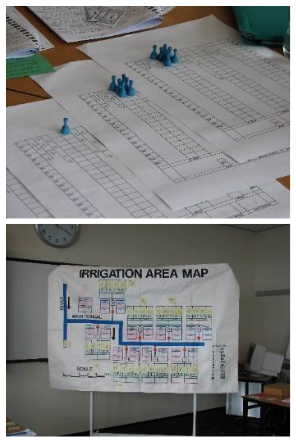
This is an article about The Irrigation Management Game (IMG), reflecting on my own use of the game in educational settings, and drawing some links with utopian and dystopian thought. The relationship between water and human wellbeing has been extensively studied and debated. Perhaps the most famous overarching theory is that of Karl Wittfogel. Wittfogel argued that certain climates imply certain forms of irrigation, which in turn imply certain political and social institutions.[1] In particular, Wittfogel thought that ancient Egypt and Mesopotamia, Hellenistic Greece, Imperial Rome, the Abbasid Caliphate, Imperial China, the Moghul Empire, and Incan Peru, were all ‘hydraulic societies,’ whose despotic character arose from the need to manage complex irrigation infrastructures. Although Wittfogel’s environmental determinism has since been discredited, his work remains a great reminder that water management is seldom simply a set of technical problems. Instead, water management is intimately linked with power, labor, knowledge, discipline, control, and utopian and dystopian possibilities. Anyone who has read George Orwell’s 1984 or Aldous Huxley’s Brave New World—or is a fan of Michel Foucault—will surely recognize such themes.[2] Irrigation is one of many domains where governments have attempted to improve collective welfare without undue interference in individual freedoms.

Irrigation was on many development agendas, in states as diverse as the Neo-Assyrian empire[3], colonial states in the 19th and 20th centuries[4] and modern settings[5]. In these developmental settings, irrigation—including its aspects of control—was often associated with utopian futures, at least within state propaganda and planning discourse. In colonial Africa, for example, European powers imposed irrigation regimes on communities they treated as ‘historyless’, while perceiving themselves as creating an ideal, rational order.[6] After the Second World War, with many colonized countries gaining independence, irrigation systems that had been constructed and/or planned became part of post-colonial international development.[7] Former colonial experts became international experts, and new experts were trained within irrigation approaches developed in colonial times.

In the first decades of post-WWII development, the main focus was on building new and rehabilitating existing irrigation infrastructure. From the 1970s onwards, more attention was paid to issues of managing these infrastructures—including relationships between managers, farmers, and other water users. These discussions intensified in the 1980s, if only because results lagged behind the expectations (sometimes too optimistic—utopian!—expectations) of governments and engineers. New methods of design and management began to emerge, and slowly began to adopt more participatory processes, to accommodate stakeholders’ knowledge and wishes. The main topic of this article, the Irrigation Management Game (IMG), is a result of these intensified efforts.

The IMG was initially developed to support discussions among irrigation managers on farmer strategies and water delivery problems, especially in the larger systems in South and South-East Asia.[8] After positioning the IMG within a gaming context, I will examine how the game reflects the realities that I study—both in practical and theoretical terms. I will conclude by suggesting that the IMG allows us to explore how utopia and dystopia are in the making, and not fixed in advance by a given environmental setting and management system. Especially in irrigation, I will suggest, the margin between utopia and dystopia can be thin.

Continue reading “Telling the Acrobats which way to Jump: Irrigation Gaming and Utopian Thinking”

The Value of Science Fiction

By Martin Griffiths, Brecon Beacons Observatory

Science fiction (SF) has many definitions. From the perspective of educators, Joanna Russ’s definition must be one of the best: SF is “a literature that attempts to assimilate imaginatively, scientific knowledge about reality and the scientific method, as distinct from the merely practical changes science has made in our lives.” It is this imaginative approach to science that underlies SF’s broad appeal. The phenomenal success of high-grossing films such as Star Wars, Independence Day, Jurassic Park, ET, Close Encounters, The Day After Tomorrow, Avatar, the Marvel Cinematic Universe movies, and many more, attest to the success of not only SF’s value as entertainment, but its ability to excite, fascinate and encompass human values.

Science fiction and education

The inclusion of SF in the schooling curriculum can promote discriminating faculties with applicability in later life. Some of the greatest scientists of the previous century, figures such as Carl Sagan, Robert Goddard and Richard Feynmann, were inspired by the speculations found in SF. Scientists such as Isaac Asimov, Fred Hoyle, Gregory Benford, David Brin, Paul McAuley, Alastair Reynolds and Kim Stanley Robinson also became award-winning SF writers. 

Continue reading “The Value of Science Fiction”