
By Kemi Cole
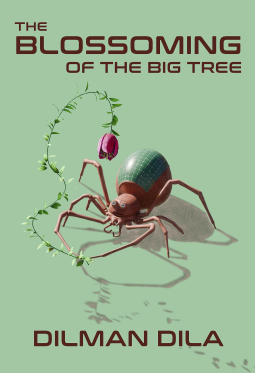
Adita does not want to lead anything. She is seventy years old, she would rather pedal a solar tractor across an acre than borrow a battery from a neighbour, and she has spent her life arranging her existence so that other people leave her alone. However, the system she lives under has other ideas.
Yat Madit, the political system Dilman Dila imagines in his novella The Blossoming of the Big Tree, distributes power so thoroughly that there is nowhere to hide from it. Dila has also written an essay tracing the precolonial Acholi governance structures that inspired this world, grounding the fiction in historical and political argument. This is the beating heart of the book, and also its best joke. Adita becomes the central figure of a narrative about a system explicitly built to have no central figures. The irony is precise and it does not soften.
What makes Adita remarkable is not that she changes. She does not. She remains uncomfortable in her own skin, hostile to touch, resistant to the idea that her interiority should be understood by anyone else. Dila never asks her to overcome this. The narrative does not cure her through the pressure of events or through a relationship. Instead, her introversion becomes the actual mechanism by which Yat Madit functions at scale. A leader who wants nothing consolidates nothing. A leader who retreats cannot become a tyrant. The political argument and the character are the same thing. That is what makes her work.
The world Dila builds around her is grounded and specific. Kampala is Kampala. Villages have names. Solar panels are made from a paste of leaves and algae. Governance runs on consensus down to the smallest communal decision. Dila embeds Acholi concepts into the narrative without translation. He is writing as if Uganda is the centre of the world, not a location that requires outsider comprehension. That act of centering is political. What is unusual is not the centering itself, which is a defining feature of Africanfuturism, but the depth and specificity of the political system he builds from precolonial Acholi structures, and his refusal to simplify it.
When war arrives, Adita must navigate the central paradox of Yat Madit: how do you mount a defence in a system explicitly built to reject centralised command? A federation of hundreds of villages cannot coordinate quickly enough through pure consensus. The problem emerges early. As someone says in frustration: “Really? An idea to defeat the mighty army of USA? You?” The question is not cruel. It is structural. Dila is naming what his system cannot do. In response, they create a War Council of twelve people to speed up decision-making, but that very act risks betraying the founding principle that power should not concentrate. The danger, as Dila makes clear, is that such small numbers could lead to centralism, to a few people making decisions that affect everyone. They have created the thing they feared most in order to survive.
In face of this massive threat of war, solutions seem to arrive faster than the reader can absorb them. A spaceship appears. Technology embedded with living jok code, a form of sentient programming rooted in Acholi spiritual tradition rather than Western computing logic, is deployed. A satellite is accessed. Because so much depends on mechanisms the narrative never fully clarifies, the resolution feels contingent in ways that might be intentional but are also difficult to settle into.
Lokang, who should be the most complex figure in the novella, sits at the centre of this problem. En, the pronoun used for Lokang, is not a god. En is not quite human. En designed much of Yat Madit and then withdrew from public life, quietly innovating for decades. The novella never gives the reader enough to know what en actually is beyond those outlines. This means Lokang cannot quite carry the weight the final movement of the story needs from en. Dila seems aware of this and does not try to solve it by making Lokang less opaque. It is a choice, but it costs something in the narrative and might leave a reader wanting more.
What is not in question is the seriousness of what Dila is attempting. He is not interested in the aesthetics of Africanfuturism. He is interested in whether a society built on consensus can survive the demand for speed that crisis requires, whether precolonial political structures powered by contemporary technology could actually function, whether you can write about power without making power the story. These are genuine questions and the kind that speculative fiction is uniquely positioned to ask, using narrative to stress-test political ideas that policy cannot yet imagine.
In the aftermath, the federation does not solidify into a new order. Power begins to reconcentrate around those who used it well during the crisis. The system’s founding commitments are already being tested. Adita is alone. The tree, in Acholi tradition the meeting place where the village gathers, remains. The conversation never ends. That is not a triumphant ending. It is an honest one. It is the kind of ending that makes you want to argue with the book, which is exactly what Dila has built it to do.
The Blossoming of the Big Tree is a genuinely absorbing read, funny and serious in equal measure, and Adita is one of the most quietly original protagonists I have encountered in the genre in some time.

