By Grace A.T. Worm
The Treasure
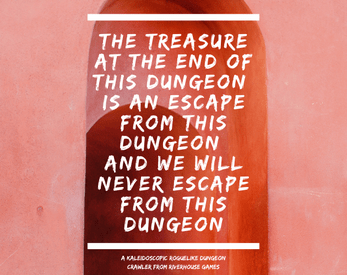
In the tabletop roleplaying game The Treasure at the End of the Dungeon is an Escape From This Dungeon and We Will Never Escape From This Dungeon (hereafter The Treasure), players enter the game’s imagined world, a dungeon, knowing that the ‘treasure’ they seek by playing the game is impossible to acquire. The game cannot be won, only perhaps eventually abandoned. It may seem counterintuitive to discuss utopia in a game that announces from the beginning that its systems and structures are permanent, and that any attempt to escape them is ultimately futile. However, it is through this surrender to the process that players learn the lessons of continued hope, perseverance, and community that serve as a foundation for much of contemporary utopian thinking. For these reasons, in this chapter I describe The Treasure as a utopia, while also recognising that it may appear dystopian.
The Treasure can be understood as a process for utopia that, through play, invites the players to build their own counternarratives about what is valuable in the world they enter into, and also work together to change that world, even knowing that practically they will never ‘win’ the game. It is necessary to adapt an in-flux knowledge of utopia through a queer and feminist understanding of a future that will never reconcile the painful past. If the players cannot escape the dungeon, then the focus shifts to developing their characters’ relationships through roleplaying. The absurdity of the players’ situation, the cycle of endless dungeon rooms, and the descriptions of characters and rooms, encourage a sense of camaraderie and community. In this sense, the game reflects the structure of utopian hope. For the players, the importance lies in fighting the cycle even when the outcome may never change for, as the game states in the world description, ‘We will never escape this dungeon. We will always try to escape this dungeon.’[1] It is possible to work towards utopia while being pragmatic in the knowledge that a perfect future does not exist. In the rest of this chapter, I examine the function of archetypal characters, the utopian dimensions of the players’ roleplaying, and how the game mobilises themes of pragmatism in relation to its feminist and queer utopian ideals.
Utopia is a complex term, and how different pieces of media create and present utopia varies wildly. For this chapter, I approach utopia as a practice stemming from discontent that arises from problems in the present, and exploration of possible futures where these problems are solved or nonexistent. Later in this chapter, I will explore how this vision of utopia shifts into focus through a queer and feminist lens. As suggested by Lucy Sargisson’s Fool’s Gold?: Utopianism in the Twenty-First Century (2012)and Erin McKenna’s The Task of Utopia: A Pragmatist and Feminist Perspective (2001), utopia can present visions of a future in which deeply entrenched social, economic and political problems are resolved or transformed. Sargisson writes that utopia is working towards ‘identifying core problems with today […] and placing them in a new imaginary context. They thus imagine how the world might be if the core “wrongs” identified by the author were transformed.’[2] McKenna explores utopia in relation to the philosophical tradition of pragmatism, and also emphasizes the centrality of hope in interacting with utopian ideals: ‘Utopian visions are visions of hope that can challenge us to explore a range of possible human conditions.’[3]
Utopia is ostensibly where problems are fixed. The creation of a completely separate and carefully integrated fantasy world has often been central to utopian thinking; and not just that it is separate, but that it is totalising. Fredric Jameson describes the movement away from causal utopias as either obsolete due to an inability to solve any and all social disintegration or due to the unparalleled global wealth and technology; however he argues using utopia as an idea to examine politics is still useful.[4] Thomas Moylan in Demand the Impossible similarly describes this developing idea of utopia as imperfect and rejects utopia as blueprint, he describes utopia as ‘[f]igures of hope’ through opposition where utopia is ‘produced through the fantasizing powers of the imagination, utopia opposes the affirmative culture maintained by dominant ideology’.[5] The completely separate utopian world — with readily available solutions for all the problems it seeks to overcome — has fallen out of favor. As Sargisson writes, ‘Most contemporary utopias tend not to offer visions of complete worlds. And most contemporary utopias avoid depicting a single solution; they decline to offer one complete and finished vision of the good life.’[6] In contemporary society, where political, religious, social, and environmental issues have remained at least as divisive as they have been historically, the idea of a perfect utopia that solves all the major conflicts of our current society seems impractical. The Treasure is fundamentally focused on creation and exploration, while providing enough character descriptions to spurn new identity formation without homogenising identity experiences. For example, there is no perfect solution to climate change, and scientific consensus on its causes has not translated to broad political and public agreement, but this does not preclude the struggle for environmental justice. So progress must be made in a more improvisatory, patchwork way. Similarly, contemporary utopias usually don’t try to articulate one single vision of society that is so compelling nobody could refuse it.
Continue reading “We Will Never Escape Utopia: Gender, Queer, Pragmatic, and Hopeful Utopia in The Treasure at the End of the Dungeon is an Escape From This Dungeon and We Will Never Escape From This Dungeon“ vector-bsfa.com