Life by Gwyneth Jones (2004)

Life cover
Life‘s exploration of the working life of a scientist is one of the best I’ve read; and the thoroughness with which it maps the faultlines between sex and gender makes it, for me, the best thing Jones has written in a strong decade of work, and a deserved winner of the Philip K Dick Award. Paul Kincaid’s review in Foundation 95 finds a few faults to argue with, but sums up the novel’s virtues well:

None of these quibbles is fatal to the book. It remains beautifully written, vividly realised, seriously thought-out. It is rare to come across a novel which is clearly the consequence of such serious thought. The ideas are complex and patiently illuminated; and the story has been carefully constructed to throw those ideas into relief. If we read science fiction for intellectual as well as emotional engagement, then this is what the genre is all about.

Please email me with your top ten science fiction novels by women from the last ten years (2001-2010). All votes must be received by 23.59 on Sunday 5 December. Your own definition of science fiction applies.

Cheltenham 2010

My main complaint about the sf programme at this year’s Cheltenham Literary Festival is that I couldn’t spare the time and money to go to more of it. As it was, I spent a very pleasant weekend in Cheltenham, staying with friends, and went to three events over two days. All three were worth attending, if only for the pleasure of seeing serious items at a mainstream literary festival take sf seriously. Of course, though it should go without saying that my recollections are likely imperfect, there were also some frustrations.

Most of those came in the first event, China Mieville and John Mullan, in conversation:

Why is there never any science fiction on the Booker shortlist? Yet why have so many ‘literary’ novelists, from Atwood to Ishiguro, borrowed their stories from science fiction? Where does sci-fi lie on the literary landscape? What are the issues of perception surrounding this genre and its counterpart ‘literary fiction’, and how porous are the borders between them?

This was a follow-up to last year’s brief fuss on the same topic, and as Mieville emphasised more than once, all credit to Mullan for turning up to defend his remarks. Each man set out their stall for about ten minutes, then there was some back and forth, and then they opened the floor to questions. Mieville’s contention was that the Booker prize should do one of two things: either be genuinely open to all types of fiction; or admit that it is concerned with a specific category of fiction, no more or less a category than the many others with which bookshops are stocked. Mullan’s reply, stated with increasing firmness as the discussion wore on, was that literary fiction is a category apart, primarily because it eschews formula.

There were, I think, two problems facing the debate, one embedded in the panel description, the other in the panelists. The former was the assumption — pushed at slightly, but never to the extent that I would have hoped for — that a work published outside the category science fiction, and not stocked in the “special room in bookshops” that Mullan talked of, is not science fiction. So Mullan, for instance, mentioned his surprise at being informed that Ishiguro’s Never Let Me Go, to his mind the greatest English novel of the last ten years, could have been nominated for a science fiction award; and confessed that although his first thought on hearing that it had lost the Arthur C Clarke Award to Ryman’s Air was to be intrigued, his second was to assume that it must have lost not because Air was a better novel, but because Never Let Me Go failed to meet the rules of science fiction (specifically, he suggested, in focusing on the characters instead of explaining its world). The assumption buried in there did not go uncommented on — Mieville even dragged out sf’s no good/they bellow ’til we’re deaf. But, although I wouldn’t wish to claim that that attitude towards “outsider” sf doesn’t exist, it would have been good to be able to suggest a bit more strongly that Air is indeed a novel very worth Mullan’s time; and to be able to emphasise that Ishiguro is far from the only non-category-sf author to be shortlisted for, or to win, a science fiction award; that David Mitchell, Jan Morris, Marcel Theroux and Sarah Hall have all appeared on the Clarke Award shortlist in recent years, and that a couple of years ago Michael Chabon won a Hugo and a Nebula. If, as Mullan contends, the borders have hardened since he was younger, the hardening doesn’t seem to be coming from the sf side.

The second problem was related to the first, insofar as it became awkwardly clear that while the discussion was going to be primarily about the absence of category sf from the Booker list, only one of the participants could and would talk fluently about fiction from all over the literary map. Mullan had almost no recent primary experience with category science fiction. His astonishment, for instance, that Mieville could suggest that a science fiction writer — Gene Wolfe, to be specific — might be the equal of JM Coetzee, seemed to be genuine. And it meant that he had no real way to engage with Mieville’s suggestion that different categories of fiction might have different, but equally valid, “aesthetic specificities”; and that one of sf’s specificities might be estrangement, as compared to literary fiction’s preference for recognition. When making his case for the importance of formula to genre it was telling that Mullan pointed over and over again at crime fiction, describing a template detective story. It would have been good to ask: what is the template story of a science fiction novel? The clearest demonstration of Mullan’s inability to consider that the characteristics of literary fiction Mieville was pointing at might be, in their way, as much generic markers as anything in a science fiction novel was highlighted by his description of Charles Yu’s How to Live Safely in a Science Fictional Universe — which he’d read as background for a documentary on first novels — as “a send-up of science fiction”, when in fact — with its solipsistic, sadsack narrator obsessed with his relationship with his father — it plays with the conventions of “literary fiction” at least as thoroughly. (And in fact, I’d argue the metaphysics of Yu’s novel are constructed — not even subtly! — to articulate, among other things, precisely the sorts of points about literary categorisation that Mieville was trying to make.)

After all that, the second event — an interview of Iain M Banks by the editor of the Guardian Books website, Sarah Crown — was thoroughly refreshing for the unabashed enthusiasm for sf that radiated from Banks. Indeed, the first audience question could have been a plant, so completely did it seem to justify every caricature of literary snobbishness ever constructed by sf fans — the guy actually stood up and asked, in so many words because I wrote them down, “I realise this may provoke a fight, but I have to ask: why does Iain Banks, one of my favourite writers, spend so much time wasting his prodigious talent on science fiction?” — and so fully did Banks seize the opportunity to offer a full-throated and crowd-pleasing endorsement of sf as “the most important genre of the modern age”. (It was also rather cheering to hear Banks refer to himself off-handedly as writing “in two genres”…) Surface Detail sounds, in many ways, like Culture business as usual; but Banks did a good job of reminding the audience of how appealing that business can be.

Sunday’s event, also ably moderated by Sarah Crown, was probably the one I went into with highest hopes:

British Science Fiction From H G Wells to John Wyndham, Britain has been home to some of the most groundbreaking and successful classic science fiction writers. Explore past classics and the best of the current crop as authors Iain M Banks, Gwyneth Jones, Michael Moorcock and Guest Director China Miéville discuss this very British tradition.

Inevitably — and not just because three of the four panelists were respondents to the survey! — there was familiar ground covered, but it was covered thoughtfully. So, we had a consideration of how the loss of empire shapes British sf, and the extent to which in some cases it may be an assumed influence, even imposed by expectation rather than springing from within. We had The Politics Question, with the observation that it’s not so much that American sf is right-wing and British sf left-wing, but that American sf has both right and left wings, and British sf, generally speaking, has not heard from the right, plus a discussion of how individualistic vs communitarian philosophies work themselves out at the level of narrative. And we had some discussion of how sf has been positioned in relation to mainstream literature, with Michael Moorcock suggesting (not for the first time, I think) that where American sf has a stronger tradition of writers who express their ideas through sf, British sf has a stronger tradition of writers who seek to express science-fictional ideas: that is, more writers for whom science fiction is not an entire career, for whom the idea comes before the form.

Perhaps the most interesting part of the discussion came when it strayed into what-next territory. Nic, braver than I, raised the topic, pointing out that the recent history of British sf has been a self-described golden age, particularly in the resurgence of space opera, but that other developments, such as the reduction in the number of women writers, suggested a narrowing of the field, and asked which the panel felt was the more powerful trend. Gwyneth Jones suggested, in line with recent discussion here, that British space opera, at least, is no longer a growth industry and may be starting to stagnate; and that women writing sf and feminist sf in general may have suffered for being positioned as “the next thing” in a genre that is always hungry for the next thing, rather than more usefully seen as a an evolution. (Mieville, in turn, suggested that it may be worth looking to what he characterised as an “underground tradition” of British sf — involving Katharine Burdekin, Jane Gaskell, and another writer whose name I forget — for a more congenial reception of women.) And speculating on the next thing, the panel suggested that the sf to look for may be that coming from elsewhere — from the Pacific Rim, or Africa — and may not necessarily be prose sf. Or it may be — and this was the point missing from the earlier debate for me, even bearing in mind Moorcock’s comments — that more and more interesting fantastical writing is coming from writers positioned outside the current category; Mieville cited Toby Litt, David Mitchell and Helen Oyeyemi as writers to keep an eye on, all picks I’d cheerfully agree with

All good clean fun. Perhaps not all attendees agreed, mind you; as we were leaving the panel discussion, an elderly gentleman behind me was heard to wonder why, oh why, do sf writers always seem to be so interested in navel gazing?

When A Datapoint Becomes A Trend

Earlier this week, John Gray wrote about sf in the New Statesman, setting out an argument about The State Of Science Fiction. He begins by praising The City & The City‘s insight into the way we live our lives, asserts that “this insight comes without any suggestion that the situation can be changed”, and takes this stance as paradigmatic of modern sf, as opposed to classic sf’s belief that humanity can and will shape the future.

Even at its most pessimistic, science fiction has always been a humanist genre. The consoling assumption has been that while civilisation may be flawed and fragile, it can always be rebuilt, perhaps on a better model, if only humans have the will to do it.
[…]
If science fiction is no longer a viable form, it is because the humanist assumptions that underpinned it are no longer credible even as fictions. The hybrid type of writing that has evolved in recent years is symptomatic. “Slipstream”, “cyberpunk” and “new weird” blend together influences as diverse as Arthur Machen and Mikhail Bulgakov, Charles Williams and William S Burroughs. What these styles of writing have in common is an absence of politics. No world-changing project features in any of them. Miéville is an active member of the Socialist Workers Party, but his brand of fantastic fiction has as much to do with his political hopes as Wells’s scientific fables did with his utopian schemes. Wells may have fantasised about a world government using science for the masses, but it was the clairvoyant dreams that appear in The Island of Dr Moreau that expressed his true vision.

During much of the 20th century, speculative fiction served an impulse of world transformation. Fantasy was understood as an exercise in which alternative worlds were imagined in order to create new possibilities of action. Today fantasy has the role of enabling us to see more clearly the elusive actualities. The question of action is left open. We debate what can be done to change the world, but no one expects an answer.

This is not an argument that comes completely out of left field. It is not the same thing as William Gibson’s future fatigue — the idea, as expressed in Pattern Recognition and Spook Country, that all we have is the spinning of the given moment’s scenarios — but it’s related, I think, inasmuch as if you think you can’t realistically talk about the changes to come, you’re not talking about changes that will come. Nor is it the same thing as Gary Wolfe’s proposition of Evaporating Genres, which is much more an argument about where and how science fiction appears; except that you would expect some changes in the character of science fiction to go along with changes in where and how it’s published, and Mieville’s book is the exemplar of a crossover text.

So in some ways I agree with Cheryl Morgan that “instinctively” Gray’s point has “a certain validity”, at least that the sort of sf he describes has become a more prominent strain of sf. But there’s an awful lot to argue with. Some of the argumentation is dubious — I’m a little bit in awe of that “If science fiction is no longer a viable form”, for so unapologetically repositioning as a given what was at best an implicit proposition a few paragraphs earlier — and, most problematically, as presented Gray is extrapolating from an absolute paucity of datapoints. He probably didn’t have to do so for the sake of his argument. He would have been justified to arrogate to his cause The Road — certainly the most widely-noticed apocalyptic vision of the last decade, and distinguished by its utter refusal of Wyndham-esque rebuilding — and perhaps the advocates of Shine might say that, in part, they’re addressing the gap that Gray identifies.

But here’s the complete list of writers of sf cited in Gray’s piece, as it stands: Wells, Zamyatin, Huxley, Stapledon, Orwell, Heinlein, Wyndham, Moorcock, Harrison, Lem, Ballard, Mieville. Laurie Penny has an excellent, necessary riposte on the familiar imbalances here:

Gray’s article lists not a single woman writer, nor any writer of colour — nor, indeed, any living writers from the 21st-century save Miéville. It is particularly startling that, in his digest of 20th-century dystopian fiction, he neglects to mention Margaret Atwood’s The Handmaid’s Tale, a near-future novel set in a brutal patriarchal theocracy, alongside Orwell’s Nineteen Eighty-Four and Huxley’s Brave New World.
[…]
Women’s liberation has always been, in Gray’s words, an “impulse of world transformation”. Imagining alternative futures in order to create a potentiality of action has been particularly important for women writers and writers of colour seeking to articulate social oppression.

There’s a list of the usual counter-suspects at the end of Penny’s piece, credited to Farah Mendlesohn and (suggestively) China Mieville. A few things strike me about that list. One, it’s as American-led a list as Gray’s piece is Brit-heavy; make of that what you will. Two, someone really needs to fix “Tricia O’Sullivan”, because I wince every time I read it. Three, Sullivan’s Maul is a good example of the sort of sf that — having spent part of the weekend discussing it — jumped out at me as noticeable by its absence from Gray’s piece, that is, sf engaged with some form of posthumanity. There’s plenty of it around, and it’s exactly about imagining radically transformed human experience. Fourth, and finally, Gwyneth Jone’s Bold as Love sequence is a pretty devastatingly effective counter-example to Gray’s argument, being as Sherryl Vint puts it, precisely “a thoughtful and thorough meditation on the political options facing us in the 21st century”, clearly accepted as a major work.

Penny’s piece itself, however, I find myself unable to agree with entirely. I’m not sure that sf “can’t help but replicate the strategies of radical politics and identity politics”; I might be convinced by “is particularly amenable to”, but there’s an awful lot of conservative sf out there. And moreover it seems to me that it’s not hard to come up with examples of books by women that fit Gray’s agenda — he includes weird fiction, for instance, which gets him books like Steph Swainston’s The Year of Our War, and he includes slipstream, which gets him books like Lydia Millet’s Oh Pure and Radiant Heart. Both of those are, you can argue, works that highlight “elusive actualities” rather than propose alternatives. I rather suspect Gray didn’t mention them not because sf by women, in a broad sense, is antithetical to his argument or his particular humanist sensibility, but because he’s just not familiar with it.

Notes on a Shortlist

Almost everyone, it seems, agrees about at least one thing about this year’s Arthur C Clarke Award, the winner of which is announced tonight: that it’s a good shortlist. (That post now updated with more review-links, by the way.) I’m not about to break that hardening consensus, and may even raise the stakes slightly. I think the 2010 shortlist is one of the very good ones; for me, as a shortlist as a whole, probably the strongest since 2003, when Light vied against The Scar and the ultimate winner, The Separation. Two of the novels — Gwyneth Jones’ Spirit and Kim Stanley Robinson’s Galileo’s Dream — have been hailed as returns to form, two more — China Mieville’s The City & The City and Adam Roberts’ Yellow Blue Tibia — as their authors’ best to date; and the remaining two — Chris Wooding’s Retribution Falls and Marcel Theroux’s Far North — are certainly not without their champions. Perhaps the most pleasing thing about the shortlisted novels is their variety. There are more and less straightforwardly science fictional works, set in times ranging from the seventeenth century to hundreds of years hence, and if you’re not calling them sf, you could call these books crime novels, Westerns, comedies, and adventure stories. (Or just novels, of course.) It’s a good showcase. But a novel is a prose narrative with something wrong with it; and so, though it’s harder to do than it was last year, we must look for what’s wrong with these offerings.

What it isn’t, for once, is very British, and the most British book on the list — if only for its blokeish humour — is the one most people throw out of the balloon first. Retribution Falls has plenty to recommend it, particularly pace and, in its retro-magical setting, colour, and is welcome on the shortlist as an adventure story, a form too often given critical short shrift that nevertheless requires considerable craft. I kick it out of the balloon first as well, though, not for being what it is, but for flirting with smeerpdom. It seems to me that the story Retribution Falls tells is not sufficiently specific to its fantastic content: that it could be retold in another time or place without changing much more than the vocabulary. (I’d say this is partly where the omnipresent Firefly comparisons are coming from.) And that’s not enough to be the best science fiction novel of the year, the book put forward as an example of what science fiction can be and can do. There’s also the question of the book’s female characters, which aren’t exactly depicted on equal terms with the men, although on that point I’m willing to give the novel more credit for self-awareness than, say, Nic or Abigail are (although this is not to mention the question of the book’s sole near-silent ex-slave character of colour, which is harder to excuse). Such factors must be considered when assessing the book, I’d argue; the political is as inextricable a part of literary judgement as the aesthetic.

An author usually impeccable on both fronts is Gwyneth Jones, whose Spirit — being a retelling of The Count of Monte Cristo — would seem to also risk smeerpdom, but which actually passes at least that test with flying colours. I haven’t read the original, but I know its outline, and Jones does not seem to be in thrall (and in the book’s last third, seems to revise her model quite inventively, if not, in the end, entirely convincingly); nor have I read the major preceding work in Jones’ own oeuvre, the Aleutian trilogy, but there to I didn’t feel the absence of context particularly strongly. That is: Spirit is a full, contained science fiction novel. It’s about that most speculative of subjects, identity, or at least is at its best, so far as I’m concerned, when it hews closest to this theme. There’s much here about what defines us, and what might define us, in an era when space travel that treats mind and matter as interchangeable information — the raw stuff of self — and much about individuals who are defined, usually as Other. The novel’s great weakness is a lack of consistency. It really is a bit all over the place, veering from political intrigue to action-led set piece to introspective periods of what is glossed as “poetic time”; the latter are the most reliably good, and a section half-way through the novel set in a prison is seriously impressive, but the quality is never as even as it should be. A lesser but still significant weakness, I think, is a lack of freshness, a sense of being a bit second-had. Sometimes this is to good effect. I can see how Jones’ Star Trek aliens play into her theme — the alien understood as an element of humanity; or, in this case, perhaps more accurately humanity understood as an element of the alien — and I don’t want to take, for instance, Jones’ playfulness with gender, which delivers plenty of welcome perceptual jabs, for granted. But on balance, even if some aspects of the book aren’t seen as often as we might hope, there seems to me too little here that hasn’t been seen before.

Which brings me to China Mieville’s The City & The City, whose central conceit has clearly already entered the canon of Really Neat Speculative Ideas. What is so very neat about it, it seems to me now, and the novel’s greatest accomplishment, is how successful it is at exposing readers’ assumptions. To talk about The City & The City in any sort of depth is to reveal with uncommon clarity how you think about the world, about people and about fiction: all of which are always worth doing. But it is for me a less satisfying novel — certainly a less satisfying science fiction novel; I do think it reads much more interestingly as fantasy — than it a political act. Its plot is seldom remarked upon, although I note that in general this aspect seems to pick up more praise from readers who spend more time with crime novels than I do; and its narrator contains no great depths, and to my ear just a bit of strain in his voice. It’s primarily for the neatness of its conceit, I’d guess, that the novel quite deservedly won the BSFA Award — and, not surprisingly, it’s the front-runner in Liz’s poll. (The BSFA Award is not a great predictor of success in the Clarke Award, though, with only four books ever having done the double.) Mind you, if it does win, it will be a remarkable event, making Mieville the first author to win the Clarke Award three times; and three times within a decade, no less.

Now it gets really hard. Is Yellow Blue Tibia Adam Roberts’ best novel? Well, that probably depends on why you read Adam Roberts novels. There is certainly something to the idea that it’s his most relaxed, owned novel — as Jonathan put it, the work that combines Roberts’ various hats, as a writer of novels, histories, spoofs and criticism, “into one magnificent red satin topper”. In the honorable tradition of sf novels about science fiction, it surely has a spot marked out for it; it is funny; it has things to say about totalitarianism as well; it’s as technically well-formed a novel as you could wish; and its science fictional conceit delights me. To date the major charge against Yellow Blue Tibia has been Catherynne Valente’s hard-to-ignore assessment of “painfully inept cultural appropriation” (on which Roberts lightly comments here). That is: it is hamfisted as a depiction of Russian-ness. To me, the novel seems much more about popular conceptions of Russian-ness than about the thing itself. As Dan puts it, River of Gods would have been both a poorer and less honest novel if it had been written primarily with reference to depictions of India, but I don’t see that Yellow Blue Tibia is trying to be River of Gods, and I’m a little baffled that anyone tries to take it as such. It seems to me far too ironic, too playful, to self-conscious to be taken as striving — as McDonald’s novel clearly does strive — for anything approximating that horrible concept, “authenticity”. (That, and cultural appropriation strikes me as most egregious when there is a severe power imbalance in favour of the person doing the writing; and I don’t see that between the UK and Russia.) That sense of play, indeed, is one reason I read Adam Roberts; but another is to be challenged, to have my expectations about fiction and the world in general confronted in some way or another. And on that score, Yellow Blue Tibia disappoints me, seems to have fewer edges not just than Roberts’ other novels, but than other books on this shortlist.

If The City & The City is a popular choice for the award, Far North is becoming something like the reviewer’s choice, with Dan, David, Nic and Abigail all leaning in that direction, and Martin revising his odds accordingly. And for all that it’s been a long time since “the mainstream book” went home with the Clarke Award — since The Sparrow in 1998 — my head thinks that this could be Far North‘s year. It has a purity of concept and execution matched by no other novel on the shortlist, save perhaps The City & The City, and Theroux’s offering is a substantially more interesting novel of character (which does tend to be, in the end, one of the things the Clarke goes for). In its pragmatic depiction of life after ecotastrophe it eschews judgement in a way that few other such novels are able to — as Abigail puts it, it shows The Road how it’s done — and its Zone is as provocative and memorably eerie a location as antecedents. (It is also, like the previous three novels, a work that draws on Eastern/Northern Asia for its affect — a huge region, of course, but there do seem to me to be some affinities between Spirit‘s Baykonur metropolis and Chinese-influenced culture, The City & The City‘s vaguely defined border location, Yellow Blue Tibia‘s Communist Russia, and Far North‘s Siberia. And, of course, the one novel I haven’t discussed has a European setting. This is not, as I said, the most British shortlist.) In all, Far North is a novel that’s easy to argue for and hard to argue against, which is why I think it will win: after all, my mostly strongly felt argument against it, like Amanda, is simply that I like Galileo’s Dream more.

Kim Stanley Robinson’s novel, which ranges between Galileo’s lifetime and the medium-far future, is expansive and rough where Far North is contained and controlled. It is a long book and — like its protagonist — can be exasperating (although this does not mean that I agree with Rob Grant’s assessment that it is “written to impress rather than entertain“), but it nails the dismount. And more than any of the other books shortlisted, it’s the one I want to revisit. (Of course, the judges will have revisited it, and all the others.) This is partly just because Robinson’s model of human nature and culture is one I am quite strongly in sympathy with: that the world may not be sane, but that it behooves us to find as much sanity as we can, and struggle for more; that it is possible to be utopian without de-emphasizing the challenges to that position. And it’s partly because I want to explore how Robinson tackles the material that’s new to him — the alien — in more detail. But it’s mostly because I want to revisit the things that are specific to Galileo’s Dream that Galileo’s Dream does so extraordinarily well. The exploration of memory, of how human beings live in time; the science-fictional dreams that use the techniques of sf past to address the tropes of sf present; and most of all, the sophisticated analysis of what it means to write a biographical historical fiction, to intervene in the thoughts of a past life as a future traveller (or writer). You can feel the tension — can in fact see it develop over the course of the novel — between that idea of Galileo as we can imagine he might have been, and Galileo as we (as Kim Stanley Robinson) would like to be able to imagine he was. At the end of a decade that’s given us quite a lot of historical fiction novels about science, for me Galileo’s Dream stands as the best of them: and of the books on this shortlist, I think it contains the most beauty, and the most truth. And so I hope it wins this year’s Arthur C Clarke Award.

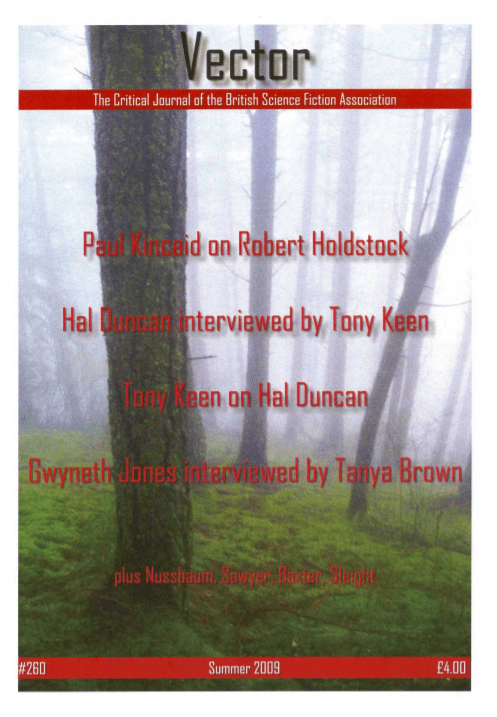
Vector 260: Fantasy and Mythology

A bit belated, this, for which I apologise. While I was away on holiday, the latest BSFA mailing should have dropped through members’ doorsteps. If you haven’t received it, let us know; it should have looked like this:

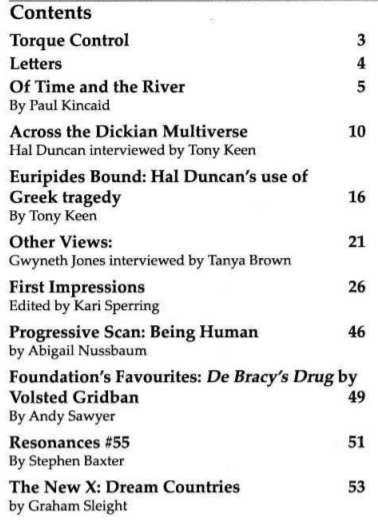
And the contents of Vector:

Torque Control — editorial
Letters — or, this issue, letter; keep ’em coming, though
Of Time and the River — Paul Kincaid on Robert Holdstock
Across the Dickian Multiverse — Hal Duncan interviewed by Tony Keen
Euripedes Bound: Hal Duncan’s use of Greek tragedy — Tony Keen
Other Views — Gwyneth Jones interviewed by Tanya Brown
First Impressions — book reviews edited by Kari Sperring
Progressive Scan — a column by Abigail Nussbaum
Foundation’s Favourites — a columnn by Andy Sawyer
Resonances — a column by Stephen Baxter
The New X — a column by Graham Sleight

There’s a little discussion of the issue in the BSFA forum. And inexcusably not credited in the issue is Drew Brayshaw, whose photograph provides the basis for the cover.

Also in the mailing, as the photo shows, is the latest issue of Focus, and the latest BSFA Special booklet: SF writers on SF film: from Akira to Zardoz, edited by Martin Lewis, who has posted about the booklet here. Adam Roberts has posted his contribution, on Blade Runner, here.

Last, but certainly not least: Matrix Online has relaunched. with oodles of features and reviews.

Links Shake the World

I’m in Glasgow for most of this week, for work-related reasons, so posting is likely to be light; but I can at least catch up on my linking.

EDIT: I knew I’d forget something. Can anyone work out, based on these reviews, whether 2666 is a work of the fantastic?

Kairos

Kairos coverKairos is a novel that spends a lot of time refusing to look you in the eye. Very nearly half of its pages (which number 260 in the revised 1995 edition, i.e. not the one pictured; I don’t know if the original 1988 edition is substantially shorter or longer, although Jones’ afterword suggests not) have passed before it actually admits that it’s going to be something more than one of the most grimly hypnotic visions of a real-year-88 near future committed to paper, but the pattern is there from the start. The first person we encounter is Sandy Brize who, on a cold August day, is deciding to leave the lover with whom she has spent her whole adult life. We never see the leave-taking itself: what we get is Sandy’s thought that, “around her failing love affair the failing world had gathered: started and spoiled, tried and failed, until Sandy could scarcely tell the two apart” (3), and other cheerfully entropic observations. Similarly, chapter two, a flashback to ten years earlier, doesn’t show us the couple in happier times; rather, it begins with Sandy having visited Otto Murray, who has just given birth, in hospital. Chapter three then opens with Otto Murray alone in a protesting crowd, Sandy having stormed off after an argument. And so on. In each case, the imagined scenes are more powerful than anything Jones could have written, of course; when Otto does visit Sandy, post-breakup, in the story’s present day, it’s something of an anticlimax, although one in which what is not said, what is absent, remains a looming presence — which, for marginalized inhabitants of a United Kingdom falling to pieces, whose inhabitants are only too well aware that the future is being decided elsewhere, even if by war, is only fitting.
The urban gloom that pervades most of Kairos is a peculiarly British drabness, but — another way in which the novel is evasive — conjured predominantly in the corner of the eye, through observations such as Sandy’s that relate a character and their environment. It’s an approach you could describe as street-level, if that didn’t conjure images of the lurid angsts of cyberpunk. Things that would be the meat of a more typical science fiction novel are passed over in brief, or excluded altogether. We are told that the Tories are in power — after one term of a “moderate” Labour government — but the Prime Minister is never named. The first decade of the twenty-first century has apparently seen “the oil crisis, the dollar crisis, the Japanese Rearmament”, and there’s mention of “the Islamic Bomb” and “the Israeli Bomb”, plus various brushfire wars, but Kairos cares about these events only to the extent that they shape the people who have to live with them in the back of their mind. Most characters are introduced in terms of the niches they cling to, of class, race, gender, sexuality, and how those niches constrain and define them. Sandy and Otto are unambiguously poor, but even the better-off characters seem excluded from wherever it is that the decisions are being made. For Sandy, increasingly as the novel proceeds, the only way to live in such a world is to seek a kind of psychic oblivion. Otto, on the other hand, raised in a relatively more liberal time, feels “betrayed […] she had no choice but to consider certain conditions normal and struggle for their recovery” (39). At times, it’s almost a cliché of how the eighties in Britain are meant to have felt, but its power remains. For all that Otto, Sandy and their friends try to find a way to deal with the world they find themselves in, Kairos can be as corrosive to the soul, if not the senses, as its inspiration.

The sf plot is, to start with, a conjuring trick. There is an organization, with the slightly cringe-inducing name of BREAKTHRU, which probably started life as a pharmaceutical company, apparently became a millennial cult, and has hung around for reasons not fully apparent to any of the characters. Sandy goes to one of their meetings, and is partly baffled, partly repulsed by their ideology. At the same time, Otto’s young son, Candide — a cruel affliction of a name if ever there was one – reports occasional sightings of things that may or may not be angels. Otto herself ends up in possession of a package, containing something taken from BREAKTHRU, which is barely mentioned until one of Candide’s angels turns up, explains the plot (ta-da!), and then anatomizes Otto and her friends:

“Okay, so we’ll rerun the story so far. The container that has gone astray holds an enormous quantity, relatively speaking, of a very new and potentially very dangerous drug.
[…]
“With the concentration that is packed in that little tube, there is no need to ingest it. It affects any contacts like a kind of radiation. Touch isn’t necessary, even: intention is enough.
[…]
“It gets right back to the, um, sub-particulate interface between mind and matter. It is operating under Planck’s constant, down where everything turns into everything else. It’s like, you can really play around with things.
[…]
“[You] probably think of yourselves as outsiders, dissenters. That isn’t true at all. In fact you epitomise the present state of the world, especially in this country and the others like it; white consumerism. […] You’re very comfortable in your separate ways but deep down it’s all based on denial.” (113-5)

It’s difficult to convey how incongruous the twin intrusions this passage represents — the appearance of an angel, kilt and golden breastplate and all, and the sudden, brazen clarity he brings to the story — seem after a hundred densely gnarled pages of Kairos. Whether or not the angel came from heaven, or is simply a kairos-user, he certainly appears to have come from another story, though as the last part of the quote may suggest, he doesn’t herald a dramatic shift in the novel’s trajectory. With kairos loose in the world, what the second half of the book sets out to demonstrate is that denial does you no good if intention is enough.

So the characters set out on journeys that take them deeper into landscapes that they are probably creating. These chapters are, at times, almost unbearably tense; they are also largely superb. Otto finds herself wandering dazed through the ultimate betrayal, a postapocalyptic Brighton — the aftermath of World War, for her, is marked by silence everywhere, the absence of people — then incarcerated in a prison that may be as much mental as it is real, before temporarily losing her identity entirely: one chapter begins, starkly, “The prisoner had escaped. It could not remember how” (220). Meanwhile, Sandy journeys with Candide to the headquarters of BREAKTHRU; she was not actually present during the angel’s visitation, but is increasingly conscious that the separation between her mind and the world is breaking down. She may be trapped in a version of the story that Otto has created, refracted through her own psyche. In one of the book’s most striking images, while trapped in a motorway traffic jam Sandy looks up to see ” the pale November sun burst into an arc. A multiple arc of white suns spanned the sky. Everyone in all the cars shouted in terror and amazement” (150). Whether this is a literal change in the nature of reality, or simply how Sandy interprets the sunbursts of nuclear war, is unclear; as is, for a long time, whether the war itself is real, or caused by the protagonists thinking it so, or simply happens to coincide with the Kairos event. It seems to be the revolution the characters have been yearning for. It is terrifying. It even succeeds, briefly.

Or perhaps more than briefly. John Clute described the end of the book this way:

But Candide joins forces with Sandy, Otto’s working-class lesbian lover who has suffered both the snubs of her circle and most of the wounds an uncaring state can inflict. Sandy’s apocalyptic bitterness now combines with Candide’s natural abandon to impose a convulsive transmutation upon the shattered land. But kairos, which literally means fullness of time, has also a specifically Christian meaning: the moment of Christ’s appearance. Though Jones wisely refrains from attempting to limn an actual Second Coming, the vision that closes Kairos, of an unpatriarchal world in which it is inconceivable that dogs (and humans) might be tortured, rings backwards through her text like a blessing, and justifies it. (Look at the Evidence, 135; TLS, 6 January 1989).

I’m with him for the first couple of sentences, but although the vision he mentions is in the book I read, it doesn’t close it. This may be what changed between the two editions, because in mine the final chapter of Kairos takes place after the event has ended — after, in fact, it has been made safe to think about, by parcelling it away as some kind of cosmic phenomenon, not a human action at all — in a world which in many ways appears to be going on much as it ever has. Not all: there are echoes of the power that kairos lent its users, and Otto in particular seems to have retained some ability to shape the reality she sees, and in fact worries that “I have to keep imagining things now” (259), lest they end. And some characters who had been dead are restored to life. But although there may be more, as Otto puts it, to the kairos event than “a changing of the guard” (231), there is also less. Sandy’s new job working on road repairs is purely mundane. Torture remains conceivable, although perhaps it might be more effectively resisted; an absence of dialogue has been replaced by “the ever present murmur of the human ocean”.

If it’s a blessing, it’s a fundamentally pragmatic one. I can’t think of many other novels in which the political and science fictional arguments complement each other quite so carefully; nor many from which the science fiction ultimately evaporates so devastatingly. What is left are people. Essays could be written about the way this novel plays with identity, but they would have to note, as Otto ultimately does, the potential for self-defeat in such considerations. “We would rather be slave owners and slaves,” she declares, “than try to live in the real world” (220). And so it seems to me that Kairos ends where it must. More people may have realised that opportune moment — the time of changes – is always right now, but crappy jobs and politics remain. The world remains; and we remain.

London Meeting: Gwyneth Jones

The guest at tonight’s BSFA London Meeting is Gwyneth Jones, author of Bold as Love and many other books, and winner of the 2008 Pilgrim Award for SF Criticism. She’ll be interviewed by Tanya Brown.

As usual, the venue is the upstairs room of The Antelope, 22 Eaton Terrace, London, SW1W 8EZ. The closest tube station is Sloane Square, and a map is here.

The meeting is free (although there will be a raffle), and any and all are welcome. The interview will start at 7pm, although there’ll be people in the bar from 6 onwards. (Annoyingly, those people won’t include me.)

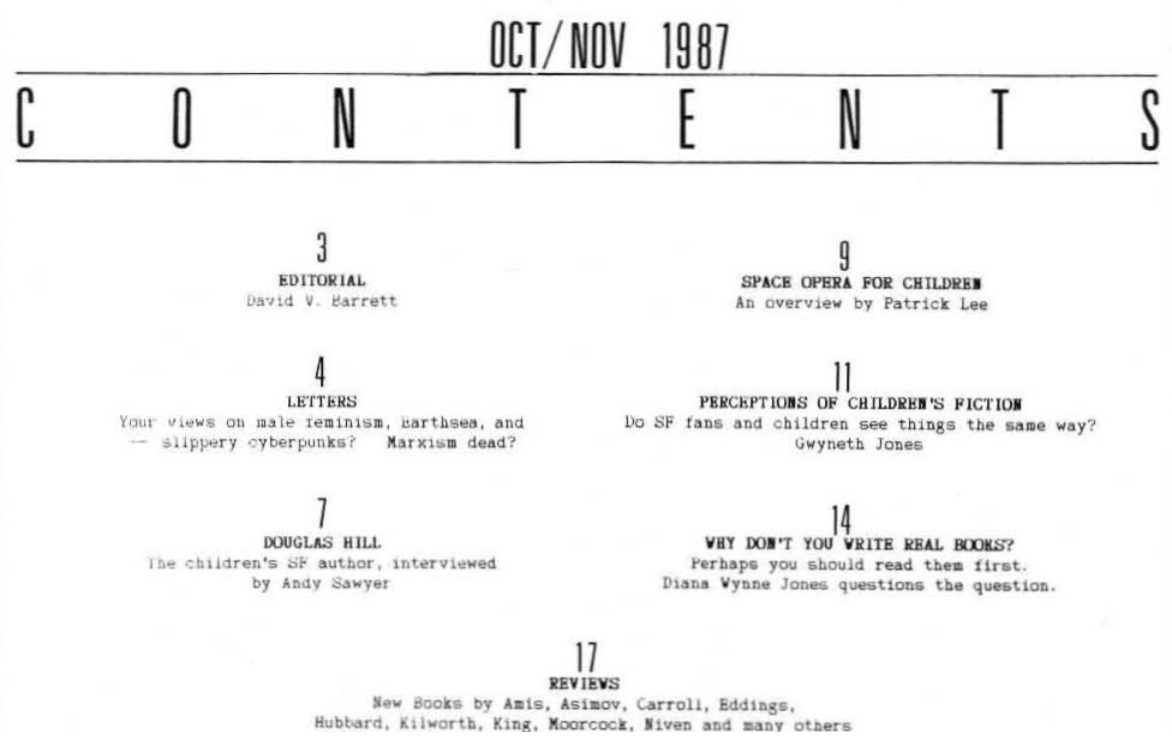
Vector #140

Why devote an issue of Vector to something many BSFA members said goodbye to years ago? Why should adults read something written for 10 year olds? Who is children’s SF actually written for? And why? Why should children read it? Does it have any value? Why should there be such a thing?

David V. Barrett

In writing SF, you try to achieve the shock of the new by inventing or distorting the world of your fiction. Children’s writers do not have to try with the externals, the readers’ inexperience is enough. The journey they must make is into their own past. But the technique is the same: a kind of cleaning of the needle — re-cognition of a world that is strange but also your own.

Gwyneth Jones

But the main thing I set out to do, at the start, was to break the two really restrictive old taboos. Taboo One stated that all adults, particularly parents, must be shown as wise, powerful, kind, understanding — in fact, faultless. Adults with faults were Baddies and had to be killed or reformed on the last page. Taboo Two permitted one child in each book to have one fault in order that he or she could be punished horribly, thus making the book Moral.

Diana Wynne Jones

So I decided to recognise this and treat every character of whatever age as a real person. The resulting freedom astonished me. The battle-line stopped seeming grim. I saw it as just a set of people with fears and foibles like anyone else. And there was no need to wonder what children wanted. I knew, since children are people too. I could write about the whole human race (ad any non-humans I cared to devise) and the only limit turned out to be that anyone reading the book has to be able to say, “Oh yes, we would react just like that!”

Diana Wynne Jones