Hugo Nominee: “The Gambler”

Here’s the story. Here’s the comment:

Alvaro Zinos-Amaro, at Strange Horizons:

“The Gambler” by Paolo Bacigalupi explores one character’s sense of responsibility to honest news-reporting in a world that dictates content by popularity (pings, clicks, links, social pokes, etc.). The narrator’s distinctive first-person voice and observations on culture (“Americans are very direct”) weave a fascinating tapestry, though I personally found some of his uninformed perspective unlikely, and bordering on irrational righteousness. Search for identity is always compelling, though, when handled adeptly, and that is certainly the case in this piece. “True Names,” “Molly’s Kids” and “The Gambler” all make comments of varying seriousness on generational succession. “The Gambler” does so most eloquently by having the protagonist explicitly recognize how he is following in his father’s ideological footsteps.

Paul Raven, at Futurismic:

With “The Gambler“, Paolo Bacigalupi steps out of the niche that has been built around him on two counts – first by writing something so near-future it could be set before the close of the current decade, and second by writing something with a glimmer of hope to it. A plausible enough vision of the future of web-based new media to provoke io9 to cite it as accurate (albeit slightly ironically, considering their recent broadening of remit), “The Gambler” is actually a classic story re-told – the journalist who, despite the disapproval of his superiors, wants to write the news stories that really matter as opposed to puff-pieces.

David Soyka, at Black Gate:

However, the story here that I’d pick for the “hit single” […] is “The Gambler” by Paolo Bacigalupi. The narrator is a web journalist in a near future in which readership – and the news feed’s stock price – is measured instantly. Reporters who file stories that get the most clicks directly contribute to company profitability. What kind of stories get the clicked on most frequently? Well, if you’re guessing that it might be the tabloid celebrity stuff as opposed to detailed analyses of government reports, you’d be making a reasonable extrapolation based on the current state of media “news” coverage.

The “gamble” is that there might be an audience for something more substantive than the usual fluff. That the gamble might have a chance of winning is why it is a science fiction story.

Charles Tan at Bibliophile Stalker:

Another undeniable favorite is Paolo Bacigalupi’s “The Gambler” due to its focus on its Vietnamese protagonist. The strength of the piece is Bagicalupi’s focus on character and this is evident as we get flashbacks of the narrator’s father who is a martyr of sorts. There’s a lot of details packed into the story that gives it a rich flavor and makes it believable. Where Bacigalupi triumphs is that while the story could easily have taken place in the modern era, what makes it science fiction is the exaggerated qualities of our culture. By the time we reach the end, the story’s fairly predictable, but it nonetheless hits your gut and even I’m forced to evaluate my reasons for writing.

My original comments:

There’s an unavoidable element of meta about “The Gambler”, never more prominent than when Kulaap tells Ong, with a sigh, that “No one reads a depressing story, at least, not more than once”, and Ong responds by insisting (quite rightly) that his stories are real news. Thus (the suspicion is unavoidable) does Bacigalupi deal with his reputation for miserablism. But the reader is never nudged into noticing this parallel — you need information external to the story to see it — and the story instead wisely spends its time deepening Ong’s quiet but firm sincerity. The end of the “The Gambler” is probably the most touching thing Bacigalupi has yet written: what Ong gambles on is human nature, and Bacigalupi makes us want him to win.

So generally positive, then, but with some reservations — the plausibility of the central character, and I’d like to know what others make of Abigail’s observation in the comments to my original post that the ending felt truncated to her. I’m also slightly surprised not to have found more comment about this story out there; have I missed any significant write-ups?
Hugo Nominee: “Alastair Baffle’s Emporium of Wonders”

Time for this week’s discussion. The story is here, and for the opinion round-up we start with Rich Horton:

“Alastair Baffle’s Emporium of Wonders” is a thoughtful story about one of those mysterious shops, this on a magic supply store at which a couple of boys meet, leading to a lifelong partnership. And now they are aging, and try to find the store one last time. Inevitably, when they find it, they find that there is real magic on offer. But is such magic really worth the price? This is one of Resnick’s better stories, though still not really one to which I’d give a Hugo. In the end, for me, the final revelations weren’t intriguing or new enough to push the story from “decent” to “special”.

The Fix:

In “Alastair Baffle’s Emporium of Wonders” by Mike Resnick, Silver and Gold are two old men who met each other as kids in the titular shop, which purports to sell magic tricks. They are now ninety-year-olds in a retirement home, reminiscing on the past, but they decide to take one last look at the shop, to see whether it’s still there, and when they find out it is, Baffle makes them an offer hard to refuse…

Although this starts slowly, I loved the atmosphere that it drew, from Chicago in the thirties to the present day, and the Emporium of Wonders is truly a wonderful place. The interplay between the two main characters was spot-on and often hilarious as they nagged at each other. The ending was not altogether surprising, but it succeeded in presenting both answers to a dilemma in a clever fashion, while not passing judgments on either. Recommended.

Russ Allbery:

Like a lot of Resnick’s writing, this story is a bit sentimental, but it didn’t take the obvious and expected ending. It’s about two old men, lifetime friends and partners in all sorts of things, who first met in a mysterious magic store. As retirees living in a nursing home, they decide on a final adventure and try to find some trace of the store that meant so much to their childhood. As one might expect, they succeed in finding it, and from there the two men have different reactions nad follow different paths. I liked the ending; it avoids any obvious happy ending and tells a more complicated story about aging, belief, memories, and decisions. (7)

Jason Sanford:

The short story “Alastair Baffle’s Emporium of Wonders” by Mike Resnick (in the January 2008 issue of Asimov’s Science Fiction magazine) deserves to be on every award and anthology short-list next year. Not only is the story amazingly well written, it’ll stab you through the heart while leaving you both sad and optimistic about humanity and our desires. This is Resnick at his very best.

John Berlyne:

Stalwart Mike Resnick’s story “Alastair Baffle’s Emporium of Wonders” is a haunting tale of two old men having one last roll of the dice. They venture out of their sheltered home in search of a magic shop they remembered from the youth and lo and behold, they find it, just exactly as it was seventy years ago. Weirdly, the proprietor is equally unchanged. It is a bittersweet story of ambitions unfulfilled, suffused with gentle humour and a generous pinch of pathos.

Best SF:

At the other end of the age range, is a very, very satisfying story from Resnick. Two old guys, sharing a flat in a retirement complex, are getting very near to the end of their lives and their almost life-long friendship. With creaking joints and failing organs, they reflect on their moment of first meeting, in the magic store which they visited as children. They reflect on that time, as young boys when all was possible, and indeed, Alastair Baffle seemed to suggest that even more was possible.

Maury Gold is determined to see if the shop is still there. Against all the odds, of course, as he is 92, so the shop must be long gone. Nate Silver reluctantly accompanies him, and they find that not only is the shop still there, but so is the owner, and Mr Baffle appears to be not a year older. It appears that Baffle has much more to offer than sleight of hand tricks, and Gold is quite willing to take what is on offer, whilst Silver less so.

It’s an extremely effective but gentle and subtle story.

A bit more positive than the initial reactions here, then. But what did you think?

Hugo Discussion Schedule: Best Novelette

Following on from Liz’s post, I’m not attending Eastercon this year. I’ll no doubt be tracking some of the online shennanigans over the weekend, including virtual panel discussions that should be happening at Maureen’s place, but I’m going to be spending most of my time (a) watching TV, (b) catching up on reading, (c) catching up on editing, and (d) catching up on my own review-writing. And as part of (b), I’ll be reading the first of the Hugo-nominated novelettes, with the intent of posting about it on Sunday. I’m going to be following the alphabetical-by-title order on the Anticipation website, which means first up is …

Alastair Baffle’s Emporium of Wonders” by Mike Resnick (Asimov’s Jan 2008)

And for those who want to play along at home, the subsequent schedule — one discussion a week, on Sunday afternoon — should look like this:

19 April: “The Gambler” by Paolo Bacigalupi (Fast Forward 2)
26 April: “Pride and Prometheus” by John Kessel (F&SF Jan 2008)
3 May: “The Ray-Gun: A Love Story” by James Alan Gardner (Asimov’s Feb 2008)
10 May: “Shoggoths in Bloom” by Elizabeth Bear (Asimov’s Mar 2008)

BSFA/Hugo nominee: “Exhalation”

I’m going to be lazy with this one, and quote other people. In the pro camp, Alvaro Zinos-Amaro:

And now for something quite extraordinary. If you’re looking for a single reason to purchase Eclipse Two then you may be out of luck, because Ted Chiang’s “Exhalation” is at least three of them. It is without a doubt one of the finest and freshest breaths of story I’ve ever come across. It is immediately compelling, a superlative example of a story that pulls on a seemingly mundane observational thread, and reasonably proceeds from it to unwrap the entire fabric of existence. Though time will be the ultimate judge, I have no reservation in calling it a masterpiece. The story is narrated in the first person by a character who appears to make a crucial discovery about air. What he is able to deduce from his initial and further experiments comprises the narrative’s unforgettable journey into expanding consciousness. The story’s execution, on the whole minimalist in approach, is flawless. It unfolds in gradual revelation, and every component fits as perfectly as those described in the character’s empirical forays into literal self-reflexivity. Of course, it also functions superbly on a metaphorical level and pays tribute to classic SF stories dealing with entropy and thermodynamics. The intellectual thrill of reading it might be compared to directly experiencing William Blake’s “world in a grain of sand” and “eternity in an hour,” except in this case contained in a few molecules of air.

Rich Horton also likes it:

“Exhalation” is quite as spectacular as last year’s Hugo winner, “The Merchant and the Alchemist’s Gate”, and yet completely different. It depicts an utterly unusual artificial world, apparently completely made of metal, whose inhabitants are likewise metal, and who breathe air supplied by replaceable lungs. It is told by one of these people, who discovers how their brains work, as it becomes clear that the supply of air is diminishing. The setup seems to imply some history that other writers might have exploited — is this a society of robots after humans have left, perhaps? — but Chiang’s interests are elsewhere, and the story explores deeper philosophical questions, and comes to a very moving conclusion. To make the obvious pun — it took my breath away.

Abigail Nussbaum:

Ted Chiang’s “Exhalation,” though a chilly thought exercise of a story, is a chilly thought exercise by Ted Chiang and therefore cooler, more inventive, and more interesting than just about anyone else’s chilly thought exercises.

But Martin Lewis is less keen:

If you had told me before I had read the stories that I would be rating the Chiang bottom I would have told you to pull the other one. Generally, it is much as you would expect a Chiang story to be: typically rigourous, taking a single idea and working it through. Unfortunately it is a lame idea. Chiang sits us down and explains the terrible beauty of, er, entropy. Great. Oh, and it contains no dialogue which must make it slipstream.

EDIT: And Ian Sales:

It is a truth universally acknowledged that Chiang is one of the best writers of short science fiction currently being published. Which means every Chiang story is not only judged against all others published around the same time but against every other Chiang story. Which does him no favours. Especially in this case. ‘Exhalation’ is pretty much a thought experiment, with very little in the way of plot. It’s well-written, but it failed for me in several aspects. It lectures the reader… and the explanation for this doesn’t quite justify the up-front info-dumping. Further, the central premise isn’t actually that interesting, and all the story does is provide a slow and cumbersome vehicle for the narrator to figure out that entropy exists.

So: read the story (or listen), and while I’m driving home, post a comment to tell me which camp you fall into — and, most importantly, why. (Spoiler! I liked it. And my why will wait until later.)

Hugo Nominees 2009

It’s all awards all the time, at the moment. Taken from the Anticipation website:

Best Novel

Anathem by Neal Stephenson
The Graveyard Book by Neil Gaiman
Little Brother by Cory Doctorow
Saturn’s Children by Charles Stross
Zoe’s Tale by John Scalzi

You know what Adam Roberts said earlier about feeling that the stuff he’s interested in and value in sf are not the things sf as a whole considers interesting or valuable? That’s how this ballot makes me feel.

Best Novella

The Erdmann Nexus” by Nancy Kress (Asimov’s Oct/Nov 2008)
The Political Prisoner” by Charles Coleman Finlay (F&SF Aug 2008)
“The Tear” by Ian McDonald (Galactic Empires)
True Names” by Benjamin Rosenbaum and Cory Doctorow (Fast Forward 2)
Truth” by Robert Reed (Asimov’s Oct/Nov 2008)

On the upside, at least I should get to read “The Tear” now.

Best Novelette

Alastair Baffle’s Emporium of Wonders” by Mike Resnick (Asimov’s Jan 2008)
The Gambler” by Paolo Bacigalupi (Fast Forward 2)
Pride and Prometheus” by John Kessel (F&SF Jan 2008)
The Ray-Gun: A Love Story” by James Alan Gardner (Asimov’s Feb 2008)
Shoggoths in Bloom” by Elizabeth Bear (Asimov’s Mar 2008)

On the downside, I have to read another Mike Resnick story.

Best Short Story

26 Monkeys, Also the Abyss” by Kij Johnson (Asimov’s Jul 2008)
Article of Faith” by Mike Resnick (Baen’s Universe Oct 2008)
Evil Robot Monkey” by Mary Robinette Kowal (The Solaris Book of New Science Fiction, Volume Two)
Exhalation” by Ted Chiang (Eclipse Two)
From Babel’s Fall’n Glory We Fled” by Michael Swanwick (Asimov’s Feb 2008)

Two Mike Resnick stories! And a good year for Monkey stories, it seems.

Best Related Book

Rhetorics of Fantasy by Farah Mendlesohn (Wesleyan University Press) [Introduction online]
Spectrum 15: The Best in Contemporary Fantastic Art by Cathy & Arnie Fenner, eds. (Underwood Books)
The Vorkosigan Companion: The Universe of Lois McMaster Bujold by Lillian Stewart Carl & John Helfers, eds. (Baen)
What It Is We Do When We Read Science Fiction by Paul Kincaid (Beccon Publications)
Your Hate Mail Will be Graded: A Decade of Whatever, 1998-2008 by John Scalzi (Subterranean Press)

Excellent to see Rhetorics and What is is We Do … there.

Best Graphic Story

The Dresden Files: Welcome to the Jungle. Written by Jim Butcher, art by Ardian Syaf (Del Rey/Dabel Brothers Publishing)
Girl Genius, Volume 8: Agatha Heterodyne and the Chapel of Bones. Written by Kaja & Phil Foglio, art by Phil Foglio, colors by Cheyenne Wright (Airship Entertainment)
Fables: War and Pieces. Written by Bill Willingham, pencilled by Mark Buckingham, art by Steve Leialoha and Andrew Pepoy, color by Lee Loughridge, letters by Todd Klein (DC/Vertigo Comics)
Schlock Mercenary: The Body Politic. Story and art by Howard Tayler (The Tayler Corporation)
Serenity: Better Days. Written by Joss Whedon & Brett Matthews, art by Will Conrad, color by Michelle Madsen, cover by Jo Chen (Dark Horse Comics)
Y: The Last Man, Volume 10: Whys and Wherefores. Written/created by Brian K. Vaughan, pencilled/created by Pia Guerra, inked by Jose Marzan, Jr. (DC/Vertigo Comics)

Excellent to see this category got enough nominations to form a ballot at all.

Best Dramatic Presentation, Long Form

The Dark Knight, Christopher Nolan & David S. Goyer, story; Jonathan Nolan and Christopher Nolan, screenplay; based on characters created by Bob Kane; Christopher Nolan, director (Warner Brothers)
Hellboy II: The Golden Army, Guillermo del Toro & Mike Mignola, story; Guillermo del Toro, screenplay; based on the comic by Mike Mignola; Guillermo del Toro, director (Dark Horse, Universal)
Iron Man, Mark Fergus & Hawk Ostby and Art Marcum & Matt Holloway, screenplay; based on characters created by Stan Lee & Don Heck & Larry Lieber & Jack Kirby; Jon Favreau, director (Paramount, Marvel Studios)
METAtropolis by John Scalzi, ed. Written by: Elizabeth Bear, Jay Lake, Tobias Buckell and Karl Schroeder (Audible Inc)
WALL-E Andrew Stanton & Pete Docter, story; Andrew Stanton & Jim Reardon, screenplay; Andrew Stanton, director (Pixar/Walt Disney)

Scalzi is having a good year, I see.

Best Dramatic Presentation, Short Form

“The Constant” (Lost) Carlton Cuse & Damon Lindelof, writers; Jack Bender, director (Bad Robot, ABC studios)
Doctor Horrible’s Sing-Along Blog Joss Whedon, & Zack Whedon, & Jed Whedon & Maurissa Tancharoen , writers; Joss Whedon, director (Mutant Enemy)
“Revelations” (Battlestar Galactica) Bradley Thompson & David Weddle, writers; Michael Rymer, director (NBC Universal)
“Silence in the Library/Forest of the Dead” (Doctor Who) Steven Moffat, writer; Euros Lyn, director (BBC Wales)
“Turn Left” (Doctor Who) Russell T. Davies, writer; Graeme Harper, director (BBC Wales)

I guess Abigail was right about the votes splitting for Sarah Connor Chronicles.

Best Editor, Short Form

Ellen Datlow
Stanley Schmidt
Jonathan Strahan
Gordon Van Gelder
Sheila Williams

Best Editor, Long Form

Lou Anders
Ginjer Buchanan
David G. Hartwell
Beth Meacham
Patrick Nielsen Hayden

Best Professional Artist

Daniel Dos Santos
Bob Eggleton
Donato Giancola
John Picacio
Shaun Tan

Best Semiprozine

Clarkesworld Magazine edited by Neil Clarke, Nick Mamatas & Sean Wallace
Interzone edited by Andy Cox
Locus edited by Charles N. Brown, Kirsten Gong-Wong, & Liza Groen Trombi
The New York Review of Science Fiction edited by Kathryn Cramer, Kris Dikeman, David G. Hartwell, & Kevin J. Maroney
Weird Tales edited by Ann VanderMeer & Stephen H. Segal

No Ansible!

Best Fanzine

Argentus edited by Steven H Silver
Banana Wings edited by Claire Brialey and Mark Plummer
Challenger edited by Guy H. Lillian III
The Drink Tank edited by Chris Garcia
Electric Velocipede edited by John Klima
File 770 edited by Mike Glyer

Oho, Electric Velocipede? That makes things a bit more interesting.

Best Fan Writer

Chris Garcia
John Hertz
Dave Langford
Cheryl Morgan
Steven H Silver

No surprises here, however.

Best Fan Artist

Alan F. Beck
Brad W. Foster
Sue Mason
Taral Wayne
Frank Wu

The John W. Campbell Award for Best New Writer

Aliette de Bodard [with fiction sampler]
David Anthony Durham [with novel excerpts]
Felix Gilman
Tony Pi [with links to online fiction]
Gord Sellar [with links to online fiction]

And that’s an interesting list to finish on; I look forward to seeking out the work of those writers I haven’t already encountered.

Out with the old …

Oh, I had such plans. As a member of Anticipation (even if it’s not certain that I’ll actually be attending) I get to nominate in the Hugos; given that, why not wait until I nominate before writing any kind of best-of-2008 list? I get a couple of extra months to catch up on 2008 books and stories that I missed, and plenty of time to write a detailed summary of my reading.

Well, so much for that idea. Instead, here’s my Hugo ballot, mere hours before the nominating deadline, with some abbreviated commentary.

Best Novel

Flood by Stephen Baxter [discussion]
The Gone-Away World by Nick Harkaway [review]
Lavinia by Ursula K Le Guin
Song of Time by Ian R MacLeod [review]
Dreamers of the Day by Mary Doria Russell [review]

I am nothing if not quixotic. I thought it might be hard to fight the temptation to nominate books I liked but also thought had a chance of getting enough nominations to be shortlisted; I also thought I’d have a much harder time actually narrowing it down to five books, because my overall feeling is that 2008 was a year with many good genre novels, but few if any great ones. As it is, the process was relatively straightforward. These are books that (a) I want to read again, and (b) I want other people to read, even if the result will only be that more people tell me Dreamers of the Day isn’t really a fantasy, and even if only Lavinia is a real shortlist prospect (Flood might have a shot next year, I suppose, because the US edition will be out). Ironically, I’m actually pretty ambivalent about Lavinia; I only finished it today, but the problem might be that Cecelia Holland and Gary Wolfe are both right, which I didn’t reckon on being possible. But like my other nominees it’s a book that provokes me to think about it, and that at least is a good thing.

Best Novella

“True Names” by Cory Doctorow and Benjamin Rosenbaum (Fast Forward 2)
Gunpowder by Joe Hill (PS Publishing)
“The Surfer” by Kelly Link (The Starry Rift) [review]
“Truth” by Robert Reed (Asimov’s, October/November 2008)
Distances by Vandana Singh (Aqueduct)

This category, on the other hand, I thought would be a struggle, and it was, although in the end I’ve got five nominees I’m happy with. The standout, though, is “True Names”, which as Abigail says combines its authors’ strengths to brilliant effect.

Best Novellette

The Gambler” by Paulo Bacigalupi (Fast Forward 2)
“The Ice War” by Stephen Baxter (Asimov’s September)
“The Illustrated Biography of Lord Grimm” by Daryl Gregory (Eclipse 2)
“Special Economics” by Maureen F. McHugh (The Del Rey Book of Science Fiction and Fantasy) [review]
“Legolas does the Dishes” by Justina Robson (Postscripts 15) [review]

As for novella, I have a clear favourite here — “The Gambler” — but unlike novella, winnowing myself down to only five nominees was tricky.

Best Short Story

“Exhalation” by Ted Chiang (Eclipse 2)
“The Goosle” by Margo Lanagan (The Del Rey Book of Science Fiction and Fantasy) [review]
“An Honest Day’s Work” by Margo Lanagan (The Starry Rift)
The Small Door” by Holly Phillips (Fantasy Magazine)
“Evidence of Love in a Case of Abandonment” by M. Rickert (F&SF October/November [review]

I spent quite a while going back and forth between “An Honest Day’s Work” and “The Goosle”; I’ve read enough good short stories this year that I felt I should only nominate one by any given author. But in the end I decided that was a silly rule; they both deserve their nominations.

Best Related Book

Maps and Legends by Michael Chabon (McSweeny’s) [review]
The Seven Beauties of Science Fiction by Istvan Csicsery-Ronay Jr (Wesleyan)
What it is we do When we Read Science Fiction by Paul Kincaid (Beccon)
Rhetorics of Fantasy by Farah Mendlesohn (Wesleyan)

I’m missing a book in this slot, and in fact these are the only four books of related non-fiction I read in 2008; but they all deserve nominations.

Best Dramatic Presentation (Long Form)

Hellboy 2
Mongol
Wall-E

Mongol is only just touched by the fantastic; Hellboy 2 is beautiful but flawed; and I’ve watched Wall-E three times. (And The Dark Knight isn’t science fiction or fantasy.)

Best Dramatic Presentation — Short Form

Battlestar Galactica, “The Hub” (4×09), by Jane Espenson
Dr. Horrible’s Sing-Along Blog by Maurissa Tancharoen, Jed Whedon, Joss Whedon and Zack Whedon
Pushing Daisies, “Frescorts” (2×04), by Aaron Harberts, Gretchen J. Berg, and Lisa Joy
Terminator: The Sarah Connor Chronicles, “Alpine Fields” (2×12), by John Enbom
The Middleman, “The Sino-Mexican Revelation” (1×03), by Javier Grillo-Marxuach

There’s a certain amount of closing my eyes and sticking a pin in it going on here. Let’s see: I think Galactica‘s fourth season was a big step back up in quality, and wanted to recognise that, but those first ten episodes are essentially serialised; so I’ll go for the one with the big space battle. I haven’t caught up with Pushing Daisies, and all the episodes I’ve watched so far have been good, but “Frescorts” is probably the best, narrowly. And there are half a dozen episodes of The Middleman I could have nominated, but this was the one that fully won me over to the show. “Alpine Fields”, though, I feel pretty sure about; although Sarah Connor had a lot of good episodes, that’s the one I feel works best as a showcase, and aside from the pilot, it’s the one I’d pick to show someone why they should watch.

Best Editor (Long Form)

Pete Crowther (PS Publishing)
Jo Fletcher (Gollancz)
Simon Spanton (Gollancz)

Alas the SF Editors wiki isn’t even close to being up to date. So Fletcher and Spanton get nods because I think Gollancz had a good year, and Crowther gets one for publishing Song of Time.

Best Editor (Short Form)

Lou Anders (Fast Forward 2)
Ellen Datlow (The Del Rey Book of Science Fiction and Fantasy)
Susan Marie Groppi (Strange Horizons)
Jonathan Strahan (Eclipse 2, The Starry Rift)
Sheila Williams (Asimov’s)

As ever, short fiction editors are easier to judge. Most of these follow on from my short fiction nominations; the exception, Susan Groppi, gets a nod because what I read of the Strange Horizons fiction this year was good, even if none of it made it to my ballot.

Best Semiprozine

Interzone, ed. Andy Cox et al.
The New York Review of Science Fiction, eds. David Hartwell, Kathryn Cramer and Kevin Maroney
Foundation, ed. Graham Sleight
Strange Horizons, ed. Susan Marie Groppi, Jed Hartman and Karen Meisner

Interzone had a definite uptick in quality in 2008 compared to the previous couple of years, I thought, so I’m happy to give them a nod; and the other two were reliably good. Locus misses out on a nomination for the way they handled their awards, and a couple of other bits of bad behaviour.

Best Fanzine

Asking the Wrong Questions by Abigail Nussbaum
Banana Wings, ed Claire Brialey and Mark Plummer
Coffee and Ink
The Antick Musings of GBH Hornswoggler, Gent
The Internet Review of Science Fiction, ed. Stacey Janssen

Best Fan Writer

Claire Brialey
Graham Sleight
Abigail Nussbaum
Mark Plummer
Micole S.

These two categories go together, for obvious reasons. With the exception of Antick Musings and IROSF (which does say it’s a fanzine, for now), they’re also stuffed with people I know personally as well as admire. I make no apology for that; fan writing, so far as I’m concerned, is to a large extent about personal connection, and most of the people I’ve nominated are people I know either first or best (or both) through their writing. But, you know, they put out some damn good writing last year.

The John W. Campbell Award for Best New Writer (Not a Hugo)

J. M. McDermott
Patrick Ness
Gord Sellar

This one, thankfully, does have an up-to-date website to help you out, although of course it’s not fully comprehensive. Annoyingly, I believe that Mr Harkaway’s eligibility got burned by a couple of stories published in Interzone in the mid-nineties (although Interzone is no longer a qualifying market, it was then).

And that’s your lot (except that I’ll also be nominating Stephen Martiniere for Best Professional Artist). Tomorrow: 2009 begins.

Who wins Nebulas?

In the Tor.com thread referenced in the previous Hugo post, Charlie Stross asks:

Leading off at a tangent: in light of the age profile of Hugo nominees/winners, has anyone done anything similar about SFWA and the Nebulas? What’s the average age of SFWA members, and what’s the average age of Hugo voters? Could the perceived loss of relevance of the Nebulas over the past decade possibly be a harbinger of the same trend — age-related conservativism — hitting the Hugos?

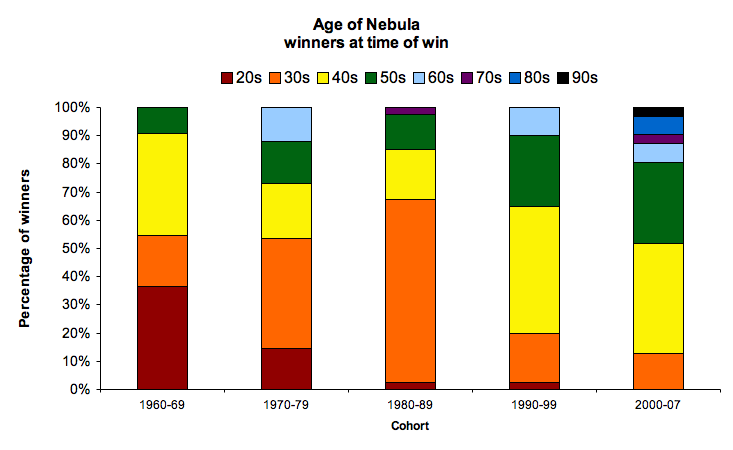
I don’t know of any available demographic data about the age of SFWA members or Hugo voters, but we do have the list of Nebula winners, courtesy once again of Nicholas Whyte. Here’s the graph for the Nebulas, done in the same way as for the Hugo graph in the previous post:

Doesn’t look much different, does it? The average age of a Nebula winner has risen from 37 in the 1960s, to 53 in the most recent decade, but the most telling data is the number of winners who were in their twenties and thirties per decade. In the 1980s, there were 27 winners in their twenties and thirties; in the past seven years, there have been four. And three of them were Kelly Link.

This age trend doesn’t hold for the Clarke or Tiptree award, both juried awards, but neither of them have been around for very long compared to the Hugos and Nebulas. Jeff suggests that we look at the Hugo nominees, to see if the nominees are younger and the older, familiar name always wins, and it might be interesting to look at the Locus award to see if the wider voting population makes a difference, but I think I am turning into crazy stats lady already and I will leave those for another day.

There’s more interesting discussion over at James Nicoll’s journal. If you want to do your own number-crunching, you can get the spreadsheet Niall and I used here.

Who Wins Hugos?

Elizabeth Bear:

Anyway, I had an epiphany while reading the ToC of the 2007 Year’s Best Science Fiction. Which basically amounted to– “oh.”

We don’t read them. And they don’t read us.

Well, really. I wonder when the last time was that Bob Silverberg read a story by Benjamin Rosenbaum, David Moles, or Yoon Ha Lee?

See, I’m thinking I’m on to something here. There’s a generation gap in SFF; we’re having different conversations, the Greatest Generation, the Baby Boomers, and Generation X. And as the Millennials (really, guys, this Gen Y thing has to stop: grant the kids their own identity) enter the genre, they too will be having their own argument.

Patrick Nielsen Hayden:

Reporting on this year’s Hugos, Nicholas Whyte observed that Elizabeth Bear is only the second person born in the 1970s to win a Hugo Award for fiction. (Tim Pratt was the first, winning the short-story award last year.) I found this stunning. This means that of the 94 people who have ever won fiction Hugo Awards, only two are under 38 years old. When I was a young SF reader, Hugos were regularly won by people in their twenties and early thirties. It’s one thing to murmur about the aging of SF; it’s another to look at the numbers.

Anna Lawrence (in the comments to PNH’s post):

Are we allowing for birth date: date of Hugo ceremony? Maybe authors born in the 50s are ‘old’ now (I would dispute this), but if they had won awards in the 70s and 80s they would have been Young Turks (and, if in the 60s, child prodigies).

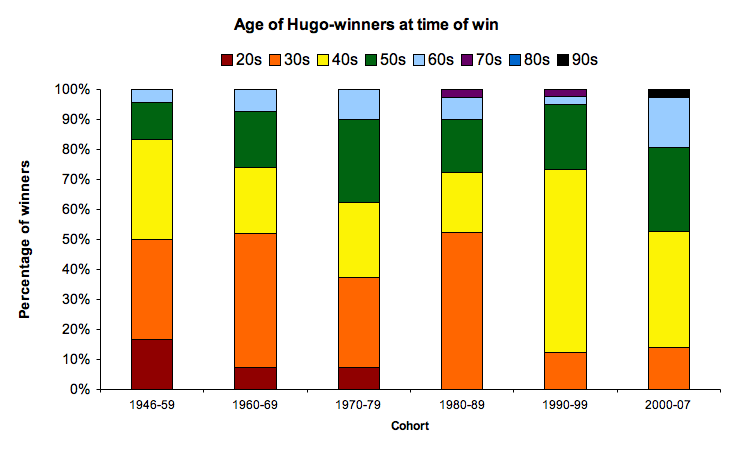
Hence, a graph, based on Nicholas Whyte‘s data, plus this year’s winners.

image119

(For some reason, I couldn’t get Excel to export in colour. Don’t ask me why. UPDATE: New graph, courtesy Liz. Praise Liz!)

  • In the first three cohorts, between 7% and 17% of Hugos for fiction go to people in their twenties; after that, none do.
  • In the first four cohorts, between a third and half of Hugos for fiction go to people in their thirties; once you get to the nineties, that drops to less than 15%.
  • The proportion of Hugos for fiction going to writers in their sixties is twice as high in the present decade as it’s ever been previously.

P.S. New site layout — good? Bad?

Hugo Award Winners

Here they are, then:

NOVEL: The Yiddish Policemen’s Union, Michael Chabon (HarperCollins; Fourth Estate)

I called it! I totally called it. Is this the end of the squandered promise of sf? Well, no; but probably not insignificant, either.

NOVELLA: “All Seated on the Ground”, Connie Willis (Asimov’s Dec 2007; Subterranean Press)

NOVELETTE: “The Merchant and the Alchemist’s Gate”, Ted Chiang (F&SF Sep 2007)

SHORT STORY: “Tideline”, Elizabeth Bear (Asimov’s Jun 2007)

Novella and novelette are as expected, and I’m pleased about the Chiang and less pleased about the Willis. Bear beating Michael Swanwick and Mike Resnick is a bit of a surprise, but not an unwelcome one.

RELATED BOOK: Brave New Words: The Oxford Dictionary of Science Fiction, Jeff Prucher (Oxford University Press)

Well, I thought this was a two-horse race between Barry Malzberg and Shaun Tan. Apparently not! I thought Brave New Words was an admirable project, though, so this is ok with me.

DRAMATIC PRESENTATION: LONG FORM: Stardust (Written by Jane Goldman & Matthew Vaughn, based on the novel by Neil Gaiman. Directed by Matthew Vaughn. Paramount Pictures)

Interesting that it managed to beat out Heroes S1; I look forward to the voting stats on this one.

DRAMATIC PRESENTATION: SHORT FORM: Doctor Who: “Blink” (Written by Stephen Moffat. Directed by Hettie Macdonald. BBC)

Hardly an undeserving winner, although I was rooting for “Human Nature”.

EDITOR, SHORT FORM: Gordon Van Gelder

EDITOR, LONG FORM: David G. Hartwell

I hope Long Form isn’t just going to oscillate between Hartwell and PNH.

PROFESSIONAL ARTIST: Stephan Martiniere

SEMIPROZINE: Locus, Charles N. Brown, Kirsten Gong-Wong & Liza Groen Trombi

FANZINE: File 770, Mike Glyer

FAN WRITER: John Scalzi

I called this, too, and am not unhappy about it. Although hopefully he’s not going to go on to win for the next twenty years straight …

FAN ARTIST: Brad Foster

John W. Campbell Award for Best New Writer (Not a Hugo): Mary Robinette Kowal

Wow. Another surprise — not just that Scott Lynch didn’t win, but that the only short fiction writer on the ballot did — and, again, not an unwelcome one.

So: a decent set of winners for the most part. Cheryl Morgan has a few notes about finishing positions; interesting to see that Scalzi came second in Best Novel (apparently, by nine votes).

Further reactions here, here, here, here, here, here, here, here, here, here, here, here, here.