The Short Story Nominees

I am usually underwhelmed by the Hugo short story nominees. I accept that my tastes are out of step with the pool of Hugo voters, as I am not a big fan of Michael Burstein’s short fiction, and the less said about most of Mike Resnick and Robert J. Sawyer’s previous nominees the better, but the one time I voted in the Hugos I put No Award first as a protest against how uniformly terrible the stories on that year’s ballot were. So it’s pleasing to report that the short stories, while not all great, range from pretty decent to really pretty damn good. Here’s my ranking:

Bottom of my ballot I would put Mike Resnick’s ‘Distant Replay‘. It’s the best Mike Resnick story I have ever read, and that’s why it wouldn’t end up below No Award, but the appeal of his work remains a total mystery to me. Yet another story about science fiction being used in some way to reunite a man with his love, (in this case, a man meets a young man and woman who are exactly like him and his (dead) wife, and hooks them up), it’s less cloyingly sentimental than usual and has a couple of nice ideas, and that’s about it.

‘A Small Room in Koboldtown,’ by Michael Swanwick, is a locked-room mystery noir in a fantasy setting. The internet informs me it’s a universe he’s written in before, and the setting is interesting, but then it uses the fantasy setting to pull a big cheat. I like mysteries, and they work best when they are clever enough that you can’t work out exactly how it was done but all the clues are there. When the resolution of the mystery is a magical solution I couldn’t predict, I feel cheated out of my ending.

Having dispatched with the bottom two, we get to two stalwarts of the UK SF scene who are harder to separate – Ken MacLeod’s ‘Who’s Afraid of Wolf 359?’ and Stephen Baxter’s ‘Last Contact.’ Who’s Afraid of Wolf 359? is space opera from Ken MacLeod, in the same setting as his BSFA-award-winning Lighting Out. Proper hard SF, it has AIs and seedships and lots of future civilizations, I can’t quite put my finger on why I don’t like it as much as I expected. I think it could do with being longer, to flesh out the events around the ending, and give us more of the central character. There’s just nothing which particularly grabs me, so I put it at number three.

Last Contact is a very English disaster story – the big SFnal idea is the end of the world, but the story is about two women preparing for the end in Oxfodshire, planting flowers that will never grow and sitting in the garden drinking tea while they wait for the ground to be ripped apart under them. It’s a cosy catastrophe, with a much lower degree of looting and general chaos and anarchy than what I think would actually happen if you announced the world was going to end in six month’s time, but I found it rather charming. I don’t think Baxter quite pulls it off, but it’s in second place for me.

My pick of the short stories is Elizabeth Bear’s ‘Tideline,’ which is a great example of how a small SF idea can turn into a lovely story. Lovely is the appropriate word, as it’s a heartwarming little tale of a shipwrecked war-machine, alone on a beach mourning her lost compatriots, and the human boy she meets and takes care of. The hints of worldbuilding fit around the well-drawn characters, filling out enough of the background to satisfy but leaving parts of it unknown, and Bear’s prose is probably the best of all the stories, bar maybe the Swanwick. It pulls off beautifully what Last Contact can’t quite do.

So I’d like the Best Short Story Hugo to go to Elizabeth Bear, but I won’t be upset if it goes to MacLeod or Baxter.

Other views:
Abigail Nussbaum mostly agrees with me, but doesn’t like Baxter as much. Nicholas Whyte doesn’t like the MacLeod at all, but agrees with my top pick. Karen Burnham agrees with my top two, but hasn’t read any of the others. John at SF Signal also isn’t fond of the Macleod, and likes the Resnick much more.
Awards

So after being cheered by Ian. R Macleod’s Sidewise Award for the wonderful The Summer Isles, and wryly amused that Ken Macleod picked up a third Prometheus Award with Learning the World, I woke up this morning (absurdly early, considering what time I got home last night) anticipating the main event: the Hugo Award results.

It’s not as satisfyingly rightheaded a slate of winners as we got last year. The short fiction categories are a bit of a mess—the idea that Connie Willis’ “Inside Job” and David Levine’s “Tk’tk’tk” are better than, respectively, Kelly Link’s “Magic for Beginners” and Margo Lanagan’s “Singing My Sister Down” is, without wishing to offend, ludicrous; Peter S. Beagle’s novellette win is defensible, but it wouldn’t have been my pick—but other than that it’s not too bad. Serenity‘s win in Best Dramatic Presentation: Long Form is well-deserved, and Steven Moffatt’s Doctor Who two-parter was the best thing on its ballot. Kate Wilhelm’s Storyteller wasn’t (I was rooting for Gary K. Wolfe’s Soundings), but it is a good book—and perhaps more impressively, it beat a book by The Mighty Langford.

Actually, it seems to have been a year for results that go against the common complaint that Hugo voters are swayed by name recognition, at least in some categories. Sure, Locus and Langford picked up their annual awards, but David Hartwell, editor of everyone from James Tiptree Jnr to David Marusek, finally converted a nomination to a win, and in doing so became the first second non-dead book editor to win a Hugo (somewhat ironically, given that his omission from the winners’ list was one of the reasons behind the motion to split Best Editor into two categories).

More refreshingly still, the Best Novel winner is impossible to snidely dismiss as having gone to the author with the biggest publicity campaign, or the most vocal fanbase, or the most popular blog, as has become somewhat de rigueur when discussing recent winners, or when trying to predict this year’s (I was not immune to this). The award has gone to a book that I haven’t read, but which I have heard almost exclusively good things about from people I trust who have; which is to say that it seems to have gone to a book that (get this) can only have won because a population of informed voters liked it best. Whether or not I end up agreeing that Robert Charles Wilson’s Spin was the most deserving book on the shortlist, it strikes me as, at the very least, a good result for the health of the Hugos as an institution.

EDIT: the nomination and voting stats. Headlines: Neil Gaiman declined a nomination for Anansi Boys; World of Warcraft and Lego Star Wars were the top nominees in the ‘Interactive Video Game’ category that was dropped due to lack of interest; in the final vote, “Magic for Beginners” ran “Inside Job” pretty darn close, but Spin had a comfortable lead from the start and John Scalzi wasn’t far off winning the Campbell Award outright; and Andrew M. Butler’s last year on Vector got six nominations for Best Fanzine, which is nice to see. Further commentary here and here.

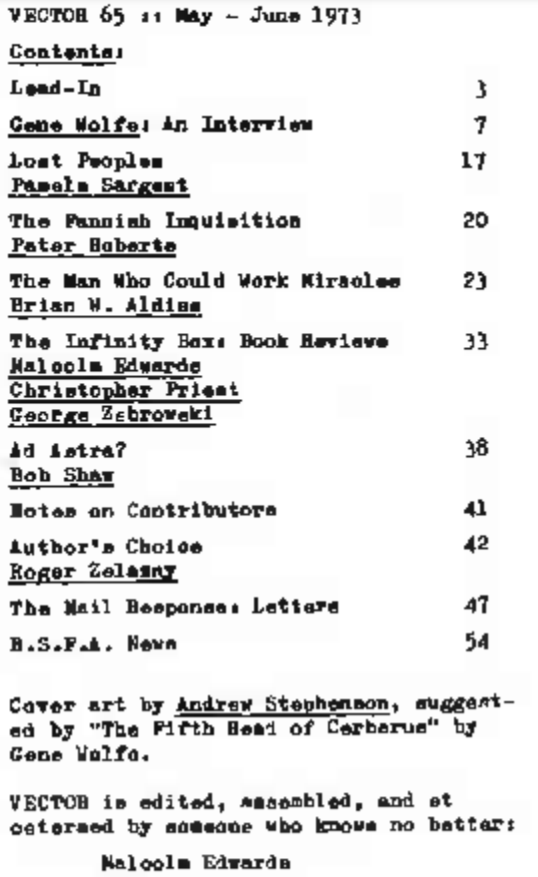
Vector #65

Dear Malcolm,

I really don’t understand James Blish: is his memory failing him, is he fishing for compliments in a very curious way, or has his dislike for me reached such heights that his reasoning powers have suffered? (++ Puzzled readers are referred to Vector 62, p. 34 ++) I could answer him that he underrates me: he has no idea of what expressions of contempt I am capable when he thinks I have treated him with the utmost contempt “up to now”. But such flippancy probably isn’t necessary. Besides, what he says simply isn’t true; for one thing, James Blish hardly is in a position to pass any judgement on all I have written about him, for the simple reason that there undoubtedly is much that he has never seen; and while most of it is unfavourable, not everything is unfavourable. As to the specific case of Solaris, I have quite explicitly commented (in a letter to him) on several points of his F&SF review that I thought especially perceptive; so why should Blish now be “stunned” to find his name included in an enumeration of people who liked Solaris; or indeed, why should he think such a mere listing has any special significance either for him or me? And that makes me the devil who would quote Scriptures?

I must also deny that my favourite word “for the rest of us” is “dishonesty”: my favourite word probably is “hack”. I may have used “dishonesty” one or two times, and if Blish wants to assert that I used it more often than that, or more often than hack, he is invited to count it. It seems to me that Blish may be allergic to this word since he himself likes to apply it to such journals as Time Magazine or Partisan Review; but I certainly once accused him of literary cheating.

What I’d like to know of Mr Blish now is whether he includes the fact that I translated his “Cathedrals in Space” in my German language fanzine, or that we made him a German offer for A Case Of Conscience among the alleged “expressions of utmost contempt”? It’s of course Mr Blish’s privilege as an author to prefer bad translations to good, a paperback deal to a combined hardcover/paperback sale, and the publisher of Lewis B. Patton, Dorothy Eden and Poul Anderson to the publisher of T.S. Eliot, Hermann Hesse and James Joyce; but the fact that we made him an offer is hardly evidence for his claims and I should also think that offering somebody a contract is of somewhat greater significance than a few remarks in the most ephemeral of publications, the sf fanzines.

Franz Rottensteiner

Dear Malcolm, I was glad to see your discussion of the last Hugo awards, disseminating the information Locus gave us. I have felt extremely unhappy about the whole thing, ever since I read that Locus. It is almost impossible to say anything about it, though, and I don’t know who to say it to. I do immensely appreciate the honor — it is a real honor — of being nominated and voted for by all those people, all those strangers who have “met” one only in one’s book — it gives me a pleasure that no nomination or award from a selected jury could give. But this “Australian ballot” (my conviction is that it’s called that because it turns everything upside down) spoils it all. My novel, which clearly placed a poor third, comes in second; Anne McCaffrey’s, which as clearly placed first, comes in third! Well, all that juggling and recounting is supposed, I suppose, to insure justice. But it doesn’t. First place is first place, and when people vote for it that’s what they want — and that is the only place the business end of science fiction, the editors ad publishers, are going to pay any attention to at all. They couldn’t care less who makes second, third, and fourth; all they care about is The Prize. I think the book that received the most votes for The Prize should get the prize. And, if justice or consolation is what the Hugo committee are after, then perhaps they could designate all the second-third-fourth-fifth people, the runners-up, as “Hugo Honor Books” or something, as the Newbery Awards committee has recently taken to doing.

As it is, I haven’t been able to bring myself to vote on the Hugo nomination at all yet this year, because I have this feeling that however I vote they will add it up to come out to just the opposite of what I meant!

Your reply to Chistopher Evans’ letter in No.62 is absolutely right — for England! — but alas, not for America. There are a few excellent reviews (Horn Book for instance) and reviewers, but in egneral writing for children puts one in a ghetto just as writing sf does: and people say to me with hearty camaraderie, “I know you write for children, do you write real books too?” In fact, to put it rather crudely but I think accurately, literature for children here is considered woman’s work — in every sense of the word.

Ursula Le Guin