The Resistance

By Nick Hubble 

It might seem rather strange to start writing a column for Vector focusing on sf as a fiction of practical resistance to capitalist realism and oppression in a special issue on sf and modernism. After all, isn’t modernism the literature of the metropolitan elites? Influential books such as John Carey’s The Intellectuals and the Masses (1992) and Jonathan Rose’s The Intellectual Life of the British Working Classes (2001) certainly make this case. The latter argues that writers from the educated classes sought to maintain their elite status in the face of challenges from the masses by creating modernism, ‘a body of literature and art deliberately made too difficult for a general audience’ (393). His illustrative list of such elitists includes T.S. Eliot and Ezra Pound, but also less obviously conservative writers, such as H.G. Wells and Virginia Woolf.

While Wells was educated, he was hardly from the educated classes, being the son of a shopkeeper and domestic servant. His brilliant novel Tono-Bungay, charting the rise and fall of a quack medicine, was serialised from 1908 in Ford Madox Ford’s English Review, one of the foundational modernist magazines. The lively style of first-person narrative Wells adopted for the novel was highly influential on the work of modernist writers, including Ford’s own The Good Soldier (1915). Yet far from being deliberately difficult in order to deter general readers, Wells was a popular writer who expressed the dreams of millions who aspired to escape from the class-bound hierarchies of the age  As George Orwell pointed out, reading Wells’s sf during the early years of the twentieth century at a time of lingering Victorian values and moral hypocrisy was a liberating experience because he ‘knew that the future was not going to be what respectable people imagined’ (171). 

One feature that modernism and sf share is a resistance to the capitalist conception of time: the relentless metronomic recording by the factory or office clock of the seconds, minutes and hours of empty time to be filled by work. Instead, both genres enable the depiction of time as elastic: moments that stretch to encompass the entirety of eternity and epochs that pass in the blinking of an eye. The archetypal example of this latter phenomenon is Well’s The Time Machine (1895), in which his protagonist fast-forwards from Victorian London into a distant class-flipped future in which the Morlocks, evolved offspring of the workers, hunt and eat the descendants of their former masters, the Eloi. While the satire is savage, the experience of time travel itself is recorded in aesthetic terms through the hero’s description of watching ‘the moon spinning swiftly through her quarters from new to full’ before blurring into a ‘fluctuating band’ faintly visible against a ‘wonderful deepness of blue’ (17). 

Continue reading “The Resistance”

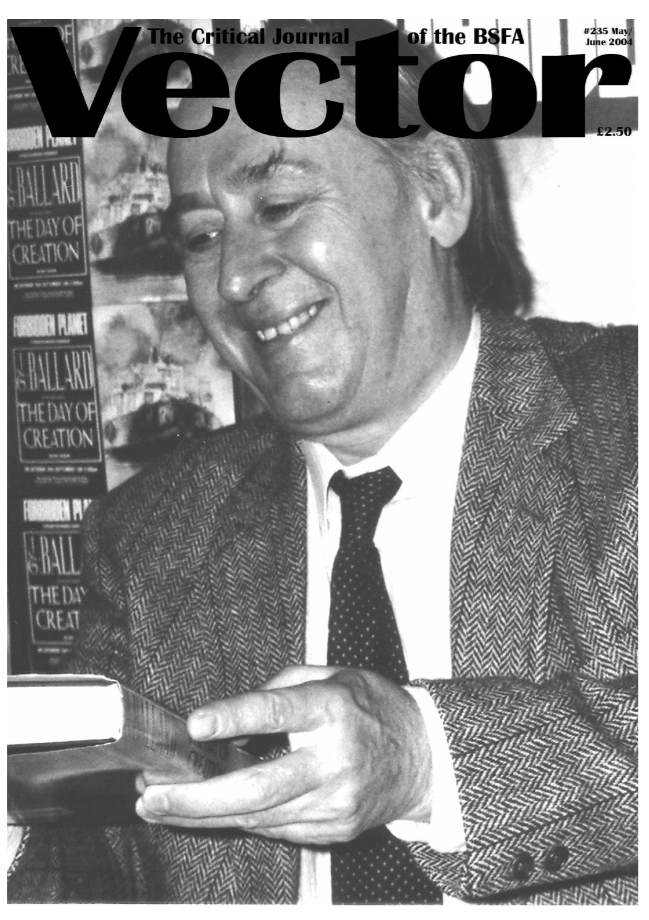
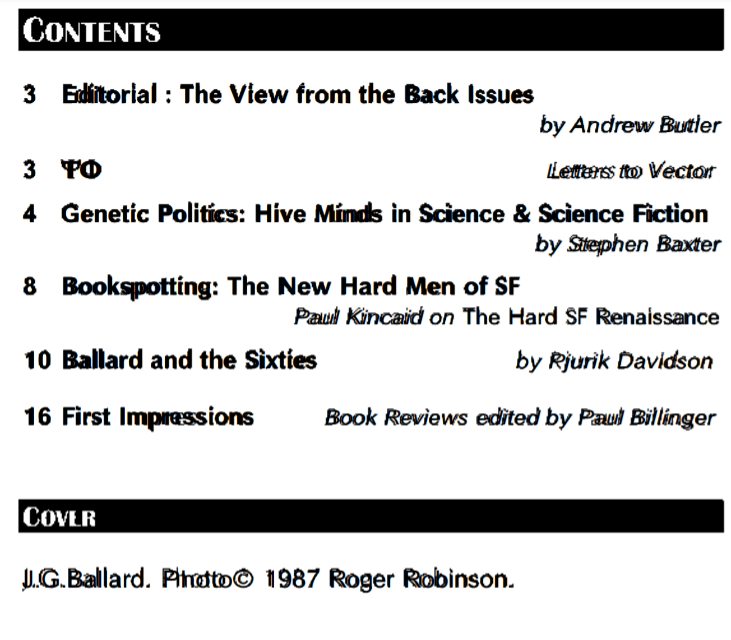
Vector #235

Over the past two years or so I’ve been building up piles of back issues of magazines and journals I use. I’d had a sizeable run of Foundations for a while, and filled in all but about four gaps, even the Philip K. Dick issue which sold out centuries ago; but my five years’ worth of Science Fiction Studies expanded to cover virtually the entire run (again four issues or so missing) and I’ve even found most of the Extrapolations since the mid-1970s, leaving the first third to get. As far as I can tell, that’s going to involve waving my flexible friend at some American bookdealers. (Note to Word fans – my spellchecker tells me that should be booksellers. Ho hum.)

Vector was more hit and miss. I had a patchy run of the various times I joined and fell off the mailing list, a pile I acquired off the back of a lorry, and a much larger pile I’d been given by the former administrator, Maureen Kincaid Speller, when I took the job on. But that only really took me back to issue 123 and (this is sad – I have a table telling me these things) the end of 1984. OK, so getting on for twenty years’ worth, with some gaps, but still less than half the run – plus there were issues of Focus, Paperback Inferno, Matrix and the other, mysterious, transient BSFA magazines such as Tangent, Parabola and Hypotenuse. OK, I made some of those up.

But I’ve recently acquired two large boxes that filled many of the gaps in the collection, and pushed me at least into the mid1960s for Vector, also filling most of the runs of the other magazines. This was fortuitous, as a number of recent articles I’ve been writing have required me to read some of the early material. To every magazine there is a time and place.

We’ve come a long way from typed stencils and duplicating machines to word processing, desktop publication and burning PDFs onto CD-Roms. There are indeed letters complaining about the placing of staples, and apologies for tardiness, and authors getting upset about reviews, and people saying the rot would set in if we stopped collating the magazines manually. Oh, and editors getting upset about only having six pages of letters of comment. One thing struck me as I’d been in a reflective mood and taking stock of my life, counting how many issues I’ve edited, how many I’ve got left: the recurring commentary on the role of the editor of Vector. It is made clear by contributors, chairs and editors alike, that the job is one held in trust. The magazine is not the mouthpiece of the editor, but the mouthpiece of the BSFA.

Any decisions and tone should reflect the feelings and opinions of the BSFA. I’m not sure how far this is the case today – I don’t think there is the same sense of ownership and stakeholding. It is clear that personalities have been reflected in the magazines, and priorities have altered over the years. I’ve largely been allowed to get away with what I’ve wanted to do, as long as I’ve kept to schedule and not gone on too long. Certainly when Cary S. Dalkin and I took over as feature editors in 1995, we were given instructions about the party line and told not to frighten the horses. Perhaps the horses are beyond frightening now. Perhaps the editorial structure — Tony Cullen as layout/production/general editor, Cary and I and then just me as features editor(s) and the various reviews editors — has meant that a single voice has not dominated, that we balance each other. There is no editor of Vector as such.

Perhaps we’re just too close to it — and in 2024 the editor of the holographic interactive Vector will laugh about how that old guy, Whatisname, used to go on about stuff and the old days; this is sf, ferchrysakes, it’s meant to be about the future. And as she searches for some inspiration for the topic of her next editorial, there is a bleep from her mobile phone to indicate a txt msg has been received (she knows it’s archaic, but there are still some members who prefer to receive Vector that way. OK, so they lose a bit in boiling it all down to 256 character chunks, but the highlights can be digested). Apparently the virtual staples are in the wrong place.

Andrew Butler

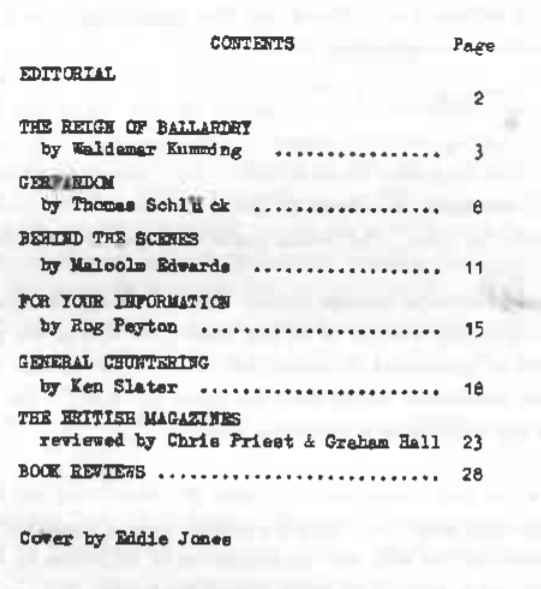
Vector #40

For an allegedly SF work by an allegedly leading writer of the genre this is a somewhat disappointing score. He certainly seems to be leading in a new direction: but it is a direction that speedily leaves the SF field enntirely for plotless and gloomy wasteland. In all of Ballard’s stories something terrible either has already happened or is happening (sometimes with no more rhyme and reason than in the ‘happenings’ that are the opop art answer to the theatre) – or things are going from bad to worse and heading for a frightful crash. The passing of the ‘sense of wonder’ has been much lamented by nostalgic readers, though it has been suggested that this is simply associated with encountering the ideas of SF for the first time, and that it still operates for many new readers. Ballard gives the impression of trying to replace it by a sense of impending doom.

Waldemar Kumming