- Torque Control (Vector 274) • [Torque Control] • essay by Shana Worthen
- Letter (Vector 274) • essay by Ian Massey
- Letter (Vector 274) • essay by Terry Jackman
- Letter (Vector 274) • essay by Tom Hunter
- Doctor By Doctor: Dr. Philip Boyce and Dr. Mark Piper in Star Trek … • essay by Victor Grech
- So Long, and Thanks for All the Visch: Douglas Adams and Doctor Snuggles • essay by Jacob Edwards
- Fishing for Time: Alternate Worlds in Nina Allan’s The Silver Wind and David Vann’s Legend of a Suicide • essay by David Hebblethwaite
- Bibliography: Law in Science Fiction • essay by Stephen Krueger
- Stark Adventuring: Leigh Brackett’s Tales of Eric John Stark • essay by Mike Barrett
- Joanne Hall Interviews Andy Bigwood • interview of Andy Bigwood • interview by Joanne Hall
- On the Colonisation of Nearby Stars • [Resonances] • essay by Stephen Baxter
- Sign of the Labrys by Margaret St. Clair • [Foundation Favourites] • essay by Andy Sawyer
- Songs of War • [Kincaid in Short] • essay by Paul Kincaid
- 2014 – A Year for Award-Winning Women? • [The BSFA Review] • essay by Martin Lewis
- Review: Ancillary Justice by Ann Leckie • review by Gwyneth Jones
- Review: Throne of the Crescent Moon by Saladin Ahmed • review by Nic Clarke
- Review: Alif the Unseen by G. Willow Wilson • review by Nic Clarke
- Review: The Adjacent by Christopher Priest • review by Paul Kincaid
- Review: The Green Man by Kingsley Amis • review by Andy Sawyer
- Review: The Alteration by Kingsley Amis • review by Andy Sawyer
- Review: Benchmarks Continued: The F&SF “Books” Columns, Volume 1, 1975-1982 by Algis Budrys • review by Dan Hartland
- Review: Astounding Wonder: Imagining Science and Science Fiction in Interwar America by John Cheng • review by Paul Kincaid
- Review: Science Fiction by Mark Bould • review by Jonathan McCalmont
- Review: Vurt by Jeff Noon • review by Shaun Green
- Review: Pollen by Jeff Noon • review by Shaun Green
- Review: Mindjammer by Sarah Newton • review by Kate Onyett
- Review: Down to the Bone by Justina Robson • review by Patrick Mahon
- Review: Starship Seasons by Eric Brown • review by Ian Sales
- Review: The Devil’s Nebula by Eric Brown • review by Tony Jones
- Review: Helix Wars by Eric Brown • review by Tony Jones
- Review: The Mammoth Book of Time Travel SF by Mike Ashley • review by L. J. Hurst
- Review: The Shining Girls by Lauren Beukes • review by L. J. Hurst
- Review: Harvest of Time by Alastair Reynolds • review by Glyn Morgan
- Review: 11.22.63 by Stephen King • review by David Hebblethwaite
- Review: The Fictional Man by Al Ewing • review by Gary S. Dalkin [as by Gary Dalkin]
- Review: Seven Wonders by Adam Christopher • review by Jim Steel
- Review: Across the Event Horizon by Mercurio D. Rivera • review by Karen Burnham
- Review: After the End: Recent Apocalypses by Paula Guran • review by Stuart Carter
- Review: Nebula Awards Showcase 2013 by Catherine Asaro • review by Cherith Baldry
- Review: Fearsome Journeys by Jonathan Strahan • review by Anthony Nanson
- Review: Magic: An Anthology of the Esoteric and Arcane by Jonathan Oliver • review by Sandra Unerman
- Review: Tales of Majipoor by Robert Silverberg • review by L. J. Hurst
- Review: Savage City by Sophia McDougall • review by Maureen Kincaid Speller
- Review: Sharps by K. J. Parker • review by Liz Bourke
- Review: Fade to Black by Francis Knight • review by Lynne Bispham
- Review: The Heretic Land by Tim Lebbon • review by Gary S. Dalkin [as by Gary Dalkin]
- Review: The Girl Who Fell Beneath Fairyland and Led the Revels There by Catherynne M. Valente • review by Sue Thomason
- Review: The Devil’s Apprentice by Jan Siegel • review by Anne F. Wilson
- Review: Rebellion by Lou Morgan • review by Kate Onyett
- Review: Angelfall by Susan Ee • review by Tony Jones
Tag: Maureen Kincaid Speller
Vector #272
Vector #271
Vector #270


Vector 267
Go away for a week, and all sorts of things happen! Vector 267 arrived while I was traveling. Most people seem to have received their copies on Saturday, although a fair minority of those were partially soaked from the ongoing rains.
This quarter’s mailing includes, in addition to Vector, a booklet of Maureen Kincaid Speller’s writings, edited by Jonathan McCalmont and laid out by Martin McGrath.
This issue contains a broad assortment of intriguing and (I hope) thought-provoking content, including a few pieces, including Sam Mardon’s elegant cover, in honour of the twenty-fifth anniversary of the Arthur C Clarke Award.
 Table of Contents
Matrix: A Magazine out of Time, Ian Whates
Introducing The BSFA Review, Martin Lewis
Sci-Fi London in 2011 in REview, Alys Sterling
Against Utopia: Arthur C Clarke and the Heterotopian Impulse
Homer’s Odyssey: The World’s First Fantasy Novel?, Juliet E McKenna
An Interview with Samuel R Delany, Roz Kaveney
Avatar: The New Fantastic Horizons of Oneiric Justice, Roberto Quaglia, trans. Teo Popescu
Kincaid in Short, Paul Kincaid
Now and Then, Terry Martin
Resonances, Stephen Baxter
Foundation Favourites, Andy Sawyer
The BSFA Review, edited by Martin Lewis
Reviews
The Routledge Companion to Science Fiction, edited by Mark Bould, Andrew M. Butler, Adam Roberts and Sheryl Vint (Routledge, 2009) – Reviewed by Glyn Morgan
The Mervyn Stone Mysteries: Geek Tragedy, DVD Extras Include: Murder and Cursed Among Sequels by Nev Fountain (Big Finish, 2010) – Reviewed by Gary Dalkin
Sci-Fi London Film Festival: Dinoshark (2010), Sharktopus (2010), One Hundred Mornings (2009), Zenith (2010), Gantz (2011) and Super (2010) – Reviewed by Martin McGrath
Ignition City, written by Warren Ellis and illustrated by Gianluca Pagliarani (Avatar, 2010) – Reviewed by James Bacon
Twin Spica: Volume 1 by Kou Yaginuma (Vertical, 2010) – Reviewed by Nick Honeywell
Mardock Scramble by Tow Ubukata, translated by Edwin Hawkes (Haikasoru, 2011) – Reviewed by Alan Fraser
Gantz (2011) – Reviewed by Lalith Vipulananthan
Under Heaven by Guy Gavriel Kay (Harper Voyager, 2010) – Reviewed by Dan Hartland
The Windup Girl by Paolo Bacigalupi (Orbit, 2010) – Reviewed by Andy Sawyer
On Stranger Tides by Tim Powers (Corvus, 2011) – Reviewed by Paul Kincaid
The Broken Kingdoms by NK Jemisin (Orbit, 2010) – Reviewed by Sandra Unerman
The Dragon’s Path by Daniel Abraham (Orbit, 2011) – Reviewed by Sue Thomason
The Heroes by Joe Abercrombie (Gollancz, 2011) – Reviewed by Maureen Kincaid Speller
The Scarab Path by Adrian Tchaikovsky (Tor, 2010) – Reviewed by Nic Clarke
The Wolf Age by James Enge (Pyr, 2010) – Reviewed by A.P. Canavan
Blood and Iron by Tony Ballantyne (Tor, 2010) – Reviewed by David Towsey
The Evolutionary Void by Peter F Hamilton (Pan MacMillan, 2010) – Reviewed by Martin Potts
Point by Thomas Blackthorne (Angry Robot, 2011) – Reviewed by Alan Fraser
Embedded by Dan Abnett (Angry Robot, 2011) – Reviewed by Stuart Carter
Vector welcomes letters of comment, or feedback on the forum.
June BSFA London Meeting: Gillian Polack Interview – 30th June 2011 – Free entry
On Thursday 30th June 2011 from around 7pm:
GILLIAN POLACK (Australian writer of speculative fiction, editor and historian) will be interviewed by Maureen Kincaid Speller (Critic and reviewer).
Note that this meeting is on the fifth Thursday of the month. There is no BSFA London Meeting on Wednesday 22nd June.
Venue:
Upstairs Room
The Antelope Tavern
22, Eaton Terrace
Belgravia
London
SW1W 8EZ
Nearest Tube: Sloane Square (District/Circle)
Map:here.
All welcome! (No entry fee or tickets. Non-members welcome.)
Interview will commence at 7.00 pm, but the room is open from 6.00 (and fans in the downstairs bar from 5).
There will be a raffle (£1 for five tickets), with a selection of sf novels as prizes.
FUTURE EVENTS:
27th July 2011 – SOPHIA MCDOUGALL interviewed by Roz Kaveney
24th August 2011* – KIM LAKIN-SMITH interviewed by Paul Skevington
28th September 2011 – JO FLETCHER: interviewer TBC
* Note that this is a month with five Wednesdays. The meeting will be on the fourth, not the last, Wednesday of the month.
Vector #266

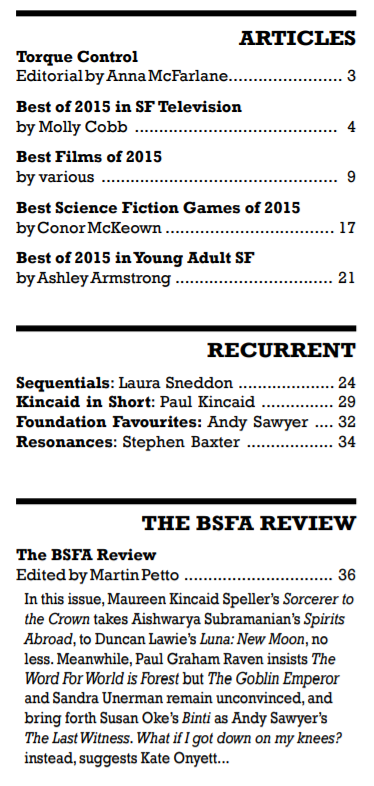
3 • Torque Control • editorial by Shana Worthen
4 • A Year in Review: Looking Back at 2010 • essay by Martin Lewis
5 • 2010: Books in Review • essay by Graham Andrews and Lynne Bispham and Mark Connorton and Gary Dalkin and Alan Fraser and Niall Harrison and David Hebblethwaite and Tony Keen and Paul Kincaid and Jonathan McCalmont and Martin McGrath and Anthony Nanson and Martin Potts and Paul Graham Raven and Ian Sales and Jim Steel and Martyn Taylor and Sandra Unnerman and Anne Wilson
15 • 2010: Television in Review • essay by Alison Page
20 • 2010 in Film: Not My Kind of Genre • essay by Jonathan McCalmont
24 • Strip Club: A Fanciful Flight • essay by Terry Martin
26 • The Promises and Pitfalls of a Christian Agenda in Stephen Lawhead’s Pendragon Cycle • essay by Anthony Nanson
30 • Scholars and Soldiers • [Foundation Favourites • 12] • essay by Andy Sawyer
32 • Alpha Centauri • [Resonances • 61] • essay by Stephen Baxter
34 • Kincaid in Short • [Kincaid in Short] • essay by Paul Kincaid
37 • Review: Finch by Jeff VanderMeer • review by Paul Graham Raven
38 • Review: Lightborn by Tricia Sullivan • review by Jonathan McCalmont
39 • Review: Surface Detail by Iain M. Banks • review by Marcus Flavin
40 • Review: The Technician by Neal Asher • review by Stuart Carter
40 • Review: Version 43 by Philip Palmer • review by David Hebblethwaite
41 • Review: How to Live Safely in a Science Fictional Universe by Charles Yu • review by Martin McGrath
41 • Review: Galileo’s Dream by Kim Stanley Robinson • review by Anthony Nanson
42 • Review: Music for Another World by Mark Harding • review by Dave M. Roberts
42 • Review: The Immersion Book of SF by Carmelo Rafala • review by Maureen Kincaid Speller
43 • Review: Zombie: An Anthology of the Undead by Christopher Golden • review by Colin B. Harvey [as by C. B. Harvey]
43 • Review: The Loving Dead by Amelia Beamer • review by Niall Harrison
44 • Review: Feed by Mira Grant • review by Alex Williams
44 • Review: Tomes of the Dead: Anno Mortis by Rebecca Levene • review by Shaun Green
45 • Review: Songs of the Dying Earth by Gardner Dozois and George R. R. Martin • review by L. J. Hurst
46 • Review: The Black Prism by Brent Weeks • review by Donna Scott
46 • Review: The Fallen Blade by Jon Courtenay Grimwood • review by Anne F. Wilson
47 • Review: Animal Alterity: Science Fiction and the Question of the Animal by Sherryl Vint • review by Gwyneth Jones
[Mary] Gentle’s prose is sharp, her powers of invention brilliant, her characters real, especially the greasy, obese Casaubon with his pet rat. They are not necessarily likeable. Casaubon is a Lord, and not on Our Side (there’s a neat scene where he’s confronted with the woman who does his laundry who has to live on far less than the cost of one single garment), and when Valentine re-appears a couple of novels down the line she does a dreadful and unforgivable thing. But, in the best tradition of the malcontents in the Jacobean drama, boy, are they vivid! This was a new thing.
For a time I used the word scholarpunk for this fusion of erudition and bad-ass attitude. Fortunately no-one noticed.
Andy Sawyer
Nowhere was this tiredness more evident than in the lugubriously self-indulgent Iron Man 2. Jon Favreau’s Iron Man (2008) was something of an unexpected hit; its combination of clever casting and pseudo-political posturing caught the public’s imagination while its lighter tone and aspirational Californian setting served as a useful counterpoint to the doom and gloom of Christopher Nolan’s The Dark Knight (2008). However, the second Robert Downey Jr.’s Tony Stark steps on stage in the sequel, it is obvious that something is terribly wrong. The film’s onanistic triumphalism and bare-faced declaration that social ills are best confronted by private sector moral entrepreneurs feels astonishingly ugly and politically insensitive at a time when private sector entrepreneurs are having their companies propped-up at the expense of the poor and the hungry. The decision to cast Mickey Rourke as a shambling Russian baddy is laughably pretentious in a film that ultimately boils down to a bunch of computer-generated robots punching each other in the face for about an hour.
Jonathan McCalmont
I found a Darwin site where a respondent asked “who else thinks Beatrix Potter may have developed her stories, about animals with increasingly human characteristics, from acquaintance with Darwin’s theory?” The idea that Beatrix Potter had to wait for The Origin Of Species before she thought of writing about reprobate foxes, trusting piglets, thieving magpies and insolent rats may seem ridiculous but this internetgeneration query is revealing. Our animal folklore is no longer refreshed by experience. In my own lifetime, here in the UK, the estrangement that began as soon as agriculture was established, has accelerated almost to vanishing point. We see animals as pets; as entertainment products we consume through the screen (where their fate, nowadays, holds a tragic fascination). We see them, perhaps, as an increasingly problematic food source. We no longer ‘meet their gaze’ as independent neighbours. The neo-Darwinists have even been doing their damnedest to break the link that Charles Darwin forged, when he transformed our deep intuition of continuity with the animal world into ‘scientific fact’.
Gwyneth Jones
And was Karel Čapek really writing about newts?
Gwyneth Jones
On the whole, however, Vint does a good job of disentangling “the animal” from the mix and Animal Alterity is an impressive achievement. A study of this kind isn’t meant to offer solutions and there are none (beyond a rather vague promise that post-humanism will blur the line between human and animal). Instead there’s a mass of evidence identifying sf as a resource: a treasury for Animal Studies academics; a rich means of bringing those moral arguments to life —drawn from an overlooked genre that has (always, already) developed sophisticated ways of thinking about looming problems that have only just occurred to the mainstream.
To the general reader, Animal Alterity offers food for thought and a quirky compendium of offbeat and classic titles. Could a “related book” on this topic become widely popular? I don’t know. In my day, sf fans tended to be petrol-headed meat-munchers, their concern for our stewardship of the ecosphere constrained by a passion for beer, mayhem and go-faster starships. Times have changed. The younger generation may feel very differently: I hope so.
Gwyneth Jones
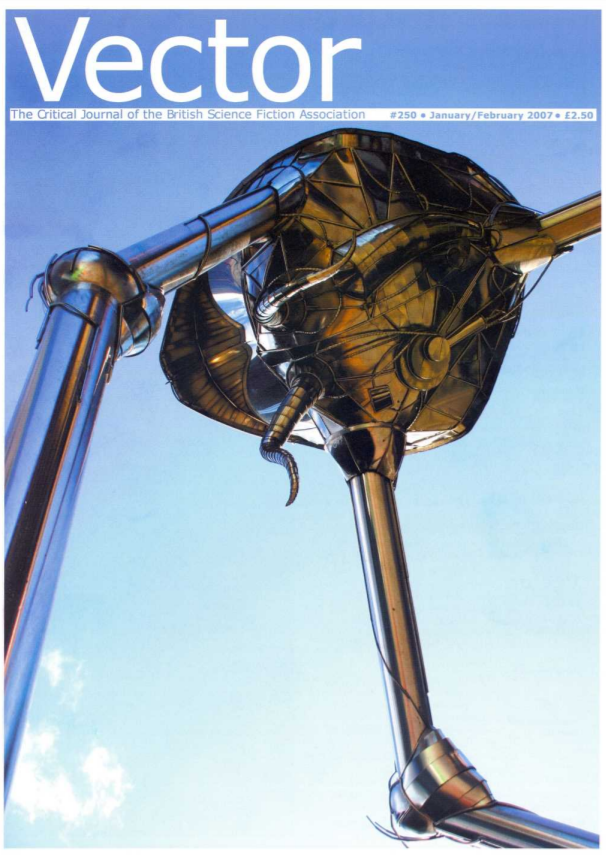
Vector #250
Ken Slater sent me Vectors 41, 42 and 43 when I was asked to do this article and it all came flooding back to me.
I was the Secretary of the BSFA. We had a new Publications Officer, Steve Oakley, and review books and money were sent to him. Heh lived about 20 miles from me, but he had romantic problems (his mother refused to speak to me, as I had introduced the lady in question), and I don’t believe Vector ever came out during his tenure. In fact, he went off to university in the autumn. I had applied for and got a job in charge of a legal department, and was attending evening classes studying law, when Ken rang me about the non-appearance of Vector.
I arranged to go over to Wisbech, and we had a committee meeting. We decided that Ken and I would jointly edit Vector until the AGM at Easter, and Ken gave me a load of stencils (remember them?) which I took home to type. We had no material, so I wrote to Dan Morgan, Ted Tubb, Chris Priest (who was also auditor, and wanted to know whether we had any money), Ken Bulmer and Phil Muldowney.
Then the fun started. Ken typed his own stencil — no spelling errors — and I typed the rest. We got in touch with Phil Rogers (the Chair) and all me at Ken’s on Saturday. Phil turned up late in the afternoon to find Joyce and I stood there, duplicating. Ken had a really old Roneo, and on every fourth page it got stuck and destroyed the paper. We stood on our feet from 10am to 4pm. When the men appeared we had something to eat, and I remember getting very drunk that night and motoring back to Deeping St James with all the papers, envelopes given to me by Ken, and money for postage from Phil.
We were pleased with theh outcome, and carried on for Vector 42 and 43. You ought to read those Vectors get the flavour of them.
In the meantime Ken and I were meeting weekly (with Joyce, of course) and spent hours trying to think how to make the BSFA safer. Phil sometimes joined us, staying late on Saturdays — but never overnight, as he had a regular Sunday appointment. We expected there was a lady involved, but later when I married Phil (in 1972) and asked him, he just smiled and said he never kissed and told.
I was working, as I said, in a legal office. I was in charge of Probate; there was a company solicitor, Danny, in the same office who went all over the world forming companies. It was office policy that all solicitors and clerks had to do a certain amount of conveyancing. Danny hated conveyancing, though, and asked me to do it for him. I agreed, or the condition that he would help me. I explained all about the BSFA, and whether it would be feasible to form a Limited Company with shares. He said now, and explained to me about a Limited Company by Guarantee, which was one of the options that had been suggested by Ken. Whilst looking into this question, of course, we were still producing Vector as before; Trish (aged 9) was proofreading and helping me to assemble the pages, which we then stapled and posted. Ken and I had such good support — although of course not everyone was pleased with our efforts.
In the meantime, I was also studying for my examis, which I took in February (and passed), and approaching authors, publishers, etc. to ask whether, if the company was formed, they would become Directors. I asked everyone from Edmund Crisping to Brian Aldiss.
We decided to enact the change by referendum, and not at the AGM. There was a lot of approval, and a lot of opposition — some of the loudest from Peter Weston, who refused to become a member. I was surprised and hurt, as we had become […] good friends — it wasn’t until I read With Stars in my Eyes that I understood we were at cross-purposes. Peter thought I wanted to break up fandom; I wanted science fiction to be recognised and respected as a genre, but not at the expense of the breakup of fandom. I thought fandom was a vital part of science fiction.
We formed the company before November when the law was changed. (After forming BSFA Ltd., the company solicitor made me form another company for the theatre he’d started in Peterborough.)
I don’t remember who took over Publications. We never saw Steve again. I carried on for a few years, but after a time, with other things on my mind, my membership lapsed, and I haven’t seen Vector for years. I’m sure it isn’t typed on stencils any more.
What energy and what fun we had in those days! Terry Pratchett said recently that there are no old people, just young people looking around and saying “what happened? Where did the time go?” I couldn’t agree more.
Doreen Parker [Rogers]
In 2006, it is perhaps difficult for people who have grown up in a culture where science fiction images and references are splashed all over the place to understand what it was like in the days when sf readers were a comparatively small group, when the racks in general bookshops were not overflowing with trilogies with individual volumes the size of house bricks. Star Wars, Blake’s Seven and various other things were beginning to generate a new wave of popular interest in visual sf, and Dr Who had not entered its long hiatus at that point, but readers were still, on the whole, very isolated from one another, and I wanted the BSFA to put them in touch with one another. I also wanted to break down what I considered to be very narrow definitions of science fiction, the ABC — Asimov, Bradbury, Clarke — approach, with a little H for Heinlein thrown in for good measure. SF was undergoing its most radical transformation since the New Wave of the 1960s, with the arrival on the scene of William Gibson’s Neuromancer in 1984, and I wanted to challenge people to read widely, think about speculative fiction, not just science fiction. In Matrix I listed anything that looked as though it might have some sort of vaguely fantastical component — magical realism was particularly flourishing at that time, I recall, alongside cyberpunk — and did not simply focus on the output of the sf publishers. Paul Kincaid was taking a similar approach material reviewed in Vector. Soon enough, the Clarke Award would begin its eclectic odyssey to explore the boundaries of sf. What I enjoyed then, still enjoy now, is to find a book in an unlikely place, or from an unexpected publisher, and think ‘yes, this isf’, whatever the author and/or publisher might thing. It’s like prospecting.
I don’t know if any of us at that point actually started a revolution; I don’t think we effected any kind of reconciliation between two sf cultures. I’m not even sure there was a revolution that needed starting, or a reconciliation thaht needed to be made. Twenty years is enough time to realise that what goes around, comes around. Something becomes important for a while, then something else arises to take its place. I freely admit I glaze over when the discussion turns to Buffy but I will be there with bells on when the discussion turns to text again. The most important thing any of us has done, still does, is to stoke the fire, keep the discussion going, and make sure there is a place for it to keep going; one way or another the BSFA has been doing that since 1958 (the year before I was born) and keeps on doing so.
Maureen Kincaid Speller
 vector-bsfa.com