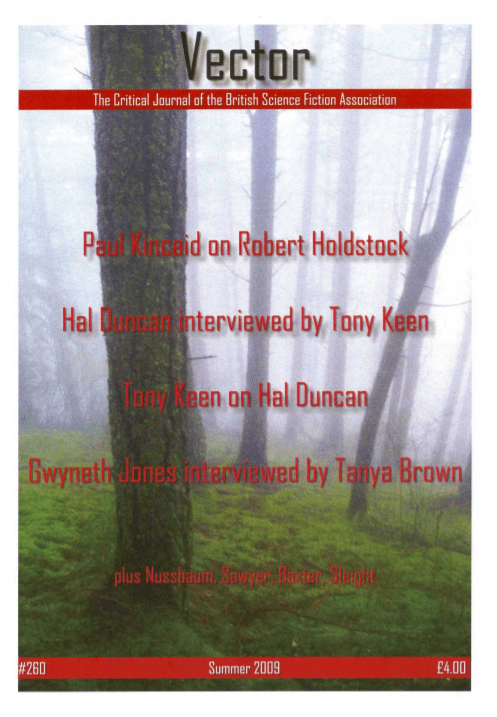
Vector #266

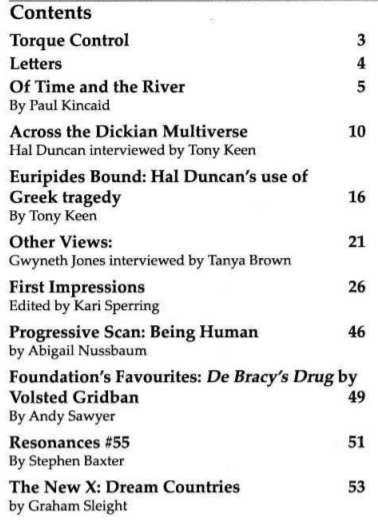
3 • Torque Control • editorial by Shana Worthen
4 • A Year in Review: Looking Back at 2010 • essay by Martin Lewis
5 • 2010: Books in Review • essay by Graham Andrews and Lynne Bispham and Mark Connorton and Gary Dalkin and Alan Fraser and Niall Harrison and David Hebblethwaite and Tony Keen and Paul Kincaid and Jonathan McCalmont and Martin McGrath and Anthony Nanson and Martin Potts and Paul Graham Raven and Ian Sales and Jim Steel and Martyn Taylor and Sandra Unnerman and Anne Wilson
15 • 2010: Television in Review • essay by Alison Page
20 • 2010 in Film: Not My Kind of Genre • essay by Jonathan McCalmont
24 • Strip Club: A Fanciful Flight • essay by Terry Martin
26 • The Promises and Pitfalls of a Christian Agenda in Stephen Lawhead’s Pendragon Cycle • essay by Anthony Nanson
30 • Scholars and Soldiers • [Foundation Favourites • 12] • essay by Andy Sawyer
32 • Alpha Centauri • [Resonances • 61] • essay by Stephen Baxter
34 • Kincaid in Short • [Kincaid in Short] • essay by Paul Kincaid
37 • Review: Finch by Jeff VanderMeer • review by Paul Graham Raven
38 • Review: Lightborn by Tricia Sullivan • review by Jonathan McCalmont
39 • Review: Surface Detail by Iain M. Banks • review by Marcus Flavin
40 • Review: The Technician by Neal Asher • review by Stuart Carter
40 • Review: Version 43 by Philip Palmer • review by David Hebblethwaite
41 • Review: How to Live Safely in a Science Fictional Universe by Charles Yu • review by Martin McGrath
41 • Review: Galileo’s Dream by Kim Stanley Robinson • review by Anthony Nanson
42 • Review: Music for Another World by Mark Harding • review by Dave M. Roberts
42 • Review: The Immersion Book of SF by Carmelo Rafala • review by Maureen Kincaid Speller
43 • Review: Zombie: An Anthology of the Undead by Christopher Golden • review by Colin B. Harvey [as by C. B. Harvey]
43 • Review: The Loving Dead by Amelia Beamer • review by Niall Harrison
44 • Review: Feed by Mira Grant • review by Alex Williams
44 • Review: Tomes of the Dead: Anno Mortis by Rebecca Levene • review by Shaun Green
45 • Review: Songs of the Dying Earth by Gardner Dozois and George R. R. Martin • review by L. J. Hurst
46 • Review: The Black Prism by Brent Weeks • review by Donna Scott
46 • Review: The Fallen Blade by Jon Courtenay Grimwood • review by Anne F. Wilson
47 • Review: Animal Alterity: Science Fiction and the Question of the Animal by Sherryl Vint • review by Gwyneth Jones


[Mary] Gentle’s prose is sharp, her powers of invention brilliant, her characters real, especially the greasy, obese Casaubon with his pet rat. They are not necessarily likeable. Casaubon is a Lord, and not on Our Side (there’s a neat scene where he’s confronted with the woman who does his laundry who has to live on far less than the cost of one single garment), and when Valentine re-appears a couple of novels down the line she does a dreadful and unforgivable thing. But, in the best tradition of the malcontents in the Jacobean drama, boy, are they vivid! This was a new thing.

For a time I used the word scholarpunk for this fusion of erudition and bad-ass attitude. Fortunately no-one noticed.

Andy Sawyer

Nowhere was this tiredness more evident than in the lugubriously self-indulgent Iron Man 2. Jon Favreau’s Iron Man (2008) was something of an unexpected hit; its combination of clever casting and pseudo-political posturing caught the public’s imagination while its lighter tone and aspirational Californian setting served as a useful counterpoint to the doom and gloom of Christopher Nolan’s The Dark Knight (2008). However, the second Robert Downey Jr.’s Tony Stark steps on stage in the sequel, it is obvious that something is terribly wrong. The film’s onanistic triumphalism and bare-faced declaration that social ills are best confronted by private sector moral entrepreneurs feels astonishingly ugly and politically insensitive at a time when private sector entrepreneurs are having their companies propped-up at the expense of the poor and the hungry. The decision to cast Mickey Rourke as a shambling Russian baddy is laughably pretentious in a film that ultimately boils down to a bunch of computer-generated robots punching each other in the face for about an hour.

Jonathan McCalmont

I found a Darwin site where a respondent asked “who else thinks Beatrix Potter may have developed her stories, about animals with increasingly human characteristics, from acquaintance with Darwin’s theory?” The idea that Beatrix Potter had to wait for The Origin Of Species before she thought of writing about reprobate foxes, trusting piglets, thieving magpies and insolent rats may seem ridiculous but this internetgeneration query is revealing. Our animal folklore is no longer refreshed by experience. In my own lifetime, here in the UK, the estrangement that began as soon as agriculture was established, has accelerated almost to vanishing point. We see animals as pets; as entertainment products we consume through the screen (where their fate, nowadays, holds a tragic fascination). We see them, perhaps, as an increasingly problematic food source. We no longer ‘meet their gaze’ as independent neighbours. The neo-Darwinists have even been doing their damnedest to break the link that Charles Darwin forged, when he transformed our deep intuition of continuity with the animal world into ‘scientific fact’.

Gwyneth Jones

And was Karel Čapek really writing about newts?

Gwyneth Jones

On the whole, however, Vint does a good job of disentangling “the animal” from the mix and Animal Alterity is an impressive achievement. A study of this kind isn’t meant to offer solutions and there are none (beyond a rather vague promise that post-humanism will blur the line between human and animal). Instead there’s a mass of evidence identifying sf as a resource: a treasury for Animal Studies academics; a rich means of bringing those moral arguments to life —drawn from an overlooked genre that has (always, already) developed sophisticated ways of thinking about looming problems that have only just occurred to the mainstream.

To the general reader, Animal Alterity offers food for thought and a quirky compendium of offbeat and classic titles. Could a “related book” on this topic become widely popular? I don’t know. In my day, sf fans tended to be petrol-headed meat-munchers, their concern for our stewardship of the ecosphere constrained by a passion for beer, mayhem and go-faster starships. Times have changed. The younger generation may feel very differently: I hope so.

Gwyneth Jones

Vector 265

Saturday morning’s post brought with it Vector 265, at long last. Not just Vector: the mailing includes a booklet in memory of Rob Holstock, edited by Niall Harrison; the BSFA Awards booklet, with all of the shortlisted short stories; and a ballot for voting on the BSFA awards.

Vector 265 is the last one edited by Niall, and it’s a hefty one, a rich tribute to Stephen Baxter, plus book reviews, edited by Martin Lewis. For those of you not currently BSFA members, here is what you’re missing out on:

Table of Contents
“That Cosmological Feeling: An Interview with Stephen Baxter”
“Stephen Baxter’s Xeelee Cycle: No Coming Home”, Jonathan McCalmont
“The Settee and the Stars: Stephen Baxter and the Dilemma of Scale”, Gary K Wolfe
“An Atomic Theory of Baxter’s Fiction”, Adam Roberts
“Three Colours NASA: Reflections on Stephen Baxter’s ‘NASA’ trilogy”, Simon Bradshaw
“Putting the Past into the Future: The Time’s Tapestry sequence”, Tony Keen
“Foundation’s Favourite: Stone Spring”, Andy Sawyer
“Baxter’s People”, Niall Harrison
“Giant Killer Rodents in Space Armour, With Guns: the other side of Stephen Baxter”, Graham Sleight

“First Impressions”, Martin Lewis
Book reviews edited by Martin Lewis
Orgasmachine by Ian Watson (Newcon Press, 2010) – reviewed by
Justin Robson
Shine, edited by Jetse de Vries (Solaris, 2010) – reviewed by
Anthony Nanson
The Quantum Thief by Hannu Rajaniemi (Gollancz, 2010) –
reviewed by Paul Kincaid
The Dervish House by Ian McDonald (Gollancz, 2010) – reviewed
by Tony Keen

The Restoration Game by Ken MacLeod (Orbit, 2010) – reviewed by
Michael Abbott
The Fuller Memorandum by Charles Stross (Orbit, 2010) –
reviewed by Martin Potts
Escape From Hell by Larry Niven and Jerry Pournelle (Tor, 2009)
– reviewed by Dave M Roberts
The Turing Test by Chris Beckett and The Last Reef by
Gareth L Powell (Elastic Press, 2008) – reviewed by Dave M Roberts
The Holy Machine (Corvus, 2010) and Marcher (Cosmos
Books, 2008) by Chris Beckett – reviewed by Jim Steel
Inside/Outside – Chris Beckett interviewed by Paul Graham Raven
Major Carnage by Gord Zajac (ChiZine Publications, 2010) –
reviewed by Shaun Green
Nexus: Ascension by Robert Boyczuk (ChiZine Pubications, 2010)
– reviewed by Graham Andrews
The Nemesis List by RJ Frith – reviewed by Ben Jeapes
The Noise Within by Ian Whates (Solaris, 2010) – reviewed by
Stuart Carter
Brave Story and The Book Of Heroes by Miyuke Miyabe
(Haikasoru, 2007 and 2009) – reviewed by Cherith Baldry
WE by John Dickinson (David Fickling Books, 2010) – reviewed by
Donna Scott
I Am Number Four by Pittacus Lore (Penguin, 2010) – reviewed by CB Harvey
Monsters Of Men by Patrick Ness (Walker Books, 2010) – reviewed
by Anne F Wilson
The Iron Hunt, Darkness Calls and A Wild Light by
Marjorie M Liu (Orbit, 2008-10) – reviewed by Amanda Rutter
The Poison Throne by Celine Kiernan (Orbit, 2009) – reviewed by
Alan Fraser
Shadow Prowler by Alexey Pehov (Simon & Schuster, 2010) –
reviewed by Sandra Unerman
The Office Of Shadow by Mathew Sturges (Pyr, 2010) – reviewed
by AP Canavan
Lord Of The Changing Winds by Rachel Neumeier (Orbit, 2010) –
reviewed by Lynne Bispham

BSFA Awards Shortlist 2011

Anyone who joined the BSFA recently may end up with the wrong impression as to how frequently mailings occur, inasmuch as we expect the next one to be sent out within the next month-or-so. It’s all still quarterly, however.

Vector welcomes letters of comment, or feedback on the forum.

2010 BSFA Awards Shortlists

The BSFA is pleased to announce the shortlisted nominees for the 2010 BSFA Awards.

The nominees are:

Best Novel

2010 BSFA Awards Best Novel Nominees

Paolo Bacigalupi – The Windup Girl (Orbit)
Lauren Beukes – Zoo City (Angry Robot)
Ken Macleod – The Restoration Game (Orbit)
Ian McDonald – The Dervish House (Gollancz)
Tricia Sullivan – Lightborn (Orbit)

Best Short Fiction

Nina Allan – ‘Flying in the Face of God’ – Interzone 227, TTA Press.
Aliette de Bodard – ‘The Shipmaker’– Interzone 231, TTA Press.
Peter Watts – ‘The Things’ – Clarkesworld 40
Neil Williamson – ‘Arrhythmia’ – Music for Another World, Mutation Press

Best Non-Fiction

Paul Kincaid – Blogging the Hugos: Decline, Big Other
Abigail Nussbaum – Review, With Both Feet in the Clouds, Asking the Wrong Questions Blogspot
Adam Roberts – Review, Wheel of Time, Punkadiddle
Francis Spufford – Red Plenty (Faber and Faber)
Jonathan Strahan and Gary K. Wolfe – the Notes from Coode Street Podcast

Best Art

Andy Bigwood – cover for Conflicts (Newcon Press)
Charlie Harbour – cover for Fun With Rainbows by Gareth Owens (Immersion Press)
Dominic Harman – cover for The Cat’s Cradle by Kurt Vonnegut (Gollancz)
Joey Hi-Fi – cover for Zoo City, by Lauren Beukes (Angry Robot)
Ben Greene – ‘A Deafened Plea for Peace’, cover for Crossed Genres 21
Adam Tredowski – cover for Finch, by Jeff Vandermeer (Corvus)

The BSFA Awards Administrator will shortly make a voting form available for members of the BSFA and this year’s Eastercon, who will be able to send advance votes based on the above shortlists. Advance votes must be received by Monday 18th April. After this date, ballot boxes will be made available at Illustrious – the Eastercon Convention taking place at the Hilton Metropole in Birmingham. The ballots will close at Midday on Saturday April 23rd and the winners will be announced at a ceremony hosted that evening at the convention.

Congratulations to all of the nominees!

P.S. Voting details are here.

London Meeting: Andrew McKie

The guest at tonight’s London meeting is reviewer Andrew McKie, who will be interviewed by Paul Kincaid.

As usual, the interview will start at 7pm, though there will be people in the bar from 6-ish; the meeting is free, and open to any and all, though there will be a raffle (with sf books as prizes).

The venue is the upstairs room of The Antelope, 22 Eaton Terrace, London, SW1W 8EZ. The closest tube station is Sloane Square, and a map is here.

British Science Fiction and Fantasy: A Panel

As noted in the original post about the survey, one of the panel’s at last week’s BSFA/SFF AGM event was a discussion of some of the questions it raises. For those who weren’t able to attend (and indeed those who were), here’s a recording — you can download the mp3 direct from here, or listen to it on the BSFA site. The panelists were Nick Harkaway, Paul Kincaid, Paul McAuley, Juliet McKenna, and Kit Whitfield, with me moderating.

Links Shake the World

I’m in Glasgow for most of this week, for work-related reasons, so posting is likely to be light; but I can at least catch up on my linking.

EDIT: I knew I’d forget something. Can anyone work out, based on these reviews, whether 2666 is a work of the fantastic?

Third Annual Science Fiction Foundation Masterclass

Location: University of Liverpool
Dates: June 10th, 11th and 12th, 2009

Class Leaders: Joan Gordon, Adam Roberts, Paul Kincaid.

The Science Fiction Masterclass is held in conjunction with the University of Liverpool. The aim of the Masterclass is to provide those who have a serious interest in sf criticism with the opportunity to exchange ideas with leading figures in the field, and also to use the SFF Collection.

The Masterclass will take place from June 10-12th at the University of Liverpool. Each full day of the Masterclass will consist of morning and evening classes, with afternoons free to prepare. Class leaders for 2009 will be Joan Gordon, Adam Roberts, and Paul Kincaid.

Applicants should write to Liz Batty at sff.masterclass@googlemail.com

Applicants must provide a short CV of either: academic credentials, essay/book publications, reviews and writing sample (this may be from a blog); all of these will be valued equally as we are looking for a mixture of experiences and approaches. A range of hotel recommendations will be forwarded to those accepted.

Applications will be assessed by an Applications Committee consisting of Peter Wright, Joan Haran, and Farah Mendlesohn.

Completed applications must be received by 31st January 2009.


Feel free to forward this advert to anyone you think might like the masterclass. Niall’s summary of last year’s event is here.

Category Schmategory

I’ve been waiting for something like this to happen for a while. Paul Kincaid reviewed The Wild Girls by Pat Murphy:

Given the increasingly complex games with authorship that her most recent novels have played, and given how much non-fiction she has written for children, it was perhaps inevitable that Pat Murphy would write a young adult novel about writing. Which is precisely what The Wild Girls is, though if you expect anything of the subtlety or complexity of those novels you are going to be disappointed. This is writing reduced to a simple lesson in life, light, appealing and entertaining but very definitely aimed at a younger audience by removing any doubts, hesitations or darker aspects.

And literaticat responded:

* young adult novel about writing…: It isn’t a YA novel. It is very clearly a middle grade novel. And yes, there’s a difference. Consider how prickly many in the SF/F community get about people who are ignorant and dismissive about SF/F. Well, that’s how children’s book people feel when people are idiots about children’s books. GRR. I don’t understand why you would want to review a mainstream children’s book when that is so clearly NOT your forte, or why you would post it on an SF site… But moving on.

* …very definitely aimed at a younger audience by removing any doubts, hesitations or darker aspects: Imagine, a children’s book aimed at children? Bust my buttons. As for doubts, hesitations or darker aspects: The dissolution of two families. The children’s struggle to cope with the emotional fallout of their parent’s disastrous marriages. Their finding their own voices in challenging times. Not doubty and dark enough? You were expecting the apocolypse, maybe?

I have issues with both these comments. To take the second comment first, I think literaticat has simply misread Paul. I do not think Paul was expressing surprise or disappointment at the fact that The Wild Girls is aimed at children, because I don’t see how you can unyoke that statement from the rest of the sentence. Paul may or may not be right that the book removes “any doubts, hesitations or darker aspects” (I haven’t read it), but it seems clear to me that it’s the concept of doing that as an approach to writing for children that he’s commenting on. And in fact, that’s the thrust of his judgement on the book — that it is “clearly written and very readable”, but that it is limited by its need to provide a lesson.

Having got that off my chest, I’m going to briefly return to my opening comment: I’ve been waiting for something like this to happen for a while. YA isn’t new, and YA sf isn’t new, but the visibility of and emphasis on YA as a category certainly seems to be greater now than it was only a few years ago; and hand in hand with a more clearly defined category come the readers with allegiance to that category, and comes a more clearly defined set of expectations for what is in that category. At the same time, over the last few years there have been a number of fairly high-profile examples of YA writers getting serious props from the main stream of genre criticism (Margo Lanagan, Ysabeau Wilce, Philip Reeve), and a number of well-regarded established sf writers turning their hand to YA (China Mieville, Stephen Baxter, Ellen Klages). All of which means that it’s not a surprise that a new YA novel by a writer who has previously committed sf picks up a review on a website devoted to sf (even though it is not, apparently, sf). At some point, given that despite what I said above most sf readers are not yet habitual YA readers, friction was probably inevitable.

But I’m not completely convinced that the situation is, as literaticat would have it, analagous to a non-sf writer reviewing an sf novel. In some ways, it is. If you’re reviewing something, you should try to be aware of that thing’s context — though I note that the definitions of YA in the US (where literaticat is) and UK (where Paul is and I am) seem to be somewhat different, to the point where I’m not even sure that “middle grade” exists as a separate shelf. (And I note that on her website, Pat Murphy merely describes the book as a children’s novel.) In a very interesting discussion at Gwenda’s place, Colleen Mondor says:

What I find sometimes reading so many MG and YA books is that there are those that seem to appeal regardless of the reader’s age (Cecil Castellucci’s work would fit in here or the KIki Strike book), some that seem to appeal more to adults that kids (I think “King Dork” is an example of this to a certain degree) and then those that adults might think are okay, but kids really go nuts over. But all of them are books for kids and for reviewers not used to wading around in these waters, it can get easy to mislabel or misread something.

This is surely true, and the inherent paradox of all reviews of children’s books, but I doubt Paul is unware of it, and I don’t think it makes sense of this specific case. Literaticat isn’t (or doesn’t seem to be) saying that The Wild Girls is good because it appeals to its target audience, she’s saying that The Wild Girls is good, full stop — that it is not the simplified, reductive story that Paul paints it as. The problem is this: how can advocates of YA (or, in this case, middle grade) fiction claim, as they frequently do and implicitly do here, that YA is an arbitrary label, that YA does everything non-YA does, and that the books that bear the label are as worthwhile on their own merits as books that do not (see, for example, the reactions to Octavian Nothing last year), and yet also object to Paul’s review on the grounds that he isn’t sufficiently familiar with “middle grade” fiction?

It looks like trying to have your cake and eat it, too. If a book isn’t making concessions to its audience, or operating in category-specific ways, then I can’t see why you’d need to be familiar with the market for books aimed at that audience to review it fairly. (There is, of course, also the argument that any reader reaction is a fair reader reaction.) And I’d argue that this is different to the equivalent sf neurosis because “sf” as a marketing category not an arbitrary label; it is a description of content. Sf novels don’t do everything that mimetic novels do, just as mimetic novels don’t do everything that sf novels do, so when a reviewer approaches an sf novel expecting it to reward her in the ways a mimetic novel will (or vice versa), a disjunction can, and often does, result.

UPDATE, 21/10: Paul Kincaid has provided his own response, in the comments below and on his journal.

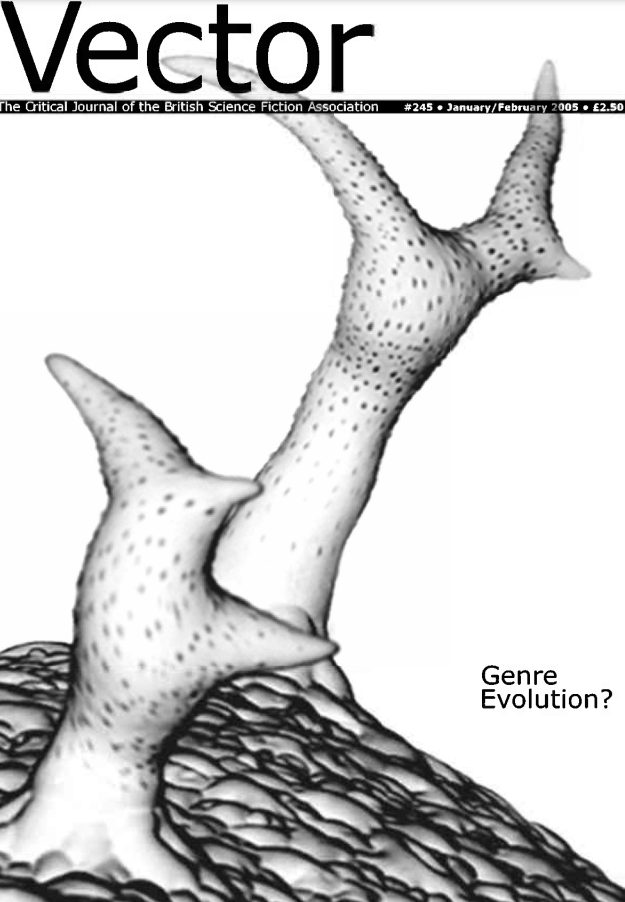
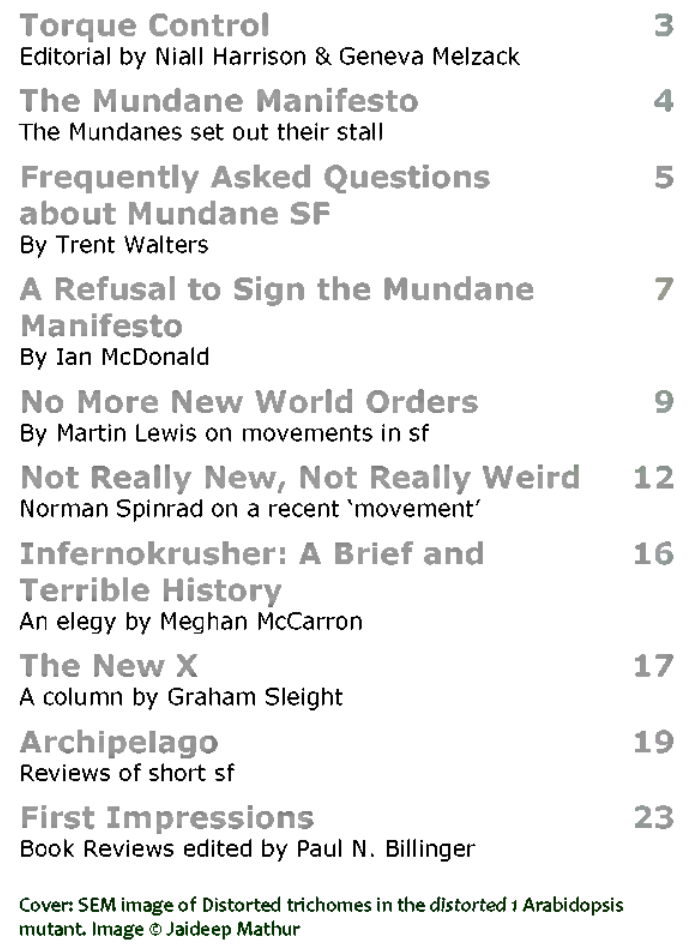
Vector #245

In this way I’m not entirely unsympathetic to the Mundane Manifesto: I just feel that it is incapable of producing ‘better’ science fiction. It will not reinvigorate the genre. Science fiction is an imaginative literature, not a realist one. Much of its strength and power lies in its ability to mythologise – the Manifesto condemns as stupidities many of the genre’s most powerful myths: the alien, time-travel, the artificial intelligence made in our own image.

Ian McDonald

But before you go and read everyone else’s manifestos, we thought we should set out our own. After all, although you may recognise our names from the reviews sections of this magazine and Matrix, we’re still relative newcomers to the BSFA, and we’re only just joining the Vector editorial team with this issue, following in the illustrious footsteps of Andrew M. Butler, under whose guidance Vector was the sort of magazine we discovered we wanted to read – and edit.

Niall Harrison & Geneva Melzack

Moorcock also had a theory about the uses of prose itself, too complex to go too deeply into here or even in his introduction to the anthology. Briefly, rather than being confined to ‘transparent’ narration of the surface phenomenology of the story, the prose line could skip allusively along its surface or swim in the iconographic and archetypal imagery beneath it, rather in the manner of poetry. Which perhaps was why the magazine paid serious attention to serious poetry, too.

Norman Spinrad

I blew up the plums

which were in the icebox

and which you were probably saving

Meghan McCarron

Reading ‘Amnesty’ recalls for me every traumatic and wonderful Butler book I’ve read, and reminds me, again, of how much reading Butler has changed my view of my world and my place in it. What changed me was Butler forcing me to root for characters who didn’t stand up for their rights (because it would have gotten them killed) but rather compromised out of necessity. She forced me to look at myself, at my often silly insistence upon abstract rights in the face of daily, unbearable, soul-destroying compromise. Would I be able to be a slave? Could I do what was necessary to save not only myself but my entire community? What would I do in a situation in which I had no good choices?

Claire Light

Note: Marked 2005 on cover.