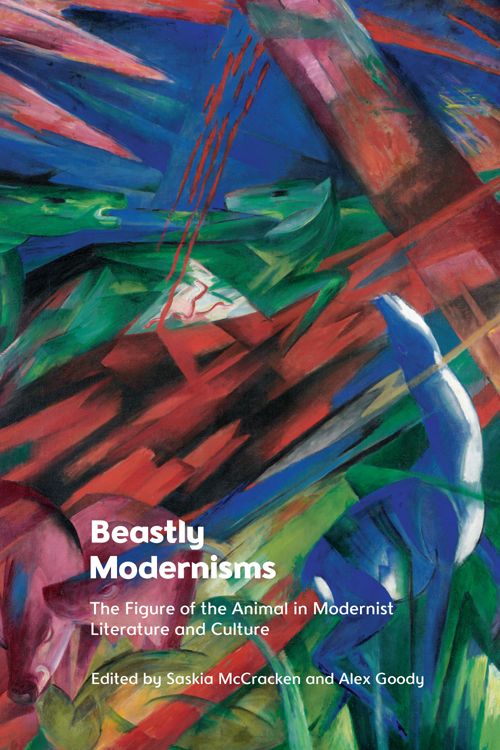
Beastly Modernisms reviewed by Paul March-Russell

Beastly Modernisms: The Figure of the Animal in Modernist Literature and Culture, eds. Saskia McCracken and Alex Goody (Edinburgh University Press, 2023)

Reviewed by Paul March-Russell

At face value, this collection of essays may not seem to be of immediate interest to the sf reader. It is primarily concerned with the development of Animal Studies – a sub-discipline that has already been significantly explored in relation to sf in the work of Sherryl Vint, Joan Gordon, and others – with reference to literary modernism, a diverse movement already noted for its challenge to traditional notions of identity and individual autonomy. The potential, though, for creative overlaps between modernism, sf and Animal Studies is already indicated by the fact that one of the co-editors, Alex Goody, was a keynote speaker at the 2019 Corroding the Now conference at Birkbeck College, London. Seen through a science-fictional lens, the encounter between human and non-human animals, the slippages between them, and their mutual affinities and kinships immediately invoke the First Contacts and uncanny relations between humans and aliens which are the stuff of genre sf. As the introduction’s reference to Jorge Luis Borges and Karen Eckersley’s chapter on Leonora Carrington make clear, imagined bestiaries are common to both Animal Studies and speculative fiction.

Without seeking to be a guide, the introduction nonetheless touches upon many of the key moments in the evolution of Animal Theory: from Peter Singer’s pioneering Animal Liberation (1975) and Donna Haraway’s ‘cyborg manifesto’ (1985) to Gilles Deleuze and Félix Guattari’s concept of ‘becoming animal’ (1982) and Jacques Derrida’s pivotal essay ‘The Animal That Therefore I Am’ (2002). The introduction also registers many of the other posthuman thinkers whose ideas have contributed both to Animal Studies and this volume in particular; from Giorgio Agamben and Rosi Braidotti to Michel Foucault and Cary Wolfe. The editors however, beginning their account with an exchange between Djuna Barnes and James Joyce (two modernists in exile, both of whom would flit between the centres and margins of the modernist canon), emphasise the affinities between Animal Studies, the revaluation of women’s writing and the decolonising of the curriculum. All such practices foreground and deconstruct the historic imposition of borders, the arbitrary gatekeeping that has characterised academic protocols and the maintenance of cultural shibboleths. To that end, the editors also note the collapsing boundary between ‘high’ and ‘low’ cultures, an elision that not only permits the entry of sf into the conversation, but which would also have appealed to such modernists as Barnes (boxing fan and purveyor of crime fiction) and Joyce (publican’s son, cineaste, and Anita Loos devotee).  

Continue reading Beastly Modernisms reviewed by Paul March-Russell”

Rejigging the Algorithm

How Jennifer Walshe is Reinventing the Music of the Past and Reclaiming the Music of the Future

By Paul March-Russell

One of the highlights of the 2022 Proms season was the London premiere of The Site of an Investigation (2018) by the Irish avant-garde composer Jennifer Walshe. This thirty-three minute piece in twenty-six sections offered a synopsis of Walshe’s preoccupations. Walshe herself, sounding like a cross between Laurie Anderson and Diamanda Galas, took the role of soloist, offering an elegiac commentary upon such topics as the race to Mars, the threat to the oceans and the prospect of digital immortality. The orchestra, largely acting as the symphonic backdrop to Walshe’s fragmented monologue, were further inveigled into the proceedings by waving party streamers, building and demolishing a tower of bricks, and wrapping a four-foot high giraffe in crinkly paper. Both the absurdity and incoherence of the piece, culled from an array of internet sources, recalled ‘the blip culture bombardment’ of the mediascape in Don DeLillo’s White Noise (1985).[1]

Jennifer Walshe/Arditti Quartet, EVERYTHING IS IMPORTANT (2019). Credit: IMD 2016/Daniel Pufe

Exactly a hundred years since the first composition of Kurt Schwitters’s sound poem Ursonate (1922-32), a text that Walshe cites as an inspiration,[2] such anti-art performances can still drive audiences either to delight or despair. In Walshe’s case, however, The Site of an Investigation is only an adjunct to her two main projects in recent years. The first, Aisteach, archives an alternate history of an Irish musical avant-garde that never existed, presenting original sound recordings and learned academic discussion. The second, The Text Score Dataset 1.0, involves the compilation of over 3000 text scores with which to retrain machine learning algorithms so that new scores can be generated by AI. This article offers an introduction to these two projects from the perspective of Walshe’s acknowledged debts to science fiction. The final section presents a speculative synthesis since, at the time of writing, Walshe has not linked the two projects together. But what if Aisteach was included as part of the dataset? What kind of future music emerges from an invented set of past sounds? How might we reclaim the future as well as the past? Could we obviate that ‘slow cancellation of the future’ as described by Mark Fisher and others?[3]

Continue reading “Rejigging the Algorithm”

Vector #287

Cover image: Larissa Sansour and Søren Lind from ‘In the Future, They Ate from the Finest Porcelain’

An interview with Larissa Sansour by Polina Levontin and Jo Lindsay Walton, plus a review of Larissa Sansour’s work. TV in 2017 by Molly Cobb and So Mayer.

Film in 2017 by Nick Lowe, Andrew Wallace, Dilman Dila, Cheryl Morgan, Ali Baker, Paul March-Russell, Amy C. Chambers, Lyle Skains, Gary Couzens, and Dev Agarwal. 

Ricardo Suazo reflects on SF inspired trends in fashion, and Martin McGrath takes a close look at three panels from Avengers #8.

Games and AR are covered by Erin Horáková, Susan Gray, and Jon Garrad.

With also have an extensive section on audio and podcasts in 2017 with Peter Morrison, Erin Roberts, Laura Pearlman, Victoria Hooper and Tony Jones.

And of course three Recurrent columns with Paul Kincaid, Andy Sawyer and Stephen Baxter, plus the Torque Control editorial by Jo Lindsay Walton.

This one’s a bumper issue — 80 pages! If you are a member of the BSFA, a copy of Vector 287 was mailed to you in March 2018. If you’re not a BSFA member yet, why not sign up now?

Missed this issue? Don’t worry, this one is also available on Lulu.