Review: Delicious in Dungeon (2024)

By Marta F. Suarez

Dine or Die, with a Pinch of Comedy

Delicious in Dungeon (2024, Netflix). Season 1, Episode 3. Living-Armour Stir Fry and Soup [00:18:57]

Delicious in Dungeon (Netflix, 2024-present) is Studio Trigger’s adaptation of Ryōko Kui’s eponymous manga (2014-2023). The series is set in a fantasy world that merges and echoes different fantasy and manga traditions popular in Japan. The overall setting takes the viewer to the dungeon crawl genre, which recently experienced a resurgence in the country after Etrian Odyssey Nexus (2018). The characters’ races and skills are shaped by influences of Dungeons and Dragons, the Middle-Earth world set by Tolkien, and even the Final Fantasy universe, which itself draws inspiration from these narrative traditions. However, what makes Delicious in Dungeon significantly different is the resonances of cooking series like Mister Ajikko (1986-1989), a manga series that had several sequel runs over the years, including a recent 2015-2019 one, titled Mister Ajikko Bakumatsu-hen. The first season comprises 24 episodes, with a new second season coming soon this 2025. 

In the world of the story, adventuring parties enter dungeons looking for the legendary Golden Country, a kingdom transported by a sorcerer to the depths of an expansive dungeon, which is said to contain the ultimate treasures. Lured by wealth, fame, and adventure, different guilds enter this dungeon with the hope of finding the lost realm. One of these teams is led by Laios Touden, a tall-man (human) Paladin Knight who starts this quest alongside his sister Falin, a magic wielder; Marcille, a half-elf mage; and Chilchuck, a halfling thief. The opening scenes present the party’s encounter with a magnificent red dragon, against which they are losing. As the beast defeats them one by one, Falin uses her last strength before being ingested by the dragon to teleport the other members of the party out of the dungeon. Still alive but on the surface, the party is now several floors above where the battle took place and too far to attempt to rescue Falin. However, due to the magic of the dungeon, Falin could be resurrected if there are some remains and she has not been fully digested. With this in mind, the group decides to return, defeat the dragon and rescue any remaining parts of Falin. However, with time being of the essence, they realise that they cannot afford to stop to resupply and find provisions, as that would risk their chance to succeed. In a conventional dungeon crawl storytelling, the party would possibly open containers to find cheese and fruit, pick edible mushrooms and seeds, or perhaps kill a rodent and eat a left-behind spoiled pie in a moment of necessity. In contrast, Laios introduces the unconventional idea of eating the monsters they encounter, setting the course for the series. With this decision, the party ensures their survival and the journey becomes also one of gastronomic exploration.

Continue reading “Review: Delicious in Dungeon (2024)”

Torque Control 301

By Phoenix Alexander

The organism is relentless

Calorie demanding, perpetually in need of hydration, oxygen, and a cocktail of other vitamins and minerals, requiring 4-8 hours sleep a night to repair itself from the ravages of the day, day after day. A lifetime’s worth of consumption. 

This unkind—some might say anti humanist—characterization is famously articulated by the nefarious Agent Smith in The Matrix, where he attempts to psychologically break a human rebel leader, Morpheus, by telling him: 

Every mammal on this planet instinctively develops a natural equilibrium with the surrounding environment, but you humans do not. You move to an area and you multiply and multiply until every natural resource is consumed and the only way you can survive is to spread to another area. There is another organism on this planet that follows the same pattern. Do you know what it is? A virus. (The Wachowskis, 1999)

The accusation, while effective for cinema, is not quite true. Smith implies that this “consumption” is a species-specific act, and not one located within a complex and interrelated ecosystem of both human and non-human life. If anything, plants should be the focus of his anger: they are the enablers of this “surviving,” this “spreading,” being masterful spreaders and survivors themselves. More radically: even drawing the lines between species may be a spurious rhetorical move. “A leaf is the only thing in our known world that can manufacture sugar out of materials—light and air—that have never been alive,” Zoë Schlanger reminds us in her recent book The Light Eaters: How the Unseen World of Plant Intelligence Offers a New Understanding of Life on Earth (Schlanger, 2024). “All the rest of us are secondary users, recycling the stuff the plant has made… Think about it: every animal organ was built with sugar from plants” (Schlanger, 2024, pp. 27-28). Her (admittedly simplified) description is useful in exculpating the human organism specifically from the charge of excessive consumption. It is not our fault; we are enabled, built literally by component organisms and their byproducts, both visible and invisible. 

Nevertheless, the human body and its source/s of sustenance tends to take on the nature of a problem to be solved in many science fictional narratives. From the replicators of Star Trek to the hideous ‘pigoons’ of Margaret Atwood’s Mad Addam series to the equally hideous ‘sligs’ of Frank Herbert’s Dune universe to the more mundane efforts of potato-growing in Andy Weir’s The Martian, authors and film-makers offer the gamut of appealing to radically unethical means of keeping the human organism alive in conditions that, even without the lack of food, threaten to kill it. (I am reminded here of the opening crawl to the movie Gravity: “Life in space is impossible”) (Alfonso Cuarón, 2013). 

Continue reading “Torque Control 301”

Dev Agarwal reviews ‘Pavane: a Critical Companion’ by Paul Kincaid

ISSN 2662-8562 ISSN 2662-8570 (electronic) Palgrave Science Fiction and Fantasy: A New Canon ISBN 978-3-031-71566-2 ISBN 978-3-031-71567-9 (eBook)

A review by Dev Agarwal

With his latest work, Paul Kincaid looks critically and in-depth at Keith Roberts’s novel, Pavane. 

Keith Roberts (20 September 1935 – 5 October 2000) was a science fiction writer and illustrator. His work on Pavane appeared first as a series of novellas from 1966 and then as a collected book in 1968. 

Kincaid notes that Roberts’ work is often admired by his fellow writers but neglected more widely as science fiction. In part, this could be due to reactions to the artist rather than his art itself. While his work is respected by those already familiar with it, Roberts’s personality probably damaged his wider lasting recognition. Kincaid observes that Roberts may have been “incapable of friendship, someone who distrusted everyone on principle, and fell out with everyone who became close to him.” 

We must go back a generation to find writers discussing Roberts’ work. Both AJ Budrys and Kingsley Amis lavished praise on Roberts. Trillion Year Spree by Brian Aldiss and David Wingrove also cites him positively, but Roberts is otherwise “almost entirely absent from other surveys of the genre.” 

This deficit of attention has only grown in the years since Roberts’ death, which makes Kincaid’s literary appreciation particularly relevant. Kincaid speculates that Pavane may suffer in genre terms from being neither fish nor fowl. It does not sit easily “in the technological territory of science fiction,” yet it is also not modern fantasy. Pavane is a particularly British work, a book made up of a cycle of stories, and one imbued by religion, sense of place, and the mythical past of the English countryside.

Continue reading “Dev Agarwal reviews ‘Pavane: a Critical Companion’ by Paul Kincaid”

Amirah Muhammad reviews ‘Afro-Centered Futurisms in Our Speculative Fiction’

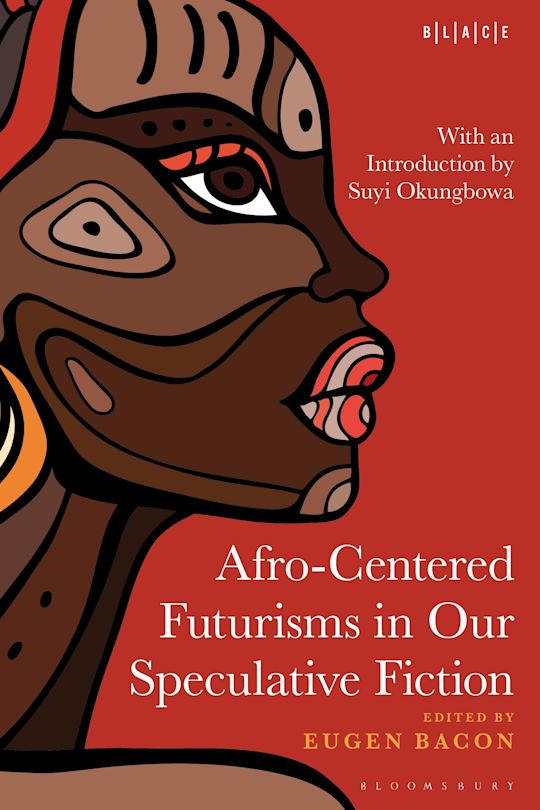
Edited by Eugen Bacon, Afro-Centered Futurisms in Our Speculative Fiction (2024) is an anthology of award-winning African speculative fiction writers, including Suyi Okingbowa, Cheryl S. Ntumy, and Dilman Dila.

The anthology pushes us to question the genre labels we take for granted – namely, Afrofuturism, Africanfuturism, and futurism – alongside introducing us to new terms, fusing specificity with inclusivity. Key to the anthology is the concept of the ‘gaze’: of looking in order to name, and the tension between fixity and fluidity that comes from it. With a blend of fiction and nonfiction, Bloomsbury describes the anthology as offering “excerpts from their work and creative reflections on futurisms with original essays.”

Afrofuturism, Africanfuturism and Afro-centred Futurisms

There are many names for speculative fiction by African writers. The anthology is chiefly concerned with differentiating Afrofuturism, Africanfuturism, and introduces Afro-centred Futurisms. ‘Afrofuturism’ often refers to Black speculative fiction, although the anthology reminds us of its origins in the United States of America through Mark Dery’s coinage. ‘Africanfuturism’ is Nnedi Okorafor’s invention to describe speculative fiction invested in African histories, presents and futures. ‘Afro-centred Futurisms,’ as Suyi Okungbowa defines it, is a plural term with an “active consciousness and open-armed framework — the privileging of the Afrodescendant self, an investment in timelessness, and an embrace of the spirituality-to-science spectrum” (18).

Continue reading “Amirah Muhammad reviews ‘Afro-Centered Futurisms in Our Speculative Fiction’”

An emotional affair with a particular orchid

Plants in Science Fiction: Speculative Vegetation. Edited by Katherine E. Bishop, David Higgins and Jerry Määttä. University of Wales Press, 2020.

Reviewed by Rhona Eve Clews


Before we dive into the myriad wonders of the first-ever collected volume on plants in SF, let me signpost by saying this article is not intended as a straightforward book review, more a subjective-entangled way into an intense and highly transformative text. As an Artist, Ecologist, Healer and dyspraxic my approach might be perceived as that of a fuzzy set, so named by Brian Attlebury, that is ‘affiliated with other texts that might seem to belong to other…terrains’ and tending to spy unexpected connections and join unexpected dots. I draw attention to this method as the unconventional, multidisciplinary approaches might be the essence of what this book points to, namely an urgent need for cross-species intimacy, or inter-kingdom intimacy. My hope is that bridging the separate islands on which different academics tend to reside will foster such closeness.

 Slurp, collage, Rhona Eve Clews
Continue reading “An emotional affair with a particular orchid”

Beyond Gender Collective: Abolish the Family!

Abolish the Family by Sophie Lewis

Review by Beyond Gender

Abolish the family? You might as well abolish gravity.” (1)

It is with these words, spoken by an imagined, horrified reader, that Sophie Lewis begins their new book. From the outset, the magnitude of the task ahead for family abolitionists is clear. To abolish the family is to attempt something frightening, something unthinkable, something which requires one to challenge the fundamental rules which bind our world together. It is, then, no surprise that again and again Lewis reaches for science fiction (SF) to articulate this vision of a world beyond the family. For an SF creator, to abolish a so-called law of nature is not a ridiculous proposition which can be used to embarrass utopians into giving up on their belief that “things could be different” (4, emphasis in original). It is rather a serious undertaking which involves an investigation of those forces which hold life as we know it together, the willingness to experiment with those same forces, and the determination to remake the world, however alien what comes next might be. This is the spirit in which we, the Beyond Gender research collective, approach Lewis’ book. We are a group of SF fans, researchers and creators who are committed to tapping into the radical potential of SF to undo the supposed naturalness of such myths as the binary model of gender, cis- and heteronormativity and, now, the family.

“Abolish the family? You might as well abolish gravity.” 

“Okay then, might as well.”

Continue reading “Beyond Gender Collective: Abolish the Family!”

First-Class Flights: The Class Politics of Labour and Flight in Sylvia Townsend Warner’s Elfin Stories

By Tam J Moules

Kingdoms of Elfin, Sylvia Townsend Warner’s 1977 short story collection, is one of her oddest and most fantastical works, the culmination of “a progressive shifting away from realism toward the explicitly anti mimetic modes of allegory and fable” (Castle, 1993), a departure which “seemed calculated to irritate and confuse a great many readers.” (Harman, 2015, p. 312) The tales were written over a period of several years, originally published separately in the New Yorker, before being published as a collection about a year before Townsend Warner’s death in 1978. They are loosely satires of class systems and aristocracy, as Harman describes: “She used Elfindom as a mirror to society, although all the satire in her elfin stories is very casually arrived at; she seems too uninterested in human dealings to aim at them with any care” (Harman, 2015, p. 313). Elfin (or fairy, the terms are often used interchangeably by both author and critics) society is portrayed as deeply decayed and corrupt, with a rigid class structure and archaic rituals dependent primarily on the whims of the powerful, disintegrating under the weight of their own isolationism and greed, and in opposition to the mortals of the tales, who are “almost universally working class”. (Priest, 2010)

There are two main layers to the class division in these stories. The most prominent is the division within Elfin society, between “flying servants [and] strolling gentry” (p.93). The division between Elfin and human society is also stratified along class lines, with the aforementioned working class mortals forming the main part of the human characters. The intersections between both of these stratifications will serve as the basis for my exploration of Warner’s treatment of class.

Claire Harman, in her 1989 biography of Sylvia Townsend Warner, describes the Elfins as “anarchic [and] amoral”. Harman is likely using ‘anarchic’ in the colloquial sense, to mean ‘chaotic’, however, in contrast to the literal sense of the word, we see that Elfin society is deeply hierarchical, and the power of flight, through the possession and usage of wings, is frequently employed as a symbol of the delineation of those hierarchies. It’s a physical power, an inherited characteristic, a visual marker to differentiate between Elfins and those they consider to be their human inferiors. It serves as a marker of the differences between Elfins and humans, a demonstration of Elfin superiority that is tied in with human religious symbolism. It also serves as a class marker within Elfin society, between the working classes who must rely on flight for labour and transport, and the upper classes who consider it beneath their dignity. We are told quite flatly of the theoretically simple social position of flight: Elfins “fly or don’t fly according to their station in life”, and the aristocrats “marked their social standing by scorning to use their wings” (p. 66). The stories frequently concern themselves with instances in which these social rules are transgressed.

I am resisting the impulse here to taxonomise every symbolic function of the power of flight in these stories, to fit them all into some universal system, since this runs counter to the playfully and deliberately contradictory nature of these stories. Partly this is due to their being written over a long period of time, changing style and tone to suit the needs of particular stories, and partly it is an artefact of the stories’ function as social satires. Though some critics have discussed her “attempt to construct a typology of fairies” (Simons in Davies & Malcolm eds. 2006), I would disagree that she makes any such attempt. It is possible to read a typology into the book, but I’d argue that this requires flattening a lot of the apparent contradictions. Flight is forbidden, except when it’s not. Contact with humans is forbidden, except when it’s not. Religion is irrelevant to them, except when it’s not. She sets out a theoretical typology, then throughout the collection she explores the complications and violations and contradictions of this typology. It might be more accurate to say that the book is a typology of contradictions, and in laying out the Elfin contradictions we are led to consider the human ones.

In writing about Warner’s treatment of animals in her fiction, Mary Sanders Pollock discusses Warner’s project to “suggest ways that Marxist thinking might permeate and complicate the boundaries […] between the “human” and the other lively beings” (2015), which I would suggest applies equally to her treatment of the Elfins as it does to her treatment of animals. We see a convergence of these two concepts in the tale ‘The Mortal Milk’, which concerns “the Royal Pack of Werewolves” (p. 68) in the Court of Brocéliande as they sicken and die. They are described as both men and beasts, as both unnatural and mortal, as a liminal state between sapient and animal, and their treatment mirrors the treatment of the human children raised in Elfin. Permeability is a recurrent symbol in these stories, be it the permeable geographical boundaries between the two worlds, the permeable species boundaries between humans and Elfins, or the resisted permeability of class boundaries.

Continue reading “First-Class Flights: The Class Politics of Labour and Flight in Sylvia Townsend Warner’s Elfin Stories”

From Woman at Point Zero by Nawal El Saadawi to The Queue by Basma Abdel Aziz

Merit Ariane Stephanos 

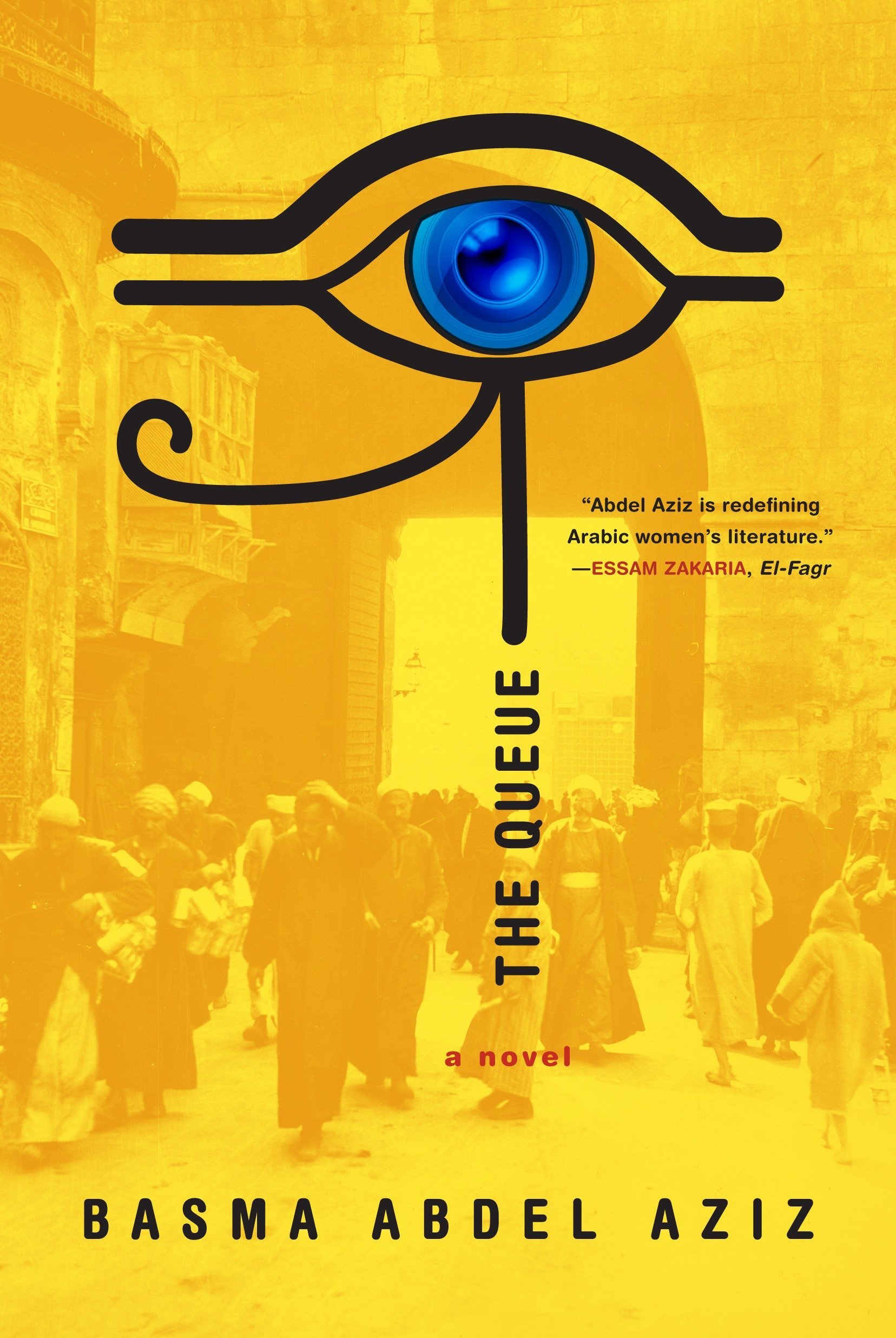
Even the titles of the novels – The Queue and Woman at Point Zero – reroute  the thoughts towards recent emotionally exhausting lockdowns. They conjure interminable waiting, to the point of breakdown.  In a way, this is precisely what these books describe. However, the denials of freedom to move, associate and connect are not caused by a global pandemic but by local patriarchal, totalitarian societies. The fictionalised/documentarian versions of Egypt spiritually and physically destroy the respective protagonists, Armani and Firdaus. Both women are driven to extreme forms of exile from their societies, Firdaus by accepting a death sentence, Armani by self-enforced mental alienation. Although all genders in these two novels suffer from oppression, women are subjected to specific forms of violence highlighted by the writers. 

The sensitivity and detail in the portrayal of these forms of gendered violence is related to the fact that not only are respective authors both women, but they are both psychiatrists. Both writers are important figures in Egyptian society, renowned for their activism and respected as powerful intellectuals. The two authors have personally experienced state-inflicted violence for their resistance, their feminism, and their criticisms of other forms of oppression. Nawal El Saadawi was fired, exiled and threatened with imprisonment; Basma Abdel Aziz’s nickname is ‘the rebel’. Both novels portray an Egyptian society from a historical vantage point that are four decades apart (1975 and 2013). These have not been decades of ‘progress’: albeit fictionalised, oppression as presented by Basma Abdel Aziz in The Queue (2013) has become more suffocating and more all consuming.

Continue reading “From Woman at Point Zero by Nawal El Saadawi to The Queue by Basma Abdel Aziz”

Of Monsters, Men and Migration: Control and Identity in Yan Ge’s Strange Beasts of China

By Ksenia Shcherbino

It is as human to move from one place to another in search of a better life, as it is to divide the world into categories of “us” and “them.” However, there is no universal definition of a ‘migrant’. Migrants are not inherently vulnerable. However, they often find themselves marginalized in the host country and are perceived by some to threaten national identity, economy, social cohesion and cultural norms. As Saskia Bonjour and Sebastien Chouvin warn us, “discourses on migration, integration and citizenship are inevitably classed, because representations of Self and Other are inevitably classed [1]”. Practices of inclusion/exclusion are based on power dynamics which are rarely fair and more often than not based on a set of prejudices, including racial prejudices that perpetuate inequality and can lock the families in the boundaries of their ‘migrant’ status for generations. Hence, children of ‘migrants’ are continued to be seen by some members of society as migrants as well despite being born in the country or having lived there for most of their lives, thus reinforcing cultural alienation and inequality. Further, the continuity of colonialist discourse fuels dehumanisation of migrants. Read through this lens of colonialism, Yan Ge’s Strange Beasts of China offers a unique experience of sieving through the questions of migration, acceptance, domination and hybridity in the body of a chimera, a creature of fantasy. The book keeps asking the readers to re-evaluate the ideas of power and possession, speech and silence. Who colonised who, are humans nothing but the former beasts who have conquered the land and re-written its history? Who has the right of speech? Is silence a way of telling a story by the marginalised (beasts)? The entwined story of memory and oblivion for monsters and humans in Strange Beasts of China turns the narrative into a battlefield of falsifiable identities and historical assumptions. “This vast city, the beasts that come and go, all of this, is a secret,” muses Yan Ge’s narrator. “No one knows why they come or why they go, why they meet or why they leave. These are all enormous, distant mysteries [2]”. Yan Ge’s Yong’an is a postcolonial space where the story of subjugation of the beasts, or the struggle for de/re-territorialisation is already part of history, and the question that haunts both humans and beasts is the same that haunts in our day and time: how the interdependence of colonisers and the colonised has shaped – and continues shaping – our understanding of the world [3].

Continue reading “Of Monsters, Men and Migration: Control and Identity in Yan Ge’s Strange Beasts of China”

Fearless by Allen Stroud

Reviewed by Dev Agarwal. This review first appeared in The BSFA Review.

Allen Stroud’s name will be well known to readers in this parish. He is currently BSFA Chair and has long been prominent in genre circles. His latest novel has been positively reviewed, including in Amazing Stories, where Ernest Lilley recommended Fearless and observed that Stroud brings “a Clarkian feel that grounds the story in the best tradition of science fiction.”

Fearless is, by flavour, not only science fiction, but specifically, space opera. Space opera, as a subgenre, has arguably two sets of defining characteristics. There is its iconography of spaceships, colony worlds, disasters, piracy and spaceship battles. However, equally important are its tonal choices of larger-than-life characters, intrigue, extravagant settings and fast-paced plotting.  Which Brian Aldiss neatly captured in his term “widescreen baroque.”

While it is fallacious to say that space opera is enjoying a renaissance (as it never went away) it is true to say that prominent names, including James S.A. Corey, Charles Stross and Ann Leckie, have boosted space opera and broadened its appeal. They built on the founding ideas of the original space opera and the popularity of the New Space Opera that came after it.  This number of books has inevitably crowded the field and the challenge for any writer is how to make their space opera stand out. 

Allen Stroud throws us into his version of the “widescreen baroque.” The novel is set in AD 2118 with habitats across the solar system (where humanity has colonised the Moon, Mars, Ceres and Europa). Fearless feels confidently New Space Opera, as it melds pyrotechnic action with ethical dilemmas and strong characterisation. This is particularly evident where Stroud challenges the male-dominated narratives of the past, to put a woman, Captain Ellisa Shann, in command of the space going vessel Khidr. Shann is one of the novel’s three first person protagonists (which also include two junior crew members, Johannson and Sellis). Shann is the most distinct of the narrators, in part because she was born without legs. Ordinarily, her story, or backstory, would include how she overcame this disability, or is defined by it.  However, Stroud has said that he “wanted to portray a disabled character in space who was not attempting to overcome her disability.” Shann’s disability is a part of her, rather than all of her.

Khidr is a rescue ship and this feels like a distinct social point that Stroud makes. He is writing space opera, and enthusiastically opening its toybox for the reader. But he is not revelling in the violence of a warship. Khidr has been described by other reviewers as analogous to the coast guard or an emergency service and its purpose ordinarily, is to assist other vessels, rather than fight. New Space Opera is able to widen the narrative to include people like Shann, physically disabled but still capable, who are in space with altruistic intentions––rather than opportunistic ones.

The Khidr’s role also allows Fearless to explore similar motivations to the work of writers like Frederick Pohl and Alistair Reynolds, who have looked at blue collar workers living in space and looking to make a living rather than warriors and world-beaters. These are the people who do the unglamourous and necessary work that often gets overlooked in the widescreen baroque.

Fearless begins with a routine emergency when Shann receives a call for help from the spaceship The Hercules. They expect to offer routine assistance, but this soon leads the crew into an attempted mutiny and Shann into a political drama that spans the colony worlds. Stroud’s use of three revolving viewpoints offers differing perspectives on the mounting crises both on and off the ship.

Space opera is well known for the speed at which tension mounts and the range of the catastrophes that its characters face. In Fearless, the plot develops fast, with all the narrative acceleration and pyrotechnic action that we might expect. The Khidr deals with an onboard murder, external attack by an unidentified spaceship, and intrigue and battles across the solar system. 

This setup gives Stroud an opportunity to turn a fresh authorial eye to a number of familiar tropes. Cliques in the space-going Fleet, hidden colony worlds and a tantalising alien manifestation dating back to Apollo 10 all appear. This makes for a story that is both a high-octane adventure and a character study for each of the three viewpoint characters.

In terms of plotting, Stroud walks the tightrope of completing the arc of his characters’ story by the final page and also setting up a sequel. He puts in motion a number of threads (starting with that alien manifestation that Apollo 10 encountered in real life) and it would have been unwise to try to neatly tie off all of these strands (and dissatisfying to the reader). By the end of the novel, the Khidr has discovered and abandoned artifacts and several political players remain unmasked and still working against the Fleet. At the same time, Stroud brings his novel to a satisfying dramatic crescendo.

Lastly, a mention for a stylistic decision that Stroud made. This is his use of present tense.  Stroud has said that this was a deliberate choice, having experimented with the form at shorter length. Ultimately, he found that present tense added more immediacy and tension to his writing. While it can be off-putting to read a long work in present tense, Fearless may just be the right place for readers to start.

And if you like Fearless, more is on its way as Stroud is currently at work on a sequel.

Copyright Dev Agarwal. All rights reserved.