The Stereotype of the Spinster Scientist

By Lynne Lumsden Green

Astounding Science Fiction, January 1955

She blinded me with science, And hit me with technology.

Excerpt from ‘She Blinded Me With Science’ by Thomas Dolby

The concept of a ‘Spinster Scientist’ is an artefact of Western Society during the twentieth century. Women, historically, had to fight for the right to be allowed to study and matriculate at universities, as they were effectively barred from tertiary education in the Western world until the late 19th century. Once women scientists existed in academia, popular culture, and mainstream society, they were of perceived as being different from their male colleagues; women were considered somehow less intelligent, and less ambitious, than their brother scientists: persistent Victorian-era beliefs within the medical profession that over-educating women would make them infertile. Even Charles Darwin argued that British women were intellectually inferior to British men. These gender biases contributed to the creation of the Spinster Scientist stereotype. However, the interactions between science practice, science fiction, and feminist movements have influenced the effect of this stereotype, creating a feedback loop where the stereotype also influenced those three arenas.

Birth of a Stereotype

The Spinster Scientist evolved over the course of the twentieth century, with the following stereotypical traits: a woman scientist, unmarried because she is dedicated to her career, or because she is socially awkward or frumpy. She generally wears glasses and isn’t interested in the latest style of clothes; she dresses for safety or comfort, not to conform to fashion. Her attitude to men is straightforward, brooking no nonsense, and though she might appear meek, she will stick to her convictions. The trope is exemplified in Susan Calvin, the robopsychologist created by Isaac Asimov, who narrates the stories collected in the anthology, I, Robot. Her character was written to be confident, brilliant, with a lifelong commitment to her work. Yet, from Asimov’s description of her in I, Robot: “She was a frosty girl, plain and colourless, who protected herself against a world she disliked by a mask-like expression and a hypertrophy of intellect.” In other words, she is a textbook example of the stereotype. In the one story where she shows a romantic interest in one of her colleagues, she is derided for wearing make-up and trying to conform to the current beauty standards. Damned when she tried to conform to gender norms, and damned when she wasn’t trying, this is a fictional example of a double standard applied to women in the professional work arena.

Continue reading “The Stereotype of the Spinster Scientist”
Electricity as a Speculative Device: The Romanian Modern(ist) SF

By Amalia Cotoi

This article explores how Romanian science fiction novels written between 1899 and 1954 engage with modernity. I am particularly interested in examining how key texts that center around the protagonist’s exploration beyond the familiar realms intersect with a modern development that was a game changer in human history: electric energy.  The analysis centers on three novels from the modernist era − Victor Anestin’s pioneering Romanian Sci-Fi novel, În anul 4000 sau o călătorie la Venus [In the Year 4000 or A Trip to Venus] (1899), Henri Stahl’s Un român în lună [A Romanian on the Moon] (1914), and Felix Aderca’s Orașe scufundate [The Submerged Cities] (1937) − and one written and published in the aftermath of WWII − Drum printre aștri  [Path Among Stars] (1954), penned by I. M. Ștefan and Radu Nor. If the works written during the interwar period represent initial major forays into the Sci-Fi genre, it wasn’t until the postwar era that the first notable presence of Sci-Fi in Romanian literature, holding institutional significance and capturing general interest, emerged. By including a novel written in the 1950s in this inquiry, I aim to challenge the chronological convention of the modernist era ending with World War II. The emergence of the communist regime, influenced by the Soviet model, signaled an unparalleled drive toward industrial and technological advancement in a European nation that was among the least developed, with a rural population twice the continental average (Murgescu, 140). Such a transition is all the more justifiable in the case of electricity, as the pace of electrification accelerated after World War II, particularly between 1950 and 1970 (Murgescu, 344), witnessing the shift from electricity as a speculative concept to a democratically commodified resource.

Continue reading “Electricity as a Speculative Device: The Romanian Modern(ist) SF”

龙马精神* Dragon Horse Vitality Spirit

* This is a common Lunar New Year greeting

Guest editorial by Yen Ooi. Published as part of Vector 293 exploring Chinese SF.

Chinese science fiction’s (CSF) growth in popularity has followed the rapid development trend of China itself. In his interview with fellow writer Maggie Shen King, Chen Qiufan (a.k.a. Stanley Chan) highlights that China has over the last four decades achieved the technological and economic advancements that countries in the West achieved in the last century. The speed of modernisation and urbanisation is a remarkable thing to behold, with 100 million people lifted out of poverty just since 2013. China’s rise has been subject to international scrutiny and criticism, which is to be expected. The most unfounded of which plumbed new depths in the past year 2020 through the pandemic. While the previous president of the United States of America (among many) used the term “Chinese virus” in his description of Covid-19, East Asian diaspora communities living in Western countries experienced increased instances of racism. What is the connection?

Genres are in general difficult to define, but CSF is especially complicated. Both the terms Chinese and science fiction defy any clear definition, yet are used so commonly that every user has their own pre-assumed definition. One popular assumption in the West is that CSF should always be read in terms of political dissent or complicity with state power. As much as that might be true for some, it is an unhelpful generalisation. After all, we do not assume that British SF is only about Brexit, or American SF only about Trump. In one sense, all storytelling is inherently political, and within Anglophone SF especially, the racist and queerphobic attack on representational diversity is often disguised as a demand to “remove the politics” from our stories. However, the necessarily political nature of storytelling is complicated in the case of the Anglophone reception of CSF. The insistence of many Western readers on interpreting CSF exclusively in relation to government censorship can itself have a paradoxically censoring effect. Some CSF authors have even resisted writing stories set in China, or allowing the translation of their work into English, for fear that readers will ignore its actual aesthetic and intellectual qualities, while using it as material for simplistic speculation: Whose side are you really on? To quote Ken Liu for what is a publication on CSF without mentioning the writer who, it feels like, has single-handedly brought CSF to Anglo-American readers?  — 

Like writers everywhere, today’s Chinese writers are concerned with humanism; with globalization; with technological advancement; with development and environmental preservation; with history, rights, freedom, and justice; with family and love; with the beauty of expressing sentiment through words; with language play; with the grandeur of science; with the thrill of discovery; with the ultimate meaning of life.

Ken Liu, Invisible Planets, 2016.

Chinese means many things: culture, ethnicity, nationality, language, people, food, celebrations, traditions, dance, art, tea, etc. It is impossible to talk about all things related to CSF, but we hope that we’ve managed to introduce some key ideas and concepts in this issue, and that you’ll find areas that particularly excite you as a writer, researcher, or reader to want to learn more.

Continue reading “龙马精神* Dragon Horse Vitality Spirit”

‘Lies to children’: From folk to formal science in Terry Pratchett’s Discworld

By Mikaela Springsteen

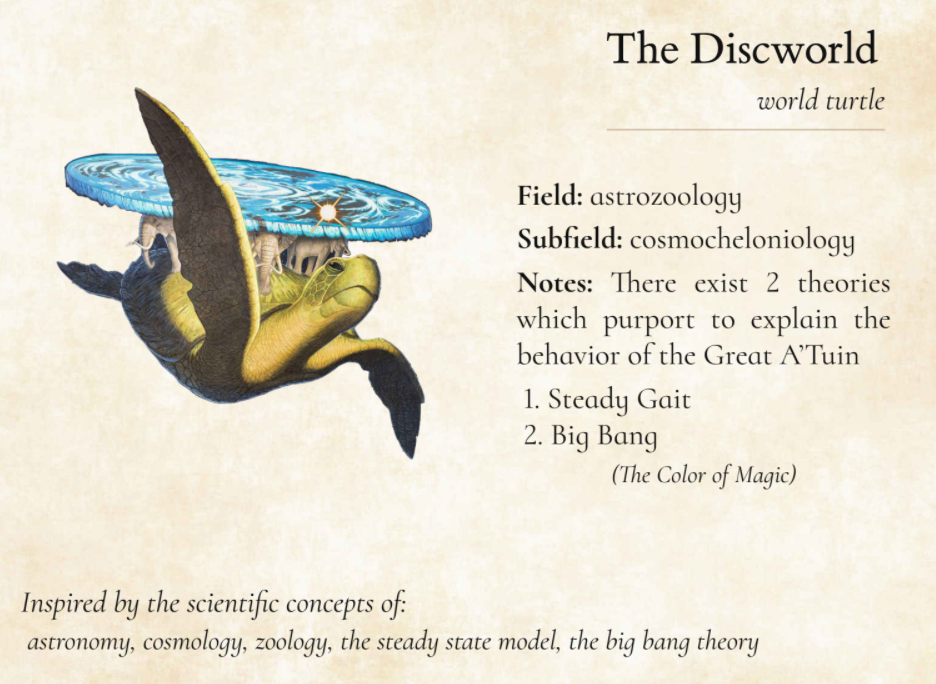
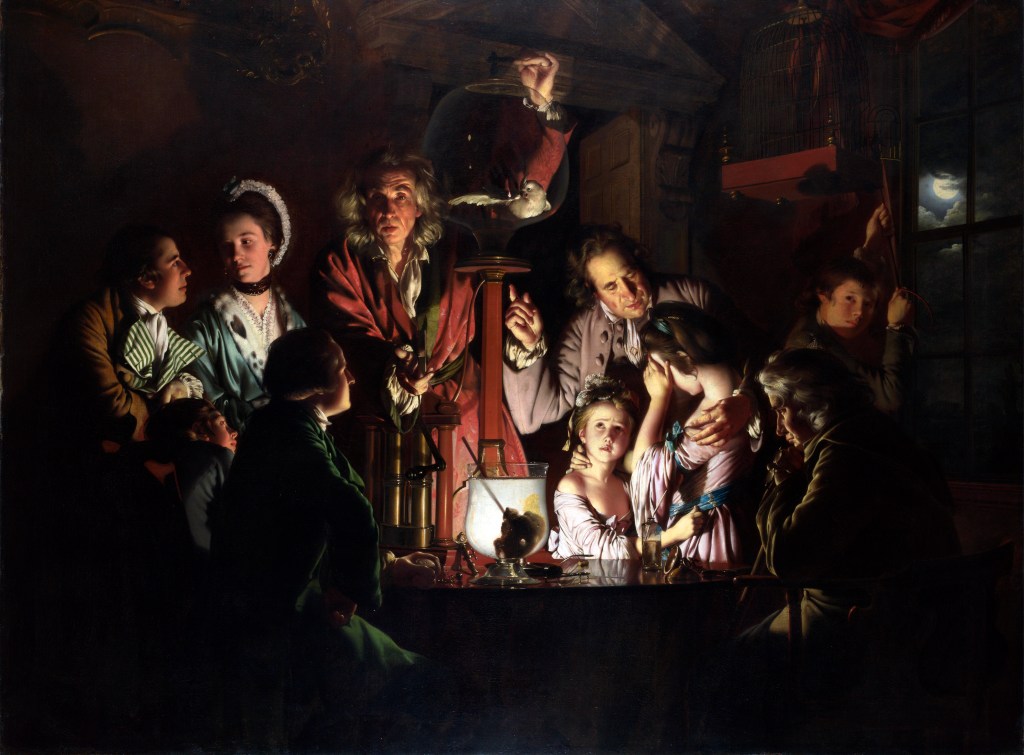
Paul Kidby, ‘The Faculty’ / Joseph Wright, ‘An Experiment on a Bird in the Air Pump’


Terry Pratchett is known for the incredible intertextuality of his work, especially in his famous Discworld series. He borrows—or steals, as all the best artists do—from the greats of the cultural canon. In fact it is the stories—the literature, fantasy, folk stories, and histories—of our world, of the so-called ‘Round World,’ which quite literally power the Disc. Pratchett’s use, deconstruction, and reconstruction of these stories have all been the topic of study before, but one discourse which Pratchett drew on quite a bit has been somewhat absent from Pratchett Studies thus far: science.

Early in his career Pratchett was a press officer for a nuclear power station; his interest in and fondness for new forms of technology has been well documented; he collaborated with the scientists Jack Cohen and Ian Stewart on four ‘Science of Discworld’ books; and, although he is perhaps best known for the broadly ‘fantasy’ series of the Discworld, Pratchett was also an accomplished science fiction author (The Dark Side of the Sun, Strata, the Long Earth series with Stephen Baxter)—a genre which has both incorporated and inspired scientific advancements. His life-long interest in science is reflected in his fantasy works as well. In the case of the Discworld series, much can be said about the Discworld as creation myth:

Through the fathomless deeps of space swims the star turtle Great A’Tuin, bearing on its back the four giant elephants who carry on their shoulders the mass of the Discworld.  A tiny sun and moon spin around them, on a complicated orbit to induce seasons, so probably nowhere else in the multiverse is it sometimes necessary for an elephant to cock a leg to allow the sun to go past.

Wyrd Sisters
The Great A'Tuin, the world turtle. There are two theories which purport to explain the behavior of the Great A'Tuin: Steady Gait and Big Bang. Inspired by the scientific concepts of astronomy, cosmology, zoology, the steady state model, Big Bang theory

To use a popular fan formulation: from a ‘Doylist’ (or out-of-universe) perspective the Discworld clearly draws on the mytheme of the world turtle. But from a ‘Watsonian’ (or in-universe) perspective, this cosmology is explored and understood scientifically (as in The Color of Magic). Other seemingly far-fetched phenomena on the Disc are similarly explained in a rather rational, even techno-scientific tone, and the series is scattered with references to collective intelligence, time dilation, and the theorized eleven dimensions of the multiverse.

This article explores how Pratchett leads us to think about the practice and culture of science. It begins by taking a look at what science looks like in the context of the Disc, then exploring the two primary groups of Discworld scientists, and finally finishing up with a look at why the use of science in a nominally fantasy world might be worthwhile to explore.

Continue reading “‘Lies to children’: From folk to formal science in Terry Pratchett’s Discworld”