By Alex Harasymiw
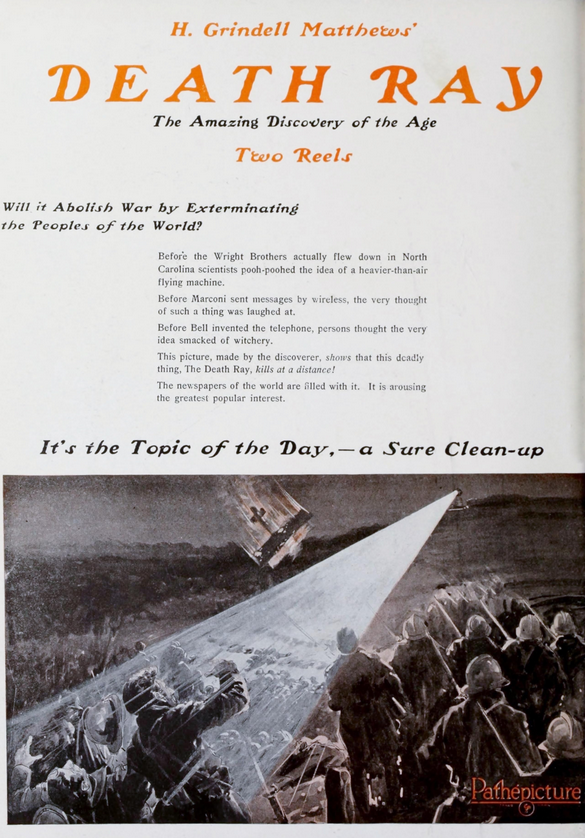
Promotional poster for The Death Ray (1924)
Introduction
There, squatting beside a bush, projecting from the field, like a tilted spotlight precariously balanced atop a porcelain beehive, we behold the death ray, its tentacle-like power cables snaking across the English countryside to somewhere off-frame. Invented in 1923 during the interwar period as the ultimate deterrent to the enemies of England, Harry Grindell-Matthews’ device sits mercifully unused, mysteriously untested, a mere testament to the destructive potential of the modern scientific mind. From the surviving photographs and the rare newsreel footage of the death ray, we can see an eerily thin beam, sweeping across an assortment of objects, a motorcycle engine, a lump of gunpowder, a quivering mouse, like that of a handheld flashlight, only, instead of illuminating each of the objects, the beam slices them like a pair of scissors, severing them from the sense of continuity between one moment and the next. First, there is light and the object, a rupture, and then an explosion to splice the two parts together. In the end, Grindell-Matthews would destroy the device, along with all the related plans, notes, and records, leaving behind only anecdotes, rumours, and film strips as evidence of this great realization of science fiction in the past.
Apart from its strange imagery, like some untimely precursor to the independent exploitation films that would appear decades later, the death ray is fascinating for the way it lingers in the popular imaginary. Despite the lack of conclusive demonstrations of the device, the way descriptions of it change from one account to another, and Grindell-Matthews’ reticence about its materials and operation, there appears to have been a widespread faith in the real possibility of the invention’s existence, and even today something like a pious agnosticism surrounds the death ray. When we consider the efforts of early silent cinema scholars to confront the often irreparable degeneration or complete loss of the films of so many marginalized filmmakers, and the implications of such loss for our understanding of the history of silent cinema, the persistence of the death ray as the lost work of a modern inventor-genius seems especially questionable. Where the absence of marginalized films and filmmakers from the official canon of silent film history is often attributed to the real material loss of their films in the present, the death ray highlights one of the central ironies of historical writing about this period: namely, that if a narrative is compelling enough to be believed, there is no problem inventing evidence to suit its ends.
Continue reading “The (Death) Ray of Destiny: Conspiracy and Speculative Historiography in Early Silent Science Fiction” vector-bsfa.com