Citadel of Chaos: an art practice to materialise an alternate present

By Mark Rohtmaa-Jackson & Allan Hughes / Blue Mountain Arcturus

When not in the tower he haunted the room where he had set up his War Tables – high benches on which rested models of cities and castles occupied by thousands of other models of soldier. In his madness he had commissioned this huge array from Vaiyonn, the local craftsman. […] And Dorian Hawkmoon would move all these pieces about his vast boards, going through one permutation after another; fighting a thousand versions of the same battle in order to see how a battle which followed it might have changed.

Michael Moorcock, ‘The Champion of Garathorm’[1]

In Moorcock’s The Chronicles of Castle Brass, Hawkmoon is consumed by a madness to commission his miniature armies, and finds their permutations and predictions more absorbing than the fine day outside his room of tables. Rather than turning inward like Hawkmoon, we, under the guise of the parafictional games company Blue Mountain Arcturus, find ourselves examining tabletop gaming as a means to turn our inward selves toward the wider world: as a language through which we try to alleviate our anxieties of the fine day. This text is a summary of how we hope to achieve alterations to our conditions through an experimental practice. It hopefully points towards areas of study that might be useful to others working with tabletop games as a means to learn strategies for survival: the challenge to critical games design in the wake of Guy Debord and Alice Becker-Ho’s Game of War (1987).

Citadel of Chaos (2019) is our case study for this article, an artwork made for the exhibition Polymorph Other at Queens Hall Arts Centre, Hexham, that same year. It was conceptualised, designed and built as a large piece of scenery or terrain for a hypothetical wargame table. It is a background rather than a focus; something that gives a place an environment that enables other things to happen. As such it is about the possibilities of things happening because of what we might have made. But this is not just on the small scale (a piece of scenery allows a story to be told between players through a game being played) but in the belief that this kind of work can change things outside of the system in which their world is contained (that such stories can lead to possibilities elsewhere).

Continue reading Citadel of Chaos: an art practice to materialise an alternate present

Telling the Acrobats which way to Jump: Irrigation Gaming and Utopian Thinking

Maurits W. Ertsen

“I mean I can book the acts, but I can’t tell the acrobats which way to jump!”

James George Hacker (portrayed by Paul Eddington)—Yes Minister, Series 2, Episode 2: ‘Official Secrets

Utopia and Irrigation

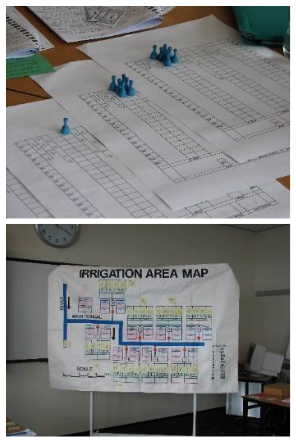
This is an article about The Irrigation Management Game (IMG), reflecting on my own use of the game in educational settings, and drawing some links with utopian and dystopian thought. The relationship between water and human wellbeing has been extensively studied and debated. Perhaps the most famous overarching theory is that of Karl Wittfogel. Wittfogel argued that certain climates imply certain forms of irrigation, which in turn imply certain political and social institutions.[1] In particular, Wittfogel thought that ancient Egypt and Mesopotamia, Hellenistic Greece, Imperial Rome, the Abbasid Caliphate, Imperial China, the Moghul Empire, and Incan Peru, were all ‘hydraulic societies,’ whose despotic character arose from the need to manage complex irrigation infrastructures. Although Wittfogel’s environmental determinism has since been discredited, his work remains a great reminder that water management is seldom simply a set of technical problems. Instead, water management is intimately linked with power, labor, knowledge, discipline, control, and utopian and dystopian possibilities. Anyone who has read George Orwell’s 1984 or Aldous Huxley’s Brave New World—or is a fan of Michel Foucault—will surely recognize such themes.[2] Irrigation is one of many domains where governments have attempted to improve collective welfare without undue interference in individual freedoms.

Irrigation was on many development agendas, in states as diverse as the Neo-Assyrian empire[3], colonial states in the 19th and 20th centuries[4] and modern settings[5]. In these developmental settings, irrigation—including its aspects of control—was often associated with utopian futures, at least within state propaganda and planning discourse. In colonial Africa, for example, European powers imposed irrigation regimes on communities they treated as ‘historyless’, while perceiving themselves as creating an ideal, rational order.[6] After the Second World War, with many colonized countries gaining independence, irrigation systems that had been constructed and/or planned became part of post-colonial international development.[7] Former colonial experts became international experts, and new experts were trained within irrigation approaches developed in colonial times.

In the first decades of post-WWII development, the main focus was on building new and rehabilitating existing irrigation infrastructure. From the 1970s onwards, more attention was paid to issues of managing these infrastructures—including relationships between managers, farmers, and other water users. These discussions intensified in the 1980s, if only because results lagged behind the expectations (sometimes too optimistic—utopian!—expectations) of governments and engineers. New methods of design and management began to emerge, and slowly began to adopt more participatory processes, to accommodate stakeholders’ knowledge and wishes. The main topic of this article, the Irrigation Management Game (IMG), is a result of these intensified efforts.

The IMG was initially developed to support discussions among irrigation managers on farmer strategies and water delivery problems, especially in the larger systems in South and South-East Asia.[8] After positioning the IMG within a gaming context, I will examine how the game reflects the realities that I study—both in practical and theoretical terms. I will conclude by suggesting that the IMG allows us to explore how utopia and dystopia are in the making, and not fixed in advance by a given environmental setting and management system. Especially in irrigation, I will suggest, the margin between utopia and dystopia can be thin.

Continue reading “Telling the Acrobats which way to Jump: Irrigation Gaming and Utopian Thinking”

The Rules of Utopia: The Procedural Rhetoric of The Book of Cairn

By Tyler Brunette

In ‘Back to the Future: Wells, Sociology, Utopia, and Method,’ Ruth Levitas argues:

[…] we would be better served both as sociologists and as citizens by a more utopian method, one which embraces the Imaginary Reconstruction of Society (IROS) as an active device in reflexive and collective deliberations about possible and desirable futures.[1]

Few activities dovetail better with Levitas’ proposal, one of collective deliberation and active imagination, than tabletop roleplaying. Indeed, both utopianism and tabletop roleplaying are often derided by their detractors as mere frivolity, and unworthy of serious consideration. However, as an interactive medium based on cooperative imagination of the possible, tabletop roleplaying games (TTRPGs) offer a unique opportunity for analysis of the practice of the IROS.

Cover of The Book of Cairn. A hooded anthropomorphic mouse gazes over the hilt of a sword, which they are holding by the top of the blade.

In this article, I analyze one such game: SoulJAR Games’ The Book of Cairn (Cairn). While at first glance, Cairn appears to be little more than yet another ‘fantasy heartbreaker,’ I argue that Cairn’s combination of unique rules and use of a pastoralist utopian setting function as a method of critique, of both contemporary social conditions, and of the themes embraced by the TTRPG industry more broadly.[2] Specifically, I argue, two interlocking rhetorics are built into the rules of Cairn, producing through play of the game both a sense of what would be necessary to maintain (albeit imperfectly and abstractly) a small pastoralist utopian society, and also an enactment of those activities around the gaming table. Before turning to my analysis of Cairn and the implications of its rules, I first address the theoretical underpinnings of my approach. After my analysis, I conclude by discussing the limits of Cairn’s IROS.

Continue reading “The Rules of Utopia: The Procedural Rhetoric of The Book of Cairn

Post-it Utopia: The Promises and Pitfalls of Arium’s Lean Worldbuilding

By Nicholas L. Stefanski 

Arium: Create

The worldbuilding TTRPG Arium: Create by Adept Icarus promises a utopian procedure for creating gameworlds that are generative, safe, and liberating environments for roleplayers, an undertaking animated by recent debates over the prevalence of harmful, stereotypical, or simply repetitive tropes throughout the TTRPG industry. While the shift away from these problematic tropes is admirable and perhaps overdue within the industry, Arium’s approach to addressing this issue is also notable for its enthusiastic endorsement of creativity techniques stemming from the world of corporate management and innovation consulting. Specifically, Arium’s Lean Worldbuilding approach shares many commonalities with the Lean management philosophy that emerged in the 1990s, largely inspired by Toyota’s operating model. Both Arium’s Lean, and Lean as it is now understood in business, are associated with the pervasive use of Post-it notes for ideation and collaboration.

Image Credit: Shutterstock

This article explores how Arium’s utopian solutionism and endorsement of a signature technique of post-Fordist management presents both pitfalls and opportunities for inventive, utopian roleplay. Beginning in the critical mode, I suggest that by adopting techniques that reduce the art of imaginative worldbuilding to a ritualized formula, Arium: Create risks building worlds that are creative merely for the sake of creativity, and consensual mainly in their appeal to the lowest common denominator. Inspired by Adorno and Horkheimer’s critiques of jazz and the culture industry, and following Eitan Wilf’s ethnography of Post-its and critiques of the innovation and creativity industry, the first movement of the article asks whether such strategies of routinized, commodified creativity can only ever produce the ‘freedom to choose what is always the same.’[i] Nevertheless, while this danger should not be ignored, I argue that it would be wrong to dismiss Arium or to label it as utopian in only the pejorative sense. Taking cues from theorists responding to Adorno’s pessimistic stance toward popular culture, notably Adorno’s Frankfurt School colleague and interlocutor Walter Benjamin, the second movement of the article suggests that despite its embrace of corporate solutionism, Arium’s collaborative worldbuilding contains a generative kernel, revealing an additional movement in the dialectic between oppressive technologies of control and the utopian impulse.

Continue reading “Post-it Utopia: The Promises and Pitfalls of Arium’s Lean Worldbuilding”