
A film review by Maz Jardon
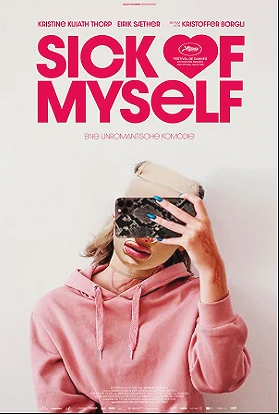
“Beautiful tragedy” might seem like an oxymoronic statement, but one that holds multitudes of truth for Western aesthetics, from the inclusion of Little Nell’s malady in Charles Dickens’s The Old Curiosity Shop as synonymous with her beauty and purity, to the recent trend of “Sick-Lit” Young Adult novels that blend medical drama narratives with teen romance themes. What emerges from these depictions is a distorted mirror image of the reader both seeking and being subjected to, the social power of being a medical spectacle. Kristoffer Borgli’s debut feature film Sick of Myself comments on the trend of reflexive voyeurism-exhibitionism by countering the notion of a Romantic affliction with grotesqueness and a liberal dose of body horror. Scathing in commentary and relentless in gore, Sick of Myself (2022) provides a riotous narrative layered with a critique on postmodern loneliness, the economy of sympathy, and the mirage of corporate inclusivity.
Sick… follows 20-something Signe (Kristine Kujath Thorp) and her tragi-comedic attempts to eclipse her boyfriend’s artistic success by attracting sympathy through medically induced self-harm. Sick premiered on May 22nd, 2022 at the 75th Annual Cannes Film Festival but would not receive a global release until 2023, to largely positive, albeit polarising, reviews.
Opening with a scene of Signe and her boyfriend Thomas (Eirik Sæther) at an upscale restaurant competing for attention with their respective techniques – Signe, pretending it is her birthday, and Thomas, pretending he is rich and successful – the film’s premise is set. The up-the-stakes dynamics of the plot is affirmed when Thomas flees the restaurant, with a stolen $1000 bottle of wine in hand, and is chased by their waiter. Later, Signe witnesses a near-fatal dog attack and overcomes the Bystander Effect to call an ambulance and care for the woman’s wounds until the ambulance arrives. During her walk home, when onlookers see her covered in blood and assume she is the victim, she realises she can receive far more attention from sympathy than gratitude. The narrative escalates, much like how an untreated dog bite festers.
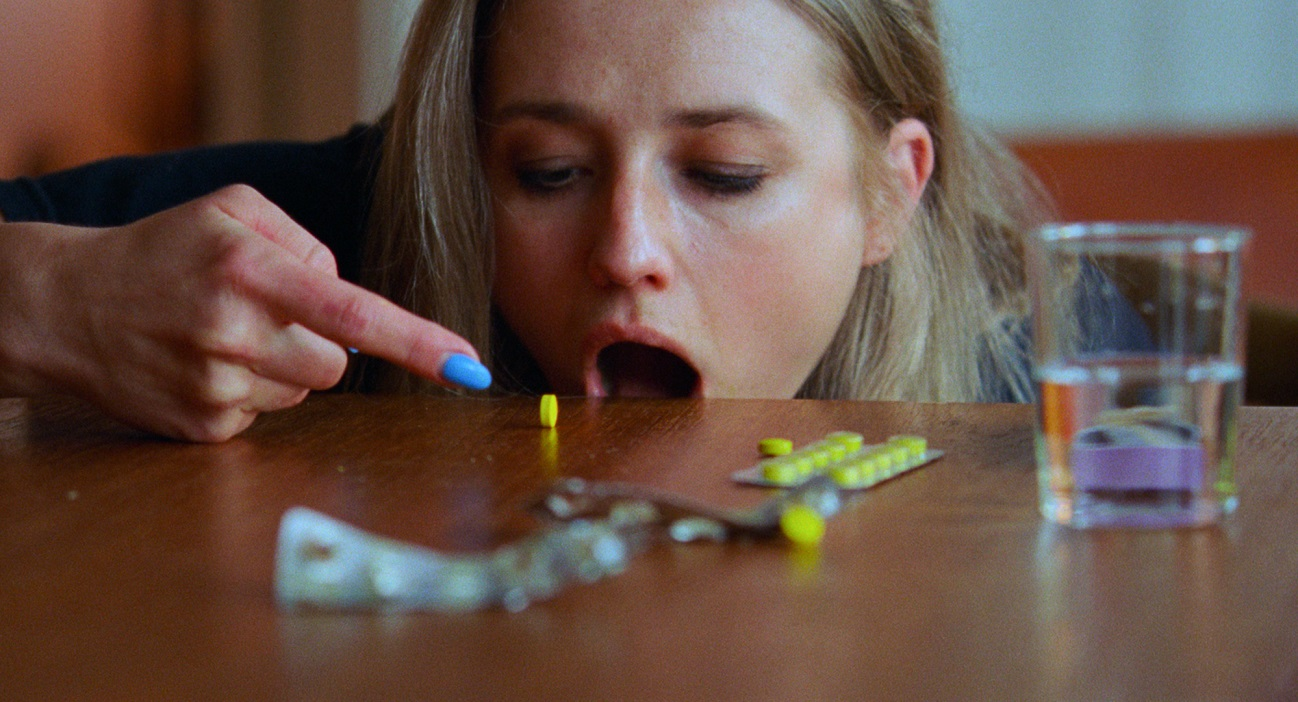
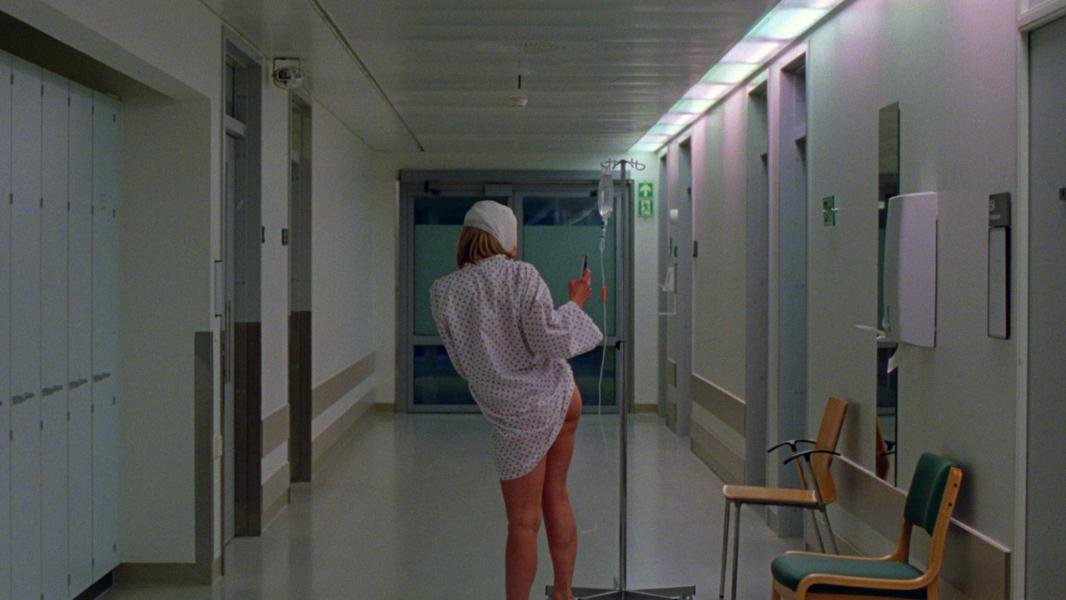
Sympathy-grabbing feats start pretty harmless. First, Signe is pretending she has a deathly peanut allergy while at a dinner for Thomas’ art exhibit. Quickly, however, these spiral from manipulative to criminal. She attempts to recreate the dog attack with herself as the victim, and finally, illegally purchases a Russian sleep medication that causes an irreversible skin condition. The dance that auteur Kristoffer Borgli orchestrates, with the brutality of images to the scoring reminiscent of the disturbing works of string composer Krystof Penderecki, never precludes the development of the film as a satire. While in the ER and covered head-to-toe in bandages, Signe is snapping selfies on her phone, framing her bleeding sores as an erotic subject. When eventually released from the hospital with a diagnosis of “unknown non-contagious skin condition,” Signe finds that the transient attention she received from her friends and family disappoints: “56 messages and […] then life goes on?” Signe’s need to be a spectacle is the spectacle. Where does this leave the viewer?
Critics viewing Sick through a medical or psychoanalytic lens might be quick to point out the similarities between Signe’s behaviour and Munchausen’s syndrome. But such comparisons, like the initial side effects of Lidexol, are only cosmetic. Munchausen’s is a disorder that causes a patient to commit self-harm in order to appear or become ill, for example, by taking diuretic medications to induce vomiting. While Signe undoubtedly harms herself for attention, unlike the sufferers of Munchausen’s, she frequently refuses care.
After being coaxed to remove her bandages, she realises she can attract more sympathy from the increased visibility of her scars. Signe begins modelling for a burgeoning agency whose ethos is showcasing “alternative beauty,” which, in practice, involves conventionally attractive models with visible but minimally disruptive disabilities. Sick has been criticised for approaching its satire with a “scattershot” approach, but the humour in scenes involving Signe’s brief modelling career retains some of Borgli’s most clear and focused satirical punches. The satirical intent is most fully realised in connection with the modelling agency because of Borgli’s experience working in the field of advertising before transferring his visual and aesthetic skills to feature film directing. Before Sick of Myself, Borgli’s directorial advertising credits included commercials for Twizzlers and Sweetgreen. Borgli’s palpable hatred of advertising dominates the screen and saturates every sound, colour, and artistic choice the viewer encounters.
In one sequence, following a fallout with her friends because of a perceived decline in their care for her, Signe reaches her apex of Lidexol consumption, causing her condition to become more than just “skin-deep,” deforming her appearance beyond the tolerance bounds of the modelling agency. Arriving at a shoot for a commercial for “boundary-breaking” gender-neutral baggy clothing called Regardless*, Signe horrifies her agent and the crew with her head that is massively swollen, her mouth obscured by scars and cysts, and her hair fallen out. The crew is disconcerted by Signe’s grotesque appearance, not because of a genuine concern for her rapidly declining health, but rather because their notions of “beautiful” disabilities have been challenged, their own moral posturing and the vapidity of the brand, revealed.

Borgli, who also plays the commercial’s director, often toes a fine line with intellectual condescension by trying too hard to ensure that his criticism of the advertising world and his body horror jokes are understood, never letting the viewer feel that they are laughing at disability but at Signe’s severe moral imperfections and loneliness-inducing social norms. Or, as is Regardless*’s case, at commodifying disability rather than striving for inclusivity.
The film holds an aggregate score of 88% on Rotten Tomatoes and a 7.2/10 on IMDB, with many critics and personal reviewers citing the “mean-spiritedness” of the film. In either respect, the callousness and relentlessness of the tone, and its commentary on spectatorship, place Sick of Myself aside from other speculative genre films in recent cinematic memory.
The ending won’t be spoiled in this article, but it is an apt assessment that Sick of Myself is mean. This conclusion may repulse some and attract other viewers to test their own sensibilities and tolerance for body horror, but it must be noted that the film has a heart as well. Sick taps into the gushing, open vein of concerns about narcissism in the age of social media, cutting into the follies of identity politics and its capacity for weaponization. Many critics might call the imagery needlessly grotesque, unnecessarily violent, or even exploitative, but grotesque, violent, exploitative imagery might be just what we desire in the genre and hence deserve.
“There are no innocent bystanders … what are they doing there in the first place?”
William S. Burroughs, Exterminator!


One thought on “Sick of Myself: a Manic Satire on Spectatorship, Vomiting Blood, and the Icarian Limits of Identity Politics”