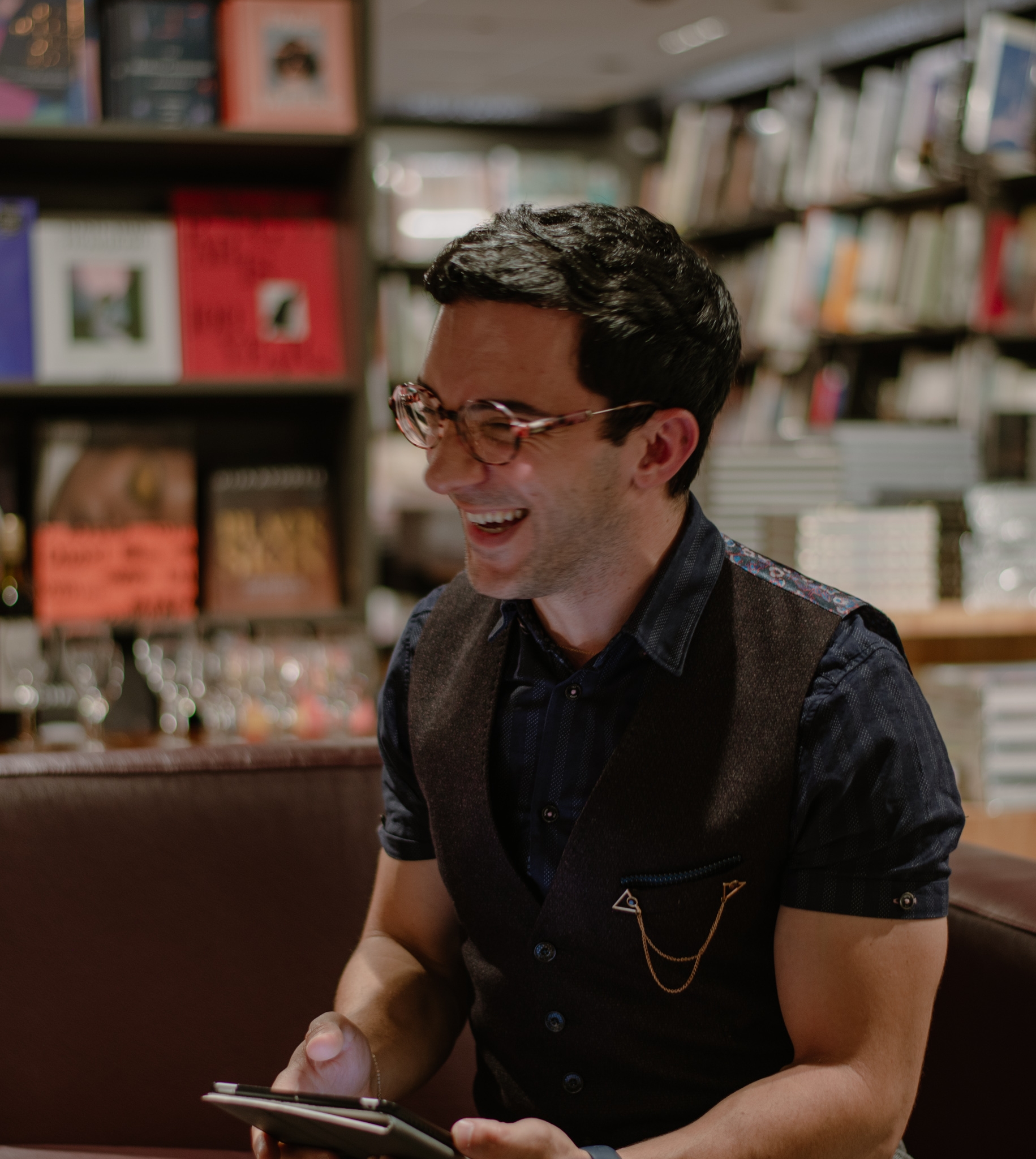
Vector interviews Hoa Pham

Hoa Pham is the author of eight books and a play. Her last book Empathy is also out with Gold SF. Her first novel Vixen won the Best Young Writer Award from the Sydney Morning Herald and was shortlisted for the Best Fantasy Novel Aurealis Award. Her novella Wave was translated into Vietnamese. Her play Silence was on the VCE Drama List. More about her work can be found at www.hoapham.net.

Spoiler alert: for the end of The Other Shore

Does your novel The Other Shore have an origin story, what inspired the book?

The Other Shore was inspired by the existence of a Vietnamese government psychic bureau who reunited the remains of the war dead with their descendants. A BBC documentary was made about it in 1996 – so it must be true. I haven’t seen the documentary so I have been free to make up my own world of psychics and spirits. To me the very existence of the bureau poses interesting questions about the Communist government, when they first came to power they denounced all ancestral worship and Buddhism as being contrary to the creed of the new nation. However this stance has softened as it has become evident that the spirituality of the Vietnamese people is not easily oppressed. There is now state sanctioned Buddhist monasteries and other religions are tolerated such as the Cao Dai and Christianity. The government has done a U turn, inviting formerly exiled Zen Master Thich Nhat Hanh to teach on pilgrimage in the country in 2007, in order to be admitted to the UN security council- they could not be seen to be oppressing religious activities.

How are the wishes of the dead taken into account? Is it always clear who wants to be reunited with whom?

My questions in the novella revolved around a single premise- how can you reconcile the ethics of the dead where there are no sides, with working for the communist government as a psychic? The stance of the Vietnamese government regarding the Vietnam/American War is complex, they have made peace with the Americans but have not laid aside enmity towards the South Vietnamese war veterans that fought alongside them-the so called Imperial puppet forces. So if a government employed psychic came across the remains of the Southern dead what is s/he to do? All ghosts wish to be reunited with their descendants so they can look out for them and receive offerings in the cosmology of the novella.

It is interesting that the story is told from the perspective of the mediator,  please tell us more about her.

I made my protagonist Kim a young girl of 16, naïve to Vietnam’s recent history to navigate through this ethical minefield. Her guides include Ba- her grandmother, and Buddhist abbots and abbesses that she meets through her work as a psychic. She chooses to reunite the Southern Vietnamese war dead with their descendants against her orders and she ends up defecting to America with an American “missing in action” team including a Vietnamese-American psychic. Finding the remains of the American soldiers “missing in action” issue is also a live one for the US administration today.
Defecting in the actual or to the psychic America? Is the psychic world as divided as the real one? 

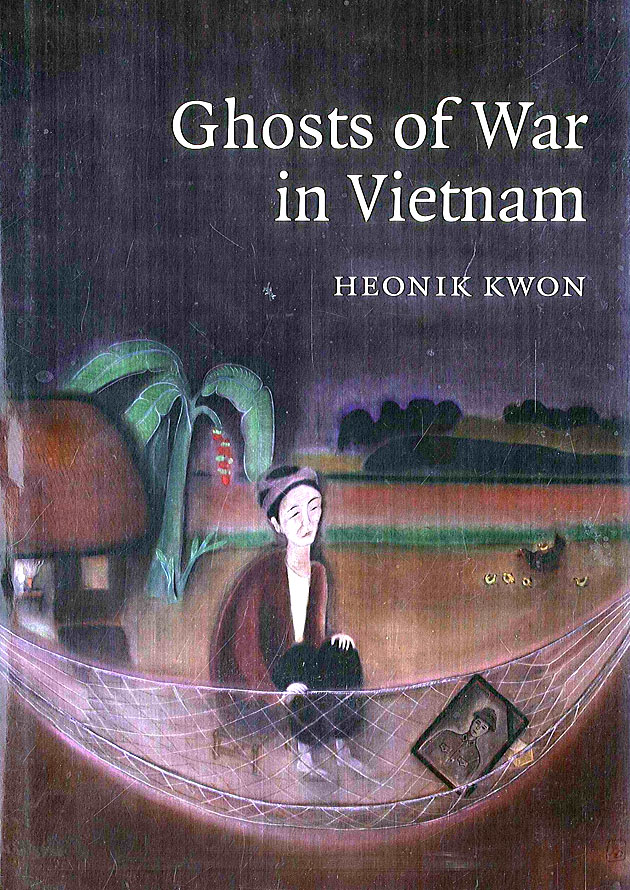
I built the psychic world drawing heavily from “Ghosts of war in Vietnam” by Henrik Kwon a Korean anthropologist who spent two years researching war ghosts in villages. He ascertained that the war dead did not hold sides in Central Vietnam where he investigated, and emphasised the importance of the war dead remains to be reunited with their descendants where possible. With the existence of mass graves holding bodies from all sides of the conflict, local domestic shrines in people’s homes also have altars for wandering ghosts to receive offerings and some measure of peace. 

An ancestral family shrine

That is a moving image of hospitality. Are there no fears that ghosts seeking revenge might show up?

Ghosts seeking revenge are termed “hungry ghosts” and there is a special day for them in mid August where people give offerings to the restless undead.

What of the Buddhism in the book? What philosophy underlies the narrative?

The philosophy of the Buddhists in the story come from Thich Nhat Hanh teachings (called Thay meaning teacher), the Zen Buddhist Master I follow. Thay teaches that mankind are not the enemy, fear and anger are the enemy. He travelled to America in the sixties to lobby for peace in Vietnam and was nominated for the Nobel Peace Prize by Martin Luther King. His pilgrimage in 2007 included Great Ceremonies of Mourning for all those who have suffered in the war. He has said that the Vietnam/American War was a war of ideology pitting brother against brother. He has established monasteries of practice around the world including in America.

The protagonist is responsible for guiding others through a very complicated terrain, what about her own journey?

Kim undergoes an awakening in the book to the possibilities of being a psychic in a democratic country and her potential as a woman. At the beginning of the book she is defined by what she doesn’t have, good looks or a boyfriend. Her sister is getting married and that seems to be Kim’s destiny too. But being a psychic complicates this future She discovers her Buddhist spiritual heritage through her grandmother and the Buddhist abbot she comes into contact with while working for the Communist government. She chooses a Buddhist ethical way to practice as a psychic but it goes against the government orders she has.  She ends up marrying a Vietnamese American psychic for her defection to America rather than for love. 

The statue is of Quan Am the female Buddha

You allude to the role of storytelling in Buddhism, how would you position your novel in relation to Buddhism? 

The Other Shore aims to be an exploration of ethics and the spiritual, pragmaticism and Buddhism. It is a tale whose second edition is dedicated to Thich Nhat Hanh who passed away in 2022 in Hue at his root temple in Vietnam. 

Ghosts are conventionally transparent – you can walk through them – but they’re also opaque because they are radically Other to our lived experience. How did you try to capture that tension of creating characters that are human and yet not entirely knowable?

The benign ghosts I write about are archetypal the wise woman, the maiden etc They all have knowledge of the spiritual realm that Kim as a naive protagonist does not have (and one assumes the reader does not have). In the cosmology that I write from ancestral ghosts are their human selves except they are on the other shore in the spiritual realm. I do not explain every manifestation, Kim takes it on faith and I ask the reader to as well.
Fiona Moore interviews Oghenechovwe Donald Ekpeki

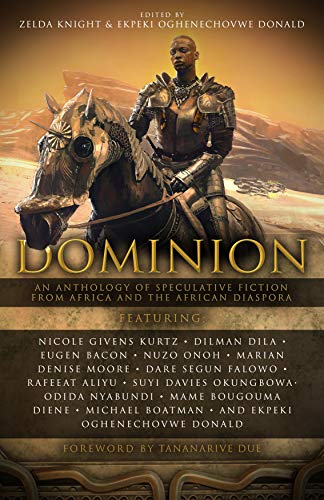
Your “breakout” book was Dominion: An Anthology of Speculative Fiction From Africa and the African Diaspora. Can you tell us how that came about?

Zelda Knight, my co-editor, reached out to me, after publishing my short story “Ife-Iyoku” in their short fiction mag, Selene Quarterly. They wanted to do the anthology and asked if I would like to contribute a story or co-edit. I chose both, and the rest is history. 

You also edited Bridging Worlds: Global Conversations On Creating Pan-African Speculative Literature In a Pandemic. How does editing non-fiction compare with editing fiction?

It’s interesting. More work I believe, as fiction comes naturally to me. I automatically know and have a feel for what I want in fiction. But non-fiction in my experience requires more to get it to say the things it wants to in the ways that’s most fitting. Still as rewarding though. 

Do you see the two works as complementary, or separate, efforts?

I believe they are complementary, like one stream that flows into another. One fed into the other. Naturally, after reading stories by African writers, I felt we needed to hear the story of the storytellers. The story behind the story. 

As well as an editor, you’re also a writer of short fiction. Can you talk about how the two fit in with each other in your life?

I have more of a sense of stories since I started editing. What might work and be needed, in addition to what I want to write. It broadens one’s horizons. 

Do you think you might try writing longer fiction in the future? If so, what?

Yes. Definitely. I have already written and am working on more of those: a novel, and a bunch of novellas. And looking to go on sub after several more drafts. 

You trained as a lawyer. Do you feel like your professional background influences your fiction (and/or non-fiction)?

Yes. It definitely does. Case laws exposed me to so many scenarios and how stories unfold in real life. Legal reasoning meanwhile allows you to be able to parse your thoughts in a manner that’s very helpful with non-fiction.

What does Nigeria, as a writing scene, bring to the SFF world?

As the largest Black nation on earth, with over 200 million people of hundreds of languages and ethnic groups, a wealth and beauty of diversity, Blackness and the African continent. 

Africa, and Nigeria in particular, seems to be breaking out on the genre scene. Why now, and what can the SF writing community do to sustain this breakout?

I would say it’s a combination of the culmination of the work done consistently over decades to build some sort of structures, like the Nommo award, African speculative fiction society, and the hard work of writers coming today. 

Continue reading “Fiona Moore interviews Oghenechovwe Donald Ekpeki”

Beastly Modernisms reviewed by Paul March-Russell

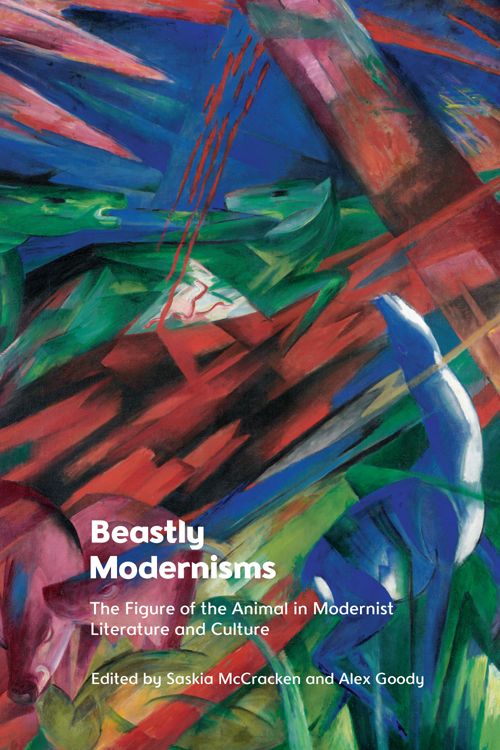
Beastly Modernisms: The Figure of the Animal in Modernist Literature and Culture, eds. Saskia McCracken and Alex Goody (Edinburgh University Press, 2023)

Reviewed by Paul March-Russell

At face value, this collection of essays may not seem to be of immediate interest to the sf reader. It is primarily concerned with the development of Animal Studies – a sub-discipline that has already been significantly explored in relation to sf in the work of Sherryl Vint, Joan Gordon, and others – with reference to literary modernism, a diverse movement already noted for its challenge to traditional notions of identity and individual autonomy. The potential, though, for creative overlaps between modernism, sf and Animal Studies is already indicated by the fact that one of the co-editors, Alex Goody, was a keynote speaker at the 2019 Corroding the Now conference at Birkbeck College, London. Seen through a science-fictional lens, the encounter between human and non-human animals, the slippages between them, and their mutual affinities and kinships immediately invoke the First Contacts and uncanny relations between humans and aliens which are the stuff of genre sf. As the introduction’s reference to Jorge Luis Borges and Karen Eckersley’s chapter on Leonora Carrington make clear, imagined bestiaries are common to both Animal Studies and speculative fiction.

Without seeking to be a guide, the introduction nonetheless touches upon many of the key moments in the evolution of Animal Theory: from Peter Singer’s pioneering Animal Liberation (1975) and Donna Haraway’s ‘cyborg manifesto’ (1985) to Gilles Deleuze and Félix Guattari’s concept of ‘becoming animal’ (1982) and Jacques Derrida’s pivotal essay ‘The Animal That Therefore I Am’ (2002). The introduction also registers many of the other posthuman thinkers whose ideas have contributed both to Animal Studies and this volume in particular; from Giorgio Agamben and Rosi Braidotti to Michel Foucault and Cary Wolfe. The editors however, beginning their account with an exchange between Djuna Barnes and James Joyce (two modernists in exile, both of whom would flit between the centres and margins of the modernist canon), emphasise the affinities between Animal Studies, the revaluation of women’s writing and the decolonising of the curriculum. All such practices foreground and deconstruct the historic imposition of borders, the arbitrary gatekeeping that has characterised academic protocols and the maintenance of cultural shibboleths. To that end, the editors also note the collapsing boundary between ‘high’ and ‘low’ cultures, an elision that not only permits the entry of sf into the conversation, but which would also have appealed to such modernists as Barnes (boxing fan and purveyor of crime fiction) and Joyce (publican’s son, cineaste, and Anita Loos devotee).  

Continue reading Beastly Modernisms reviewed by Paul March-Russell”

We can play more than fantasy cops: An interview with Gabriel Caetano

Hi Gabriel, thanks so much for chatting today. Why don’t you start by introducing yourself and your background in roleplaying games?

Sure. I’ve loved roleplaying games since I was a kid, maybe ten or twelve years old. My first experience was with a Brazilian system called 3D&T. There were a couple of games like World of Darkness that were available too. 

After a break, I eventually got into D&D 5e. I enjoyed it for a while, but I became disillusioned for various reasons. Especially issues with representation. I got involved with communities such as Three Black Halflings. At some point I just realised that D&D was a corporate product that would never actually be any good. It was fundamentally flawed, and couldn’t be fixed, because the people making the money didn’t care.

Then I discovered Wanderhome by Jay Dragon, which uses the Belonging Outside Belonging design approach. That’s a token-based system, that allows for collaborative storytelling without relying on constant dice rolls. Dungeons & Dragons really sets the tone for what many people think roleplaying games can be, but Wanderhome showed me that roleplaying games could be something entirely unique — not just another battle simulator, or game of colonizer make-believe. The community was part of that as well, such as the Wanderhome unofficial Discord (kisses and hugs, if you are reading this!).

So Wanderhome became a way for me to explore more games, and eventually get into game design myself. My first reaction was to go to almost the polar opposite of D&D. Even designing Roots & Flowers, and getting into Solarpunk, was kind of a rebound from D&D. “Let me get this shit out of my system!” Since then I’ve drifted in a few different directions. Now it’s more of a personal, mindful effort to create things I enjoy.

Brilliant, thanks! I want to get into your game design work soon. I enjoyed the recent Game Master Monday actual play of Roots & Flowers. But first, can we talk a bit more about D&D’s issues with representation?

You know, these games often involve stories of venturing into perilous wilderness and grabbing everything you find. It’s a structure that can perpetuate colonialist attitudes. You just take up your weapons, go into someone else’s house, tear shit down, kill everybody, pick up relics and stuff. Then you come back, call everybody you just killed ‘monsters,’ and call it a day. Then the cycle begins again.

Of course Wizards of the Coast will say, “We can improve this, we can fix it.” No, you can’t. It is the core premise of your game. You may be able to make it more and more palatable to certain sensibilities, but it will fundamentally be the same thing. At the end of the day, it’s just about D&D making money, and Hasbro shareholders lining their pockets. It’s for the benefit of a couple white billionaires somewhere. You’ve got to trash it.

You’ve got to trash it, and make something new. You can’t fix it. 

Continue reading “We can play more than fantasy cops: An interview with Gabriel Caetano”

Phoenix Alexander is the new Editor-in-Chief

Vector is building a bigger team and is delighted to welcome a new Editor-in-Chief!

Phoenix Alexander (he/him) is the Jay Kay and Doris Klein Librarian for Science Fiction and Fantasy at the University of California, Riverside, where he curates one of the world’s largest collections of catalogued science fiction. 

He completed his Ph.D. in the departments of English and African American Studies at Yale University, where he also worked as a curatorial assistant at the Beinecke Rare Book and Manuscript Library for three years. Prior to coming to UCR he was the Science Fiction Collections Librarian at the University of Liverpool. 

Phoenix is a queer, Greek-Cypriot scholar and writer of science fiction himself. His work has appeared in The Magazine of Fantasy and Science Fiction, Beneath Ceaseless Skies, Black Static, Safundi: the Journal of South African and American Studies, and Science Fiction Studies. He is a full member of the Science Fiction Writers Association (SFWA), and served as a judge for the Arthur C. Clarke Award for 2021 and 2022.  

Bittersweet Utopias: An interview with Kellynn Wee

We were lucky enough to chat with Kellynn Wee, researcher and designer of tabletop roleplaying games, about solarpunk, utopia, memory, narrative and chance, the TTRPG scene in Singapore, and much more.

Hi Kellynn. Why don’t you start by introducing yourself?

Sure, my name is Kellynn Wee, and I’m currently a PhD candidate at UCL. I’ve been looking at play communities in Singapore, and how players relate to fantasy and speculative worldbuilding in tabletop roleplaying games. I have a background in anthropology, so I’m interested in the social relationships and meanings that emerge from these play communities – in how games can become sites to explore different relationships and identities, and how games allow us to deal with different forms of value, different approaches to uncertainty, or new ways of imagining the self. I’ve also been working on a climate futures game, Move Quietly and Tend Things, which I describe as a bittersweet utopia. 

This research involves a lot of playing games, right?

Oh for sure. I’ve never played so many games in my life! I recently calculated and it was nearly 250 games in about twenty months of ethnography, which should kill my passion for games, but somehow hasn’t. And I think that’s a good sign.

Wow! Has the play sometimes felt like work?

It’s a good question. There are always interesting tensions between play and work, right? Have you read Play Money by Julian Dibbell? It’s about quitting his day job and becoming a full-time loot farmer …

No, but that sounds kind of up my street.

Well, there were definitely games that felt like drudgery. I think it’s because of the volume of games I played. Some games just didn’t spark. It might be the dynamics of the players at the table, the kind of energy people are bringing to it. Roleplaying games are so dependent on the particular constellation of individuals at that point in time. 

Right.

But even when they don’t quite spark, it’s not exactly like work. I mean, I still had fun!

That’s good! I guess ‘work’ and ‘play’ is one wobbly binary, and then ‘work’ and ‘fun’ is another wobbly binary? There is some interesting writing by Bo Ruberg about the variety of emotions associated with play — fun is an important one, but it’s not the only one.

Sure.

You are researching the games and the players and the communities. But can I ask about games themselves as research tools? I’m wondering how games and play have been used in anthropological research historically, and whether you see potential for using them in new ways in the future.

Well, it’s pretty common for games to be pedagogical tools, right? They’re ways to place students into an anthropological frame of mind. I know that games have been successfully used to reframe research findings beyond textual outputs. For instance, I recently attended a talk by Andrea Pia, who designed a game for students to explore the topic of Chinese rural migration. They transformed their research into an interactive digital narrative where you’d make choices for a migrant character to proceed through the world, and it used photos, videos, quotes and characters that derived from Pia’s fieldwork. 

That sounds interesting.

Yes, it was really interesting. Using games as research methodologies though? Maybe that’s something that hasn’t been explored all that much, or at least it’s something I’ve yet to fully grasp myself. I wonder why not though, right? Playing, especially role-playing, and ethnography share many principles. The first thing that comes to mind is the art of asking questions well. There’s this act of iteration, of only understanding whether a method works by doing it, and then coming back to ask what sort of tools or approaches you need to get to an understanding that you want. There’s the act of making the implicit explicit, of paying attention to what is unsaid as much as what is said. There’s the consideration of different relationships, different identities, how people are going to come together and interact in the same space. There’s this element of sharing sensorial or bodily space. 

These are all aspects that anthropologists pay attention to. And so do tabletop roleplayers. A roleplaying game can also make aspects of relationships and elements of social currency visible. I also think games can act almost like a kind of meta-reality tool. While anthropologists and other social scientists often act on the principle of making the familiar strange when thinking about their work, I think games can often carry out the opposite act of making the strange familiar–exploring peculiar worlds and peculiar viewpoints by using everyday tools that help us frame our capacity for action regardless of the circumstances. So yes, many game practices resemble ethnographic practices and ethnographic thinking. It’s exciting to think what might be done with that, but it’s still a question I’m exploring. 

Your answer is making me think of this interview as a very rules-lite roleplaying game.

Should I roll some dice?

Continue reading “Bittersweet Utopias: An interview with Kellynn Wee”

Ambitopia: Futures Beyond the Binary

By Redfern Jon Barrett

We live in a golden age for speculative fiction. Futurist novels, shows, and movies have achieved a cultural saturation which would have been difficult to foresee just a couple decades ago, largely thanks to our increasingly unpredictable and perilous world. But rather than simply doling out temporary escapist relief, speculative stories help us comprehend our own cultures and their problems. Often, contemporary issues are approached via one side of a binary: either they’re exaggerated, showing us their destructive potential via a dystopia, or else they’re understood via their solution, producing a utopia.

So far, so obvious. But why are utopia and dystopia the genres we use to exaggerate and comprehend our own societies? Human communities are not structured according to a simplistic binary, instead being dependent on ever-changing laws, ideas, and social conventions. We know that truth ultimately lies in shades of grey, so why do black and white narratives still predominate in speculative fiction? Is this binary still useful as we wade deeper into the 21st century? What alternatives are out there?

Binary Problems

A few years ago the speculative writer Laurie Penny and I were interviewed on the subject of utopia. Penny, who is also a prominent journalist, posited a serious problem with utopias: namely, that the desire to create an idealised society has been used to justify numerous atrocities throughout our own history. Considering the many massacres committed in the name of a perfect world – theocratic, eugenicist, nationalist, agrarian, or Communist – it’s a difficult point to argue with. In Penny’s words, “true utopia is fascism”, underscored by a rigid set of idealised rules, unable to ever truly change or adapt; at best stagnant, and at worst, totalitarian.

Continue reading “Ambitopia: Futures Beyond the Binary”