By Redfern Jon Barrett
We live in a golden age for speculative fiction. Futurist novels, shows, and movies have achieved a cultural saturation which would have been difficult to foresee just a couple decades ago, largely thanks to our increasingly unpredictable and perilous world. But rather than simply doling out temporary escapist relief, speculative stories help us comprehend our own cultures and their problems. Often, contemporary issues are approached via one side of a binary: either they’re exaggerated, showing us their destructive potential via a dystopia, or else they’re understood via their solution, producing a utopia.
So far, so obvious. But why are utopia and dystopia the genres we use to exaggerate and comprehend our own societies? Human communities are not structured according to a simplistic binary, instead being dependent on ever-changing laws, ideas, and social conventions. We know that truth ultimately lies in shades of grey, so why do black and white narratives still predominate in speculative fiction? Is this binary still useful as we wade deeper into the 21st century? What alternatives are out there?


Binary Problems
A few years ago the speculative writer Laurie Penny and I were interviewed on the subject of utopia. Penny, who is also a prominent journalist, posited a serious problem with utopias: namely, that the desire to create an idealised society has been used to justify numerous atrocities throughout our own history. Considering the many massacres committed in the name of a perfect world – theocratic, eugenicist, nationalist, agrarian, or Communist – it’s a difficult point to argue with. In Penny’s words, “true utopia is fascism”, underscored by a rigid set of idealised rules, unable to ever truly change or adapt; at best stagnant, and at worst, totalitarian.
Not only that, but it’s a rare utopia which sees a powerful way forward without, you know, killing or getting rid of most people. I’m personally a huge fan of Marge Piercy’s Woman on the Edge of Time, having given multiple papers and presentations on the book, but the utopia it presents is only possible following a devastating war that saw the demise of most of the human population. I also love Star Trek, but the Federation could only come about with… oh yes, a devastating war that saw the demise of most of the human population. Even the more benign version, founding a utopian society in the wilderness a la Ursula Le Guin’s The Dispossessed or Kim Stanley Robinson’s Red Mars trilogy, requires us starting all over again – with considerably fewer than billions of people.
It’s telling that so many fictional utopian societies require so much death or isolation. It may be a cliché to say the ends justify the means, yet such moral bargaining for the sake of ideology has been a great driver of real human suffering. We’ll do anything for a perfect world.
Yet dystopia isn’t exactly off the hook, either. It’s a genre I happen to love, and I’ve certainly written dystopian stories, but there are very real issues with its potential impact on our own worldviews and mindsets. My own argument was that envisaging and representing future realities alters our expectations and brings them closer into being: Orwell’s most famous work, for an obvious example, did nothing to prevent the rise of the surveillance state, and in fact there’s an argument to be made that his work in fact brought about a sense of inevitability when it comes to intrusive technology. The same can be said for cyberpunk and unrestrained capitalism, or Yevgeny Zamyatin’s We and totalitarianism, or Oryx and Crake and, well, everything.
Of course, we shouldn’t abandon either genre. But if we truly want to understand our own potential via speculative fiction, we can do better than the binary.
Enter Ambitopia
What if we were to play to the strengths of each genre, weaving the potential inherent in both utopia and dystopia into richer stories, and more complex futures? By incorporating both utopian and dystopian extremes within a single environment, we can explore the true potential for change in our own world – for the better and the worse – while engaging in thought experiments that are more emotionally complicated and politically nuanced. These aren’t societies simply born of mundane neutrality: dramatic extremes form the heart of ambitopia.
Of course, as Margaret Atwood points out, every utopia contains an element of dystopia (and vice versa) – a phenomenon she refers to as ‘ustopia’. Ambitopias take this concept a step further; consciously writing societies of extremes which are still rooted in ambiguity, much like our own world, is a different challenge than finding light in the darkness, or darkness in the light. Ambitopias form a careful balancing act, forming a cohesive and believable society that cannot be categorised as either good or bad, yet one which is still dramatically speculative.
In short, an ambitopia presents a world both distinctly better and worse than our own. Since I first articulated the concept in the article with Laurie Penny, the idea of ambitopia has inspired essays and thinkpieces, been discussed in academic theses, journals, and has even inspired the naming of a radio show: Sounds Toward A Queer Ambitopia, by the interdisciplinary artist and composer Yann Novak.
It’s a simple enough concept, but one which has struck a chord with people. Ambitopias can be a powerful storytelling tool for our own times, as generations of societal struggles rise to the surface, dominating public discourse in a whole new way.
That’s right, it’s time to discuss everyone’s favourite subject: political oppression.
We Need Ambitopia
For me, and for a lot of people, the desire for ambitopia is more than a little personal. As a person almost two metres tall who wears both makeup and a beard, I’ve experienced a lot of unwanted attention – which is a polite way of saying abuse, aggression, and violence. This behaviour isn’t even limited to the past: my partner and I recently had a glass bottle thrown at us, in the street, in the middle of the day, because we were holding hands and I was wearing eyeshadow. I can’t begin to describe the fear, rage, and self-doubt this evokes: is it my fault for being openly queer? Did me being nonbinary put the person I love in danger? Is worse to come?
That’s horrible, you might think, but what does it have to do with speculative genres? Well, it leads to another problem when it comes to the utopia/dystopia binary: for people living in a state of social anxiety, whether due to their queerness, Blackness, poverty, or anything else, dystopia can simply be too much. I couldn’t finish watching The Handmaid’s Tale (despite loving the book), because I couldn’t devote so many hours into a future where I’d be dead. It’s too much when I’m already worrying for my safety.
More bleakness? The world is bleak enough as it is. And this isn’t something limited to the marginalised: it’s become normal to feel profound anxiety about the future, caught as we are in an extreme mix of better and worse outcomes. It’s been amazing to witness the increasing legality of same-sex marriages, as much as it is terrifying to watch demagogues demonise trans youth. There are fewer people living in global poverty, but people’s lives are upended by poor housing policies and inadequate social safety nets. Solar is now cheaper than coal, but somehow the skies still flood with carbon.
Time to focus on the positive, you might think. And that can help, sometimes – but how can we really relate to a perfect future? How can a pristine, whitewashed world be really relevant to people at a time of social upheaval, ravaged ecosystems, and rising fascism? You might as well be promising me a better world awaits in the afterlife.
I started writing ambitopia before even coming up with a term because it felt natural to me. I need optimism like a drowning person needs driftwood – it might not fix all my problems, but it keeps me from going under. Yet singular optimism feels hollow, akin to an offhand You’ll be all right or Things will get better, well-meaning and patronising at the same time. I want – need – hope for a better world, but for many of us the current world contains plenty of dystopia, and waving it away does us no good. Speculation needs darkness to be relatable.
Ambitopian societies incorporate both utopia and dystopia, while being defined by neither. Not only does this allow for a more multifaceted approach to social reflection and worldbuilding – reflecting on outcomes both positive and negative – but it also increases the agency of the world’s inhabitants. Ambitopia can foreground acts of solidarity and resistance in the face of oppression, meaning people aren’t merely represented as passive victims, but active agents of their own futures. Rather than being wholly shaped by the utopia or dystopia around them, ambitopian heroes can both shape and be shaped by the world.
Nonbinary Thinking
Since coming out as nonbinary I’ve thought a lot about binaries in general, far beyond the societal straightjacket of gender. To restrict ourselves purely to binary thinking is to place strict limitations on who we are and what we’re capable of – both individually and as a species. Yet, while the influence of a good/evil framework has eroded over the centuries since the Enlightenment, our fiction still uses this model to understand our own potential. We would (hopefully) never identify our own complex and confused world as merely good or bad, but we’re perfectly prepared to entertain the idea that our futures may flatten into binary simplicity.
While queer theory has largely focused on breaking down sexual and gender binaries – heterosexual, homosexual, man, woman – a queer lens can subsequently be applied to all walks of life. In a recent conversation I had with the nonbinary author Meg-John Barker, we discussed de-binaried approaches to religion, morality, and psychology; all of which naturally followed from exploring our own gender identities. Along with their writing partner Alex Iantaffi, Barker has written extensively on nonbinary philosophy and its many personal, social, and cultural applications, most notably in their 2019 work, Life Isn’t Binary.
Writing Ambitopia
When we break down a binary we wind up with something more than the sum of its parts. In questioning the nature of masculinity and femininity, deconstructing each and applying elements of both, I’ve connected with myself in ways I never could have expected. As an author I want to expand my approach to speculative worlds in the same way I’ve expanded my approach to my own identity. It might seem obvious, but to me, ambitopias are nonbinary storytelling.
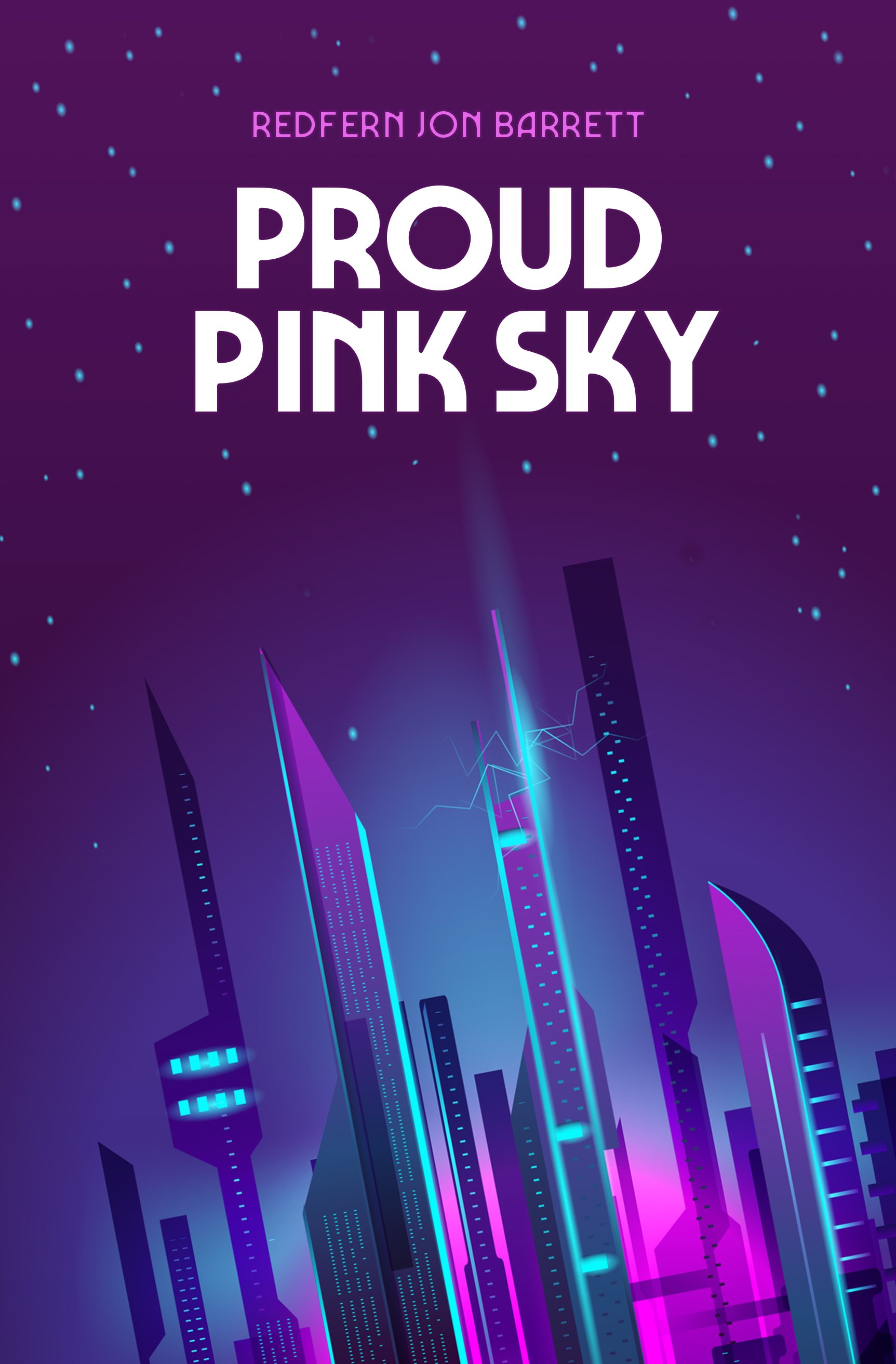
Inspired by twenty years of LGBTQ+ community organisation, my speculative novel Proud Pink Sky could only ever be an ambitopia. Set in the world’s first gay state, it would be misleading to present such a scenario as utopian, and dishonest to present it as dystopian. For better and for worse, the queer world is also one of extremes, where radical solidarity, joyous experimentation, and open forms of love play out alongside often-vicious transphobia, systematic gatekeeping, and a whole new sense of conformity. After the giddy thrill of coming out comes the disheartening prospect of being boxed in.
This elitist, segregated, generous, chaotic, and ever-shifting society forms the setting of Proud Pink Sky, exaggerated within the confines of a glittering cyberpunk city-state, where queer subcultures descend into sub-subcultures, each with their own carefully demarcated boundaries: districts especially for bears, twinks, butches, or femmes. The borders of sexual and gender identity are physically marked upon the city itself, dividing what should be a shared experience into a rigid social hierarchy, while still providing recognition and shelter from a homophobic world.
Queer societies often contain extremes which simply aren’t found in Western cishet culture, and these extremes became the focus of the novel itself. Despite the simplicity of public debate, our diverse and disparate communities cannot be categorised as simply good or bad. Only in exploring both the utopian and dystopian aspects of a gay state can we gain a multifaceted understanding of LGBTQ+ cultures and mindsets as they exist today. There are countless other communities which would benefit from an ambitopian imagining.
Beyond the Binary
Utopias and dystopias ultimately inform our vision of the future, being vehicles for our own hopes and fears. Just as 1993’s action-dystopia Demolition Man represents conservative fears of a politically-correct society, and the Star Trek franchise the embodiment of the Humanist ideal. We’ve all seen Orwell invoked when someone fears a political or technological development.
The point is, we do take our speculative visions very seriously. Yet utopia and dystopia have never really been binary opposites. Each feeds the other, with advances in one direction often sparking dire and unpredictable outcomes somewhere else. We would consider it particularly odd to apply such a dualistic logic to the past: imagine a history paper which asked ‘Was the Roman Empire ultimately good or evil?’ or ‘Was the development of Mesoamerican society positive or negative?’ Human history has always been a mix of extremes: we may see the Renaissance as a time of higher learning and empathic Humanism, yet it was also the period in which the burning of women for witchcraft and the mass executions of men for sodomy truly began in earnest – not to mention the first stirrings of colonial genocide.
As exemplified in David Graeber and David Wengrow’s best-selling account of human history, The Dawn of Everything (2021), we are flexible, context-driven creatures, always projecting and self-reflecting, forever engaging in monstrous and benevolent experiments. We may vary, often dramatically, but never wholly for the better or the worse.
Conclusion
Ambitopia lets us embody our anxieties in a way that’s grounded yet imaginative – both grasping the positive and negative potential in a society, while also taking such potential to its logical extremes. We need both hope and despair – as Agent Smith of The Matrix (1999) so famously speculated:
“Did you know that the first Matrix was designed to be a perfect human world? Where none suffered, where everyone would be happy. It was a disaster. No one would accept the program.”
We struggle to recognise a world without suffering: as I pointed out earlier, speculation needs darkness to be relatable. To believe otherwise is to wipe out an entire side of human nature, just as attempts to build a perfect world so often end up destroying many real, living humans. We represent the most positive and negative aspects of our kind, mixed together, forever making things unimaginably better and worse – and we would benefit from more idealised worlds that acknowledge the many contrasting aspects of ourselves.
Because ambitopia is something very human, ever-pushing at boundaries with considerably mixed results, and in order to understand our own societies we need to tell stories which recognise that progress isn’t linear, that the world is forever shifting in both better and worse directions. Our past highlights the very best and worst that humanity has to offer, and few would argue that the present is any different. Whatever the future holds, we can be sure it will be one of extremes: if we were to witness our world in another few centuries, it would appear simultaneously utopian and dystopian.
It would look, to us, like an ambitopia.
 vector-bsfa.com
One thought on “Ambitopia: Futures Beyond the Binary”