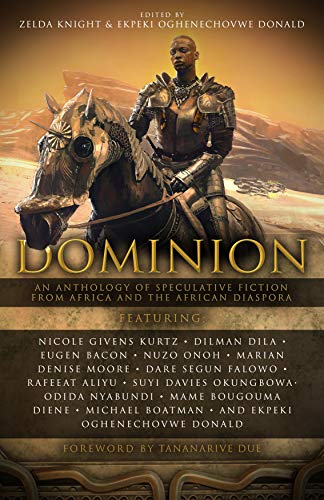
Your “breakout” book was Dominion: An Anthology of Speculative Fiction From Africa and the African Diaspora. Can you tell us how that came about?
Zelda Knight, my co-editor, reached out to me, after publishing my short story “Ife-Iyoku” in their short fiction mag, Selene Quarterly. They wanted to do the anthology and asked if I would like to contribute a story or co-edit. I chose both, and the rest is history.
You also edited Bridging Worlds: Global Conversations On Creating Pan-African Speculative Literature In a Pandemic. How does editing non-fiction compare with editing fiction?
It’s interesting. More work I believe, as fiction comes naturally to me. I automatically know and have a feel for what I want in fiction. But non-fiction in my experience requires more to get it to say the things it wants to in the ways that’s most fitting. Still as rewarding though.
Do you see the two works as complementary, or separate, efforts?
I believe they are complementary, like one stream that flows into another. One fed into the other. Naturally, after reading stories by African writers, I felt we needed to hear the story of the storytellers. The story behind the story.
As well as an editor, you’re also a writer of short fiction. Can you talk about how the two fit in with each other in your life?
I have more of a sense of stories since I started editing. What might work and be needed, in addition to what I want to write. It broadens one’s horizons.
Do you think you might try writing longer fiction in the future? If so, what?
Yes. Definitely. I have already written and am working on more of those: a novel, and a bunch of novellas. And looking to go on sub after several more drafts.
You trained as a lawyer. Do you feel like your professional background influences your fiction (and/or non-fiction)?
Yes. It definitely does. Case laws exposed me to so many scenarios and how stories unfold in real life. Legal reasoning meanwhile allows you to be able to parse your thoughts in a manner that’s very helpful with non-fiction.
What does Nigeria, as a writing scene, bring to the SFF world?
As the largest Black nation on earth, with over 200 million people of hundreds of languages and ethnic groups, a wealth and beauty of diversity, Blackness and the African continent.
Africa, and Nigeria in particular, seems to be breaking out on the genre scene. Why now, and what can the SF writing community do to sustain this breakout?
I would say it’s a combination of the culmination of the work done consistently over decades to build some sort of structures, like the Nommo award, African speculative fiction society, and the hard work of writers coming today.
The rise of virtual and hybrid conventions worldwide seems to have been a positive thing for the visibility of African writing. As someone who’s been a virtual guest at a number of cons, do you feel it was a help in your case?
Immensely. With conversion rates of foreign currency and the economy what it is, not to mention visas and immigration, it had been impossible for Africans on the continent to really participate in genre events. But with covid and virtual cons, that became more possible.
What can the sf community do to help improve participation from African writers?
Well, recognizing that the landscape and terrain here is different, access is a real issue, not to mention obstacles like language, resources, amenities. Simply realizing and understanding this will reflect in how we interact with African writers and the hoops they have to jump through to overcome these barriers and obstacles. And that in turn can encourage more participation. But not recognizing them, and subjecting us to the same standards that you’d hold Western, European or Global North writers to, will definitely do the opposite and discourage participation. Telling us that the only way we can show up is not good enough, without providing any alternatives that work is simply telling us not to show up.

Your latest book is Between Dystopias: The Road to Afropantheology. Can you define Afropantheology as a genre and how it fits into the wider SFF world?
There’s a whole essay coming up, and the Introduction of the book to do that. Not to mention my guest of honour ICFA plenary. You’ll have to get the book to see some of these. Pre-order link here.
But very briefly, I’ll say that Afropantheology, like the name sounds, is one in conversation with Afrofuturism. Different sides of the same coin of perception, as origins and cosmologies are to futurisms. Time bring as they say, relative. Also, the Afropantheology collection got a starred review on Publishers Weekly, which you can see here.
How does this conversation go? Is pantheology complementary to futurism? Antithetical to it?
Complementary, adjacent if you will. Different points of a spectrum or sides of a coin. Whichever you prefer. It makes a lot of sense if you think of time as a circle instead of a straight line. History being something that as we say, repeats itself. So the past is constantly reoccurring and the path of the future constantly takes us back to history, culture and the things we think we have left behind, if only in different forms.
Can you outline the connection between dystopia and Afropantheology implied in the title?
These are connected. Dystopia interrupted Afropantheology. Africa’s pantheology. Slavery, colonialism, post and neo colonialism. But we must find a way, a path through the fires of dystopia to the promise and reality of pantheology. That is what the book, and pantheology aims to do.
How are we moving towards finding this path?
We are doing that by rediscovering our connection to African spirituality, defined as what it is, rather than through the sieve of western and colonialist terms as we have for centuries. Names as we say have power. As do framings and definitions. So seeing the thing for what it is, calling it what it is, Pantheology, acknowledging the source and thrust of these stories and re-examining them under this new sieve is going a long way on that path.
What authors or works would you say exemplify Afropantheology?
A number of my works do that. Like my Otherwise, Nommo-winning, Nebula-nominated novella Ife-Iyoku, The Tale of Imadeyunuagbon. Tobi Ogundiran’s Guardian of the Gods, forthcoming on Tordotcom, Wole Talabi’s Shigidi and The Brass Head of Obalufon, Ehigbor Okosun’s Forged by Blood, Tomi Adeyemi’s Legacy of Orisha series, Masquerade by O.O Sangoyomi, the works of Tendai Huchu, Cheryl Ntumy, and many such works featuring the Orisha, other deities and systems of African spirituality.
As there’s Afrofuturism and African futurism as distinct genre trends, is there an African pantheology as distinct from Afropantheology
When I think of it, Afro- actually means African. Thus, Afropantheology is African pantheology. In my execution of Afropantheology, like in all my other projects, I work for it to cover all of Africa, it’s different flavors in it’s being non-monolithic. All the different groups that lay a claim to and all peoples of African descent are welcome to Afropantheology. My WFA winning Year’s Best African Speculative Fiction anthology for example had both Africans on the continent and in the Disapora, Black people the world over. Same with my Locus nominated Bridging Worlds: Global Conversations On Creating Pan-African Speculative Literature In A Pandemic. Same with the Locus winning, WFA, NAACP Image awards mominated Africa Risen: A New Era of Speculative Fiction. All my projects as I said, aim to encompass and embrace all of Africa, in an effort at unification, while still acknowledging and celebrating all our different and diverse flavours.
And finally, the dad jokes. What inspires all the puns all over your social media?
Jokes? What jokes? Those are my most profoundest nuggets of wisdom. They birthed Ekpeki’s first law – The existence of one thing implies the existence of other closely related things…😄
Tell us about any of your new projects, or other future activities.
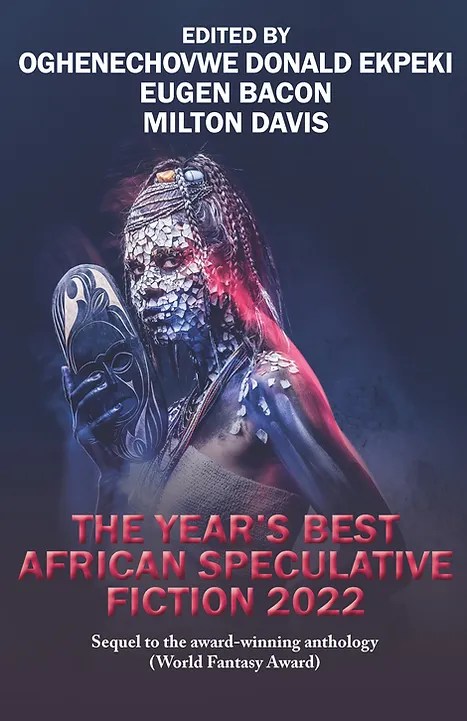
There’s a bunch. I’m now a member of the IAFA board, and the VICFA conference co-ordinator. And our next VICFA conference this November will be titled AAAA! – AI, Automata, Algorithms and Art. And our guests of honour will be Steven Barnes, Annalee Newitz and Martha Wells. In addition to that, the Year’s Best African Speculative Fiction anthology volume 2 is out and you can get it here. There’s a couple more things in the horizon, but that’s what I can talk about right now.

 vector-bsfa.com
One thought on “Fiona Moore interviews Oghenechovwe Donald Ekpeki”