
Michael Butterworth is a UK author, publisher and editor. He was a key part of the UK New Wave of Science Fiction in the 1960s, contributing fiction to New Worlds and other publications. In 1975 he founded Savoy Books with David Britton, co-authoring Britton’s controversial novel Lord Horror. In 2009 he launched the contemporary visual art and writing journal ‘Corridor8’. His latest works are the eponymously titled Butterworth (NULL23, 2019) – a collection of his New Wave-era fiction – and a novel, My Servant the Wind (also NULL23), based on his 1971 writing notebooks, which develops themes found in his early writing and Complete Poems.
Jean-Paul L. Garnier is the owner of Space Cowboy Bookstore, producer of Simultaneous Times Podcast, and editor of the SFPA’s Star*Line Magazine. He is also the deputy editor-in-chief of Worlds of IF & Galaxy Magazines. He has written many books of poetry and science fiction.
JPG – On top of being the author of many books (SF and otherwise), you’ve also had a tremendous output as an editor. How have these two roles played off each other, or interfered with each other, and how have you found a balance between the two?
MB – They are not separate. I started publishing and editing magazines and later books when J. G. Ballard, who collaborated with me on two pieces of fiction for New Worlds, told me I needed to be more prolific. I’m not a prolific writer, or wasn’t then, so I began exploring the idea of publishing. I published work that I liked, and discovered I could move between the two literary forms in alternation, and that they fed off one another, and writing and publishing are all the stronger for it. The only sense in which they ‘interfered’ with one another is that I sometimes got impatient with the view that a publisher is not a creative entity. I felt that I was not being properly assessed as a writer, and that my contribution to the New Wave of SF, and the direction in which I eventually took it with Savoy Books, was being overlooked. I still feel that only parts of my career have been seen, and that the dots haven’t been joined. I am using past tense because, apart from a couple of Savoy projects, still ongoing, publishing may have finally run its course with me, and I’m busy writing. But never say never.
JPG – When, where, and how did Savoy Books come into existence, what was the catalyst for starting the publishing house, and how did your partnership with David Britton begin?
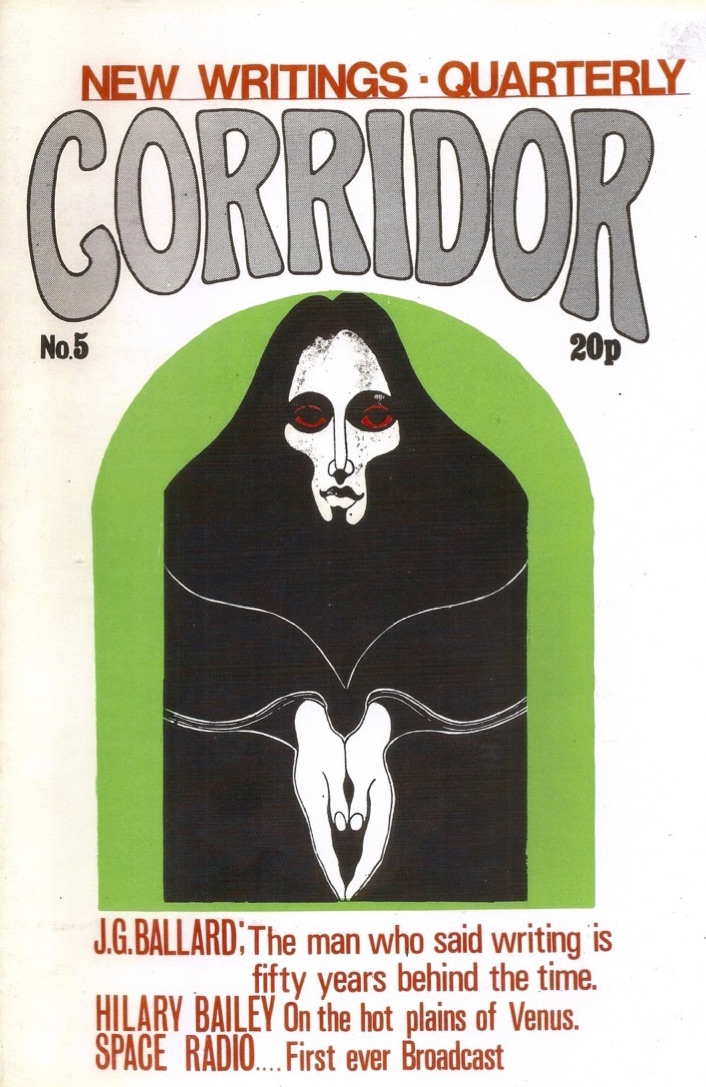
MB – Savoy Books started in Manchester, in 1975. It grew out of my magazine publishing, which started in 1968 with Concentrate, a large four-page broadsheet by different authors devoted to condensed writing. I took its name from the two pieces Ballard had helped me knock into shape, ‘Concentrate 1’ and ‘Concentrate 2’. It was the same subbing process Burroughs used, which was essentially a journalist’s technique to isolate only the best or most relevant writing from a piece of work. He was applying the technique to his condensed novels, and he wanted to show me how to do it. Concentrate was distributed as a free insert in New Worlds and Ambit. After one edition it morphed into Corridor, launched in 1971 and a more conventionally styled magazine, which was my take on New Worlds. I was still comparatively young and had not long sold my first professional piece to New Worlds at the age of nineteen. Corridor ran for five issues before undergoing a title change to Wordworks, a more avant-garde affair, which ran for two issues, cut short by the start of Savoy Books. I met Dave through Corridor in 1971 because we happened to share the same printer, John Muir. John introduced us, and Dave joined Corridor as designer and Art Editor from issue #4, after my original designer left. The edition carried a review of Burroughs’ The Wild Boys by J Jeff Jones and also contained the first publication of Michael Moorcock’s Jerry Cornelius story, ‘The Swastika Set-Up’, which Dave illustrated for me. We got on well together, and when I came to do Wordworks, a more expensive production, he co-published it with me. In return, he got his own pages in the magazine. I had managed to get a pre-publication extract from Mike’s The Hollow Lands and he illustrated this, and for the next issue published a portfolio of the underground artist Jim Leon. Working together like this led to us doing Savoy Books, which was started in 1975 with Stormbringer, an oversized black-and-white adaptation by James Cawthorn of Mike’s novel. It was followed by Sojan, a paperback collection of Mike’s early sword & sorcery stories taken from Tarzan Adventures, and The Savoy Book, a collection of fiction and art compiled from the contents of our magazines and containing an original story by M. John Harrison, ‘The Incalling’. We continued from there. Hannah Nussbaum’s paper on me when she was a master’s student at the Royal College of Art, about how Savoy was a fusion of my avant-garde sensibilities with Dave’s ‘punk’ (actually 50s rock and roll) and our leanings towards fantasy, is very perceptive. Her ‘An Inward-Looking Outer Space: A Brief History of Corridor’, published on the Corridor8 website, is also very good:
More prosaically, Savoy came about due to our livelihoods. We both had money to put into the venture. Dave had his book shop, and I had a very good career writing fantasy books, plus our mothers helped as guarantors and in other ways, and by then we had also built up the right contacts to launch a mass market publishing house. Dave was in business with Charles Partington when I first met him, and so it’s correct to say that Charles was also a co-founder of Savoy but left after Stormbringer was published and began a more lucrative career as a printer. I think he was disillusioned by the slow monetary returns of publishing.
JPG – How and when did Corridor morph into the contemporary arts and writing journal Corridor8, and did the journal retain any of its science fiction roots?
MB – There was an almost forty-year gap between the two magazines, and Corridor8 came about due to a whole series of things. I wanted to get back into magazine publishing. My father had died leaving me some money, and my wife said, “well, why don’t you publish one?”—very brave (or stupid!) of her—and at the time we had watched a television programme about architect Will Alsop’s concept of a linear city forming along the Transpennine motorway across the neck of England, stretching from Liverpool to Hull. Rather than have ribbon development ruining the countryside, huge edifices the size of small towns would be strung along the motorway at intervals. Another driver was an interest in conceptual art. I wanted to learn about that, and so the idea of relaunching Corridor as a contemporary visual art magazine came to me. The circles I was moving in at the time meant I was also getting to know artists, three in particular, and they became the first editors of the journal. A further influence on me was an innovative bespoke creative design company I’d discovered, who took charge of the look of the magazine. The first edition had Will Alsop’s linear city as the theme, the idea being that Corridor8 would look at Art in the Supercity, that is, contemporary art in the North of England today, and that’s what we did. The designers came up with a tall, oversized journal that represented the city’s conjectured linear nature, and I commissioned Iain Sinclair to write two long commentaries. Iain made two reccies of the region, one by car with Chris Petit from Hull to Liverpool and then again with his wife by bus pass in the reverse direction. (Free bus passes for people who were reaching pensionable age had then just come in and were still a novelty.) Iain was guest speaker at the magazine’s launch, at Urbis Museum of the City (now the Museum of Football), Manchester, and also undertook a Manchester walk, the transcript of which I ran in the second edition. The articles for Corridor8 eventually formed the ‘North’ section of his 2012 book Ghost Milk: Calling Time on the Grand Project. The new Corridor was launched in 2009, first as a print and then as a digital platform with occasional publications. The initial print version ran for three roughly annual editions before I stepped down and handed the project over to others. It’s the only venture I’ve undertaken that continues without my involvement.
The science fiction elements are integral to the journal. We, all of us, I and the editors, had an ‘SF sensibility’, if you like, amongst other speculative interests, eg in music and film, and because of its antecedents the very title of Corridor8 is ‘future’ in its way; there were seven issues of Corridor, and now it had become a generic eight. As Roger Luckhurst has attested, citing both Jean Baudrillard and Fredric Jameson, SF has been absorbed by the culture, and some of the artists featured by the editors of Corridor8 use SF themes and tropes; others are science fictional in nature, and the journal reflected this ‘merging’ as a whole. Here and there, to signal Corridor8‘s roots, I made this overt, for instance the first edition is dedicated to New Worlds and J.G. Ballard, who had died more or less as we went to press. For issue two—for which the designers had chosen a paperback gatefold book design—I commissioned Carol Huston’s article ‘Does the Angle Between Two Walls Have a Happy Ending? New Worlds: Britain ‘New SF’ 1967-1970’and republished a piece of Langdon Jones’ concrete poetry, ‘Flower Gathering’, from New Worlds. One of the magazine’s editors featured Chris Watson of Cabaret Voltaire— and released a CD of his sound recordings made in the Arctic Circle to go with the article. I commissioned Roger Luckhurst to talk about the SF artists Ivan and Heather Morison. Roger also wrote about Richard Kostelanetz for us. Richard’s Breakthrough Fictioneers (Something Else Press, 1973) is a massive anthology presenting speculative and experimental writings by artists such as the conceptualist John Baldessari and performance artist Vito Acconci alongside New Wave writers like Ballard, Burroughs, John Sladek, and myself. Running New Wave authors alongside their counterparts in the New York artworld of the 1960’s and 70’s wasn’t the point of the anthology but to me it made it total sense, because the two scenes, the New York conceptual art one and UK New Wave, had aspects that were very similar, in some of John Sladek’s work and Pamela Zoline’s art particularly, and noticing this had sparked my interest and led to me doing the magazine in the first place. The third edition was science fictional in its design, formed of four A4 quarterly magazines with glossy art covers and newsprint interiors, and launched at quarterly intervals in different regions of the North of England. For this edition, there was also a limited-edition screen-print binder, launched separately:five parts and five launches in all. Four more editions, which we planned in meticulous detail—our new editor even flew out to Seoul to do her research—would have connected cities in the North of England with international cities via digital corridors, but at this, the Arts Council, who had been match-funding me, pulled the plug. I was seeing how far I could go, but while the local Arts Council supported us it was too ambitious for their national counterparts under whose jurisdiction, with this level of funding, I now fell. But by this time Corridor8 was established. It didn’t really need to go higher, and I decided I wanted to devote more time to writing and stepped down. The job was taken over by others. I think I was also ready to stop. For five years I had been working well into the night, almost 24/7, running both Savoy Books and project managing Corridor8.
JPG – You’ve recently moved away from Manchester. What did the city mean to you, your bookstores, and your writing, how did it affect your work, and has your work changed since leaving?
MB – Most of my work was written in Manchester — it’s where I grew up and lived and loved and spent most of my life – and so my writing, which tends to be confessional in style, carries its stamp. But I have no qualms about leaving. The area I’m in is the suburbs of a large town, but it’s surrounded by country, and it’s got the kind of feeling I remember from when I grew up on one of Manchester’s southern edges. At seventy-six it feels like I’ve reconnected with something essential. My childhood, I guess. It’s quieter and not as fast, but there are different narratives going on: boy racers in their first vehicles, parents taking their children to school, ice-cream vans playing ‘Just One Cornetto’ at teatimes, the shouts of children playing, neighbours stopping to talk, and so on, which has a reassuring effect. The industry of Savoy Books—the production line of the titles, the bookshops generating income, the battles against censorship and so on—which occupied a great deal of my life, seemed as though it would never end, but it has, and it was a gradual process. There has been no sudden wrench. The new area has not affected my work that I know of, at least not yet, due to the fact that the projects I am working on I began in Manchester, so I have just brought them with me. Over time it may.
JPG – You’ve worked with both traditional publishers and many small presses and magazines around the world, what do you find to be the strengths of each, and which kinds of outlets do you prefer for your work?
MB – It’s important for a writer to get work published, so both have their strengths, traditional publishers, obviously, for their potential audience-reach, and the small press for writers who aren’t readily taken up by the mainstream publishers. I was lucky to have my first published piece of work taken by New Worlds, a newsstand magazine, and when I became a regular contributor, to have been anthologised widely by mainstream publishers like Hutchinson in London and Doubleday in the US. But there was a problem, in that, even though, in Ballard’s terms, I needed to be more prolific, New Worlds, with a firm sale of 6,000, only took so much of my work. The next rung down, for a magazine with a similar profile, was Ambit, with a sale below 2,000; the editor there didn’t like anything that was Beat inflected, which ruled me out… and so even smaller presses, with sales in the hundreds, became a second home for me, especially for my poetry. After the New Worlds period, for a couple of years when my children were very young, to be able to look after them at home I went freelance and was with much larger houses like Wyndham Publications and Times Warner. Since then, it has been a mixture.
JPG – Your latest book, Complete Poems 1965-2020, features many works that first appeared in small press magazines, it covers a lot of ground and ultimately won you the Laureate Award for Best SF poet, and led to an exhibition of your works in Joshua Tree’s Art Queen Gallery.s someone known mostly as a publisher and author of fiction what has this meant to you?
MB – I have always known that I am primarily a poet, who often expresses himself in prose, but I have always written poetry as poetry, and in fact one of my first non-classroom pieces of work at school was a poem, which started my writing. When I assembled Complete Poems, I was surprised to find that they have become something more than their parts. I had always viewed them as being fragmentary. Yet over the years they have been in the background of my life, quietly telling their own story. I was surprised to find the book won an award, and for it to be the focus of an exhibition. I suppose what it means to me is that it has confirmed what I knew, but also that it has unexpectedly provided another slant on my work, which I didn’t expect.
JPG – What’s coming up next for you, and what are you currently working on SF and otherwise?
MB – I am writing a memoir of my late father, one of the first vegans and food reformers. As a young man he tried to escape to a small Caribbean island to live and start a family with other islanders. It is where my science fiction roots come from. The book tells my story as well as his, but it begins when, after two world wars, certain idealists of his generation tried to forge new lives. These islanders saw themselves as families of the future, starting a new and better world, but the venture ended in tragedy before the colonisers could set themselves up. My father’s dream of it remained, and he spent the rest of his life trying to recreate the life that would have been. He tried first with us, his family, in a big house and garden in South Manchester where he attempted to be self-sufficient, growing his own food, and then, finally, after his obsession with diet and lifestyle destroyed his marriage, on a remote smallholding high in the hills of mid-Wales where he managed to achieve something that corresponded with the real island. The book is called The Sunshine Island, an ironic title, because, knowing my father, the way he was, if we’d have gone to live on the island we would have ended up in a ‘Mosquito Coast’ situation. There was an eerie similitude to this, because the island where he almost took my mother to, pregnant with me, was part of the Islas de la Bahía, just off the coast of Honduras, that is, very close to where Theroux set his novel! Other than that, I’m writing a long piece of science fiction that might become a novel if I can sustain it. It’s got a picaresque structure, so it will stop when it stops. Neither book has a publisher, but for anyone interested, passages from both have been appearing in Carter Kaplan’s annual journal, Emanations, (which is now in its tenth edition). My work can also be found in various anthologies from Space Cowboy books.

 vector-bsfa.com