Who Writes the Future: All Tomorrow’s Futures at King’s College London

By Zoe Mantas

The panel, left to right: Claire Steves, Elizabeth Black, Christine Aicardi, Benjamin Greenaway, Stephen Oram

What could the future look like? What do we want it to look like? ‘All Tomorrow’s Futures: scientists meet sci-fi writers to invent possible futures’ hosted by the King’s Institute for Artificial Intelligence attempts, if not to answer, then to explore how we might try. 

Bringing together creatives and experts, All Tomorrow’s Futures is a project in foresight, attempting to provide plausible (or at least thought-provoking) narratives for how technologies may change our society. What makes it different from other projects is its methodology tying experts and creators together from the very start of the process to bounce ideas off each other and bring in research and creative resources. The panel was chaired by Dr. Christine Aicardi, senior research fellow in science and technology studies (STS) from King’s College London, and included editors and writers Benjamin Greenaway and Stephen Oram, with contributions from Dr. Elizabeth Black and Professor Claire Steves, and the discussions focused more on the process and intent of the project rather than the content of the book which contained resulting stories. 

So, what is foresighting? Let’s start with what it isn’t: a definitive prediction. Foresighting isn’t about saying what will happen. It’s about saying what could happen.  More importantly than that, it is about the skill of asking important questions and developing ideas to support future possibilities. Interestingly, the panellists emphasized the importance of participatory foresight, bringing in perspectives beyond the usual ‘experts’. The panellists emphasized the importance of asking who is envisioning these futures in the status quo right now and the need to actively include those in society who feel, in the main quite rightly, that they do not have agency in the decisions being made that will affect their futures.This also goes beyond the UK, for example, the future is African – it is the youngest continent, yet our global future imaginaries in the field of science fiction and beyond are not yet shaped in a way representative of people who will live in those futures. 

Continue reading “Who Writes the Future: All Tomorrow’s Futures at King’s College London”
Jean-Paul Garnier interviews Pedro Iniguez

Pedro Iniguez is a Mexican-American horror and science-fiction writer from Los Angeles, California. He is a Rhysling Award finalist and a Best of the Net and Pushcart Prize nominee. 

His work has appeared in Nightmare Magazine, Never Wake: An Anthology of Dream Horror, Shadows Over Main Street Volume 3, and Qualia Nous Vol. 2, among others. 

Forthcoming, his horror fiction collection, FEVER DREAMS OF A PARASITE, is slated for a 2025 release from publisher Raw Dog Screaming Press. https://pedroiniguezauthor.com/

Jean-Paul L. Garnier is the owner of Space Cowboy Books bookstore and publishing house, producer of Simultaneous Times Podcast (2023 Laureate Award Winner, BSFA, Ignyte, and British Fantasy Award Finalist), and editor of the SFPA’s Star*Line magazine. He is also the deputy editor-in-chief of Worlds of IF & Galaxy magazines. In 2024 he won the Laureate Award for Best Editor. He has written many books of poetry and science fiction. https://spacecowboybooks.com/ 

JPG – What made you want to take on the themes in Mexicans on the Moon through speculative poetry, and where did specpo take you that other mediums might not have allowed? 

PI – I think there’s a power in the brevity and playfulness of poetry that really worked in my favor with this collection. Speculative poetry allows me to shift gears quickly from poem to poem. For example, in Mexicans on the Moon, you’ll find poems that are heartwarming, funny, sad, chilling, or thought-provoking. It allows the poems to take on their own life, be tonally different, while still feeling thematically coherent in the grand scheme of things.  

Continue reading “Jean-Paul Garnier interviews Pedro Iniguez”

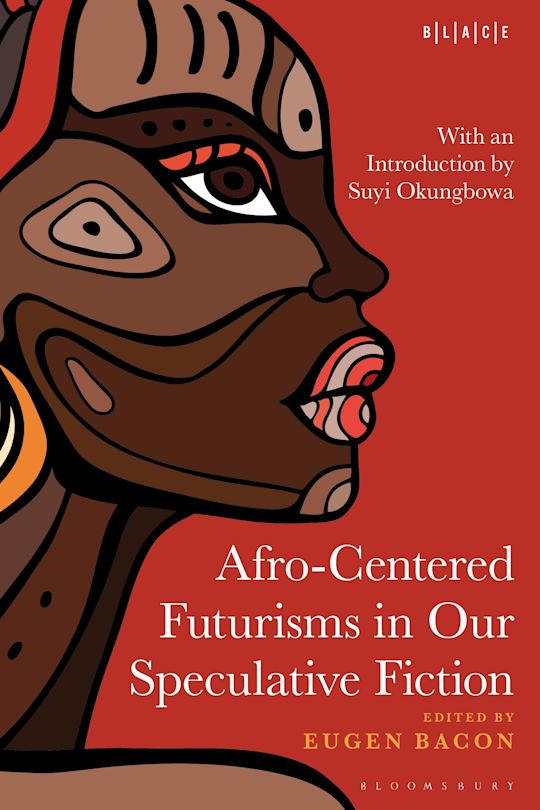
Amirah Muhammad reviews ‘Afro-Centered Futurisms in Our Speculative Fiction’

Edited by Eugen Bacon, Afro-Centered Futurisms in Our Speculative Fiction (2024) is an anthology of award-winning African speculative fiction writers, including Suyi Okingbowa, Cheryl S. Ntumy, and Dilman Dila.

The anthology pushes us to question the genre labels we take for granted – namely, Afrofuturism, Africanfuturism, and futurism – alongside introducing us to new terms, fusing specificity with inclusivity. Key to the anthology is the concept of the ‘gaze’: of looking in order to name, and the tension between fixity and fluidity that comes from it. With a blend of fiction and nonfiction, Bloomsbury describes the anthology as offering “excerpts from their work and creative reflections on futurisms with original essays.”

Afrofuturism, Africanfuturism and Afro-centred Futurisms

There are many names for speculative fiction by African writers. The anthology is chiefly concerned with differentiating Afrofuturism, Africanfuturism, and introduces Afro-centred Futurisms. ‘Afrofuturism’ often refers to Black speculative fiction, although the anthology reminds us of its origins in the United States of America through Mark Dery’s coinage. ‘Africanfuturism’ is Nnedi Okorafor’s invention to describe speculative fiction invested in African histories, presents and futures. ‘Afro-centred Futurisms,’ as Suyi Okungbowa defines it, is a plural term with an “active consciousness and open-armed framework — the privileging of the Afrodescendant self, an investment in timelessness, and an embrace of the spirituality-to-science spectrum” (18).

Continue reading “Amirah Muhammad reviews ‘Afro-Centered Futurisms in Our Speculative Fiction’”

Issue 301, ‘The Future of Food’—Call for proposals

Alien (1979), Dir. Ridley Scott 


From Soylent Green to Slusho!, Okja to Isserley, food is an often central, if not always visible, aspect of SF/F world-building. How human societies feed themselves characterises futures as dystopian or utopian as scarce or abundant, as just or exploitative – imbricating issues of climate change, bioethics, animal rights and the rights of nature, systems of labor and resource distribution. While food and food webs are often associated with structural violence in SF/F, the genre also provides examples of ‘model’ futures through feminist utopias such Woman on the Edge of Time, technological imaginaries such as Star Trek’s replicators, and the various agricultural and societal revolutions posited by an entire genre: solarpunk. 

For its 301st issue, the Vector editorial team is seeking contributions that explore the multifaceted and nuanced ways that speculative genres imagine the future of food. As we try to implement technologies that enable us to make food out of air,1 plastic,2 or, more prosaically, algae, as we 3-D print steaks or make ‘beef rice’3 (without a single cow), what role does science fiction play in shaping attitudes or conversations around such technologies? When we try to figure out how to provide for a growing global population in the face of the climate crisis and biodiversity loss (largely driven by agriculture), should we turn to science fiction for help with reimagining food cultures?

Suggested questions / topics
Food products of the future   
Synthetic, lab-grown meat 
Animal farming and ethics 
Terraforming for agriculture 
Growing food in space 
Eating practices 
The human body 
Health 
Slaughtering practices  
Imagining post-scarcity futures
Eating others 

Please submit your proposal by Dec 14, 2024 to vector.submissions@gmail.com, including:


A 150-500 word proposal, including estimated length;
Something about yourself, either a 50-100 word bio or a CV.

Articles should be between 1,000 and 8,000 words. Please let us know your estimated word count. We seek articles that are carefully grounded in scholarly research, while also being clear, engaging, and suitable for a broad audience (including non-academics). Articles will be due by March 30th, 2025.  

Please also feel free to make queries about other formats, e.g. reviews, interviews, curated reading lists, roundtable discussions, unusual / innovative formats. 

  1.  https://www.esa.int/Applications/Technology_Transfer/Food_out_of_the_thin_air
    ↩︎
  2. https://www.mtu.edu/magazine/research/2022/stories/plastic-trash-protein/ ↩︎
  3. https://www.theguardian.com/environment/2024/feb/14/lab-grown-beef-rice-could-offer-more-sustainable-protein-source-say-creators
    ↩︎