By Chisom Umeh
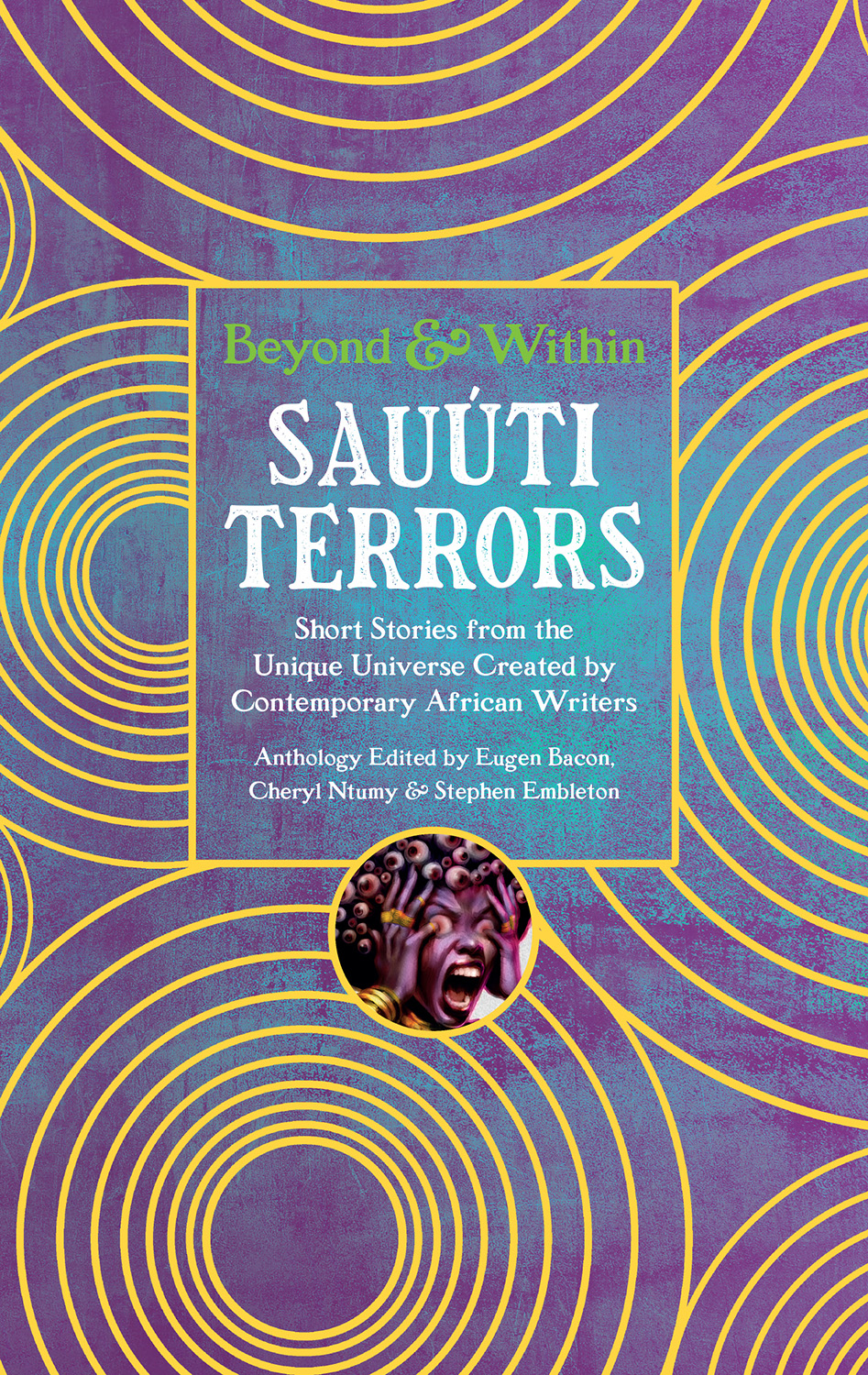
My first direct encounter with the Sauútiverse was in 2022 when, at the Ake Books and Arts Festival in Lagos, panellists Wole Talabi, Dare Segun Falowo, Stephen Embleton, and Cheryl Ntumy, members of the Sauúti Collective, introduced the shared world project. I sat there in the audience, watching as the lights dimmed and a video of the Sauúti creation myth was played to us. Over the animated visuals was an echoing voice apparently merged from the real voices of the Sauúti founding members. This voice, supposedly that of the Mother, the chief deity of Sauúti lore, told the story of the universe’s birth from a single Word.
The two-minute clip entranced me, and, long after the lights had been turned back on and the applause had faded, I was still transfixed by its power. There, on stage, the panellists introduced several aspects of this vast, sprawling secondary world featuring a two-star system, five planets, and three moons. Since then, the Sauútiverse has exploded, birthing two anthologies, three novellas, numerous short stories and poems, a novel, and additional works in the pipeline, all set in and exploring the diverse cultures, science, belief systems, and history of this intricately built shared world inspired by Africa. It has also been picked up and nominated for various awards, including the Nommos and the BSFA.
In this latest anthology, we’re shown a dark and terrible aspect of this world, not as a mere scare tactic, but to remind us that a universe this wide and sprawling wouldn’t be remotely realistic if it didn’t possess a horrific underbelly. Stories here do not shy away from the unsettling, the bone-chilling, the hair-raising, and the blood-curdling. The writers are super inventive in the ways they describe horror and fright. Across 18 short stories and poems, they boldly unleash all manner of terror. The writers commit strongly to Sauúti lore, which includes new words and Sauúti-specific terminologies. This, of course, can be a bit difficult for a new reader to grasp. But if they endure and get beyond that, they’d see that it adds to the overall uniqueness and beauty of the Sauútiverse.
The anthology opens with a poem from Linda D. Addison that has haunting implications for the planet Órino-Rin, then follows immediately with an absolute screamer of a story by T.L. Huchu. I know this anthology explores the darkness and terror that lurks in the crevices of the Sauútiverse, and I was indeed horrified by many elements in The Temple of the Weeping Drum, yet, the more this opening story unfolded, the more I found myself yielding to another emotion: awe. Huchu’s writing has a certain vividness to it that lends realism to whatever world he creates. The story, which is about a fearsome cult of men that steals and sacrifices girls to gain power, speaks to the horrors of subjugation and the evil that can emerge when people who hold the most twisted beliefs about the world are left to their own devices for long enough.
In “The Rawness of You,” Eugen Bacon tells a dreamlike tale that almost seduces you with its lyricism, only for it (like the unnamed protagonist in the story discovers) to reveal that its true shape is jagged and hungry and ready to swallow you whole.
Cheryl Ntumy’s Where Daylight Meets Darkness, is calm and speaks to a different kind of unsettlement, one that emerges when you realize all the things you’ve ever believed and trusted are lies. It asks how you can carry on amidst the fear that plagues you when you know you’re living with a fundamental falsehood that grants you undue privilege. Would you tell the truth and doom your people? Or keep the lie and doom your soul?
In the poem The Exorcism of Mofoyefomo, Ishola Abdulwasiu Ayodele thrusts us into a frightening ritual that attempts to free a woman of her demons, and it reads like those chilling stories we were told as children that still have a grip on us even as adults.
What might be perhaps the most terrifying of the stories for me is ironically one of the shortest. Wole Talabi’s flash fiction piece The Final Flight of the Ungu-ugnu has the ingredients of a proper space horror/mystery, and it held my attention from start to finish. It’s a report of a spaceship, Ungu-ugnu, that unknowingly ventures into a Bermuda Triangle-like area of space and has gone missing. No one is sure of what happened to it, but the descriptions of the final moments of its crew are bone-chilling. It leaves you with that adventurous taste of a mystery left unsolved, but, being well acquainted with Sauútiverse lore, I think I have an idea what happened. But I’ll be keeping that to myself.
Kofi Nyameye’s magisterial piece, The Unspoken, is reality-shattering and my favorite of all the stories. As in Wole’s story, something mysterious has happened and a doctor has been called in to help untangle the knot, but what they find in this dark tale is something that stretches back to the very creation of the universe itself, setting the stage for an ageless, all-encompassing horror to emerge. This is one of those stories that echoes in your mind long after you’ve read the final word. Mother have mercy!
Dare Segun Falowo doesn’t drop the ball, suffusing the air Kofi ignited with a dreadful poem, The Whirring of Anu’tu, about a boy who kills his sibling and the frightening consequences that ensue.
Shingai Njeri Kagunda swoops in just after with a complex and moving story of grief and the horrors of trauma when it becomes a tangible thing wrapping itself around your neck. Mma’riama in The Wound Asks for Air experiences memories of people who have lived before her as if they are her own. Their pains and grief torment her as though she caused them, and she must learn to learn from this and live with it. A summary can hardly do this story any sort of justice. Its many layers need to be experienced to be grasped, much like the foreign memories of Mma’rioma herself.
In Moustapha Mbacké Diop’s story, Naguu-Àll, Echoed in Moonlight, the danger is two-pronged. The main character, a girl with the ability to see into the spirit world, faces imminent harm both from the ancestral beast she’s searching for and the ruthless hunters also seeking it out. While she wants to find it in hopes of learning deep secrets about herself from it, the hunters have more sinister motivations, and one must give way to the other.
Stephen Embleton’s Separation is nightmarish. The monster that lurks within the story is imposing yet very silent, slowly eating at the psyche of the protagonist, who’s trapped mid-air in a cave on one of the harshest planets in the Sauútiverse, Órino-Rin. There’s also an undercurrent of grief that adds to the dire situation the main character is in, as he longs to be rejoined once again with his wife and child who may or may no longer be alive.
As you may have already noticed, I had a good time journeying through this anthology (and glad to know that there will be book two). Each story was self-contained and packed with enough intrigue to carry me onto the next. The writers all brought their ‘A’ game, approaching the subject matter with varying and unique perspectives, some of which speak to the present, real-life issues we face in our world. Demagogues with twisted beliefs about how the world works have actually taken over power and are dictating who should live or die, so we might as well be living in The Temple of the Weeping Drum. The horrors don’t just live on the page, but hit pretty close to home because, like in Cheryl’s story, we have to keep choosing where our loyalties lie, either to the truth or the lies our countries have told the world to get to where it is today.
BIO: Chisom Umeh is a Nigerian fiction writer and poet. His short stories have been featured in Omenana, Apex, Clarkesworld, Year’s Best African Speculative Fiction 2023, African Ghosts anthology, Isele, Mythaxis, Scifi Shorts, and elsewhere. His short story, “Ancestor’s Gift”, won the 2024 Tractor Beam short story contest. He was a finalist for the Seattle Worldcon Short Story Contest and is the winner of the 2025 Nommo Award for Best African Speculative Fiction Short Story.
 vector-bsfa.com
One thought on “SAUÚTI TERRORS Review”