The Resistance/ Vector 302
As Heraclitus pointed out, you can’t step in the same river twice. The current is continually flowing, responding to the seasons and the weather, swirling into ever changing fractal patterns. While this is literally true, the power of the adage is metaphorical. We live with this constant change. Some people like it. Some people don’t like it. But it’s more complicated than that. For most of the history of the human race – up to the end of the Palaeolithic and into the Neolithic – people lived fluid, seasonally nomadic lives in tune and rhythm with natural change. Just to be clear, I’m not romanticising that lifestyle. To paraphrase George Orwell, I’m a selfish and lazy intellectual who expects their oat milk and New Statesman to be delivered to the doorstep. However, the larger point that I’m trying to make is that we can choose to live fluidly in relation to change or we can choose to live against change, by metaphorically damming the river. Most of recorded history is dominated by the latter approach, which broadly takes the form of imposing solid-state, hierarchical social structures in place of fluid cultures.
Here, I’m defining culture not in the narrower sociological sense as being the way of life of a particular society, but in the broader anthropological sense of the holistic manner in which humans interact with each other and the wider natural world. When sociologists talk about social reality, they are talking about the norms and behaviours resulting from a particular social structure. In the world today, the dominant social structure is that of nation states, bound together through a system of global capital. The core organisational features of the nation state are rigid class hierarchy and a hard binary divide between two genders. These features are so central to the ‘social reality’ of a nation state like the UK that many confuse them with inescapable human nature and biology. However, if culture is seen as broader and independent of social structure, then it challenges the norms that constitute social reality. The clash between these two opposed value systems underpins the culture wars that have increasingly raged across the Anglosphere and beyond.
While it is difficult to think outside the parameters of the social structures we inhabit, science fiction does offer imaginative possibilities for freeing ourselves from such constraints. For example, in devising ‘the Culture’, Iain M. Banks suggested that a future technologically advanced civilisation could choose to align itself with a fluid sense of life and change outside state structures rather than attempting to socially engineer a perfect society within those structures in the manner of Soviet Communism. In 2025, however, we are not choosing between solid-state socialism and some sort of futuristic anarcho-communism. Instead, the choice being offered – at least, as it’s often portrayed in the mainstream media – appears to be between, on the one hand, varying models of authoritarian ‘respect’ for traditional values and, on the other hand, ideas of autonomy and social justice, which are now often described by their political opponents as the ‘woke’ progressivism of a metropolitan liberal elite. Demoralised, as most of us are, by the seemingly endless ebb and flow of the struggle between these two apparently opposing worldviews, it’s difficult to imagine any meaningful future let alone the prospect of a utopian culture. It’s far easier to picture a not-too-distant future in which two women are huddling outdoors at night by a bonfire while wolves howl around them.
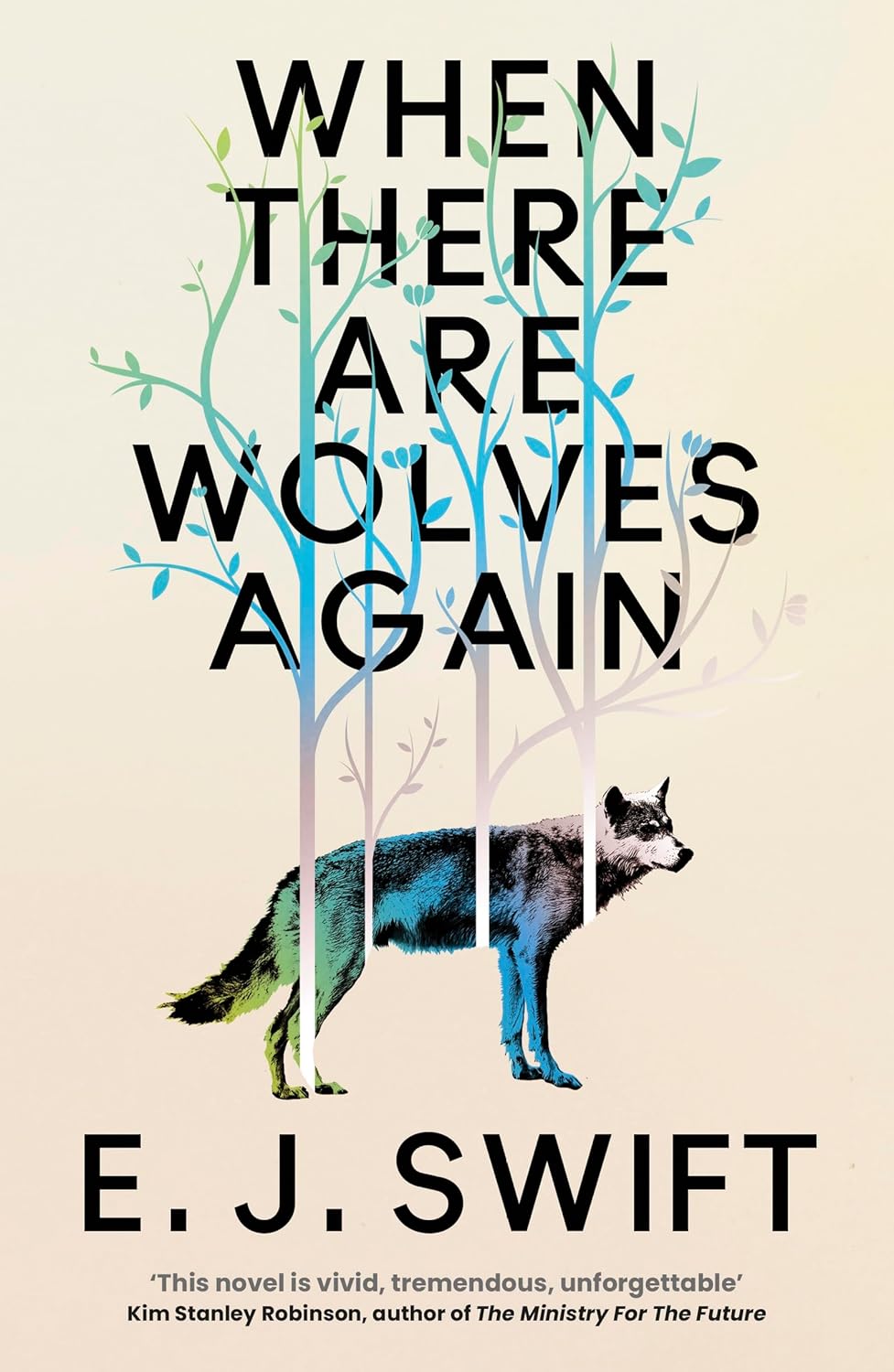
However, when we encounter this scene at the opening of E.J. Swift’s When There Are Wolves Again (2025), it’s not intended to represent the aftermath of societal collapse but rather offered to us as a snapshot of a new cultural pattern of life emerging in Britain. Lucy Gillard is telling the documentary filmmaker Hester Moore about her experiences during the 2020 Covid pandemic fifty years earlier, while they celebrate Beltane. Both women have worked to enable the reintroduction into the Cairngorms of the wolves that they are listening to. In this novel, rewilding is the physical manifestation of a deeper transformation of the UK from closed solid-state society, mired in distrust and collapsing public services, to what we might see as the beginning of a zoefuturistic open culture that is connected holistically to the environment.
Swift narrates the future by alternating between the stories of her two protagonists, always jumping forward a few years at a time. This allows her to sketch in plausible political shifts in the background, such as a political coalition between the Labour Party and the Liberal Democrats paving the way to an introduction of proportional representation and a ‘Right to Roam’ bill, enabling access to the countryside. While these developments are important, they pale into insignificance in comparison with the shifts in consciousness that Lucy and Hester experience as environmental and political conditions change. For example, when 16-year-old Lucy and her Gran go on a journey to the ‘temperate rainforest’ (78) of Dartmoor in 2030, it’s not a tourist-industry weekend break but something more like an expedition into the wild. It’s a journey of growth for Lucy but also an example of how experience can be liberated from capitalist commodification. Without having undertaken this trip, she would not go on to embrace countercultural values and become one of the central organisers of a protest camp outside Balmoral which is part of a campaign to return crown lands to the commons.
When There Are Wolves Again is subtly written and the focus is always on character-driven story but the subtext – from the namechecking of seasonal festivals to the moon-phase-motif section breaks – is that we should embrace a new cultural sensibility and spirituality beyond the straight and narrow instrumental logic of late capitalist Britain. In this respect, the novel reads like an updating of 1970s countercultural feminist concerns for a specifically British twenty-first-century context. Shortly after I read When There Are Wolves Again, I read the Scottish writer Margaret Elphinstone’s first two novels, which also draw on feminist thinking to call for a new cultural pattern in Britain, but in the context of the 1980s.
Elphinstone’s The Incomer, is set in the ‘far future’ – at least 3-400 years into the future – and was published in the iconic grey-bordered design of The Women’s Press sf series. It came out in the same year (1987) as Banks’s first Culture novel, Consider Phlebas. Far from Banks’s shiny AIs and biotechnology-enhanced trans-humans, Elphinstone’s characters live in a largely pre-industrial-revolution world of rural villages and horse and carts. Although the society she depicts is clearly post-collapse and there have been nuclear accidents, if not all out war, at some point, it quickly becomes obvious that this level of technological development doesn’t simply reflect reduced capability but is a matter of conscious choice. People have adopted different norms to those of the twentieth century when the novel was written. For example, society is now matrilineal. Householders are adult women, and the men of those households are their brothers, sons, uncles and so on. Apart from anything else, this arrangement enables the expansion of genetic diversity for what would otherwise be isolated settlements, as women often choose to take men from other settlements or traders and travellers as the father of their children.
Both autonomy and respect are not only central to this society but also necessary to support its philosophy of nonviolence. Adults are treated as responsible for their own actions, but this acknowledgment of their agency also leads to them being treated with respect. Consent is sought not just for sexual relations but even for proximity, conversation, questions – basically for all forms of familiarity outside the household. The implicit logic behind this social philosophy is that by entering into these kinds of exchanges with strangers, one is not only taking responsibility for the consequences of this interaction and its effects on both self and other but also opening oneself up to change and becoming different. This change is something that can both be feared and hoped for. For example, the innkeeper Bridget finds the travelling musician Naomi ‘intriguing, attractive even’ as though representing ‘some part of herself that she might have been but had not quite become’ (63). On the other hand, she cries silently for Naomi to stop playing her music ‘before the whole fabric of life was rewoven, before she took Bridget’s ordered years and unravelled them, setting them up in a new pattern, a new weaving of threads which would wind her away from everything that was sure and familiar’ (64).
The importance of music to the novel and its sequel, A Sparrow’s Flight (1989), reflects the idea of cultural exchange as being one way of facilitating the unmaking and making of cultural patterns that is part of the process of living fluidly with the continual prospect of becoming different. Naomi acts as an agent of change by travelling and playing her fiddle at fairs and festivals and also by teaching music to both men and women. She also learns new music where she can and even from the past. In A Sparrow’s Flight she teaches herself Bach’s Drei Sonaten und Drei Partiten für Violine from a score that has been preserved since the before times in a sealed room. In this respect, Elphinstone’s novels turn out to be more like those of Banks than is superficially apparent. Both situate the true value of artistic culture – including ‘high culture’ – as lying in its capacity to help enable the wider culture entering into a fluid holistic relationship with the environment. Music is particularly effective in this respect because like Heraclitus’s river it consists of swirling patterns, which can be endlessly combined and recombined.
Elphinstone is able metaphorically to map music to environment by showing Naomi as a traveller. In the first half of A Sparrow’s Flight, walking becomes fluid as tramping over endless hills is compared to voyaging over the waves, so that settlements become islands. Journeying with someone becomes an intensified form of negotiating the boundaries of autonomy and respect with the result that both are changed and become different. Time dilates and separates from the linear narratives of history. As Naomi observes, ‘Time is only short if you want to use a person. Otherwise there is the present which is all the time in the world’ (54). This resonates with the logic behind the episodic story-journey narrative structure of When There Are Wolves Again. Swift and Elphinstone are not just exploring shifting the cultural pattern of life in Britain. More specifically, they are asking the question of what life after patriarchy might look like and offering some answers.
Another novel that does something similar, although in a more provocative style, is Alice Albinia’s Cwen (2021). ‘Cwen’, as we are informed by the novel’s epigraph, is the old English word for ‘woman, wife, female, ruler of a state’. Here, it is also the name of a small, unmanned, island and the spirit presiding over its Neolithic cairn and nearby spring, who also fulfils the function of chorus in the novel, punctuating chapters which describe a courtroom-based ‘Inquiry into Unfair Female Advantage in the Islands’ with reflections on several thousand years of experience. The ‘Islands’ are an unnamed archipelago off the east coast of Scotland, whose culture has been transformed by a subtle programme of intervention in support of women led by former cabinet minister’s wife, Eva Harcourt-Vane. The loose inquest format of the novel, in which the women Eva has worked with testify as to their collective motivations and achievements, invites readers to ponder whether it is indeed time both for a thoroughgoing overhaul of the patriarchy and to put ‘gynotopia’ – a term Albinia playfully throws in – in the dictionary or, indeed, on the map.
Beneath the playfulness, though, the episodic narrative works to similar effect as Swift and Elphinstone’s novels by weaving a new cultural pattern. However, Albinia wasn’t content to just explore these ideas novelistically, writing a non-fictional companion to Cwen, The Britannias (2023), which describes her journeys over a period of ten years to many of the smaller islands surrounding Britain, often focusing on the Celtic women associated with them. In her introduction, she notes that, ‘It was reassuring to be shown – through writing of this book about British island history – that patriarchy is only a recent invention’ (Albinia 2023: xx). The liminal nature of these islands – in some cases shifting shape over time in response to sea levels – suggests a fluid culture of becoming that both predates and potentially postdates the linear narratives of official British history. The western coastline in particular was characterised by different trading relationships and nationalities, anticipating the polylingual character envisioned in zoefuturism. Albinia describes a 1509 wedding in Rathlin – an island between Ireland and Scotland – in which the Scottish bride spoke English, Gaelic and French. Foreshadowing Swift’s fictional portrayal of the campaign to open up royal land, Albinia discusses how Scotland gained control of its foreshore and seabed from the Crown Estate as a result of the Scotland Act 2016.
While the historical information it discloses is invaluable, the real strength of The Britannias lies in Albinia’s descriptions of the journeys she takes and the people she meets, and the activities they engage in including music, performance, and protest. She is the real-life counterpart of Elphinstone’s Naomi and Swift’s Lucy and Hester. What all these books reflect is both that the culture we live in does not stand still but continuously swirls and flows, always becoming something different, and that we can embrace that change and even weave new patterns in relation to it.
Works Cited
Alice Albinia. The Britannias: An Island Quest. London: Allen Lane, 2023.
Alice Albinia. Cwen. London: Serpent’s Tail, 2021
Margaret Elphinstone. The Incomer. London: The Women’s Press, 1987.
Margaret Elphinstone. A Sparrow’s Flight: A Novel of a Future. Edinburgh: Polygon, 1989.
E.J. Swift. When There Are Wolves Again. London: Arcadia, 2025.
Nick Hubble (they/them) is a writer, researcher and critic, whose books include The Proletarian Answer to the Modernist Question (2017) and Culture Wars in Britain (2026). They have written for Strange Horizons, LA Review of Books, Tribune, Speculative Insight and ParSec. From Autumn 2026, Nick will be the new editor of Foundation. They also blog at Prospective Cultures and may be found on BlueSky @thehubble101.bsky.social.
 vector-bsfa.com
One thought on “Nick Hubble in Zoefuturism”