Reviewed by Chukwunonso Ezeiyoke
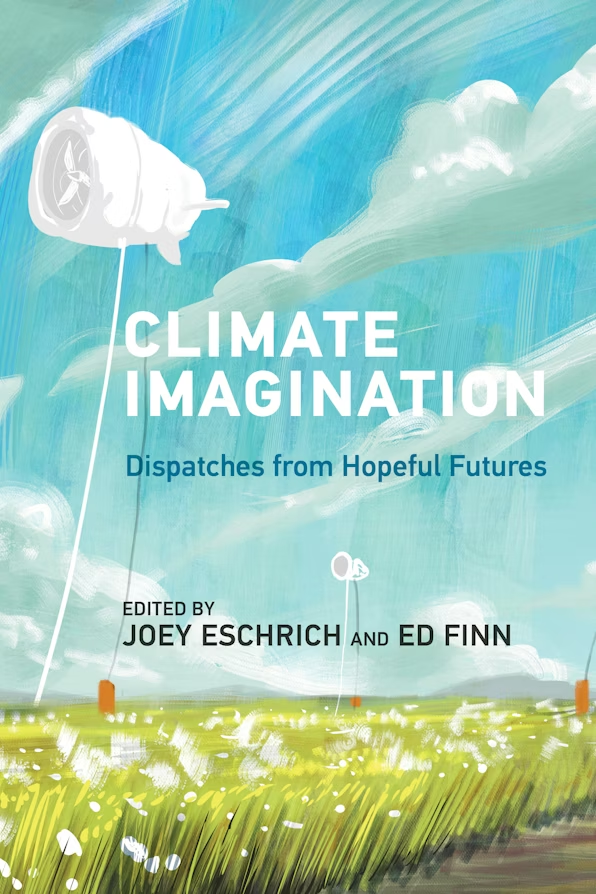
Climate Imagination: Dispatches from Hopeful Futures edited by Joey Eschrich and Ed Finn has 23 chapters with a preface, introduction, and afterword. The book started its life as a part of The Climate Action Almanac. “The book grew out of the Climate Imagination Fellowship, started at Arizona State University’s Center for Science and the Imagination in 2021” (2026:ix). In its preface, the book announces that it foregrounds hopeful stories about climate imagination. The dominant climate narrative, it argues, is full of doom stories, which leave people feeling ‘hopeless, helpless, and disillusioned’ (Eschrich and Finn 2025: ix). This stand echoes Mark Fisher’s Capitalist Realism:Is There No Alternative?(2014). For Fisher, fear and cynicism do not inspire bold thinking; they form a bedrock of conformity and conservatism that hampers action and change. For Fisher, hopefulness changes the situation from one in which nothing can happen to one that allows for the actualisation of possibilities. Fisher’s stand can be traced to a theorist such as Fredric Jameson (2005), and further back, to Thomas More, the first known utopian novelist.
However, the word ‘utopia’ was hardly mentioned in the introduction or the preface framing Climate Imagination: Dispatches from Hopeful Future, and it appears sparingly throughout the collection. This may be intended or unintended. However, there could be a good reason why the book was framed this way. Utopia has a bad reputation. An early criticism of it could be seen from Karl Marx in Manifesto of the Communist Party published in 1848. Marx accuses utopia of lacking materialism. More recently, Karl Popper (1945) links the concept of utopia to totalitarianism. As Julien Kloeg notes, ‘Utopianism’s bad reputation is partly due to its association with the attempt to realize communism in the Soviet’ as such it is considered ‘politically dangerous’ (2016: 451). Current criticism on Utopia is such that were directed to hopeful climate narrative such as carbon removal technology. Matt Simon (2023:online) argues that “carbon removal might even encourage the continued burning of fossil fuels, if countries can say they’re sucking carbon out of the atmosphere to offset their emissions” they could end up burning more fossil fuels instead of looking for clean energy. This, in turn, sustains the capitalist structure that privileges fossil fuel consumption. Perhaps these criticisms have led the collection to shy away from exploring the book’s connection to utopian unconsciousness, even though the book draws heavily from this tradition. Unconscious here “consists of those repressed impulses, desires, drives, wishes… that the conscious mind does not care to acknowledge” (Mark Bould 2021:15). Utopian unconsciousness is defined here as those hidden utopian ideological impulses of a text.
Climate Imagination: Dispatches from Hopeful Futures is a mixed bag of memoirs, interviews, scholarly articles, and fiction. This disparity in the creative expressions employed by the authors in the book, luckily, does not result in a disjointed book. I think there is something symbolic about it, reflected in both the form and the content of the collection, namely: that the book champions diversity. Diversity in its form allows it to incorporate different styles of artistic expression under the umbrella of a single edited volume. This, in a way, is a stand it takes outside the totalitarian accusation levelled against the utopian unconscious in which plurality of forms, ambitions and aspirations is suppressed under the so-called singularity of purpose termed the ‘common good.’ A character in “City of Choice” by Gu Shi, translated by Ken Liu, a story within this anthology being reviewed here shares this sentiment thus ‘Should I really go forward? All choices come with costs. If the cost is the lives of those who are powerless, is it right to sacrifice them in the name of some greater “good”? (113). “City of Choice” is a type of story you read and reread, and it makes you angry and happy and angry again because life is messy and every decision comes with a cost, including the decision to freedom.
It is not only the style of the book that is diverse; the contributors come from different localities of the globe: “China to Wales, Germany to Nigeria, Sri Lanka to Mexico, Malaysia, India, the United States, and more” (Eschrich and Finn 2025:ix) to articulate different climate challenges of what is being done, what could be done, and the potential ‘becomings’ of climatic futures. A lot of the climatic ‘becomings’ shared by a good number of the authors in the collection are akin to what Bodhisattva Chattopadhyay and Jade Taylor call ‘co-futurism.’ Taylor defines it as a future that is interconnected and overlaps, also recognising “ethnic specific and regional specific futurisms” (2024: 1). Taylor’s definition is not specific to climate futurism; the collection, which focuses on climate, is part of futurism in general.
The content of this book follows a similar pattern as its writers explore what an inclusive future means, starting with the first story in the collection, “Three-World Cantata” by Vandana Singh. The story explores this theme and shows that futurism should not become mere progressivism, but should include both human and nonhuman elements and be led by ordinary citizens rather than corporations. The character Chingari (the story doesn’t mention their gender) and their team creates IntMRI, which allows them to take a person’s consciousness into a preexisting climatic scenario with the intention of convincing the person to adopt positive attitudes that will lead to climatic justice. Their initial targets are people in power who can influence climate policy. Manny, the CEO of UltraCorp, holds such power and is pimped into the project. Manny is exposed to different climate situations, including the importance of human interconnection with nonhumans such as elephants. Manny prefers managing the system rather than pursuing structural change. So, what Chingari realises is that in a world charged by personal interest, to know what is good does not necessarily equate to doing what is right. Plato suggested otherwise in The Republic where he equates knowing good to doing good. However, sustainable change, Chingari discovered, starts with the collaboration of ordinary people: ‘If you looked closely at the time axis by yourself, it remained a long, thin line stretching from past through present and into the future— nothing changed. But look at it, engage with it along with other people, other beings, and you would see it thicken, acquire structure’ (Singh 2026:34). It is through community collaboration that real change emerges.
“Death is Not an Ornament” by Hannah Onoguwe echoes a similar sentiment and shows such societal change when there is a collaboration between human and nonhuman. In my book, “Nigerian Speculative Fiction: Evolution,” I argue that recurring theme in Nigerian speculative fiction is the entanglement between human and nonhuman “which it draws from the indigenous Nigerian cosmology of co-existence between human and nonhuman in a symbiotic relationship” (2025:17). The protagonist in Onoguwe’s story is a hybrid of human and nonhuman who fights to eradicate dependence on the petro-economy by teaming with nonhuman whose inhabitant is the ocean.
In “Robots & Insects & Languages & Other Living Things” by Libia Brenda, Brenda projects this interconnection to also include machines, through the process of language. The mediator here is the IA, known as mycorrhizae, whose encoding and decoding of various means of communication between humans and other nonhumans breaks down the barrier between humans and nonhumans. Once this is accomplished, the wall between nature and culture, is broken.
In “Mina’s Dream” by Vandana Singh, activism takes a different shape, not the usual workaday protest of placard carrying (Fisher, 2014, will argue that the capitalist system has already contained this method) but from the tiny ray of hope of the ethics of the protagonist Mina. Mina’s tenderness to her garden mirrors the tenderness of her heart to her community as the protagonist says “Remember that we are entangled, all of us, with each other and other life- forms (86).” It is that love that transforms not just her community’s ecology but also spreads into a political act, which is to say that what spurred political activism here is a change in the value system.
In “Climate Action Dialogue: From Liner to Fractal”, a discussion among Nigel Topping, Farhana Yamin, and Ed Finn, among other things, carries on this discourse on ethical and societal values. It is this changing of value systems that Yamin argues is the key to unlocking a better climatic future: “I’m very excited about this shift to working at the level of values, whereas before we were just trying to tinker with a policy here, or a program there, or a bit of funding here, a few fiscal reforms here and there…. Changing values allows us to see things moving differently, and to reshape our relationships (235).” It is this stand of orientation transformation that Anna Pigott takes in “Flights of Fancy” by arguing that if over-tourism is scaled down, places like Corfu currently frequented by tourists, an activity that destroys its bioforms, will have a better, more diverse ecosystem.
Where it can be argued that value/attitude change originates from the oil companies who pushed the concept of carbon footprint, attempting to shift the conversation about infrastructure and systems into the scale of travel, gardens, and personal actions, the diversity in the views in the anthology, gives room to varied perspectives towards climate action. For instance, in the dialogue between Kim Stanley Robinson, Zeid Ra’ad Al Hussein, and Ed Finn, Kim Stanley Robinson, argues ‘that nation- states could force international finance to give up some of their ill- gotten or artificially gotten gains to pay for [climate] justice itself” (2026:300). Here, Robinson is foregrounding system change and not just individual attitudinal change.
Chinelo Onwualu shares a similar sentiment about the importance of value change in her essay, “The Case for Reckless Climate Optimism”. In a world marred with discrimination and racism, hope for the future is possible due to the value of openness and interconnectedness adopted by the younger generation born during the pandemic. Onwualu is optimistic that this new value adopted by the generation will lead to a better future because “working with hope is very different from working with fear. One leads upward, opening us up to innovations and experimentation (41).”
It is this hopeful attitude shared by Claire Armitstead in “The Robin, The Wolves, and The Library” as she waits for Robin to appear in her garden during a summer whose heat led to the decline of the species.
Pippa Goldschmidt feels a similar optimism with the city of Berlin in “A Walk in Berlin”. A city with a dark history of fascism, colonialism, and genocide, the community emerged from this “physical and moral abyss (203).” It is this resilience that gives hope.
In the “Introduction”, Ed Finn and Joey Eschrich argue for a hopeful future but add that in the collection, the hopeful futures imagined are “inspired by practical, everyday writing about climate—weather forecasts, almanacs, rainfall indexes— to try to create a user’s guide to the real world, rather than a magic eight ball revealing all of the answers” (xv). Utility is foregrounded here to counter the fantasy argument levelled against utopian unconsciousness, as utopia is “thought to be a mere fantasy” (Kloeg 2016:451) which is why Immanuel Wallerstein calls utopian unconsciousness as, “breeders of illusions and therefore, inevitably, of disillusions” (quoted in Lancaster, 2000:109) This collection exposes the weakness in such a stand. For instance, in “Climate Action Dialogue: Becoming Better Humans”, a conversation between Kim Stanley Robinson, Zeid Ra’ad Al Hussein, and Ed Finn, Robinson suggests practical ways to mitigate the climate crisis, such as the:
notion of slowing down the melting and sliding of the glaciers in Antarctica to preserve sea level, which is being pursued by glaciologists. It’s a minor expense compared to what we’ve been talking about so far, really a matter of just a few billion a year to drill through those glaciers and suck the water out from underneath them. You would need a navy like the US Navy. You would need people repurposed from the oil industry to aid the glacial slowdown project. It’s exactly the same expertise, and even the same equipment (294).
Here, Robinson gives a scalable solution to mitigate the climate crisis. Similarly, in a different location, the essay by Yudhanjaya Wijeratne, “The Unwalkable City” provides practical guides in which Sri Lankan architecture could be improved for climate sustainability. All these points show that the utopia in this collection aims for one whose foundation is built on an actionable framework.
While I found this book both informative and entertaining, the only weakness I see is its framing, which makes it look ahistorical by failing to situate itself explicitly in the utopian tradition, and tends to present itself as if it had emerged without precedent. Perhaps it is from the capitalist unconscious which currently governs the academic environment, where research is constantly forced to model itself in the language of newness. Capitalism seeks expansion and imbues an unconsciousness of seeking something new in perpetuity: new market, new brand, new technology (a company like Apple tweaks its phone every other year to announce its newness). To be relevant in a capitalist political economy, the notion of newness that signals its expansion is repetitive. This criticism, notwithstanding, the book broadens my horizon about climate futures and it is a worthwhile read.
Selected References
Bould, M. (2021). The Anthropocene Unconscious: Climate Catastrophe Culture. London: Verso.
Ezeiyoke, C. (2025). Nigerian Speculative Fiction: Evolution. London: Routledge
Fisher, F. (2014). Capitalist Realism: Is There No Alternative? Hampshire: Zero Books.
Jameson, F. (2005). Archaeologies of the future: The desire called utopia and other science fictions. London and New York: Verso.
Kloeg, J. (2016). ‘Utopianism and its discontents: A conceptual history’. Algemeen Nederlands Tijdschrift voor Wijsbegeerte 108(3). 451-468
Marx, K. and F. Engels (2007). Manifesto of the Communist Party. New York: International Publishers Co.
Popper, K. R. (1945). The open society and its enemies. London: Routledge and Kegan Paul.
Simon, M (2023). Why Deleting Carbon From the Atmosphere Is So Controversial. https://www.wired.com/story/why-deleting-carbon-from-the-atmosphere-is-so-controversial/
Taylor, T. J (2024). Introduction to Cofuturisms. The Routledge Handbook of Cofuturism. Edited by Taylor, T.J, Lavender III, I, Dillon, G.L and Chattopadhyay, B. London: Routledge
Chukwunonso Ezeiyoke’s PhD is from Manchester Metropolitan University. His research focuses on the impact of postcolonial theory on the evolution of African SF. His recent publications include a monograph Nigerian Speculative Fiction: Evolution and a collection of his short stories, Haunted Grave and Other Stories.
 vector-bsfa.com